
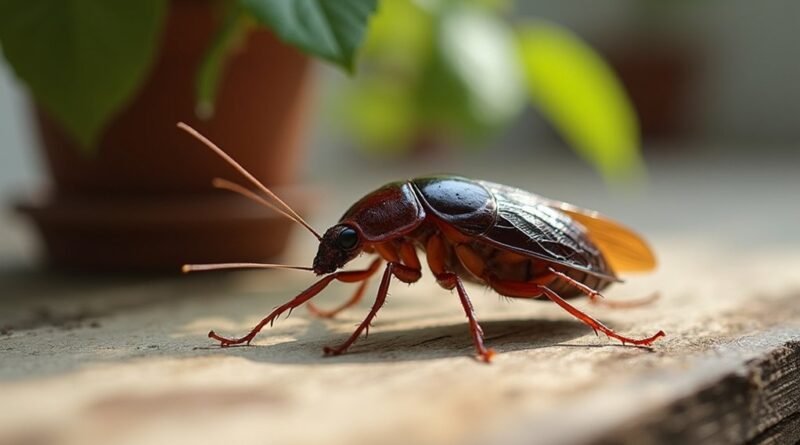
Australian Cockroach: Identification and How to Get Rid of It
You can identify an Australian cockroach by its reddish-brown body, yellow-edged wings, and pale band around the thorax — it’s 23–35 mm long and moves fast. It’s drawn to moisture, warmth, and food sources like starchy or decaying organic matter. To get rid of it, seal entry points, eliminate moisture, and use baits, gels, or residual sprays. There’s plenty more to know about stopping these pests for good.
Key Takeaways
- Australian cockroaches are large, reddish-brown insects measuring 23–35 mm, with distinctive yellow wing markings and a pale band around the prothorax.
- They thrive in humid, warm environments, hiding in bathrooms, kitchens, woodpiles, and areas near leaky pipes during the day.
- Signs of infestation include dark pepper-like droppings, shed exoskeletons, oval egg cases, and a strong musty odor.
- They pose health risks by spreading pathogens like Salmonella and E. coli while triggering allergic reactions through droppings and cast skins.
- Control them by sealing entry points, maintaining sanitation, applying residual sprays outdoors, and using indoor baits and sticky traps.
What Is the Australian Cockroach?
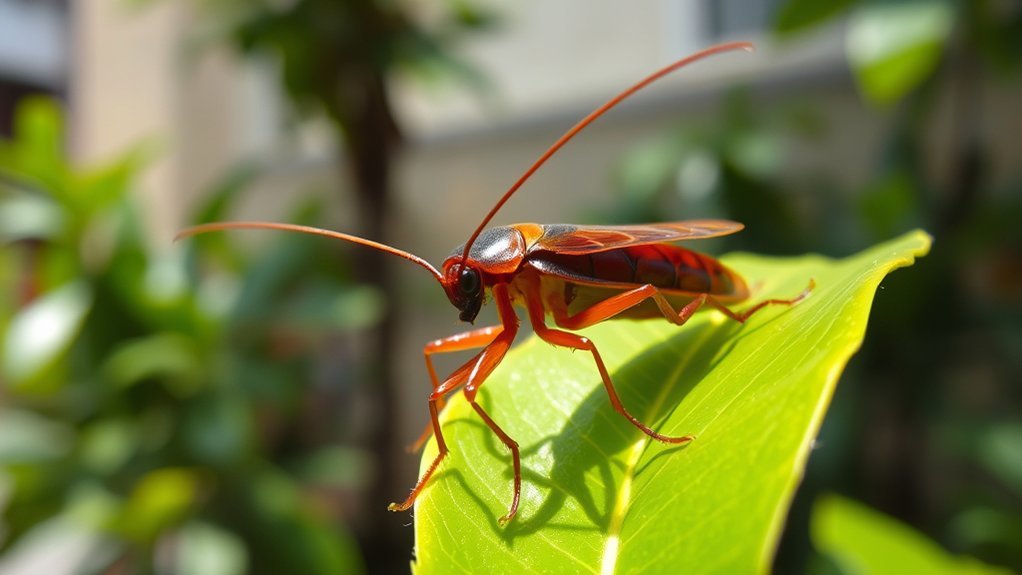
The Australian cockroach (*Periplaneta australasiae*) is a large, reddish-brown species measuring 23–35 mm in length, distinguished by its yellow wing markings and pale band around the prothorax. Its long wings extend past the abdomen, and yellow streaks near the wing base set it apart from the similar American cockroach.
You’ll find this species thriving in warm, damp environments both indoors and outdoors. Outside, it hides behind tree bark, under mulch, and in woodpiles. Indoors, it typically stays on ground-level floors, preferring humid areas like greenhouses.
Despite its larger size, it’s a fast mover. It’s nocturnal, hiding during the day and foraging at night for plant material, crumbs, and decaying organic matter. Moisture is its primary attractant.
Don’t confuse it with a water bug—it’s a common mix-up. Some regions even call it a “shad roach” or “waterbug” due to its appearance. Correctly identifying this species matters more than most homeowners realise, as misidentification leads to treatment failure in the majority of DIY pest control attempts.
Where Did the Australian Cockroach Come From?
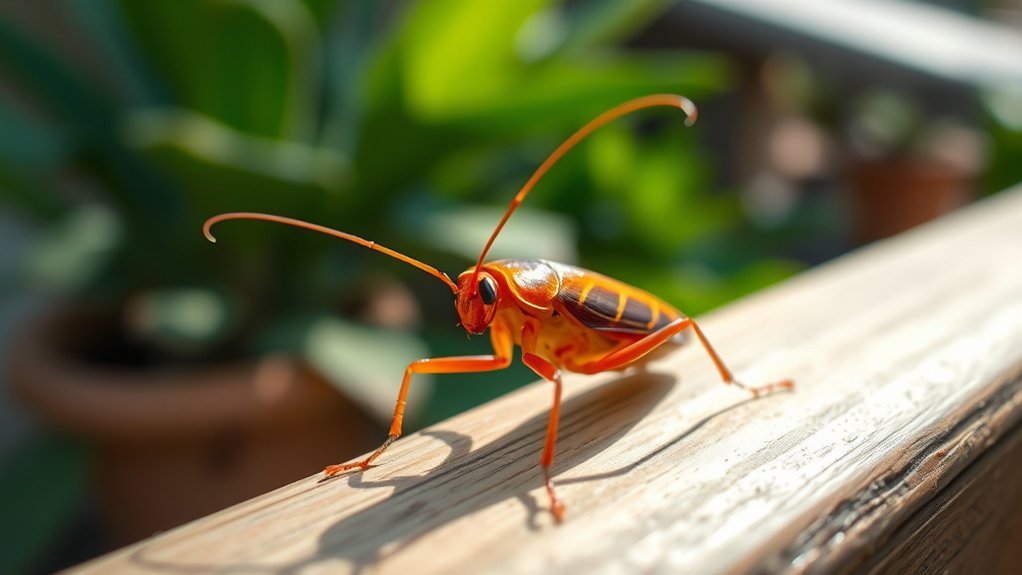
Despite its name, the Australian cockroach didn’t originate in Australia—it actually hails from tropical Africa. Entomologists widely accept Africa as its native range, supported by historical transport evidence. The misleading common name stems from its first formal description occurring in Australia after accidental introduction via shipping routes. Its specific epithet, *australasiae*, reflects where it was discovered, not where it evolved.
You’ll find a similar naming quirk with the American cockroach, which is also native to Africa despite its name.
From Africa, this species spread globally through international trade and commerce, hitching rides on cargo ships across centuries. It arrived in the Americas possibly through slave ship routes and became especially prevalent in southern U.S. states, particularly Florida. Australia received it the same way—through accidental human-mediated transport. Today, it thrives in tropical and subtropical regions worldwide, making it a true cosmopolitan pest. It is considered a peridomestic pest, meaning it primarily lives outdoors but can make its way inside.
How to Identify an Australian Cockroach
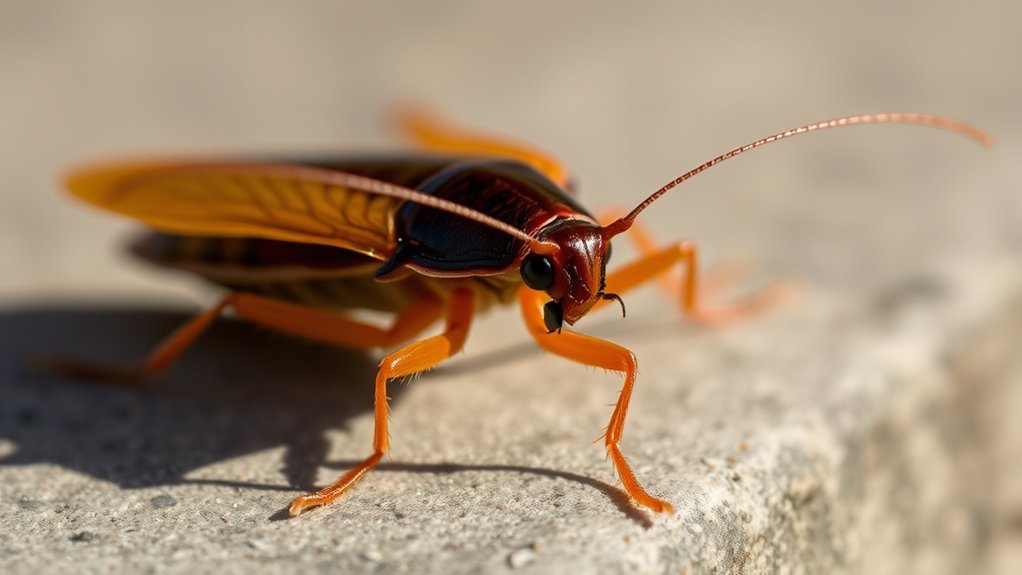
When identifying an Australian cockroach, you’ll want to look for an adult that measures about 23-35 mm in length, sporting a brown to reddish-brown body. You can spot this species by its distinctive yellow markings on the pronotum and the pale or yellow bands running along the outer margins of its forewings — features that set it apart from similar species like the American cockroach. Its long wings extend past the abdomen, giving it a sleek, elongated silhouette that, combined with its coloring and markings, makes it recognizable once you know what to look for. Despite its name, the Australian cockroach is smaller than American cockroaches, making size a helpful distinguishing factor when telling the two species apart.
Size and Color
Identifying an Australian cockroach starts with its size and color. You’re looking at an insect measuring 23–35 mm (roughly 1–1.4 inches) in body length, with wings extending 1.25–1.5 inches. It’s slightly smaller than the American cockroach, which reaches up to 53 mm, but noticeably larger than the German cockroach.
Color-wise, you’ll notice a reddish-brown to dark mahogany tone with a distinctive shiny appearance. This coloring runs consistently across the body, though juveniles display yellow or white markings before maturing. Both male and female adults share the same coloration, so you won’t find sexual dimorphism useful for identification here.
If you spot a shiny, reddish-brown roach around 1–1.4 inches long, you’re likely dealing with an Australian cockroach. Look for a pale stripe on the tegmina and a contrasting margin on the pronotum, which are key distinguishing features of this species.
Distinctive Yellow Markings
The Australian cockroach’s most reliable field marker is its yellow patterning—something the American cockroach completely lacks. You’ll notice a pale yellow band wrapping around a dark central spot on the pronotum, forming a distinct ring that sharply contrasts against the head shield. The American cockroach instead displays a figure-eight pattern, so this difference alone helps you confirm the species quickly.
On the wings, look for yellow streaks running along the outer edges of the front wings. These lateral pale margins are immediately visible and absent on American cockroaches.
If you’re identifying nymphs, check the dorsal abdomen for light yellow spots—a pattern unique to Australian cockroach juveniles. Combining these yellow features with the reddish-brown body gives you a positive identification every time. Adults typically measure 1 to 1.4 inches in length, making them a mid-sized cockroach that is large enough to spot without much difficulty.
Wings and Body Shape
Beyond the yellow markings, an Australian cockroach’s wings and body shape offer additional identification clues. Its oval, flattened body measures 23–35 mm long with a shiny, reddish-brown to dark-brown coloring.
When identifying wings and body shape, look for these four key features:
- Wing length reaches 32–35 mm, extending past the abdomen tip.
- Forewings overlap hindwings, which are membranous and hidden beneath.
- Both sexes have fully developed wings, though they prefer running over flying when threatened.
- Body shape is oval and flattened, with wings held flat against the body at rest.
Despite having functional wings capable of gliding flight, you’ll more likely spot this roach sprinting away rather than taking off.
Australian Cockroach vs. American Cockroach: Key Differences
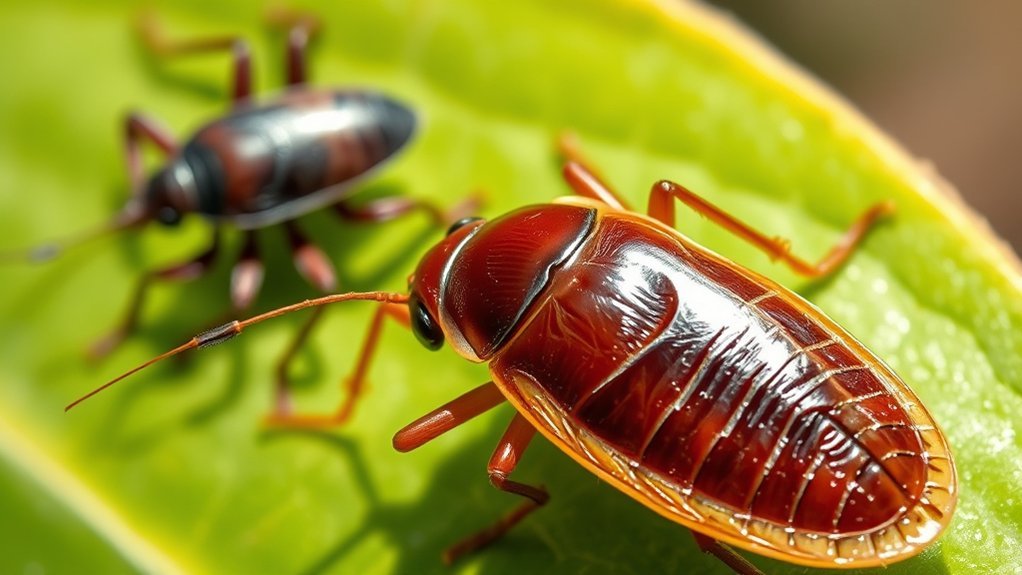
While both species share a reddish-brown coloring, the Australian cockroach is noticeably smaller, measuring 25–40mm compared to the American cockroach‘s 53mm frame. You can also spot key differences in their markings. The Australian cockroach displays distinct yellow patches on its thorax and yellow margins along its forewings, while the American cockroach features a yellowish figure-8 pattern on its head shield.
Their preferred habitats differ too. You’re more likely to find Australian cockroaches outdoors in warm, humid environments like greenhouses, whereas American cockroaches favor sewers, drains, and basements, entering homes through plumbing or foundation gaps.
Behaviorally, the Australian cockroach flies erratically when disturbed, while the American cockroach tends to glide downward from heights. Diet-wise, Australian cockroaches target plants and starchy materials, making seedlings vulnerable. American cockroaches, however, pose greater health risks, spreading 33 types of bacteria and six parasitic worms.
What Attracts Australian Cockroaches to Your Home?
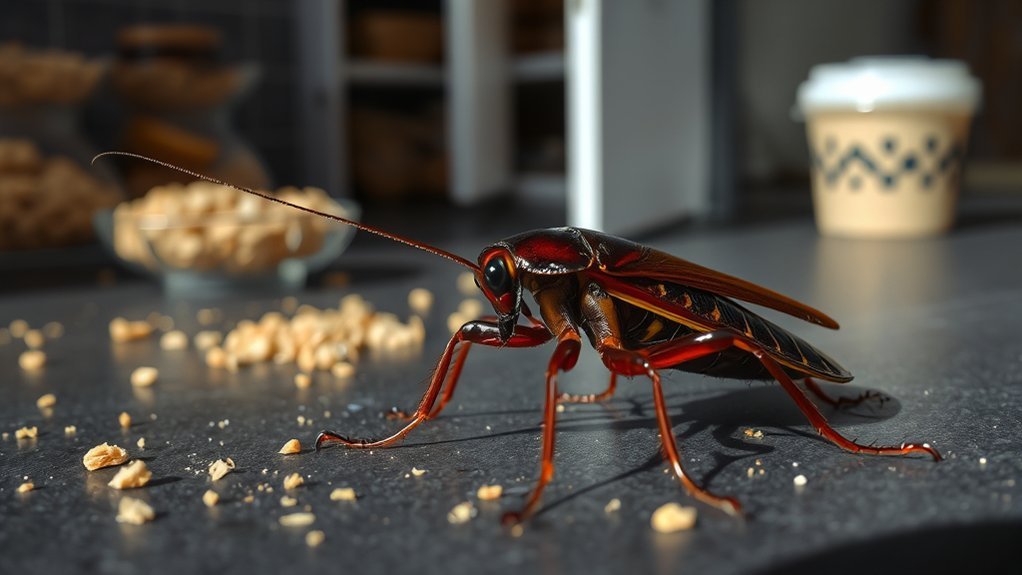
Australian cockroaches are opportunistic invaders drawn indoors by five key conditions: food, moisture, warmth, shelter, and easy entry points. Understanding what lures them helps you act decisively.
Food and moisture top the list of attractants:
- Sugary, starchy foods, decaying organic matter, cardboard, and garbage piles signal an easy meal inside your home.
- Leaky pipes, standing water in sinks or pet dishes, and high-humidity spaces like bathrooms create irresistible moisture sources.
- Temperatures above 80°F combined with humidity accelerate population growth, making heated rooms, spaces behind appliances, and greenhouses prime nesting zones.
- Cluttered, undisturbed areas—basements, roof voids, firewood piles, and rotting leaves—offer ideal daytime hiding and breeding spots.
Beyond these conditions, you’re also inviting them in through open windows, faulty screens, unsealed gaps, and transported goods. Eliminating standing water, securing food, and sealing entry points greatly reduces your infestation risk.
Where Do Australian Cockroaches Live and Hide?
Knowing what draws Australian cockroaches inside is only half the battle—you also need to know where they set up camp once they’re in.
These cockroaches gravitate toward moisture above all else. Indoors, you’ll find them in bathrooms, under sinks, in kitchen cabinets, and near leaky pipes—anywhere humidity stays consistently high. Drains, water pipes, and sewage lines also serve as both entry points and travel routes throughout your home.
They prefer lower building floors and rarely venture upstairs, so focus your attention on basements and ground-level spaces. Outdoors, they hide in woodpiles, leaf piles, and under tree bark, favoring your building’s perimeter before moving inside.
When temperatures drop, they relocate indoors; when it warms up, they head back outside. If you’ve got a greenhouse, pool deck, or hot tub area, those humidity-rich spots are prime hiding territory you shouldn’t overlook.
Signs You Have an Australian Cockroach Infestation
If you spot reddish-brown insects with yellow-margined thoraxes darting across your kitchen at night, you’re likely dealing with an Australian cockroach infestation. You’ll also want to check hidden areas for dark, pepper-like droppings, shed exoskeletons near baseboards, and oval-shaped egg cases tucked behind appliances or in crevices. A strong, musty odor resembling “frito feet” combined with these visual signs confirms an active and potentially growing infestation in your home.
Visual Infestation Indicators
Spotting an Australian cockroach infestation early comes down to recognizing five key indicators: live sightings, droppings, shed skins, damage patterns, and location clues.
You’ll notice reddish-brown insects measuring 25–35mm with yellow-margined pronota near kitchens, sinks, and cupboards. Their larger droppings resemble coffee grounds and appear near appliances and food sources. Watch for these urgent visual red flags:
- Clear or light brown shed skins accumulating in cracks and hidden spaces
- Grease smears and staining along walls and surfaces
- Bite marks or holes in food packaging
- Daytime sightings, which signal severe overcrowding
They cluster under refrigerators, stoves, and in basements. If you’re spotting multiple indicators simultaneously, you’re dealing with an established infestation requiring immediate attention.
Odor and Egg Signs
Two less obvious but equally telling signs of an Australian cockroach infestation are odor and egg cases. You might first notice a musty or mildewy smell, similar to a pet’s “frito feet.” As the population grows, it intensifies into a pungent, oily odor — strongest in humid areas like bathrooms and under sinks.
Cockroach egg cases, called oothecae, are brown or black, hard, and oval-shaped, containing up to 24 eggs each. You’ll typically find them hidden in cracks, behind appliances, or in dark, warm spaces. Their presence alongside a persistent musty smell signals active breeding in your home.
If you’re detecting both signs, you’re likely dealing with a larger infestation. A professional inspection can confirm the extent of the problem.
Are Australian Cockroaches Dangerous?
While Australian cockroaches lack venom and won’t bite you, they’re far from harmless. They pose serious health risks through contamination and allergens.
Here’s what makes them dangerous:
Here’s what makes Australian cockroaches truly dangerous — and why ignoring them puts your household’s health at serious risk.
- Disease transmission – They carry Salmonella, E. coli, streptococcus, and staphylococcus, spreading pathogens through droppings, saliva, and vomit on your food and surfaces.
- Allergic reactions – Their droppings and cast skins trigger asthma attacks, itchy rashes, throat swelling, and breathing difficulties, particularly in children.
- Food contamination – They defecate and vomit directly on food surfaces and utensils, transferring bacteria picked up from outdoor scavenging.
- Rapid breeding – Their fast reproduction multiplies contamination risks quickly, especially in warm, humid areas where pathogens thrive.
Because they’re excellent flyers migrating indoors from trees and mulch piles, controlling an infestation early prevents these health hazards from escalating inside your home.
How to Get Rid of Australian Cockroaches
Getting rid of Australian cockroaches requires five core strategies: sanitation, exclusion, outdoor perimeter treatments, indoor chemical controls, and monitoring.
Start by eliminating food, moisture, and shelter. Vacuum daily, seal food containers tightly, fix leaks, cap drain traps, and keep surfaces clean and dry. Next, seal cracks, gaps, and pipe penetrations with caulk or putty, and install tight-fitting door and window screens.
Outside, apply residual sprays like Cyper WSP or Demon WP in a 3–6 foot band around your foundation, treating doors, windows, woodpiles, and mulch. Indoors, use cockroach gels in hinges and crevices, surface sprays in voids, and baits near food areas. Dust wall and roof voids lightly with insecticide.
Finally, place sticky traps for ongoing monitoring. If infestations persist, call a licensed professional for targeted treatments, growth regulators, and regular inspections.
How to Prevent Australian Cockroaches From Returning
Once you’ve eliminated an infestation, keeping Australian cockroaches from returning comes down to five habits: sanitation, exclusion, moisture control, outdoor maintenance, and regular monitoring.
Start with sanitation and exclusion—they eliminate the conditions cockroaches exploit most:
- Store food in sealed containers, clean spills immediately, and empty garbage bins regularly with tightly closed lids.
- Seal cracks, gaps, and crevices with caulk; add door sweeps, weather stripping, and tight-fitting window screens.
- Fix leaky pipes promptly, eliminate standing water, and ventilate moist spaces like sub-floors.
- Move garbage cans away from moist areas, limit firewood stored indoors, and apply residual barrier sprays around your foundation perimeter.
Pair these steps with consistent monitoring. Schedule regular inspections of high-risk areas, use sticky traps to track activity, and check incoming cardboard boxes for egg cases. Staying proactive denies cockroaches the food, water, and shelter they need to return.
Frequently Asked Questions
Can Australian Cockroaches Fly, and How Far Can They Travel?
Yes, Australian cockroaches can fly, and you’ll find they’re most active in warm, humid conditions. They typically cover short distances through gliding bursts rather than sustained flight, preferring to crawl when possible.
How Long Does an Australian Cockroach Typically Live?
You’re looking at a total lifespan of up to 18 months for an Australian cockroach. They’ll spend 6-12 months as nymphs before reaching adulthood, then they’ll live another 4-6 months as full adults.
At What Temperature Do Australian Cockroaches Die or Become Inactive?
You’ll find that Australian cockroaches become inactive below 40°F and die at temperatures between 0°F and 15°F. They can’t breed or develop below 40°F, making cold temperatures an effective way to control them.
How Many Eggs Does an Australian Cockroach Egg Case Contain?
You’ll find that an Australian cockroach egg case contains 20–24 eggs, averaging around 22 per ootheca. Over her lifetime, a female can produce 12–30 oothecae, resulting in 240–720 total eggs produced.
Are Australian Cockroaches More Active During Certain Seasons?
Yes, you’ll find Australian cockroaches are most active during December through February when temperatures hit 20°C–30°C. They slow down in winter but don’t disappear, often moving indoors seeking warmth and shelter.
Conclusion
Now that you know how to identify and eliminate Australian cockroaches, you’re better equipped to protect your home. Don’t wait until an infestation gets out of hand — act quickly at the first sign of these pests. Use the prevention strategies outlined above to keep them from returning. If the problem persists, don’t hesitate to call a professional pest control service to help you reclaim your space.
