
Cockroach Poop vs Mouse Poop: How to Identify Which Pest You Have
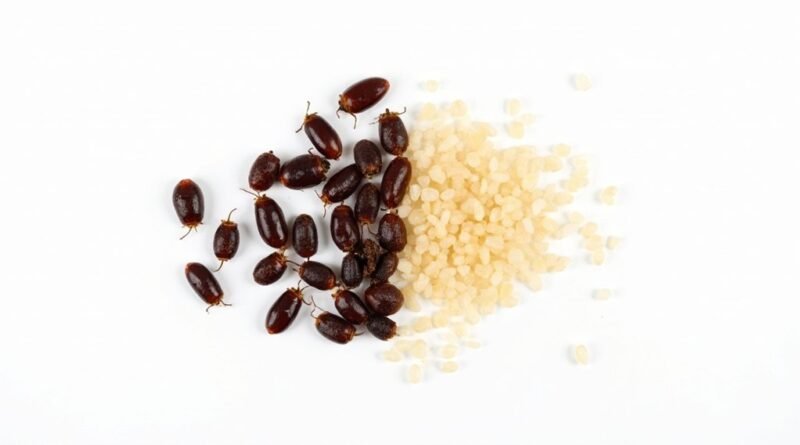
When you find droppings in your home, shape is your best clue. Mouse droppings are 3–6mm with pointed ends, while cockroach droppings have blunt ends with ridges. Smaller roach droppings resemble coffee grounds or black pepper, whereas mouse droppings form smooth, uniform pellets. Color alone won’t confirm which pest you have since both produce dark droppings. Keep these differences in mind, and everything else about identifying your specific intruder will fall into place.
Key Takeaways
- Mouse droppings are rod-shaped with pointed ends, measuring 3–6mm, while cockroach droppings have blunt ends with distinct ridges.
- Smaller cockroach droppings resemble black pepper or coffee grounds, making them easy to confuse with debris without close inspection.
- Fresh mouse droppings are shiny black and resist smearing, while fresh cockroach droppings are dark brown and smear easily.
- Cockroach droppings cluster in dark, moist areas near hiding spots, whereas mouse droppings form linear trails along walls and baseboards.
- Mice produce ammonia-scented urine trails, while cockroaches leave a musty, oily odor, helping distinguish infestations beyond droppings alone.
Cockroach Poop vs Mouse Poop: The Key Visual Differences
When dealing with a potential pest problem, knowing the difference between cockroach and mouse droppings can save you time and help you target the right treatment.
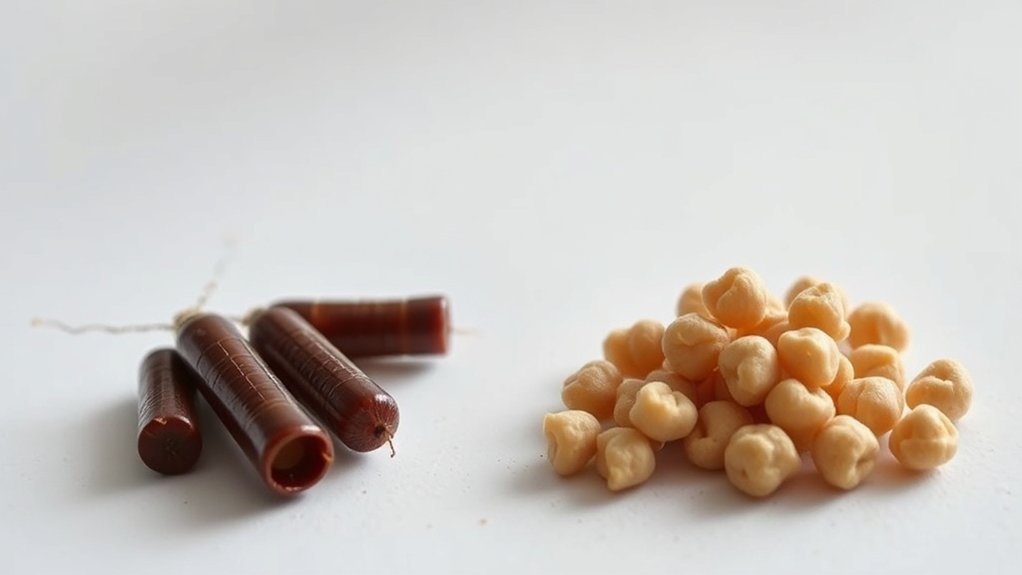
Mouse droppings measure 1/8 to 1/4 inch and appear smooth and shiny when fresh, fading to a dull gray-brown as they age. You’ll notice they’re elongated and scattered in uniform trails along walls and travel paths.
Fresh mouse droppings are shiny black and elongated, fading to dull gray-brown with age along their travel paths.
Cockroach droppings vary by species. Smaller roaches like German cockroaches leave tiny specks resembling coffee grounds, while larger species like American cockroaches produce cylindrical pellets with distinct side ridges. Unlike mouse droppings, roach feces stay consistently dry and granular, whether fresh or old.
Color-wise, fresh mouse droppings are shiny black, while cockroach droppings remain a consistent dark brown or black. You’ll also find roach droppings clustered near hiding spots, cabinets, and appliances rather than spread along distinct trails. Cockroach egg cases, known as oothecae, are sometimes mistaken for droppings but are capsule-like cases that can hold 30–50 eggs.
Shape Is the Clearest Way to Tell Mouse and Cockroach Droppings Apart
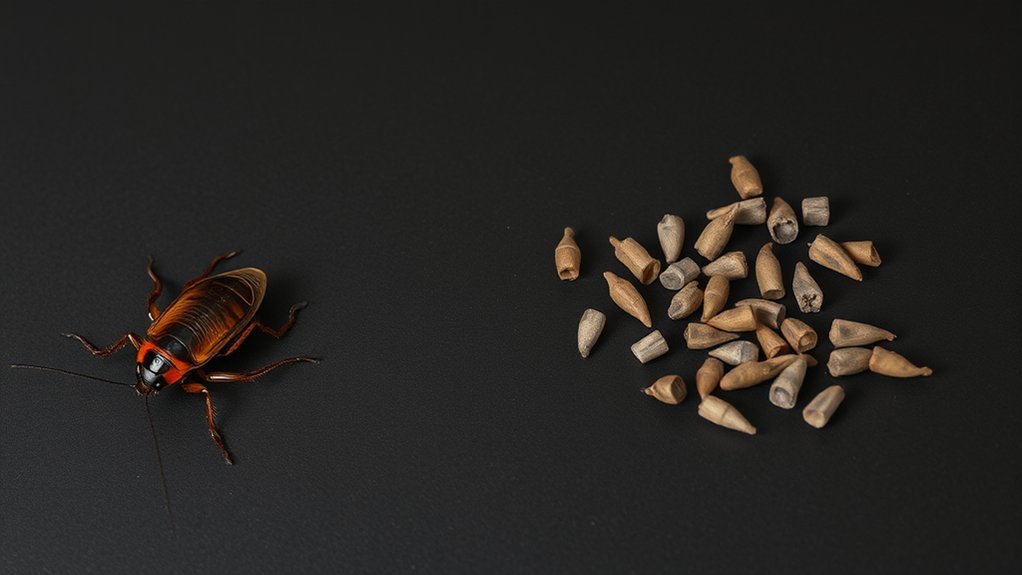
Shape offers 2 clear distinctions you can spot at a glance: mouse droppings are rod-shaped with pointed, tapered ends—like a tiny grain of rice—while cockroach droppings either appear as fine specks or as blunt cylinders with ridges along the sides.
If you’re looking at something uniform, smooth, and tapered at both ends, you’re dealing with mouse droppings. There’s no ambiguity—that pinched, rice-like shape is consistent every time.
Cockroach droppings, however, vary by roach size. Smaller roaches leave behind irregular specks that don’t resemble cylinders at all. Larger roaches produce blunt-ended cylinders, but the ridges running along the sides set them apart from mouse droppings immediately.
The easiest rule: pointed ends mean mouse, blunt ends mean roach. Ridges confirm roach origin without question. Uniformity favors mouse. Once you know what to look for, shape alone tells you which pest you’re dealing with. Misidentifying the shape can lead to ineffective pest control, meaning the actual infestation goes untreated while the problem worsens.
How Size Differences Confirm Which Pest Left the Droppings
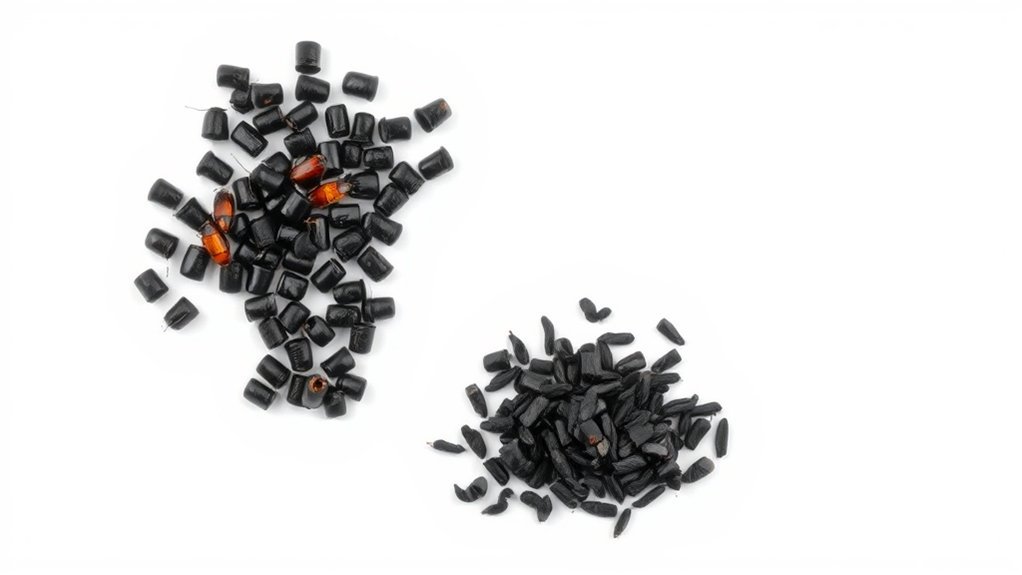
Size backs up shape when you’re trying to confirm which pest left the droppings. Mouse droppings measure 3 to 6mm, making them easy to spot without magnification. German cockroach droppings clock in at roughly 1mm, resembling black pepper specks that require a closer look to examine in detail. That size gap alone separates the two pests quickly.
American cockroach droppings complicate things because they can reach up to 1 inch, which actually exceeds typical mouse droppings in length. When you’re dealing with droppings in the 3 to 6mm range, both American cockroach and mouse remain possible, so you’ll need to check shape to confirm.
German cockroach droppings fall well below the 1/8 inch threshold for mouse droppings, so size rules out mice immediately in that case. Use size as your first filter, then rely on shape to finish the identification. Larger cockroach species produce cylindrical frass with ridges, which gives you an additional physical detail to separate them from the smoother, grain-like appearance of mouse droppings.
Why Cockroach Droppings Have Ridges and Mouse Droppings Don’t
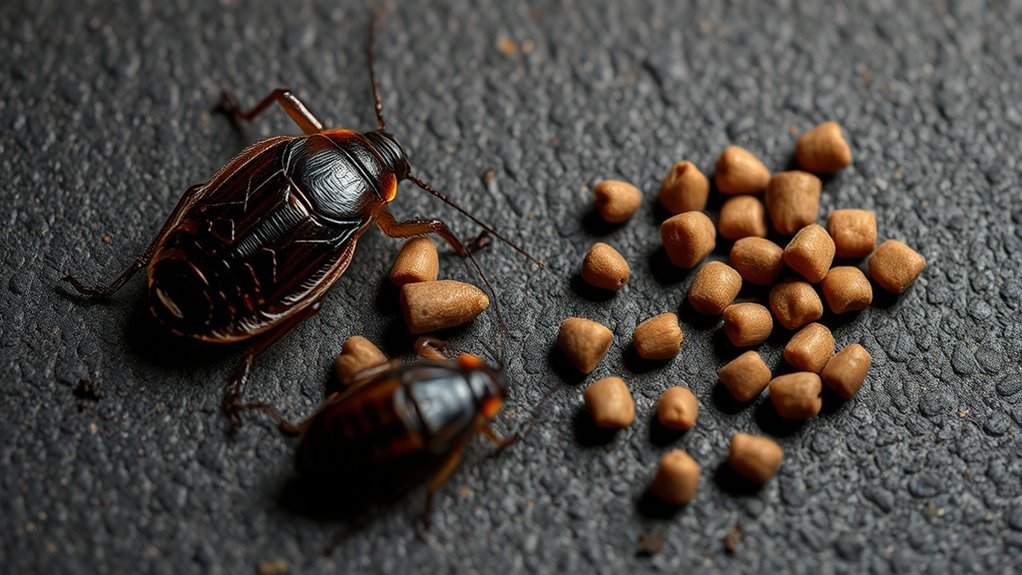
When you spot ridges running lengthwise on a dropping, you’re seeing the direct result of cockroach rectal pad anatomy, since these specialized structures absorb water and nutrients while shaping the waste as it passes through. Mice lack equivalent internal structures, so their digestive tract produces smooth, uniformly tapered pellets with no surface grooves. Understanding this anatomical difference gives you a reliable, built-in identification tool that works even when size alone doesn’t confirm which pest you’re dealing with. Cockroach droppings are also commonly found near wet, decaying materials, which serve as both a food source and harborage area for these pests.
Roach Digestive Anatomy Explained
If you’ve ever wondered why cockroach droppings have ridges while mouse droppings don’t, the answer lies in the roach’s digestive anatomy.
Three key structures create those distinctive ridges:
- Gizzard – Six internal cuticular teeth grind food and imprint texture onto waste material.
- Cuticle lining – The foregut and hindgut are both lined with cuticle, continuously shaping feces as it passes through.
- Rectal papillae – Six papillae compact the final waste without smoothing out the ridges already formed.
This combination produces cylindrical droppings with blunt ends and noticeable side ridges. Mice lack this cuticle-lined, tooth-equipped digestive system, which is why their droppings come out smooth. Once you know this distinction, identifying which pest you’re dealing with becomes much easier. The cockroach hindgut also contains a colon and ileum, but it is the rectal papillae absorption of water and salts that further concentrates and firms the waste before it is expelled.
Smooth Mouse Dropping Formation
Now that you understand why cockroach droppings have ridges, it’s easier to appreciate why mouse droppings don’t. A mouse’s digestive system produces small, tapered pellets with a naturally smooth, uniform surface. You won’t find ridges, notches, or segmented edges anywhere on them.
Mouse droppings measure 1/8 to 1/4 inch long, shaped like rice grains—widest in the middle and tapering to points at both ends. With mice producing 50–75 droppings daily, each deposit is small and consistently formed. Fresh droppings appear shiny and moist, hardening within hours while retaining that smooth profile. Diet may affect color, but it doesn’t alter surface texture.
When you spot smooth, spindle-shaped pellets, you’re dealing with mice—not roaches.
Why Color Alone Won’t Tell You Which Pest You Have
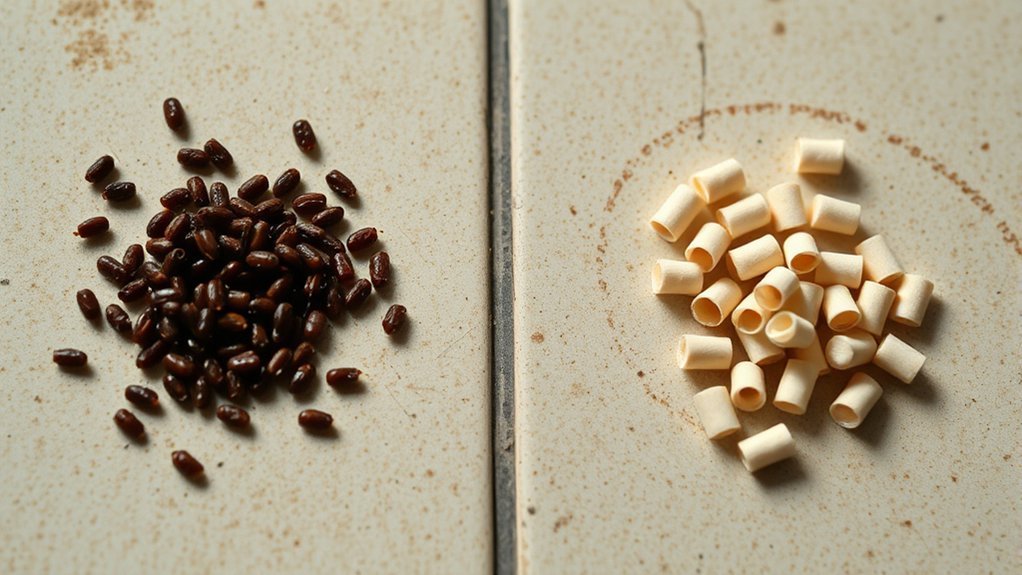
Color might seem like a quick shortcut for identifying pest droppings, but it’ll mislead you more often than not. Both mouse and roach droppings fall within the same dark brown-to-black spectrum, making color an unreliable identifier on its own.
Here’s why color fails you:
- Fresh mouse droppings appear shiny black, closely overlapping with roach droppings’ consistent dark brown-black tones.
- Mouse droppings fade to gray as they age, but roaches maintain their dull dark color regardless of age, creating timeline confusion.
- Different roach species, like German and American roaches, both produce dark brown-to-black droppings, adding another layer of overlap.
Environmental factors complicate things further. Smearing alters roach dropping color perception, while diet shifts mouse dropping shades toward different dark tones. Since no unique color exclusively identifies one pest, you’ll need to combine color observation with shape and size analysis.
Where Droppings Appear Reveals Which Pest You Have
Where you find droppings often tells you more than what they look like. Cockroach droppings appear in moisture-rich, dark spaces — behind stoves, under sinks, inside dishwashers, and within kitchen cabinet corners. You’ll also find them clustered along travel routes like wall junctions, doorways, and baseboards, or tucked into cracks and crevices where roaches flatten their bodies to hide.
Mouse droppings follow completely different patterns. Rodents concentrate their feces near nesting areas rather than scattering them along pathways. Their habitat preferences lead them to different zones than roaches typically occupy.
Infestation size also becomes clearer through location. Droppings confined to one area suggest an early or localized problem. Speckling across multiple rooms signals a larger, more established population. If you’re finding small, dark deposits clustered in humid, hidden kitchen and bathroom spaces, you’re almost certainly dealing with cockroaches rather than rodents.
How Fresh vs Old Droppings Look Different
Knowing whether droppings are fresh or old gives you one of the clearest signals about whether an infestation is still active. Both cockroach and mouse droppings follow a predictable aging pattern you can use to assess urgency.
Fresh droppings from either pest appear darker and retain moisture, while older ones lighten and dry out over time. Here’s how age changes what you’re seeing:
- Color shift — Fresh cockroach and mouse droppings are dark brown to black; older ones fade to lighter brown or gray.
- Texture change — Fresh droppings feel soft or moist, while old ones become dry, brittle, or powdery.
- Smear test — Fresh cockroach droppings smear when wiped with a damp paper towel; mouse droppings resist smearing regardless of age.
If you’re finding dark, moist droppings, treat it as an active problem requiring immediate attention.
How Much Poop Each Pest Leaves Behind
One of the fastest ways to gauge infestation severity is by how much fecal matter a pest leaves behind. German cockroaches defecate frequently, leaving dense clusters under appliances like stoves, refrigerators, and dishwashers. If you’re cleaning droppings and they reappear within days, you’re dealing with an active, growing colony.
American cockroaches produce fewer but larger cylindrical pellets, roughly ¼ inch long. You’ll typically find these scattered in damp areas like basements, bathrooms, and crawl spaces rather than in tight clusters.
Mice leave considerably more droppings per day than cockroaches, often depositing them in linear trails along baseboards and walls. The concentration increases near nesting sites, so heavier accumulation points directly to where mice are living.
In both cases, volume matters. The more droppings you find, the larger and more established the infestation, and the faster you need to act.
Smell, Tracks, and Nesting Material That Confirm the Pest
Beyond droppings alone, your nose, eyes, and a closer look at nesting materials can confirm which pest you’re dealing with. If you catch a musty, oily odor growing stronger over time, you’re likely facing a cockroach infestation, while mice don’t produce that same distinct smell. You’ll also want to check for greasy smear marks and dark egg cases that signal roaches, or linear trails of smooth, rod-shaped droppings paired with shredded nesting materials that point to mice.
Distinct Odor Clues
When cockroaches infest an area, they leave behind a distinctive musty, oily odor that intensifies as the population grows. This smell comes from roach pheromones, body oils, and frass, making it easy to distinguish from mice, which produce little to no noticeable odor. Here’s what the smell tells you:
- Musty intensity – A stronger odor confirms a larger roach population nearby.
- Oily, greasy quality – The lingering, greasy scent on surfaces indicates roach trails, unlike the faint ammonia traces mice leave.
- Location-specific odor – Concentrated smells near droppings pinpoint roach nesting sites.
If you’re detecting a persistent, oily mustiness rather than a faint ammonia hint, you’re likely dealing with cockroaches, not mice.
Rodent Track Patterns
Mice are creatures of habit, and their track patterns reflect this predictability in ways that make identification straightforward. They follow set routes along walls, behind furniture, and under appliances, leaving droppings in trails rather than scattered piles. You’ll notice uniform, rod-shaped pellets lined up along baseboards or near food storage areas, not clustered randomly like roach specks.
These trails predictably revisit the same paths, concentrating near nesting spots or pantries. Fresh droppings appear dark and shiny along these routes, fading to gray-brown as they dry. Unlike roaches, which hide in tight crevices and leave irregular clusters, mice travel open paths repeatedly, creating linear patterns you can follow. If you’re seeing consistent trails with pointed-end pellets along walls, you’re dealing with mice.
Nesting Material Signs
Two key sensory clues—smell and visual staining—help confirm which pest you’re dealing with when droppings alone aren’t conclusive.
Cockroaches produce a musty odor from pheromones in droppings and body secretions, while mice emit sharp ammonia-like urine smells concentrated in enclosed spaces like cabinets and wall voids.
Look for these nesting confirmation signs:
- Cockroach smear marks — Brown streaks along baseboards and cabinet edges indicate active travel routes through fecal matter.
- Egg cases (oothecae) — Hard, rectangular brown capsules measuring ¼–½ inch signal active breeding sites.
- Mouse urine odor zones — Pungent ammonia concentrations combined with decomposition smells pinpoint nesting locations inside wall voids.
Multiple egg cases or intensifying odors in one area confirm an established colony rather than isolated pest activity.
Are Cockroach or Mouse Droppings More Dangerous to Your Health?
Both cockroach and mouse droppings carry serious health risks, but they threaten you in distinctly different ways. Cockroaches produce chronic risks through continuous allergen exposure, while mice present acute dangers through hantavirus transmission.
| Health Factor | Cockroach Droppings |
|---|---|
| Primary Risk | Allergens triggering asthma |
| Transmission | Airborne particles during disturbance |
| Timeline | Chronic, long-term exposure |
| Most Vulnerable | Children, asthma sufferers |
| Health Factor | Mouse Droppings |
| Primary Risk | Hantavirus, salmonella, E. coli |
| Transmission | Aerosolized particles, surface contact |
| Timeline | Acute risk from active infestation |
| Most Vulnerable | Anyone in contaminated spaces |
Your immune status, age, and pre-existing respiratory conditions determine how severely either pest affects you. Active infestations of both pests pose the greatest danger, so you shouldn’t delay addressing fresh droppings regardless of which pest you’re dealing with.
Frequently Asked Questions
Can Pets Get Sick From Eating Cockroach or Mouse Droppings?
Yes, your pets can get sick from eating cockroach or mouse droppings. They’re exposed to dangerous pathogens like *Salmonella*, *E. coli*, and *Hantavirus*, causing vomiting, diarrhea, or even neurological damage.
How Long Do Cockroach or Mouse Droppings Remain Infectious After Deposit?
Cockroach droppings can remain infectious for weeks to months, while mouse droppings carry viable pathogens for up to 2 weeks (hantavirus) or 1-3 months (Salmonella). You should disinfect them immediately.
What Professional Tests Confirm Whether Droppings Are From Cockroaches or Mice?
You can confirm droppings through DNA analysis, bacterial culturing, microscopic structural examination, compositional testing for dietary markers, and urate presence detection—all professional lab methods that’ll definitively identify whether you’re dealing with cockroaches or mice.
Can Droppings Indicate How Large the Existing Pest Infestation Actually Is?
Yes, droppings can reveal your infestation’s size. You’ll notice dense clusters mean more pests, while fresh mouse pellets with urine stains suggest 20+ rodents. Roach frass spread across multiple rooms signals a colony exceeding 50 individuals.
Are Certain Home Materials More Likely to Attract Cockroaches Versus Mice?
Yes, certain materials attract one pest over the other. You’ll find cockroaches drawn to damp cardboard and grease, while mice prefer dry, chewable fabrics, paper, and stored grains for nesting and food.
Conclusion
Now that you know what to look for, you can tell cockroach and mouse droppings apart with confidence. Check the shape, size, and ridges, and you’ll narrow it down quickly. Don’t stop at identification, though. Both pests carry serious health risks, so you’ll want to act fast. Clean the area thoroughly, find where they’re hiding, and call a pest control professional if the problem’s bigger than you can handle alone.
