
Cockroach Poop: What It Looks Like, Where to Find It, and What It Means
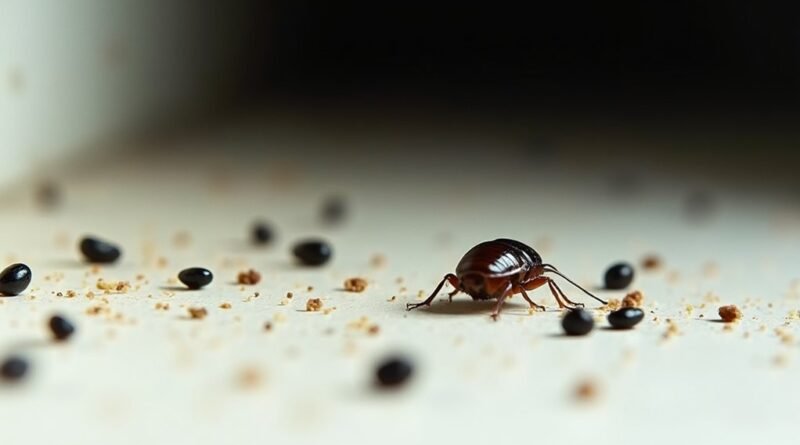
Cockroach poop looks like tiny dark specks or cylindrical pellets, depending on the species you’re dealing with. Smaller roaches leave droppings resembling black pepper or coffee grounds, while larger ones produce ridged, blunt-ended pellets. You’ll usually find them clustered near food sources, inside cabinets, behind appliances, and along baseboards. Beyond being unpleasant, they carry serious health risks, including bacteria and allergens. There’s a lot more to know about identifying, locating, and handling them.
Key Takeaways
- Small cockroach droppings resemble dark coffee grounds, while larger species produce cylindrical, ridged pellets measuring 1–3mm in dark brown or black.
- Droppings are commonly found in kitchens, bathrooms, along baseboards, near appliances, and in dark, moist utility areas.
- Unlike mouse droppings, cockroach droppings have blunt ends, granular texture, and remain dark rather than fading to gray-brown.
- Cockroach droppings carry harmful bacteria like Salmonella and E. coli and can trigger allergic reactions and asthma attacks.
- Widespread droppings across multiple rooms signal a mature infestation, while clustered deposits indicate a nearby nest requiring immediate action.
What Does Cockroach Poop Actually Look Like?
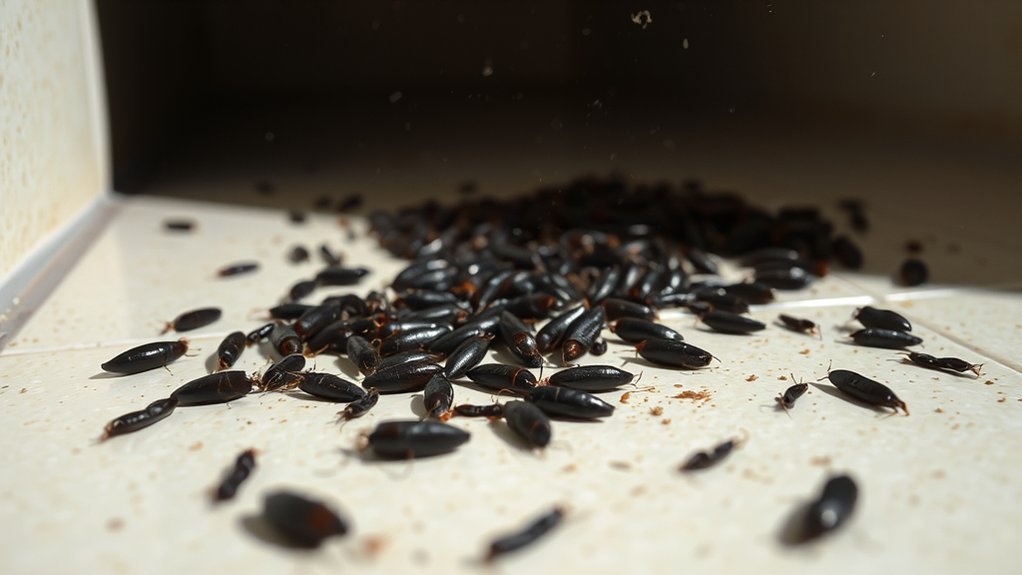
Cockroach droppings vary in appearance depending on the species, but size is your first clue — they measure between 1-3mm, far smaller than mouse droppings.
Small roach species leave behind what looks like coarse coffee grounds or ground black pepper, typically 1-2mm in size. Larger species produce cylindrical droppings around 2-3mm long, featuring visible ridges running tip to tip along the sides. You’ll also notice blunt ends on both types, which immediately distinguishes them from mouse droppings.
Color gives you another indicator. Fresh droppings appear dark brown or black and glossy. As they age, they dry out and crumble easily. You might also spot ink-like smears or dark stains rather than distinct pellets, particularly along edges and corners where roaches travel.
If multiple roach species share your space, expect size variation within the same location, making species-specific identification more challenging. Identifying the species is a critical step, as different roaches require different control methods to eliminate them effectively.
German Roach Droppings vs. American Roach Droppings
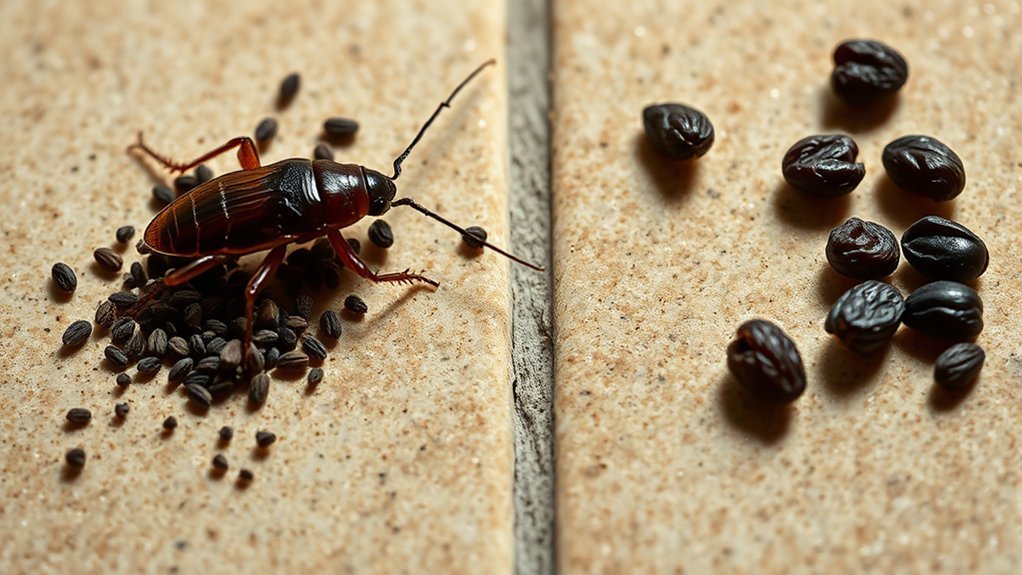
The two most common household species — German and American roaches — leave behind distinctly different droppings, and knowing what separates them helps you pinpoint which pest you’re dealing with.
German roach droppings resemble black pepper or coarse coffee grounds — tiny, dark specks you’ll typically spot on countertops, inside drawers, or along wall cracks. American roach droppings, by contrast, are larger, cylindrical pellets with blunt ends and distinctive ridges running tip to tip.
German roach droppings look like black pepper specks; American roach droppings are larger, ridged, cylindrical pellets with blunt ends.
Here’s a quick comparison to help you tell them apart:
- Size: German droppings are fine specks; American droppings are solid, substantial pellets.
- Texture: German droppings look powdery; American droppings feature visible ridges.
- Location: German droppings concentrate in kitchens and pantries; American droppings appear in damp basements, bathrooms, and crawl spaces.
- Additional signs: American roaches also leave dark brown smear marks near moisture sources.
If you’re attempting to manage a roach infestation through a pest control product business, note that store reactivation requires contacting Shopify support to get your platform back up and running.
Is That Cockroach Poop or Mouse Droppings?
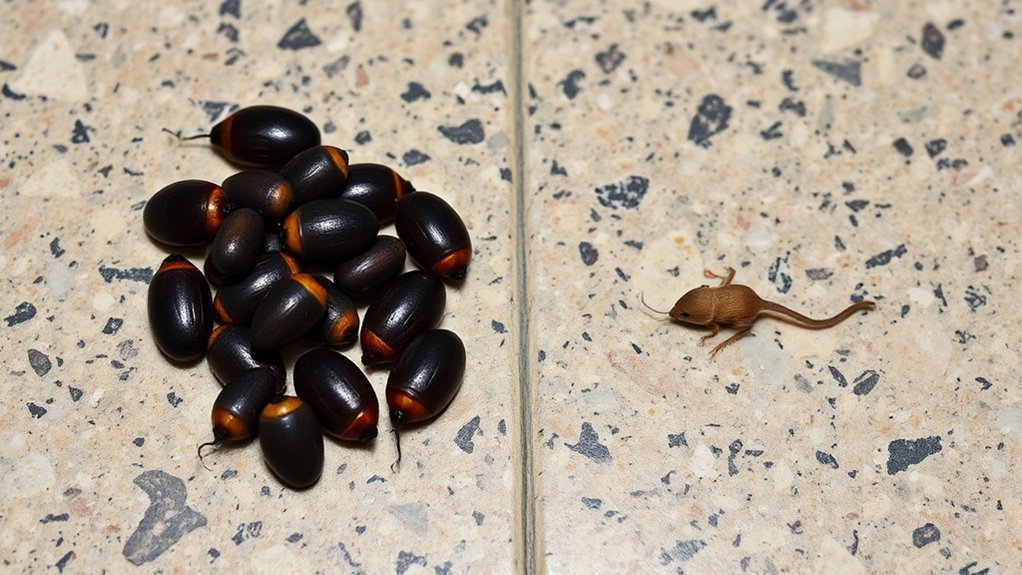
Telling cockroach droppings apart from mouse droppings can save you from misidentifying your pest problem — and applying the wrong solution.
| Feature | Cockroach Droppings | Mouse Droppings |
|---|---|---|
| Size | Under 1mm to 1 inch | 1/8 to 1/4 inch |
| Shape | Blunt, rounded ends | Pointed, tapered ends |
| Texture | Dry, granular, ridged | Smooth fresh, brittle dry |
| Color | Consistent dark brown/black | Fades from black to gray-brown |
| Pattern | Clustered near hiding spots | Uniform trails along walls |
Check the shape first — it’s your clearest indicator. Mouse droppings always taper at both ends, while roach droppings stay blunt. Texture helps too; roach waste feels granular and ridged even when fresh, whereas mouse droppings start smooth. Color shifts matter — if you’re seeing droppings that fade over time, you’re likely dealing with mice. Roach droppings maintain their dark color consistently.
Beyond appearance, consider where the droppings are found — cockroach droppings typically appear in clusters near food sources, inside cabinets, and under sinks, while mouse droppings are more commonly scattered in uniform trails along walls and behind furniture.
Where Do Cockroaches Leave Droppings in Your Home?
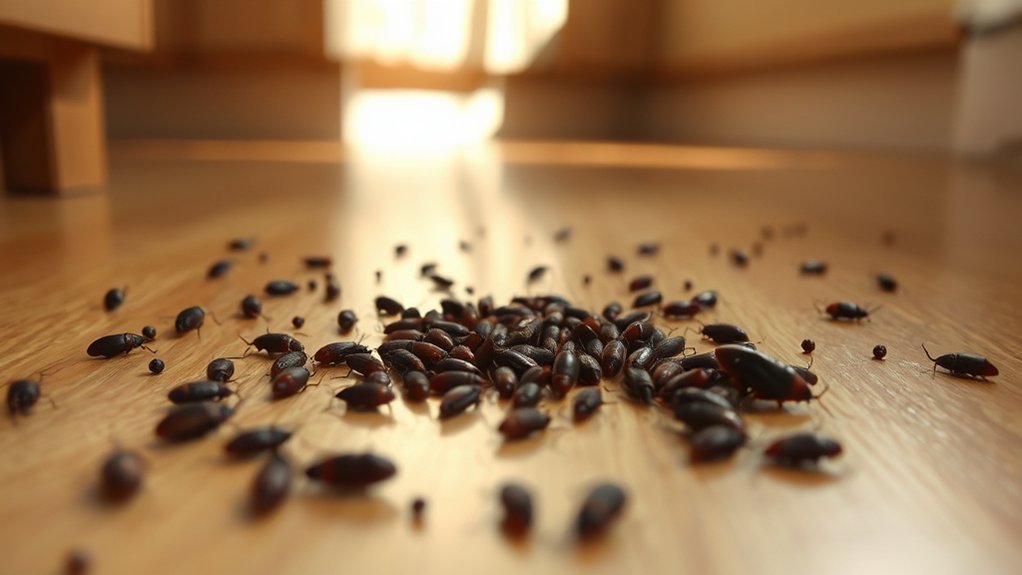
Where roaches leave droppings tells you just as much as what those droppings look like. German roaches stay close to food and warmth, so you’ll find their waste concentrated in specific zones throughout your home.
Check these four areas first:
- Kitchen hotspots – Inside cabinets, behind the refrigerator, under the stove, and inside appliances like microwaves and coffee makers
- Bathroom and plumbing zones – Under sinks, behind toilets, near floor drains, and around leaky pipes where moisture collects
- Dark, hidden spaces – Along baseboards, inside wall cracks, behind furniture, and beneath rubber mats
- Utility and storage areas – Near water heaters, in basements, laundry rooms, and behind stacked boxes in garages
Don’t overlook elevated surfaces either. The tops of cabinets and refrigerators are prime German roach territory. Finding droppings in multiple locations signals an established infestation rather than an isolated problem. Oriental roaches, on the other hand, tend to gravitate toward damp, low-lying areas like basements, making their droppings easier to locate in those specific zones.
Egg Cases, Shed Skins, and Smells That Confirm a Roach Problem
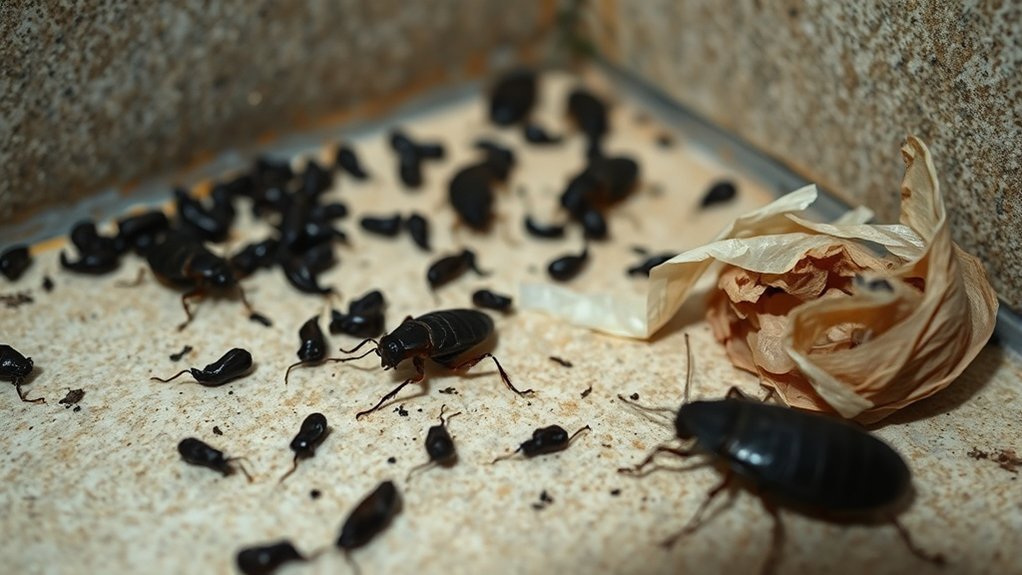
Beyond droppings, you’ll find other telltale signs that confirm a roach infestation, including egg cases, shed skins, and a distinctive odor. Roach egg cases, called oothecae, are bean- or purse-shaped capsules ranging from 5–13 mm long, with colors varying from light brown to dark reddish-brown depending on the species. Each ootheca can contain 10 to 50 eggs, depending on the species involved. You’ll also notice thin, translucent shed skins near hidden areas, along with a persistent musty, oily smell that grows stronger as the infestation worsens.
Identifying Roach Egg Cases
Cockroach droppings aren’t the only sign of an infestation you should watch for — roach egg cases, known as oothecae, are small, elongated capsules roughly the size of a grain of rice that confirm roaches are actively reproducing in your home.
Each species leaves behind distinct cases:
- German cockroach — light brown, 8 mm, carries up to 40 eggs with a zipper-like ridge
- American cockroach — turns black within days, 8 mm, holds 12–16 eggs
- Oriental cockroach — dark reddish-brown, 8–10 mm, slightly inflated appearance
- Brown-banded cockroach — light reddish-brown, smaller casing
All oothecae feature a hardened, leathery exterior with visible ridges. Finding even one means reproduction is already underway.
Recognizing Shed Skins
Roach egg cases aren’t the only physical evidence you’ll find during an infestation — shed skins are just as telling. Cockroaches molt between 6 and 14 times throughout their lives, discarding their exoskeletons as they develop from nymphs into adults. These hollow shells often resemble deflated cockroaches and vary in size depending on the roach’s life stage when molting occurred.
You’ll typically find shed skins near sheltering spots — beneath furniture, inside drawers, around electrical equipment, and in dark, undisturbed corners. Kitchens, bathrooms, and laundry rooms are common locations during German cockroach infestations.
Don’t overlook these findings for health reasons, either. Shed skin fragments trigger allergic reactions and asthma in sensitive individuals, contributing to indoor allergen levels even when live cockroaches aren’t visible.
Detecting Musty Roach Odors
While visual evidence like shed skins and egg cases confirms an infestation, your nose can tip you off just as effectively. Cockroaches produce musty, oily odors from aggregation pheromones found in their frass and body secretions. Stronger smells indicate larger infestations.
Here’s what the odor tells you:
- Bay leaf or decay scent signals Oriental cockroaches specifically.
- Increasing intensity correlates directly with egg case proliferation.
- Peppery undertones mixed with mustiness confirm frass presence nearby.
- Odor peaks during hatching, distinguishing it from steady mold smells.
Check cabinets, wall voids, and food prep areas where pheromones concentrate. German cockroach odors skew lighter and mustier, while Oriental species produce heavier, decay-like smells that are harder to ignore.
The Health Risks Hiding in Cockroach Droppings
When you find cockroach droppings in your home, you’re facing more than a cleanliness issue—you’re dealing with serious health risks. The allergens in roach feces and shed skin can trigger asthma attacks and allergic reactions, with children in infested housing showing asthma diagnosis rates as high as 13%. Beyond allergens, those same droppings carry dangerous bacteria like Salmonella and E. coli, which can contaminate your food and surfaces and spread diseases ranging from gastroenteritis to typhoid fever.
Allergens and Asthma Triggers
Cockroach droppings don’t just contaminate surfaces — they release proteins that trigger serious allergic reactions and asthma attacks. Feces, shed cuticles, saliva, and decomposing body parts all contribute allergens that become airborne when disturbed, then settle into dust, carpets, and furniture.
If you’re sensitized, breathing these particles inflames and constricts your airways. Children face particularly severe consequences:
- Hospitalization rates increase 3 to 3.4 times with high bedroom allergen levels
- School absenteeism rises notably among cockroach-allergic children
- Approximately 20% of inner-city asthmatic children fall into high-risk categories
- Air pollution synergistically worsens cockroach allergen sensitivity
Even after eliminating an infestation, allergen particles persist in HVAC systems and surfaces. Vacuuming disturbs settled particles, temporarily increasing your exposure risk.
Bacteria and Disease Spread
Beyond triggering allergies and asthma, cockroach droppings carry an alarming range of bacterial pathogens that can make you seriously ill. When roaches forage across your food, countertops, and utensils, they deposit Salmonella, E. coli, Listeria, Staphylococcus, and Streptococcus through their feces, legs, and mouthparts.
Salmonella causes diarrhea, fever, and abdominal cramps within 12–72 hours, while E. coli strains remain viable in roach feces for up to eight days. In severe cases, you’re looking at typhoid fever, dysentery, or bloodstream infections requiring hospitalization.
It doesn’t stop at bacteria. Cockroaches also vector Hepatitis A, poliovirus, and six types of parasitic worms, including pinworms. Their droppings can transmit parasitic eggs directly to your food, making every roach infestation a genuine public health threat.
How Cockroach Droppings Reveal Infestation Size
The size and spread of a cockroach infestation often hides in plain sight through the droppings left behind. By reading these deposits carefully, you can gauge how serious your problem actually is.
Here’s what the evidence tells you:
- No visible droppings — only a few roaches are present, likely early scouts.
- Small, clustered deposits — large numbers are actively moving through the area.
- Droppings near a concentrated zone — a nest is nearby, not just wandering roaches.
- Droppings across multiple rooms — you’re dealing with a mature, widespread infestation.
Beyond counting deposits, you should also notice where they appear. Localized droppings in kitchen cabinets suggest an early-stage problem. Finding fecal matter in bathrooms, basements, and behind appliances signals the population has expanded. Musty odors accompanying the droppings confirm heavy activity. Once you spot any of these signs, act immediately before the infestation grows further.
Why Cockroach Droppings Always Appear in Clusters
When you spot cockroach droppings clustered in one area, pheromones are the reason. Roaches release chemical signals that attract others to the same spots, turning a single dropping into a growing pile. You can trace active pathways throughout your home by following these fecal clusters, since roaches repeatedly mark and travel the same routes.
Pheromones Attract More Roaches
Cockroach droppings don’t just accumulate randomly — they contain aggregation pheromones that actively recruit more roaches to the same spot. These chemical signals create a self-reinforcing cycle that explains why infestations concentrate in specific areas.
Here’s what drives the pheromone attraction process:
- Fecal matter contains periplanolide-E (PLD-E), which roaches detect through specialized olfactory neurons with 100 times higher sensitivity than sex pheromones.
- Bacteria in droppings produce fatty acids that evaporate, amplifying the pheromone’s potency.
- Sterile droppings lack these fatty acids, making them far less attractive to other roaches.
- Nymphs respond strongest to PLD-E, drawing young roaches toward established harborage sites.
When you spot clustered droppings, you’re seeing a chemical “gathering signal” that’s actively pulling more roaches toward that location.
Droppings Mark Roach Pathways
Scattered randomly across your kitchen floor? That’s mice. Cockroach droppings cluster deliberately, mapping exactly where roaches eat, hide, and travel. They concentrate along wall edges, inside cabinets, and behind appliances because roaches hug surfaces rather than crossing open spaces.
| Location | Dropping Type | What It Indicates |
|---|---|---|
| Cabinet interiors | Dense clusters | Active feeding site |
| Wall-floor junctions | Smear marks | Established travel route |
| Upper shelves | Scattered specks | Vertical climbing activity |
These patterns reveal their hidden corridors. Brown smear marks appear where bodies repeatedly contact walls, while concentrated specks pinpoint nesting sites. Fine, scattered droppings suggest juvenile roaches, confirming active breeding nearby. Multiple clustered deposits across several locations signal a widespread infestation demanding immediate action.
How to Clean Up Cockroach Droppings Without Spreading Them
Cleaning up cockroach droppings requires careful preparation to avoid spreading allergens and bacteria throughout your home. Wear gloves, a mask, and old clothes before starting. Use a HEPA filter vacuum to contain particles rather than scattering them into the air.
Proper gear and a HEPA vacuum are essential first steps before tackling cockroach droppings safely.
Follow this cleaning sequence:
- Vacuum high areas first — tops of cabinets, refrigerators, and appliances where roaches commonly nest
- Target cracks and crevices — vacuum thoroughly, then immediately empty the canister outside in a sealed bag
- Disinfect all surfaces — spray a vinegar-water solution or appropriate disinfectant, scrub, and wipe clean
- Address specific materials — scrape and treat carpets, mattresses, and clothing separately using detergent, stain remover, or soap-water solutions
After cleaning, seal food in airtight containers, eliminate moisture sources, and apply residual insecticide to high-risk areas. Dispose of all protective gear in sealed trash bags to prevent recontamination.
When Cockroach Poop Means You Need Professional Help
Even after a thorough cleaning, some infestations are simply too far along for DIY methods to handle. If you’re spotting droppings alongside live roaches, smear marks, or egg cases, you’re dealing with an active, spreading population. Multiple egg cases near droppings signal ongoing reproduction that store-bought products can’t stop.
You should also call a professional if your previous DIY attempts haven’t reduced droppings or roach activity. When multiple species appear despite treatments, you need expert-level pesticides and targeted strategies.
Location matters too. Droppings in your kitchen, near water sources, or under sinks demand immediate professional intervention. These areas carry serious contamination risks, including bacteria, pathogens, and allergens linked to asthma, gastroenteritis, and typhoid fever.
If anyone in your household is already experiencing health issues, don’t delay. Professionals can locate hidden egg casings, treat sensitive zones safely, and eliminate the infestation before it multiplies further.
Frequently Asked Questions
Can Cockroach Droppings Stain Walls or Surfaces Permanently?
Yes, cockroach droppings can permanently stain your walls and surfaces. If you don’t clean them quickly, they’ll soak into drywall or plaster, creating dark, stubborn discoloration that’s increasingly difficult to remove over time.
Do Cockroach Droppings Look Different Depending on What They Ate?
Yes, what cockroaches eat directly affects their droppings’ color and composition. If they’ve consumed darker materials like garbage or sewage, you’ll notice darker feces, while varied diets create subtle differences in shade and texture.
How Quickly Do Cockroaches Produce Droppings After Eating?
You won’t find this information in the available research. To accurately answer how quickly cockroaches produce droppings after eating, you’d need additional sources covering cockroach digestive processes and defecation rates.
Can Pets Get Sick From Accidentally Ingesting Cockroach Droppings?
Yes, your pet can get sick from ingesting cockroach droppings. They carry harmful pathogens like Salmonella and E. coli, causing vomiting, diarrhea, and fever. Vulnerable pets with weakened immunity face the most severe health risks.
Do Dead Cockroaches Leave Droppings Differently Than Live Ones?
Dead cockroaches don’t leave droppings differently than live ones. You won’t notice any difference in appearance. However, live roaches produce fresh droppings near food sources, while dead roaches’ old droppings persist until you clean them up.
Conclusion
Finding cockroach droppings in your home means you’ve got a problem that won’t solve itself. You now know what to look for, where to check, and how seriously to take what you find. Don’t ignore the signs or assume it’s just one roach. The faster you act—whether you’re cleaning up droppings, sealing entry points, or calling a professional—the better your chances of stopping the infestation before it gets worse.
