
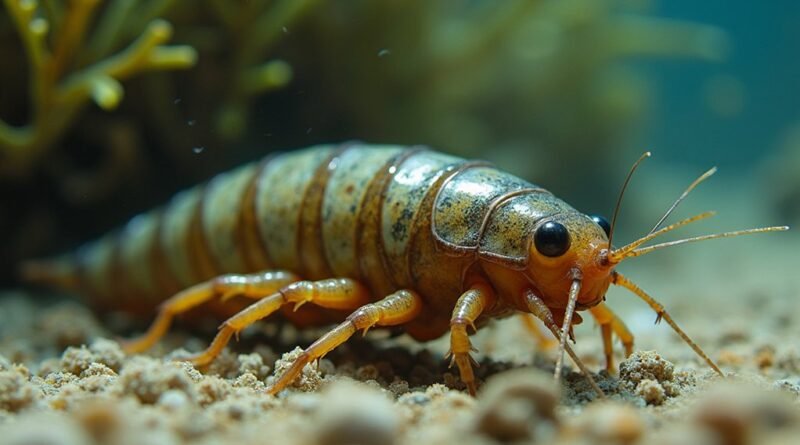
Sea Cockroach: What It Is and Is It Related to House Roaches?
If you’ve ever spotted a small, gray, armored creature darting across wet rocks at the beach, you’ve likely seen a sea cockroach. Despite the name, it’s not related to house roaches at all — sea cockroaches are isopods, closely related to crabs and shrimp. They’re harmless scavengers that play an essential role in coastal ecosystems. Stick around and you’ll discover everything there is to know about these fascinating creatures.
Key Takeaways
- Sea cockroaches are isopods, a type of crustacean closely related to lobsters, crabs, and shrimp, not household insects.
- They are not related to house roaches; house roaches belong to order Blattodea, while sea cockroaches are crustaceans.
- Sea cockroaches have a hard, gray, segmented body, 14 jointed legs, and measure up to 4 cm long.
- Unlike scavenging house roaches, sea cockroaches feed on decaying plant matter, dead animals, and microalgae in coastal zones.
- They play a vital ecological role by decomposing organic material and serving as an energy source in food webs.
What Exactly Is a Sea Cockroach?
Despite the name, sea cockroaches aren’t cockroaches at all — they’re isopods, a type of crustacean more closely related to lobsters, crabs, and shrimp than to any insect. They belong to the family Ligiidae within phylum Arthropoda and subphylum Crustacea.
The name “isopod” tells you something useful about their body: “iso” means same, and “pod” means foot, referring to their 14 jointed legs, which are uniform in appearance and function. Their exoskeleton is made of chitin, the same material found in insect shells, which explains why people draw comparisons to cockroaches.
You’ll recognize them by their elongate-oval shape, typically 20–35 mm long, with coloration ranging from brown and slate grey to olive green. Their bodies consist of seven thoracic segments and three abdominal segments, and long antennae extend from their heads — sometimes reaching nearly their full body length. They are commonly found in rocky littoral zones, sheltering in crevices, rock pools, and under stones along coastal areas.
Which Species of Sea Cockroach Are Most Common?
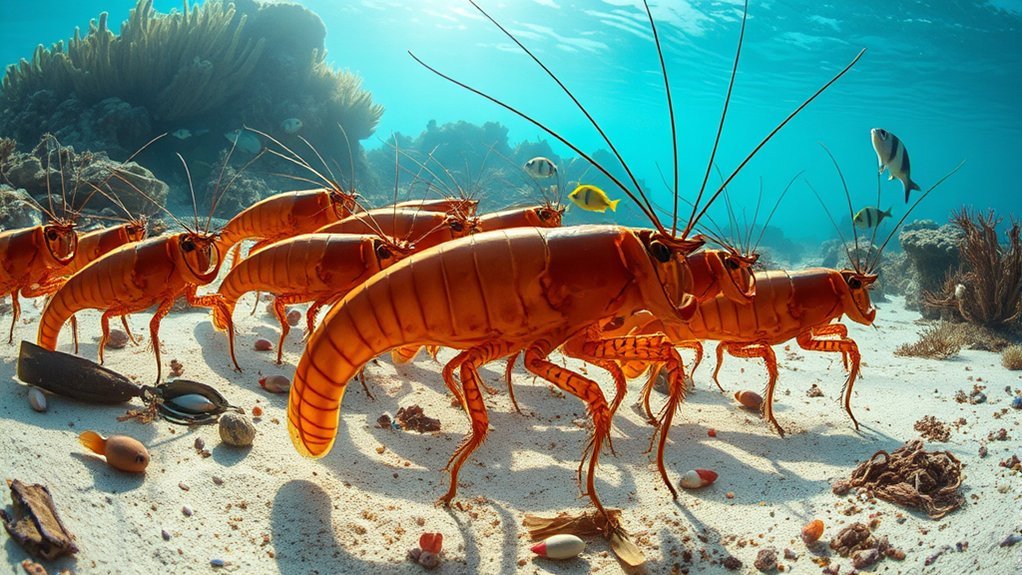
Now that you know what a sea cockroach is, you might be wondering which species you’re most likely to encounter. The answer depends largely on where you live.
If you’re along Mexico’s Pacific coast, you’ll commonly find *Chiton articulatus*, the species most people there call the sea cockroach. It’s endemic to Mexico, running from Mazatlán down to Puerto Huatulco, and it’s the only chiton harvested commercially for food in those waters.
In Europe, *Ligia oceanica* dominates rocky shores from Norway to Morocco, while *Ligia exotica* turns up in harbors and docks across temperate and subtropical regions worldwide, largely because human transportation spreads it easily.
If you’re near Cape Cod or Maine, you might spot *Ligia oceanica* in its introduced North American range, though sightings remain rare.
The giant isopod (*Bathynomus giganteus*) exists too, but its deep-sea habitat makes an encounter extremely unlikely.
*Chiton articulatus* is considered the most abundant chiton in Mexican waters, making it by far the easiest of its kind to observe along that coastline.
Sea Cockroach vs. House Roach: Are They Actually Related?
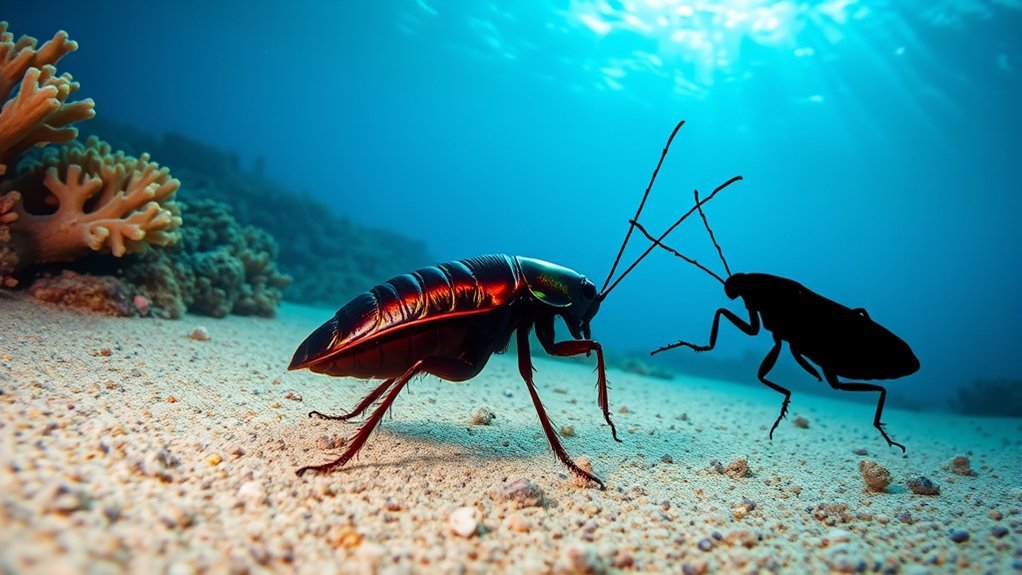
The name “sea cockroach” naturally makes you wonder whether these creatures share any real connection to the house roach scurrying across your kitchen floor. Despite the shared nickname, they’re not related at all.
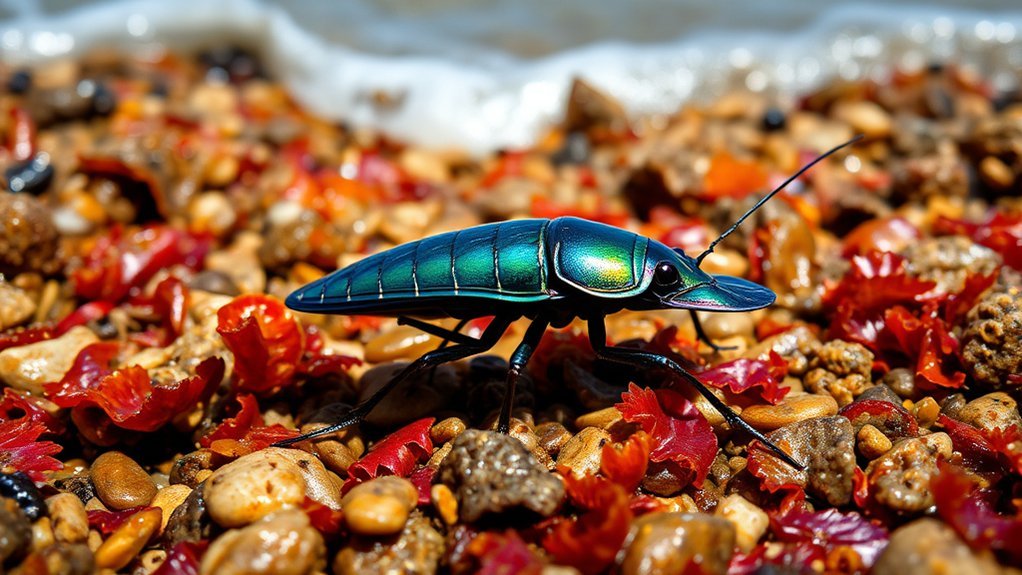
House roaches like *Blattella germanica* and *Periplaneta americana* belong to order Blattodea. Sea cockroaches, which often refer to water bugs like *Lethocerus americanus*, belong to order Hemiptera, family Belostomatidae. No direct taxonomic relationship exists between these two orders.
Their physical differences reinforce this separation. House roaches have long antennae, spiky running legs, and light brown coloring. Water bugs carry short antennae, paddle-like legs, pincer-like front limbs, and a pointed beak for catching prey.
Their behavior differs just as sharply. House roaches scavenge indoors and reproduce rapidly, creating lasting infestations. Water bugs are predatory swimmers that only wander inside accidentally. You’re dealing with two completely distinct insects that simply share an unfortunate name. German roaches, for instance, are capable of producing up to 100,000 offspring from a single pair within just one year, a reproductive scale no water bug comes close to matching.
Where Do Sea Cockroaches Live?
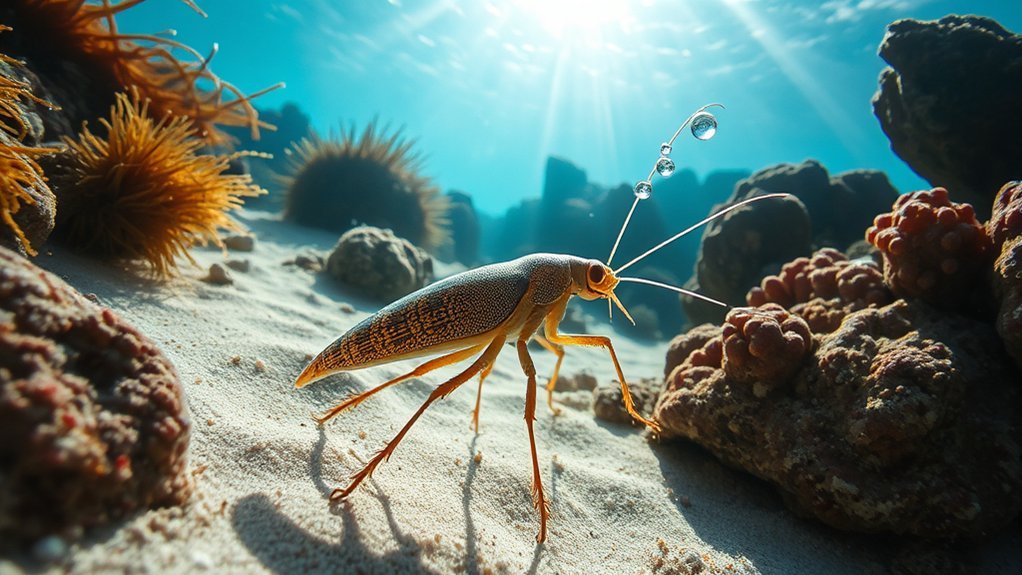
Having established that sea cockroaches are nothing like their house-dwelling namesakes, it’s worth knowing where you’d actually find these creatures. They thrive in coastal zones worldwide, from Ireland and England to Japan, South Africa, and the western Atlantic stretching from New Jersey to Argentina.
Sea cockroaches thrive in coastal zones worldwide, from Ireland and Japan to South Africa and the western Atlantic.
You won’t find them fully submerged. Instead, they occupy that narrow strip between mid-intertidal and supratidal zones, staying close enough to water to keep their gills wet.
Their preferred hangouts include:
- Rocky shorelines — hiding in damp crevices and under rocks during daylight hours
- Human structures — piers, jetties, wharves, marinas, and vessel hulls
- Coastal debris — crawling over washed-up seaweed, algae, and dead fish at night
- Mangroves and woody debris — common in warm-temperate and tropical regions where *Ligia exotica* populations thrive
They’re remarkably adaptable, which explains their near-global coastal distribution. In fact, sea cockroaches have been documented in 53 countries worldwide, spanning both temperate and tropical coastal environments.
How to Identify a Sea Cockroach
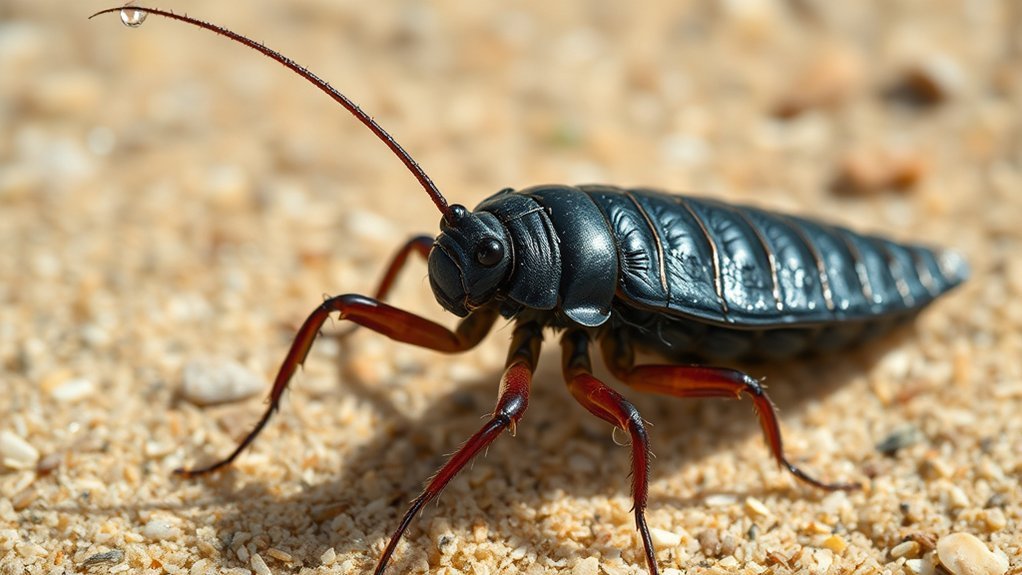
Spotting a sea cockroach is straightforward once you know what to look for. These crustaceans have a hard, gray, segmented body with brown flecks, growing up to 4 cm long. You’ll notice they’re flattened dorsally, unlike the tall, skinny bodies of amphipods.
Look for their two pairs of antennae—one large set often exceeding body length—and fourteen similarly sized jointed legs. Their bulging, unstalked black eyes are immediately striking. At their rear end, you’ll find forked uropods, and their first five abdominal segments carry flat, membranous gills that require moisture to function.
You can distinguish them from house roaches by their longer antennae, crustacean exoskeleton, and lack of wings. They have seven thoracic and six abdominal segments, and you’ll typically spot them actively crawling across rocky coastal surfaces, scavenging for food. Being primarily nocturnal creatures, they are most active during late evening and night, making daytime sightings on rocky shores relatively rare.
What Makes Sea Cockroaches So Hard to Catch?
If you’ve ever tried to grab a sea cockroach, you already know how frustratingly fast these creatures are, using their 14 jointed legs to dart across rocks and piers in sudden, unpredictable bursts. Their flat, segmented bodies let them slip effortlessly into the narrowest rock crevices and beneath pier structures, making physical capture nearly impossible. That combination of speed, low profile, and a habitat full of tight hiding spots gives them a serious natural advantage over anything trying to catch them.
Speed and Agility
Catching a sea cockroach is no easy feat. These creatures move at over 10 body lengths per second, shifting gait patterns depending on speed. At full sprint, synchronized leg phases push them to 8.54 body lengths per second, leaving alternating-phase movement far behind at 2.64.
Here’s what makes them so difficult to catch:
- 14 legs enable rapid movement across rough, uneven surfaces
- Body trunk bending optimizes propulsion during high-speed bursts without adding mass
- Unpredictable turns create erratic escape trajectories, forcing pursuers to constantly adjust
- Real-time sensory feedback lets them navigate obstacles instantly, correcting course mid-run
Their low center of gravity keeps them stable during sharp directional shifts, making every escape attempt a calculated, agile performance you’d struggle to anticipate.
Flat Body Design
Speed and agility aren’t the only reasons sea cockroaches slip through your fingers—their flat body design plays just as big a role. At roughly one inch long with minimal thickness, their segmented gray shell lets them squeeze into spaces you’d never expect. That thin profile makes them harder to see and nearly impossible to grab.
Their flat exoskeleton isn’t just about evasion, though. It supports their body without adding bulk, bearing gills near the posterior that need moisture without requiring full submersion. The shell also carries a bitter taste, giving predators one more reason to let go.
Add in color-shifting chromatophores that match rocky backgrounds, plus the ability to curl into a ball, and you’ve got a creature built to avoid capture at every angle.
Rocky Habitat Advantage
Even if you corner one on a jetty at midday, a sea cockroach vanishes before you can close your hand—not because it’s faster than you, but because it knows the terrain better. Rocky shorelines aren’t obstacles to them—they’re escape routes. Every crevice, stone, and tidal pool is a doorway you can’t follow them through.
Their rocky habitat gives them every edge:
- They cling to wet, uneven surfaces you can’t easily navigate
- They slip into crevices too narrow for predators to enter
- They hide under boulders and at cliff bases, invisible by day
- They use seawalls and rock faces to regulate both temperature and moisture
The terrain doesn’t slow them down. It protects them.
What Do Sea Cockroaches Eat?
Sea cockroaches are opportunistic scavengers that’ll eat just about anything they can find in their rocky, splash-zone habitat. Their primary food source is dead and decaying plant matter, but they’ll also scavenge decaying animals whenever the opportunity arises. You’ll often find them grazing on microalgae and diatoms growing across rocky surfaces, making them efficient cleaners of their environment.
Their feeding behavior is largely nocturnal. During the day, they hide beneath rocks and in damp crevices, then emerge at night to forage. They use their antennas to explore surfaces and locate food, crawling over rocks, piers, and jetties to access detritus above the waterline.
Because they break down rotting organic material, sea cockroaches play a meaningful role in nutrient cycling within their ecosystem. In invasive U.S. habitats, they’ve even become dominant grazers, greatly influencing how organic matter gets processed along coastal structures.
Do Sea Cockroaches Bite or Pose Any Risk to Humans?
If you’ve ever wondered whether sea cockroaches pose a real threat, the answer is yes—they can bite, and it hurts. Their sharp, needle-like mouthparts inject digestive enzymes that cause intense pain, swelling, and tingling, though the venom isn’t typically medically dangerous. You’re most at risk when you accidentally step on one or pick it up, so staying alert in their coastal habitats is your best protection.
Biting Behavior and Risks
When you encounter a sea cockroach along a rocky shoreline or pier, you’ll likely watch it scurry away rather than turn and bite you. These crustaceans rely on flight response over aggression, and they’ve developed a bitter taste as their primary defense mechanism instead of biting.
Here’s what you need to know about sea cockroach risks:
- They don’t bite humans under any documented circumstances
- They carry no pathogens harmful to human health
- They transmit zero diseases through any form of contact
- They pose no threat when you encounter them in coastal environments
Compare this to house cockroaches, which occasionally bite during severe infestations when food runs scarce. Sea cockroaches simply want nothing to do with you.
Human Safety Considerations
Three facts make sea cockroaches completely safe to handle: they don’t bite, they carry no harmful pathogens, and they’ll flee from you before you even get close. Their instinct is to hide, not confront. You won’t find them chasing you or invading your food supply either—they prefer coastal debris and decaying organic matter over anything you’d bring to a beach picnic.
If you encounter one under a rock or near a pier, expect it to sprint away immediately. Its fourteen legs make it surprisingly fast. No documented cases exist of sea cockroaches causing harm through contact or proximity. Birds and fish eat them whole without consequence, which tells you something about their threat level. They’re harmless scavengers, nothing more.
Why Rocky Shore Ecosystems Need Sea Cockroaches
Rocky shore ecosystems depend on sea cockroaches more than most people realize. These small crustaceans perform essential ecological functions that keep coastal habitats balanced and productive.
Here’s what sea cockroaches actually do for rocky shores:
- Decompose organic material — They consume decaying seaweed and plant detritus, accelerating nutrient breakdown and returning essential compounds to coastal ecosystems.
- Control algal overgrowth — Their selective grazing on green and brown algae prevents monoculture dominance, allowing slower-growing organisms to establish and survive.
- Support the food web — Shorebirds, rats, and raccoons all depend on sea cockroach populations as a critical energy source linking algae to vertebrate predators.
- Maintain habitat complexity — Their movement through crevices and rock pools aerates sediments, improves water circulation, and prevents stagnation in confined microhabitats.
Without sea cockroaches, you’d see nutrient buildup, algal overgrowth, reduced biodiversity, and weakened predator populations across rocky shore environments.
Frequently Asked Questions
How Long Do Sea Cockroaches Typically Live in the Wild?
You’ll find that sea cockroaches typically live 1-3 years in the wild, though it’s dependent on climate. In temperate regions, they’ve got an average lifespan of around 2.5 years, while Brazilian populations live 1.1-1.3 years.
Can Sea Cockroaches Survive if Removed From Their Coastal Habitat?
If you remove sea cockroaches from their coastal habitat, they won’t survive long. They’ll quickly die as their gills dry out without moisture, since they can’t function in dry, inland environments away from the sea.
Do Sea Cockroaches Molt, and How Often Does This Occur?
Yes, sea cockroaches do molt! You’ll find they shed their exoskeletons periodically to grow, though they molt less frequently than house roaches, with timing varying based on their age, environment, and species-specific development.
Are Sea Cockroaches Capable of Swimming Underwater for Extended Periods?
Yes, you’d be amazed—sea cockroaches can swim underwater for extended periods. They use their pleopods in a fluttering motion, letting them navigate deep-sea environments effectively while scavenging along the ocean floor.
How Do Sea Cockroaches Reproduce, and How Many Offspring Do They Produce?
You’ll find sea cockroaches reproduce through internal fertilization, with females carrying eggs in brood pouches for about 28 days. They release fully formed juveniles, producing between 33 and 142 offspring per batch, averaging around 80.
Conclusion
Now that you’ve learned about sea cockroaches, you can see they’re fascinating creatures that play an essential role in coastal ecosystems. Despite sharing a name with household pests, they’re not closely related at all. Next time you’re exploring rocky shorelines, keep your eyes open — you might spot one of these incredible crustaceans doing what they do best: keeping the ocean’s cleanup crew running smoothly.
