
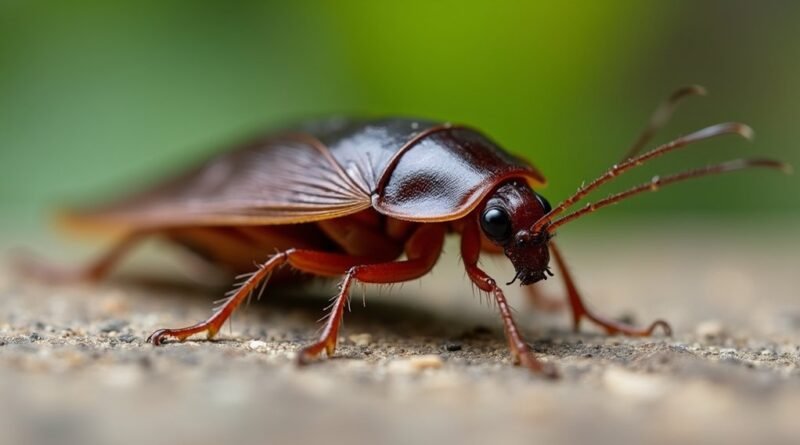
Smoky Brown Cockroach: Identification and Control Guide
The smoky brown cockroach is a glossy, mahogany-colored roach measuring up to 1.5 inches — and it’s one tough pest to control. You’ll find it hiding in gutters, attics, and woodpiles, sneaking indoors through cracks and vents. It carries harmful bacteria, triggers allergies, and reproduces rapidly in warm, humid conditions. Sealing entry points, reducing moisture, and using targeted baits are your best defenses. Keep going, and you’ll find everything you need to tackle this pest for good.
Key Takeaways
- Smoky brown cockroaches measure 1.25–1.5 inches, are glossy dark brown with no markings, and are strong fliers with fully developed wings.
- They hide in gutters, mulch, attics, and crawl spaces, drawn by moisture, decaying matter, and poor home sealing.
- These cockroaches carry Salmonella and E. coli, contaminating surfaces through droppings and triggering allergies via shed skins.
- Females produce 200–440 eggs per lifetime, with development accelerating in warm, humid environments above 70% humidity.
- Control involves sealing cracks, eliminating moisture sources, applying granular outdoor insecticides, and using gel baits near indoor plumbing.
Smoky Brown Cockroach Identification: Size, Color, and Key Features
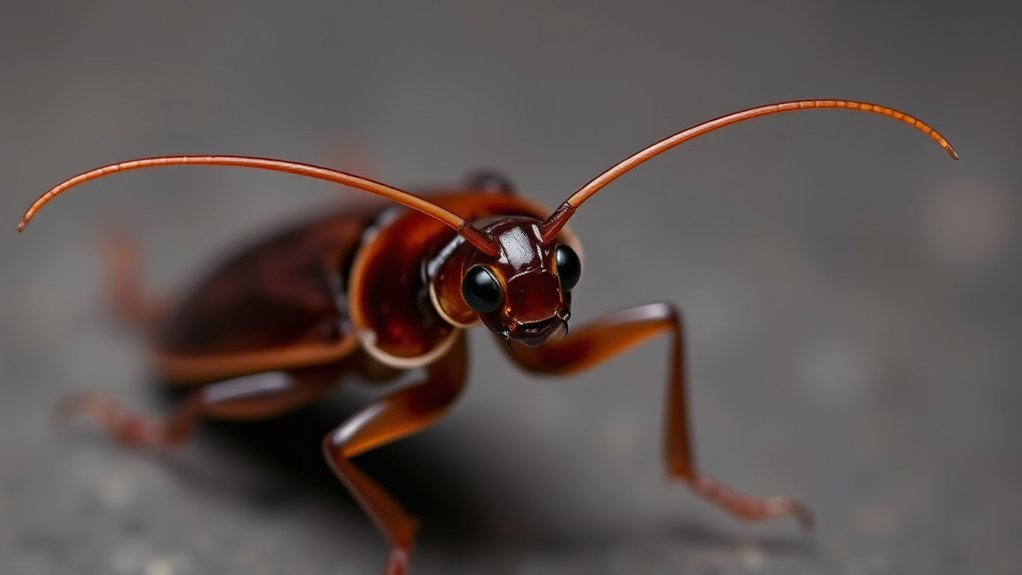
The smoky brown cockroach is one of the larger roach species you’ll encounter, measuring between 1.25 and 1.5 inches long. Adults typically reach 33–38 mm, making them comparable in size to the American cockroach.
You’ll recognize this species immediately by its uniform, glossy dark brown to mahogany coloration. Unlike other cockroaches, it has no stripes, spots, or yellow accents anywhere on its body. Its pronotum is solid dark brown, and its entire surface carries a polished, shiny appearance.
Both males and females have fully developed wings extending past their abdomen, and they’re strong, capable fliers. Their antennae are prominently long, often matching or exceeding body length. Young nymphs look different — they display a white band on their back and lighter-colored antennal tips, but they lose these markings as they mature. In contrast, the Oriental cockroach is noticeably smaller and sports a deep black, matte finish rather than the smoky brown’s characteristic glossy sheen.
Where Smoky Brown Cockroaches Hide Inside and Outside Your Home
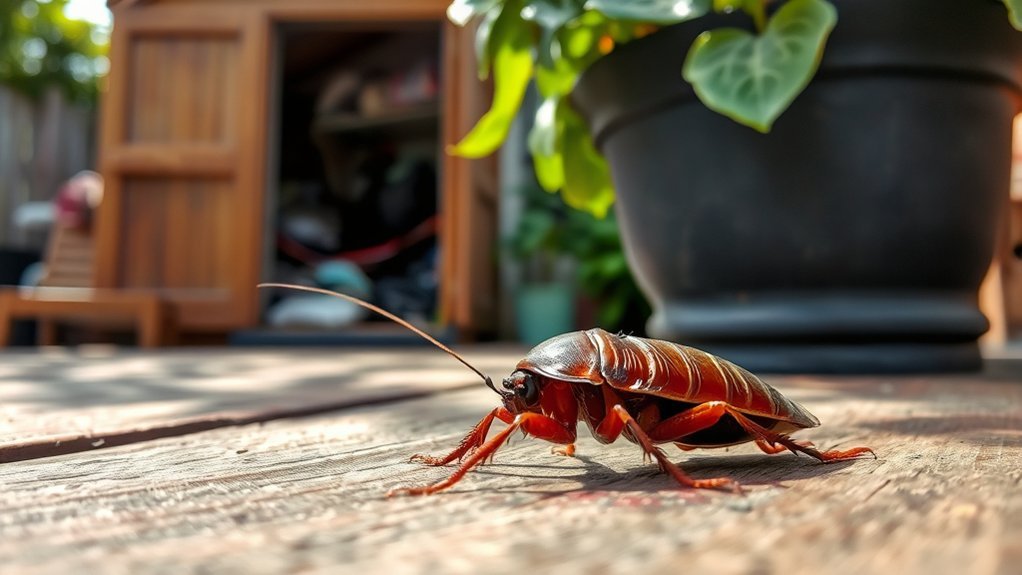
Knowing what a smoky brown cockroach looks like is only half the battle — you also need to know where it’s hiding.
Outside, check your roof line, gutters, and under shingles, where these roaches feed on organic debris. They also hide in mulch beds, leaf litter, tree holes, woodpiles, and palm tree canopies. At night, they fly from trees toward lights, which can draw them closer to your home.
Smoky brown cockroaches hide in gutters, mulch beds, woodpiles, and palm canopies — and fly toward lights at night.
Inside, they enter through roof cracks, vents, and ground-level wall penetrations. You’ll find them in attics, crawl spaces, wall voids, and around pipes, doors, and windows. They gravitate toward moisture, so check near sinks and indoor water sources. Greenhouses and cabinet voids are also common harborage spots.
Because smoky brown cockroaches dehydrate easily, they concentrate wherever moisture exists. Eliminating damp hiding spots — both inside and outside — is essential to controlling their presence around your home. In protected environments, these roaches can survive for 200 to 300 days, making long-term moisture control and exclusion all the more critical.
What Draws Smoky Brown Cockroaches Indoors and Into Your Yard
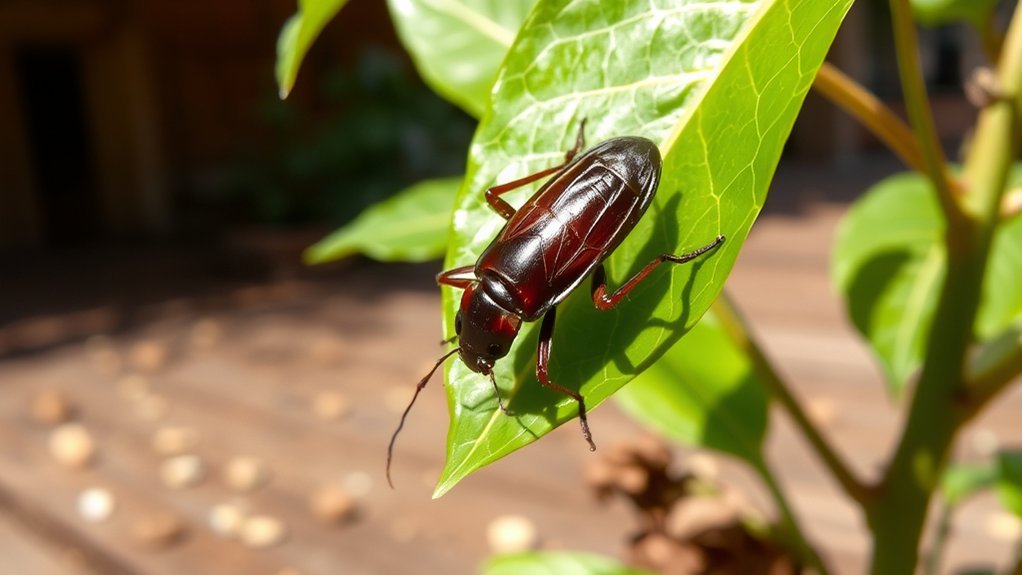
Smoky brown cockroaches don’t wander into your yard or home randomly — specific conditions pull them in. They’re highly prone to dehydration, so moisture attracts them first. Leaky roofs, standing water, clogged drains, and damp mulch beds give them the humidity they need to survive. Fix these conditions, and you remove a primary draw.
Outdoor lighting pulls them in next. They’re nocturnal and fly toward illuminated windows, doors, and gaps, using light as a guide straight into your home.
Food sources keep them close. Decaying plant matter, leaf litter, exposed trash, and pet food left outside give them reasons to stay and breed. Their diet also extends to dead insects and fecal matter, making unsanitary outdoor conditions an additional attractant.
Finally, your yard’s structure matters. Woodpiles, ground covers, block walls, and tree hollows offer the shelter they prefer. Once comfortable outside, they push indoors through attic vents, soffits, plumbing gaps, and poorly sealed doors and windows.
Are Smoky Brown Cockroaches Dangerous to Your Health?
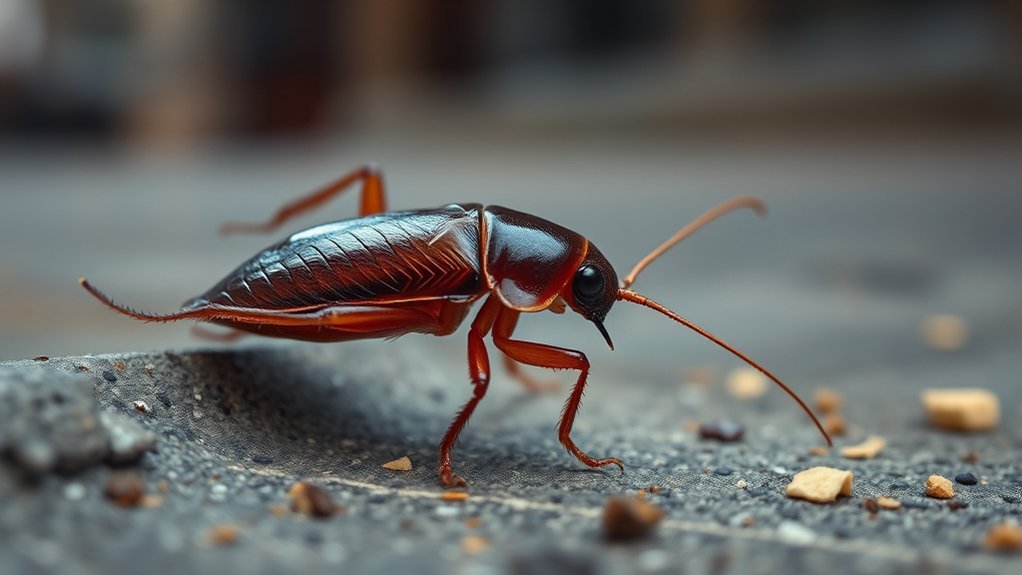
Smoky brown cockroaches aren’t just a nuisance—they’re a genuine health threat to you and your family. They carry bacteria linked to dysentery, cholera, typhoid, and salmonella, contaminating your food, cooking surfaces, and utensils as they scavenge through your home. Their shed skin casts also trigger allergic reactions, causing sneezing, itchy eyes, skin rashes, and respiratory distress in sensitive individuals. Their presence can also exacerbate respiratory conditions like asthma, making them especially dangerous for household members who already struggle with breathing problems.
Bacteria and Contamination Risks
While smoky brown cockroaches are primarily outdoor insects, they carry serious health risks whenever they enter your home. They pick up dangerous bacteria from sewers, fecal matter, and decaying organic material, then transfer those pathogens directly onto your food, utensils, and cooking surfaces.
These cockroaches carry Salmonella, E. coli, Staphylococcus aureus, Helicobacter pylori, and Pseudomonas aeruginosa. They spread bacteria through their droppings, shed body parts, and direct contact with surfaces. Their foregut alone contains nearly 48% Proteobacteria, making them highly efficient bacterial carriers.
Exposure to these pathogens puts you at risk for salmonellosis, food poisoning, gastrointestinal infections, dysentery, and gastroenteritis. They also contaminate considerably more food than they actually consume, creating widespread sanitation problems throughout any home they infest. Their presence has also been linked to triggering allergic reactions and asthma, particularly in children who are more vulnerable to airborne cockroach allergens.
Allergies From Skin Casts
Beyond bacteria, cast skins from molting pose their own health threat. Proteins within shed skins trigger allergic reactions, and since these skins become airborne, they easily contaminate household dust. You’ll find detectable cockroach allergens in 63% of U.S. homes, and even after you’ve eliminated an infestation, cast skins persist for years, continuing to release allergens as they deteriorate.
If you’re sensitive, exposure can cause itchy skin, rashes, sneezing, nasal congestion, watery eyes, and throat irritation. Unlike seasonal allergies, these symptoms don’t let up year-round.
The risks are especially serious for asthmatic children. One in five U.S. children is severely sensitive, and in inner cities, 70-80% of asthmatic children are sensitized to cockroach allergens, leading to increased emergency room visits and hospitalizations.
How Fast Do Smoky Brown Cockroaches Reproduce?
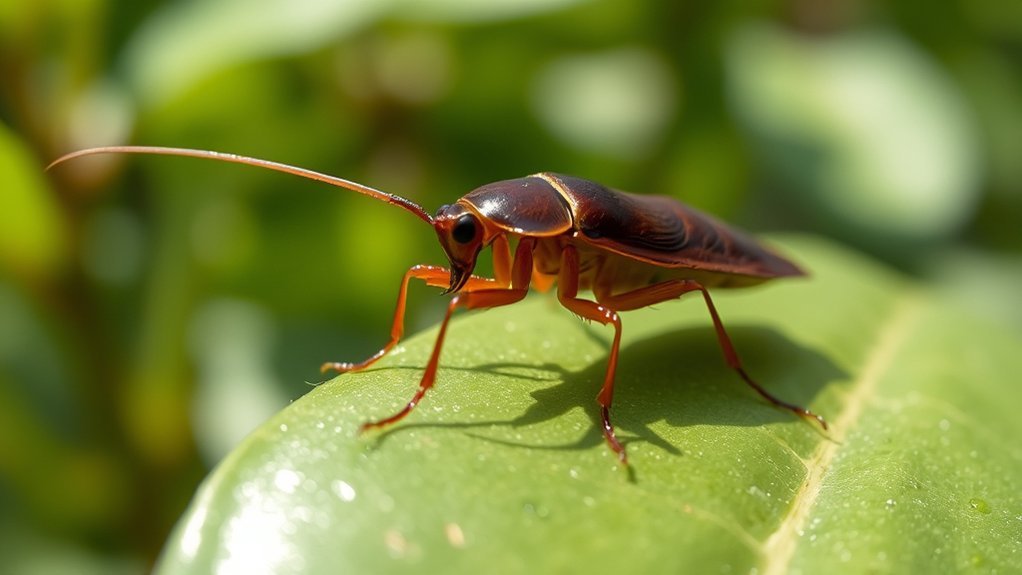
Smoky brown cockroaches reproduce quickly, with each female producing up to 17 egg capsules over her lifetime, each holding up to 26 eggs. You’ll find that humidity and warmth accelerate their development considerably, compressing what could be a two-year lifecycle into just a few months. This rapid reproduction means a small infestation can explode into a large population before you even notice the problem.
Egg Capsule Production Rate
Each female smoky brown cockroach produces 10–17 egg capsules, called oothecae, over her lifetime, with each one holding around 20–26 eggs. That adds up to roughly 200–440 eggs per female, giving infestations the numbers they need to grow quickly.
You’ll typically find these dark, black capsules measuring about 3/8 to 1/2 inch long, deposited in moist, protected locations like tree holes or sheltered outdoor spaces. Production peaks during summer and fall, aligning with adult activity and mating seasons.
Once deposited, the capsules incubate under environmental conditions that influence hatching speed. Nymphs that emerge can take one to two years to reach adulthood, meaning a single female’s reproductive output can sustain a growing population for an extended period.
Humidity Speeds Reproduction
While egg capsule production sets the foundation for population growth, how fast those eggs develop into adults depends heavily on environmental conditions — humidity chief among them. When humidity exceeds 70%, you’re dealing with near-perfect breeding conditions. Smoky brown cockroaches lose moisture through their cuticle every 2-3 days, so humid environments aren’t just comfortable — they’re essential for survival and reproduction.
In warm, humid spaces like attics, the entire life cycle accelerates dramatically. Nymphs reach maturity in as little as 9-10 months post-hatching, while cooler, drier conditions can stretch development across several years. Keep in mind that egg production also stops below 15°C (59°F), meaning temperature and humidity work together. Controlling both factors is your most effective strategy for disrupting their reproductive cycle.
Rapid Population Growth
Few insects match the reproductive efficiency of the smoky brown cockroach. A single female produces an average of 17 oothecae throughout her lifetime, each containing roughly 26 eggs. Once deposited, those eggs incubate for approximately 45–50 days before hatching, yielding around 20 nymphs per ootheca.
You’re looking at potentially hundreds of offspring from just one female. Those nymphs don’t reach adulthood quickly—development takes roughly 320 days—but once they mature, adults can survive 6 to 12 months, giving them ample time to reproduce.
Females actively call mates using pheromones, and when no males are present, they’ll reproduce through parthenogenesis. This combination of high egg output, continuous mating behavior, and flexible reproduction makes population control genuinely challenging once an infestation establishes itself.
How to Get Rid of Smoky Brown Cockroaches
Getting rid of smoky brown cockroaches requires a multi-pronged approach that targets them both indoors and outdoors. Start by eliminating harborage and food sources—discard old boxes, use tight-fitting trash lids, fix leaky drains, and pick up pet food after feeding.
Seal your home’s exterior by caulking cracks around doors, windows, pipes, and baseboards. Install mesh screens over vents and floor drains, ensuring all doors and windows fit securely.
Outdoors, apply Bifen LP Granules or Ficam Insect Bait in mulched areas and around woodpiles. Spray a 3-6 foot band around your home’s base, targeting doors, windows, and vents.
Inside, place gel baits like Apex in pea-sized drops near plumbing and crevices. Spray baseboards near entry points and treat attics, crawl spaces, and basements with Ficam granular insecticide for long-lasting residual control.
Frequently Asked Questions
How Long Does a Smoky Brown Cockroach Typically Live?
You’re looking at a smoky brown cockroach that’ll typically live around a year, though it can reach up to two years in ideal warm, humid conditions. Adults average roughly 215-218 days of adult lifespan.
Can Smoky Brown Cockroaches Survive Cold Winter Temperatures Outdoors?
No, smoky brown cockroaches can’t survive cold winter temperatures outdoors. They’ll seek shelter indoors as temperatures drop, moving through gaps and vents into your home’s heated spaces like attics and crawl spaces to stay warm.
Are Smoky Brown Cockroaches More Common in Certain Regions or Climates?
Yes, you’ll find smoky brown cockroaches most commonly in the southeastern U.S., especially Florida, Texas, Louisiana, and Mississippi. They thrive in warm, humid climates and struggle in dry or cold regions.
Do Smoky Brown Cockroaches Make Any Sounds or Noises?
You won’t hear smoky brown cockroaches making intentional sounds. They’re classified as silent pests, communicating mainly through pheromones. Large infestations may produce faint wing fluttering, but they don’t vocalize like Madagascar hissing cockroaches do.
Can Smoky Brown Cockroaches Bite Humans While They Sleep?
Yes, smoky brown cockroaches can bite you while you sleep. They’ll crawl over your exposed skin at night, targeting your face, hands, and mouth, attracted by sweat, saliva, or food residues on your skin.
Conclusion
Smoky brown cockroaches aren’t just a nuisance—they’re a genuine health risk you can’t afford to ignore. Now that you know how to identify them, where they hide, and what attracts them, you’re better equipped to take action. Whether you’re sealing entry points, eliminating moisture, or using targeted treatments, staying proactive is your best defense. Don’t wait until an infestation grows out of control—start protecting your home today.
