
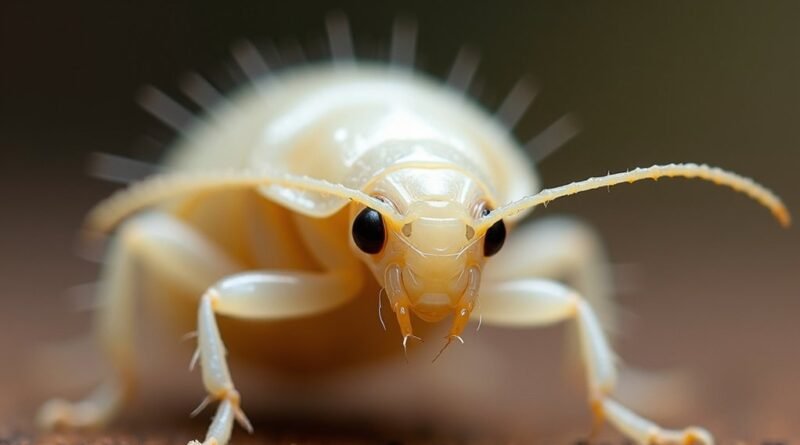
Albino Cockroach: Why Cockroaches Turn White After Molting
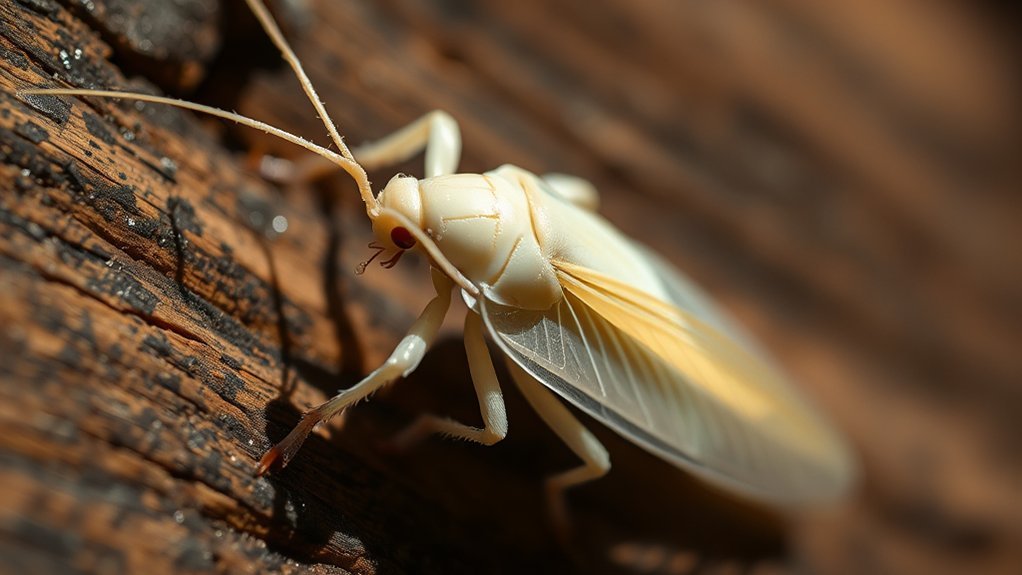
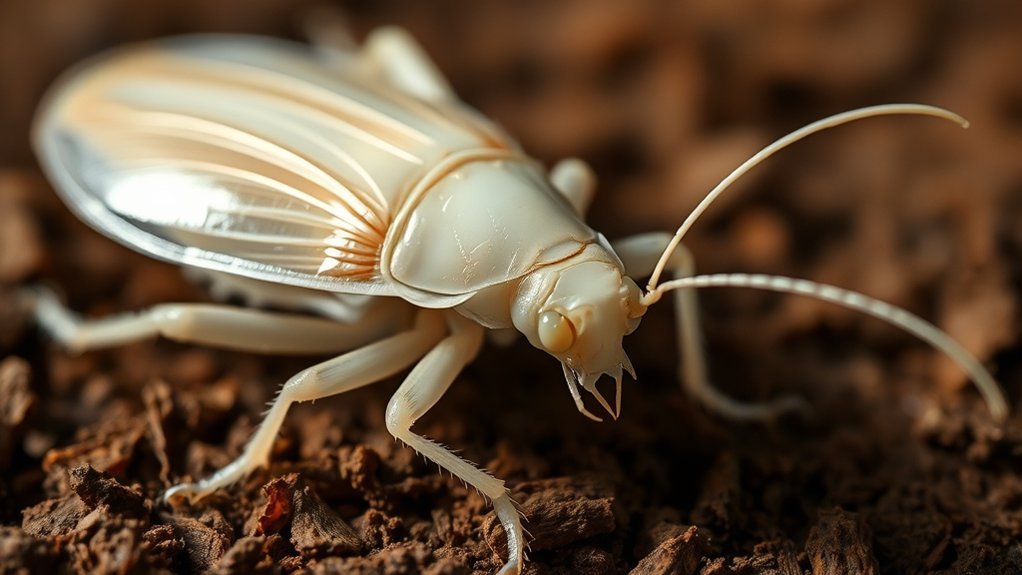
You’ve probably spotted a ghostly white cockroach and assumed it was some rare albino specimen — but true albino cockroaches don’t exist. What you’re seeing is a freshly molted nymph in its “teneral” state. When cockroaches shed their exoskeleton to grow, the new shell underneath starts out soft and completely unpigmented. Within hours, it hardens and darkens back to normal. There’s much more to this fascinating process than you’d expect.
Key Takeaways
- “Albino” cockroaches are not true albinos but newly molted nymphs in a temporary “teneral” state with unpigmented, soft exoskeletons.
- Cockroaches shed their exoskeleton to grow, revealing a pale, soft cuticle underneath that temporarily appears white.
- Hormonal signals trigger molting, with ecdysone initiating the process and juvenile hormone determining the type of molt.
- After molting, chemical reactions gradually restore dark pigmentation while sclerotization hardens the new exoskeleton within hours.
- Nymphs undergo 5 to 13 molts in their lifetime, with each white phase lasting varying durations depending on species.
There Is No Such Thing as an Albino Cockroach
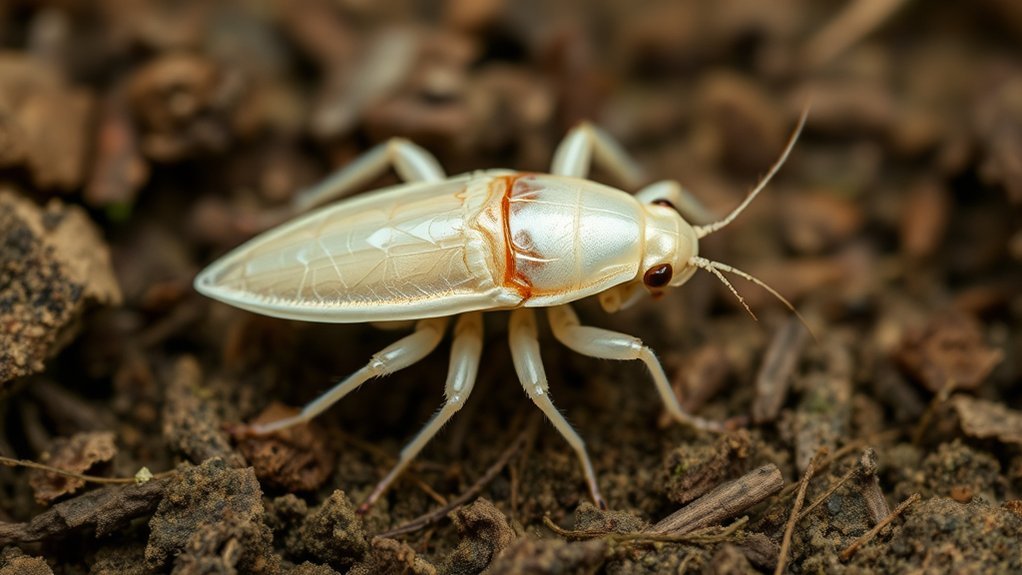
If you’ve ever spotted a ghostly white cockroach skittering across your floor, you weren’t looking at an albino—you were watching a newly molted nymph. True albinism requires a complete absence of melanin, a genetic condition with zero documented cases in cockroaches. No mutation produces permanently white adult roaches, and pest literature confirms no albino strains exist among common species like German or Oriental cockroaches.
What you’re actually seeing is a developmental process, not a genetic anomaly. When a nymph sheds its exoskeleton, its new cuticle emerges soft and unpigmented. Within 12–14 hours, a chemical reaction restores its species-typical color. The white phase is temporary and entirely normal.
The myth persists because pale roaches look strikingly different from their brown or black counterparts. Pest control experts consistently identify these sightings as misidentification of the molting process—nothing more. Cockroach nymphs are completely wingless, distinguishing them further from the adult roaches that eventually develop wings after completing their molting stages.
Why Cockroaches Turn White After Molting
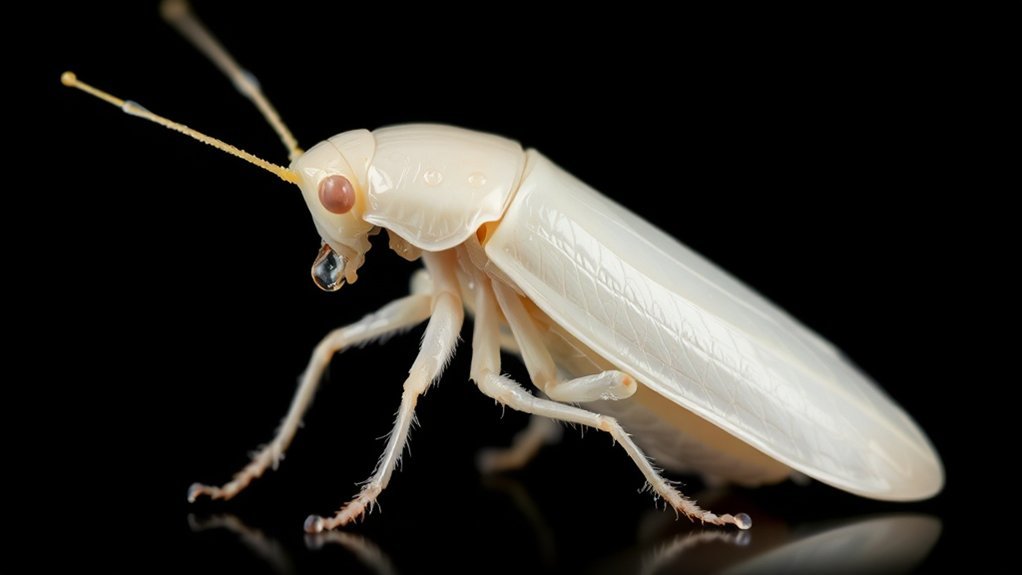
When a cockroach sheds its exoskeleton, the new shell emerges colorless and soft—completely lacking the pigmentation that gives adult roaches their familiar brown or black color.
This white phase isn’t a genetic mutation or a separate species. It’s a temporary biological process driven by specific chemical changes. Here’s what’s actually happening:
- The roach sheds its old exoskeleton, exposing a fresh, soft shell underneath.
- The new shell is slightly larger, accommodating the roach’s growth.
- Chemical reactions involving tyrosine begin producing darker pigments.
- The shell gradually hardens and darkens over several hours, restoring normal coloration.
You’re fundamentally seeing the roach at its most vulnerable. During this phase, it hides to avoid predators and stays near warm, protected areas. Once hardening completes, even the soft appendages firm up, and the roach returns to its typical appearance entirely. Depending on the species, a cockroach will go through this molting process 5 to 13 times over the course of its lifetime.
What Actually Happens When a Cockroach Molts
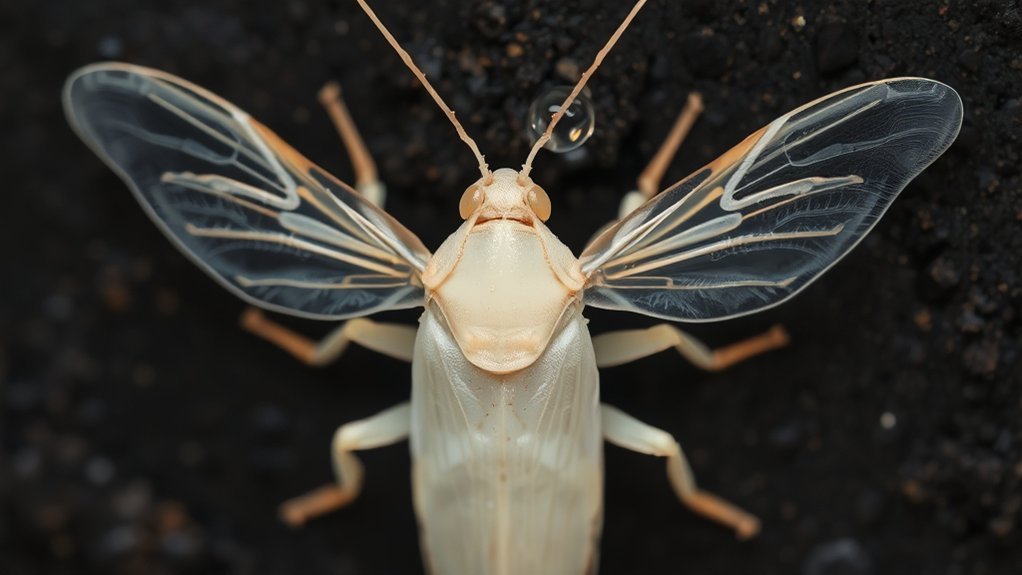
When a cockroach molts, it sheds its rigid old exoskeleton to allow its body to grow, then expands and hardens a new cuticle in its place. You’ll notice the cockroach briefly enters a “teneral” state, where its fresh skin appears soft and white before darkening within a few hours. If the old shell doesn’t fully shed, you may need to remove it manually, since a hardening new exoskeleton can trap the cockroach before it fully escapes. Depending on the species, this molting occurs 6 to 14 times throughout a cockroach’s life.
The Molting Process Explained
Molting begins when hormonal signals inside a cockroach’s body trigger a cascade of internal changes. Ecdysone initiates the process, while juvenile hormone determines whether the molt produces another nymph or a fully developed adult. Before shedding occurs, internal tissues expand beneath the existing exoskeleton, preparing the cockroach structurally. Here’s the sequence you’ll see unfold:
- A new, larger exoskeleton forms beneath the old one
- The cockroach splits and sheds its old shell
- The shed skin retains legs, antennae, and body segments intact
- The fresh exoskeleton emerges soft, pale, and vulnerable
That white appearance you’re noticing isn’t albinism — it’s simply an unhardened exoskeleton. Temperature, food availability, and species determine how quickly hardening completes and how often this cycle repeats. Cockroach nymphs go through 6 to 8 molts before reaching adulthood, leaving behind translucent brown exoskeletons each time.
Post-Molt Body Changes
The moment a cockroach sheds its old exoskeleton, its body enters a teneral state — soft, pale, and temporarily defenseless. You’re looking at a creature whose new cuticle hasn’t yet hardened, leaving it white or translucent due to a complete absence of pigmentation.
Sclerotization begins almost immediately, with full hardening taking anywhere from 1 to 24 hours depending on the species. During this window, the soft cuticle allows the body to expand slightly before rigidity sets in.
Pigmentation follows sclerotization, meaning the cockroach darkens progressively over the next several days. You’ll also notice that its sensory structures regenerate without their original coloration. Wing pads emerge, body size increases slightly, and respiratory efficiency improves as the expanded exoskeleton finalizes its structure. Adequate water intake is essential during this process, as hydrostatic pressure helps the cockroach expand its new cuticle to its full size before hardening occurs.
How Long Before a White Cockroach Returns to Normal Color?
How long a white cockroach stays pale depends mostly on its size and species. Smaller nymphs recover faster, while larger adults need more time for their shells to harden and darken fully.
Here’s a quick breakdown by species and life stage:
- German cockroach nymphs – White phase lasts 10–15 minutes before color returns.
- German cockroach adults – Full darkening takes several hours after molting.
- American cockroach adults – Pale phase lasts roughly 3–4 hours post-molt.
- Dubia roaches – Return to normal coloration within a few hours.
During this window, the roach’s exoskeleton shifts from soft and translucent to firm and dark as tyrosine compounds trigger pigment-forming chemical reactions. You’ll rarely see this process because roaches instinctively hide while vulnerable. If you spot a white roach in the open, insecticide pressure or overcrowding likely forced it into view.
Which Cockroach Species Can Turn White?
Now that you know how long the white phase lasts, you’re probably wondering which species actually go through it. The answer is straightforward: every common indoor cockroach species turns white during molting.
German cockroaches, the most frequent household invaders, go through 5-6 molts and turn white each time. Their colonies consist of roughly 80% nymphs, meaning white roaches appear regularly. Brown-banded cockroaches seek heated areas specifically during molting due to their increased vulnerability while shedding. American cockroaches complete multiple molts before reaching adulthood, displaying the same temporary whitening phase each time. Oriental cockroaches undergo an identical pale or translucent appearance during exoskeleton shedding, with their shell darkening within hours.
The pattern is consistent across all four species. Molting is a biological necessity, not a species-specific quirk. If you’re spotting white cockroaches in your home, any of these four species could be responsible.
How Many Times Will a Cockroach Turn White Before It’s Fully Grown?
Surprisingly, cockroaches don’t just turn white once — they repeat the process multiple times before reaching adulthood. The exact number depends on the species you’re dealing with:
- German cockroaches turn white 6-7 times, completing development within 100 days.
- American cockroaches go through 10-13 molts over 6-12 months, with each white phase lasting 3-4 hours.
- Oriental cockroaches molt several times across 200-600 days before maturing.
- General indoor species molt anywhere from 5-13 times, with some reaching up to 14 total molts.
Each time a cockroach molts, it enters that vulnerable white phase before its new exoskeleton hardens. Smaller nymphs stay white for just 10-15 minutes, while larger species remain soft for hours. The final molt is the most significant — it’s when the adult emerges with fully developed wings.
The Real Dangers Cockroaches Face Right After Molting
When a cockroach sheds its exoskeleton, it’s completely defenseless against predators drawn to its exposed, soft body. You’ll notice it can barely move during this teneral state, making escape nearly impossible if a threat approaches. This limited mobility and lack of protective hardening leaves the freshly molted roach vulnerable to attack for several hours.
Predation Risks Post-Molt
The moment a cockroach completes its molt, it enters one of the most dangerous windows of its life. Its soft, white exoskeleton makes it defenseless against threats that wouldn’t normally succeed. Here’s what’s closing in:
- Cannibalistic colony mates target soft-bodied individuals immediately, regardless of food availability.
- Natural predators — scorpions, mantids, spiders, and reduviids — exploit the teneral state before hardening occurs.
- High-density colonies increase encounter rates between newly molted roaches and aggressive individuals.
- Inadequate hiding spots force molting roaches into exposed locations, amplifying predation risk.
Larger species like Madagascar hissing cockroaches face extended vulnerability because their hardening period takes longer. You can’t eliminate these risks entirely, but managing colony density and providing sufficient shelter greatly improves survival odds.
Limited Mobility Dangers
Predation isn’t the only threat closing in on a freshly molted cockroach — its body is also failing it from the inside out. When a roach sheds its exoskeleton, its muscles must reattach to the new cuticle, stripping away its locomotor capability temporarily. Nerve function isn’t fully restored either, leaving the roach slow, uncoordinated, and struggling to maintain a normal gait or stance.
You’ll notice the teneral roach can barely climb, making escape nearly impossible when danger approaches. This limited mobility compounds every other vulnerability it faces — a soft body it can’t protect, a colony it can’t flee, and an environment it can’t navigate safely. Without full movement restored, survival depends entirely on favorable conditions surrounding it.
Does a White Cockroach Mean You Have an Infestation?
Spotting a white cockroach in your home is a strong indicator that you’re dealing with an active infestation. A single sighting signals a larger colony nearby, since cockroaches only molt in protected hiding spots. Here’s what that white roach is telling you:
- Active breeding — A thriving colony consists of 80% nymphs constantly molting, meaning reproduction is well underway.
- Established colony — The molting phase confirms cockroaches have settled and created a breeding environment.
- Overcrowding risk — Daytime sightings suggest the population has grown too large for hiding spots to contain.
- Hidden population — German roaches breed fastest indoors, making white-phase sightings especially common in kitchens and bathrooms.
Beyond the white roach itself, watch for pepper-like droppings, dark-brown egg capsules, shed exoskeletons, and musty odors. Don’t wait — seal cracks immediately and use baits to target the growing population.
Frequently Asked Questions
Can White Cockroaches Reproduce During Their Soft Post-Molt Phase?
No, white cockroaches can’t reproduce during their soft post-molt phase. They’re focused on hiding until their exoskeleton hardens. You won’t see mating activity, as molting’s limited to nymphs before they reach reproductive maturity.
Do Cockroaches Feel Pain While Molting Their Exoskeleton?
You can’t say cockroaches feel pain during molting. They detect noxious stimuli through nociceptors, but their responses are physiological reactions, not emotional pain experiences. Their nervous systems process sensations without the emotional component that defines true pain.
What Temperature Conditions Affect How Quickly Cockroaches Molt?
Warmer temperatures speed up your cockroaches’ molting cycle, while cooler temps slow it down. You’ll see Dubia roaches thrive at 80-90°F, completing instars faster, whereas temperatures dropping to 70°F noticeably reduce their molting productivity.
Can Cockroaches Survive if Interrupted Mid-Molt by a Predator?
If a predator interrupts a cockroach mid-molt, it’s unlikely to survive. You’d see high molting mortality already reaching 50%, so an attack during this vulnerable, defenseless stage makes survival odds extremely low.
Do Male and Female Cockroaches Molt at Different Rates?
You’ll find that male and female cockroaches don’t molt at noticeably different rates. Environmental factors like temperature and diet influence molting speed more than sex does, with only Dubia roaches showing minimal maturation differences between sexes.
Conclusion
So now you know the truth about “albino” cockroaches—they’re not a separate species, they’re just molting. When you spot a white cockroach, it’s simply vulnerable and temporarily soft-shelled. Don’t let the unusual color fool you into thinking it’s harmless, though. A white cockroach means your home has conditions where roaches are thriving and reproducing. If you’re seeing them, you’ve likely got an infestation that needs immediate attention.
