
Cockroach Lifespan: How Long Different Species Live
Cockroach lifespans vary widely depending on the species you’re dealing with. German cockroaches live just 3–6 months, while American cockroaches can survive up to 400 days. Oriental cockroaches last anywhere from 34 to 180 days, and Madagascar hissing cockroaches can reach a remarkable 5 years. Temperature, humidity, and food access all play a role in how long they survive. Keep going to find out exactly what you’re up against with each species.
Key Takeaways
- German cockroaches live 100–200 days, while American cockroaches can survive up to 400 days under favorable conditions.
- Oriental cockroaches survive 34–180 days, with females living up to 26 weeks in moist environments.
- The Madagascar Hissing Cockroach has one of the longest lifespans, reaching up to 5 years.
- Brown-Banded cockroaches average 206 days, potentially extending to 315 days in cooler conditions.
- The Giant Cave Roach lives up to 20 months, while Tiger hissers can survive 2–3 years as adults.
How Long Does a Cockroach Actually Live?
Cockroaches typically live around one year as adults, though that number shifts considerably depending on the species and their environment. Common household species survive anywhere from 6 to 15 months under ideal conditions, while some species can push that ceiling toward a decade.
You’re looking at a full lifecycle that includes egg, nymph, and adult stages, each adding weeks or months to the total timeline. The adult stage is when reproduction kicks in, but it doesn’t mark the beginning of the journey. Nymph molts precede full maturity, and depending on the species, that process alone can take several months.
Conditions matter just as much as species. Temperature, food availability, and shelter all influence how long a cockroach actually survives. So while “about one year” serves as a reasonable baseline, the real answer depends heavily on which species you’re dealing with and the environment it’s living in. Cockroach eggs are protected inside resilient egg cases called oothecae, which help offspring survive long enough to hatch and begin adding to the population.
What Temperature and Humidity Do to Cockroach Lifespan
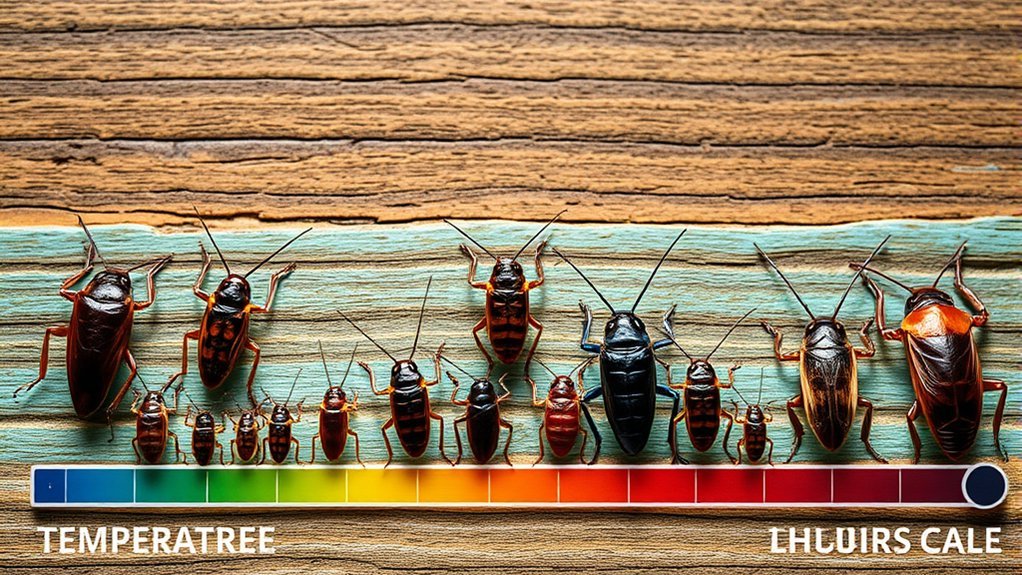
When temperatures climb between 77–91°F, cockroaches develop faster, shortening the time from egg to adult to as little as 50 days. You’ll also find that humidity above 70% keeps them alive longer by preventing the moisture loss that kills them within a week. Together, warm temperatures and high humidity create the conditions that push cockroach lifespans and reproduction rates to their peak. The American Cockroach, for example, can live up to two years when these optimal environmental conditions are consistently maintained.
Temperature Affects Cockroach Development
Temperature plays a decisive role in cockroach development, directly influencing how fast they breed, how long they live, and where they choose to settle. When temperatures fall outside their preferred range, cockroaches either slow down or die off entirely.
Here’s what temperature does to their development cycle:
- At 25°C, German cockroaches complete a full generation in just 100 days, while cooler conditions push that beyond 200 days.
- Below 15°C, reproduction slows dramatically, and nymphs take far longer reaching adulthood.
- Below 7°C, German cockroaches die within 10 hours.
If you’re dealing with an infestation, understand that stable indoor warmth accelerates their breeding cycles. Disrupting that temperature comfort zone directly weakens their ability to establish and grow populations in your home. Cockroaches also require relative humidity above 70% to truly thrive, meaning moisture control is just as critical as temperature management when limiting their ability to survive indoors.
Humidity Influences Survival Rates
Humidity shapes cockroach survival just as powerfully as temperature does. When humidity exceeds 50%, you’re creating ideal conditions for cockroaches to thrive, reproduce, and extend their lifespans. These insects need moisture to survive and can die within a week without water access.
Different species respond to moisture in distinct ways. Oriental cockroaches seek dark, damp environments and survive 34 to 180 days there. American cockroaches live up to a year where moisture is adequate. German cockroaches gravitate toward drains and basements for their water sources.
You can use this vulnerability against them. Fix plumbing leaks, control indoor humidity, and eliminate standing water. Removing moisture disrupts cockroach survival conditions, reduces reproductive success, and directly shrinks their populations in your home. High humidity levels also accelerate cockroach growth and development, making moisture control one of the most effective prevention strategies available.
Ideal Conditions Extend Lifespan
Moisture isn’t the only factor working against you—temperature plays an equally decisive role in how long cockroaches live and how quickly they multiply. German cockroaches thrive between 25–30°C (77–86°F), completing entire generations in roughly 100 days. Your climate-controlled home fundamentally hands them a perfect breeding environment.
Here’s what ideal conditions actually mean for cockroach development:
- Lifespan extends beyond 200 days when temperatures stay consistently warm.
- Egg-to-adult development completes in just 70–100 days at 25–30°C.
- Breeding cycles shorten dramatically, with oothecal incubation taking only 20–30 days.
Below 15°C, reproduction slows considerably. Above 49°C, they die within minutes. Unfortunately, your indoor heating keeps temperatures squarely within their preferred survival range year-round. Heat treatments using sustained temperatures of 115–120°F are often used by pest control professionals because heat penetrates cracks and crevices where roaches hide, eliminating both adults and eggs more efficiently than cold treatments.
Which Cockroach Species Lives the Longest?
When it comes to cockroach lifespans, the Giant Cave Roach (*Blaberus giganteus*) takes the crown, living up to 20 months under ideal conditions. This South American species thrives in dark, humid caves, feeding on decaying plant material, fruits, and carrion. Its flattened body helps it evade predators by hiding in rock cracks, contributing to its survival advantage.
Following closely, tiger hissers live 2-3 years as adults, making them strong competitors for longevity. The Death’s Head Cockroach (*Blaberus craniifer*) reaches up to 1 year, while domino roaches and question mark cockroaches each survive around 6 months.
You’ll notice that species adapted to stable, resource-rich environments tend to outlive those in more variable habitats. Larger body size also correlates with longer lifespans, as seen with *Blaberus giganteus*. Understanding these differences helps you appreciate how habitat and biology directly shape cockroach longevity.
American Cockroach Lifespan: Over a Year for the Most Common Invader
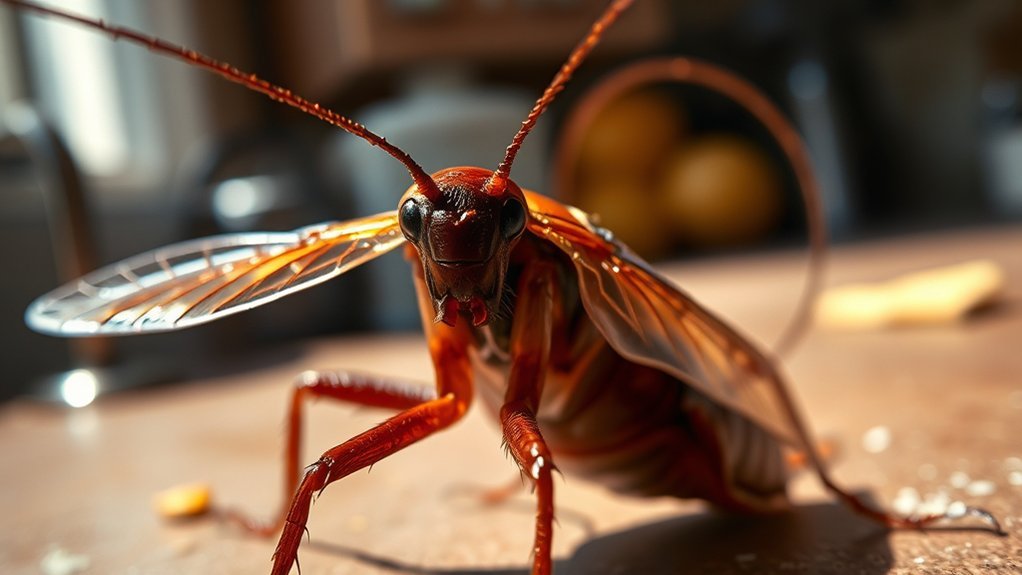
The American cockroach outlasts every other common pest species, surviving up to a year as an adult—and potentially 400 days beyond that under favorable conditions. Compare that to German cockroaches (3–6 months) or Oriental cockroaches (34–180 days), and you’ll understand why American cockroach infestations are so persistent.
American cockroaches can survive up to 400 days under favorable conditions—far outlasting German and Oriental cockroaches combined.
Before reaching adulthood, it completes a lengthy developmental journey:
- 600 days average to develop from egg to mature adult
- 10 to 14 molts during the nymphal stage before final metamorphosis
- 24–35°C (75–95°F) is the ideal temperature range that accelerates development
Once mature, a female produces up to 150 offspring during her lifetime, generating one ootheca roughly every 9–10 days. Warm, humid environments amplify everything—faster development, higher reproduction rates, and longer survival.
If you’re seeing American cockroaches, you’re dealing with a species biologically built for long-term establishment.
How Long German Cockroaches Live: and Why It Doesn’t Matter
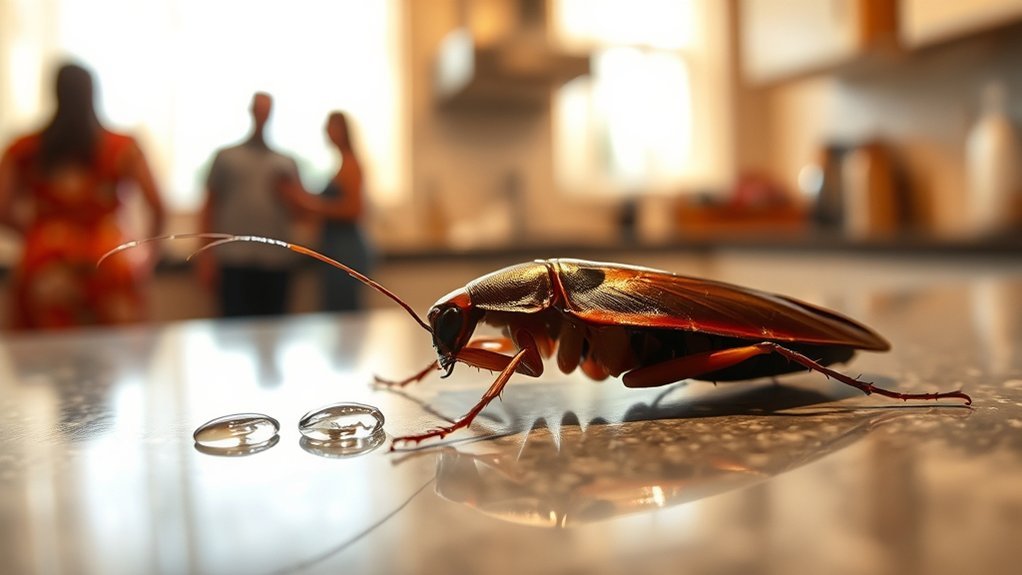
German cockroaches don’t live long—adults survive roughly 100 to 200 days—but that shorter lifespan is precisely what makes them so dangerous. A female reaches reproductive maturity just four to six days after becoming an adult, then produces seven or eight egg cases, each containing 35 to 50 eggs. That adds up to roughly 350 offspring per female.
What you’re really facing isn’t a single cockroach’s lifespan—it’s a compounding population. A lone female can spawn tens of thousands of descendants within a year. Development from egg to adult takes as little as 54 days under warm conditions, and German cockroaches thrive between 25 and 30°C. At any given moment, 75% of an infestation consists of nymphs, meaning the population you see is always smaller than the one developing behind your walls.
Their short lives don’t limit them. They weaponize them.
Oriental Cockroach Lifespan: The Dark, Damp Dweller
If you’ve got a damp basement or crawl space, you’ve likely given the oriental cockroach its ideal home. Adults live anywhere from 34 to 180 days, with females surviving up to 26 weeks in consistently moist conditions. These roaches thrive in sewers, under debris, and near decaying organic matter, and they’ll die within two weeks if you cut off their water supply.
Oriental Cockroach Lifespan Basics
Oriental cockroaches are built for the shadows, thriving in the cold, damp spaces most pests avoid. Understanding their lifespan helps you gauge how serious an infestation can get.
Here’s what defines their basic life cycle:
- Adults live 34–180 days, with females surviving 5–26 weeks while producing roughly 200 offspring.
- Nymphs take 54–542 days to mature, depending on temperature — cooler conditions slow everything down considerably.
- Each female produces 8–16 oothecae, each containing 16–18 eggs that hatch within 42–81 days.
Without water, they’ll die within two weeks. With it, they survive up to a month without food. Damp environments extend their adult survival, which is why you’ll often find them in basements and drains.
Preferred Habitat and Survival
Knowing how long oriental cockroaches live only tells part of the story — where they live determines how quickly an infestation takes hold. They thrive in dark, damp spaces like basements, drains, sewers, and crawl spaces, favoring temperatures between 68–84°F.
| Location | Why They’re Attracted | Risk Level |
|---|---|---|
| Basements & drains | Dark, cool, moist | High |
| Sewers & pipes | Organic waste, moisture | High |
| Under porches & debris | Sheltered, damp | Moderate |
Without water, they die within two weeks, but they’ll survive a month without food if moisture is available. They move slowly and stay near ground level, scavenging decaying matter, garbage, and rotting food — making unsanitary, humid environments their ideal breeding ground.
Brown-Banded Cockroach Lifespan in Warm vs. Cool Environments
Temperature plays a decisive role in how long brown-banded cockroaches live, with warm environments accelerating development and cool ones dragging it out. At 80–85°F, they move through every stage faster, while cooler spaces slow their metabolism and extend each phase considerably.
Warm environments speed up every life stage of brown-banded cockroaches, while cooler conditions slow their development considerably.
Here’s what temperature directly affects:
- Egg incubation — Hatching takes 37–103 days, with warmer conditions pushing it toward the shorter end
- Nymph development — Ranges from 90 to 276 days depending on temperature stability and food availability
- Total lifespan — Averages around 206 days but stretches up to 315 days under cool, resource-limited conditions
If you’re dealing with an infestation, understanding these timelines helps you act strategically. Warm indoor spaces like upper cabinets and appliance motors give them ideal breeding conditions. Reducing heat and eliminating food sources disrupts their development cycle and limits population growth effectively.
Madagascar Hissing Cockroach: Why This Species Lives 5 Years
Among cockroach species, the Madagascar hissing cockroach stands out for its remarkably long lifespan of up to 5 years — a stark contrast to the months-long lives of most household species. Native to Madagascar’s tropical rainforests, this wingless insect thrives in warm, humid conditions, inhabiting rotting logs and forest floor litter.
You’ll find several factors behind its exceptional longevity. After hatching, nymphs take 6 to 12 months to reach adulthood through six molts, and once mature, they survive an additional 2 to 3 years. In captivity, proper care consistently supports the full 5-year maximum.
One surprising contributor to their long life is mites. These tiny organisms clean pathogenic mold from the cockroach’s body, directly increasing life expectancy. Additionally, their semi-social nature means they thrive in groups, reducing stress. Combined with their hardy biology — capable of surviving freezing temperatures and high radiation — these cockroaches are genuinely built to last.
Does a Cockroach’s Lifespan Make It Harder to Kill?
A cockroach’s lifespan doesn’t just determine how long it lives — it directly shapes how difficult it becomes to eliminate. The longer a cockroach survives, the more reproductive cycles it completes, and the harder your elimination efforts become.
A cockroach’s lifespan doesn’t just determine how long it lives — it determines how hard it is to eliminate.
Here’s why lifespan creates serious control challenges:
- Rapid population growth — A single German cockroach produces over 300 eggs annually, meaning delayed treatment allows multiple generations to establish before you act.
- Environmental mastery — Extended survival gives cockroaches time to map reliable food sources, hiding spots, and travel routes throughout your home.
- Starvation resistance — Cockroaches survive roughly one month without food, outlasting most DIY sanitation-based elimination attempts.
Because infestations compound exponentially rather than staying static, early intervention is critical. Waiting gives longer-lived species like American cockroaches — which survive up to two years — enough time to make control considerably more difficult.
Frequently Asked Questions
Can Cockroaches Survive Without Food or Water for Extended Periods?
Yes, cockroaches can survive without food for up to 30 days, but they’ll die within 3-7 days without water. You’d find water deprivation kills them much faster than starvation across all species.
Do Cockroaches Die Faster in Urban Environments Than Rural Ones?
Yes, cockroaches do die faster in urban environments. You’ll find that urban heat, pesticides, and frequent cleaning cut their lifespans by 20-50%, while rural cockroaches often live twice as long.
How Does a Cockroach’s Lifespan Compare to Other Common Household Pests?
You’ll find cockroaches outlive many common household pests. German cockroaches survive 100-200 days, while American cockroaches live up to 2 years, surpassing houseflies’ 28 days, but falling short of bed bugs’ potential 18-month lifespan.
Are Older Cockroaches More Resistant to Pesticides Than Younger Ones?
Yes, older cockroaches are more resistant to pesticides than younger ones. They’ve developed thicker cuticles through multiple molts, reducing pesticide penetration. You’ll find longer-lived species, like American cockroaches, show the highest adaptation potential through age-related physiological changes.
Does a Cockroach’s Lifespan Vary Between Indoor and Outdoor Living Conditions?
Yes, a cockroach’s lifespan does vary between indoor and outdoor conditions. Indoors, you’ll find they live longer due to stable warmth, food, and moisture, while outdoors, cold temperatures and dry conditions shorten their survival.
Conclusion
Now that you know how long cockroaches live, you can see why they’re such persistent pests. Whether you’re dealing with a short-lived German cockroach or a years-long American roach infestation, their lifespans directly affect how quickly populations grow and how hard they are to eliminate. Don’t let their biology work against you. Understanding their life cycles helps you target them more effectively and choose treatments that actually break the reproductive cycle before it spirals out of control.
