
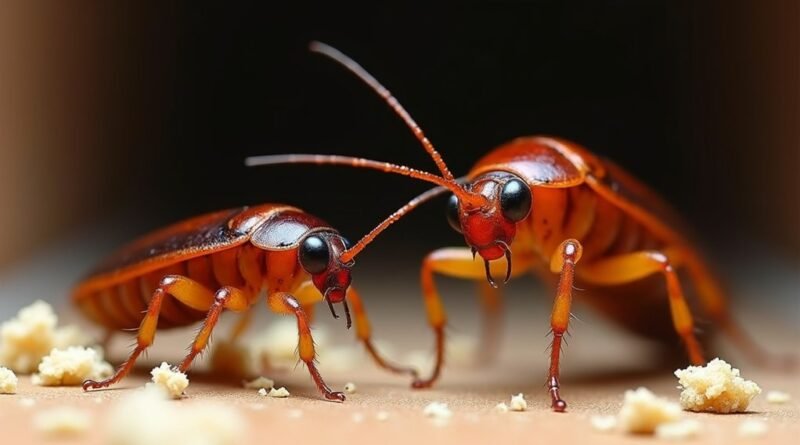
German Cockroach vs American Cockroach: Size, Behavior, and Control Differences
German cockroaches are small (½ inch), tan with two dark stripes, and they thrive indoors — especially in kitchens and bathrooms. American cockroaches are much larger (up to 2 inches), reddish-brown, and prefer sewers, drains, and damp basements before wandering inside. They also behave and reproduce differently, which means the treatment that works for one species can completely fail against the other. Stick around and you’ll know exactly what you’re dealing with — and how to beat it.
Key Takeaways
- German cockroaches are ½–⅝ inch long with dark parallel stripes, while American cockroaches reach 2 inches with a yellow figure-eight marking.
- German cockroaches prefer indoor kitchens and bathrooms, whereas American cockroaches favor outdoor sewers, drains, and damp basements.
- American cockroaches can fly short distances when startled, while German cockroaches rarely fly and retreat deeper indoors when disturbed.
- German cockroaches reproduce aggressively, producing up to 30,000 descendants yearly, making infestations far harder to control than American cockroaches.
- German cockroaches require gel baits and IGRs, while American cockroaches respond better to entry-point sealing, moisture control, and barrier sprays.
How to Identify German vs American Cockroaches at a Glance
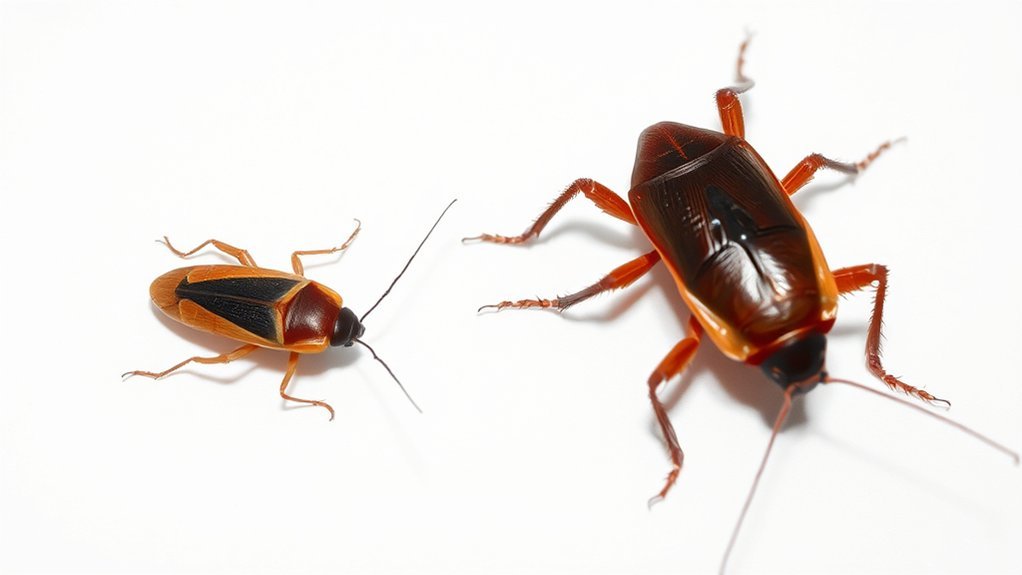
When spotting a cockroach in your home, size is your fastest clue: German cockroaches measure roughly ½ to ⅝ inch long, about penny-sized, while American cockroaches stretch 1.25 to 2 inches, closer to thumb-sized. That size difference alone helps you distinguish them quickly.
Color and markings confirm your identification. German cockroaches display light brown to tan coloration with two dark parallel stripes running lengthwise along their pronotum. American cockroaches show a reddish-brown to mahogany hue with a pale yellow figure-eight band behind their head.
Wings offer another distinction. Both species have wings, but German cockroaches rarely fly. American cockroaches fly short distances, particularly in warm conditions.
Even nymphs follow these patterns. German nymphs carry those same pronotal stripes, while American nymphs appear grayish-brown with reddish tones. Recognizing these traits across life stages makes identification faster, regardless of whether you’re seeing an adult or juvenile.
American cockroaches are often mistaken for water bugs due to their large size and tendency to appear near drains and damp areas. This misidentification can lead homeowners to overlook the need for targeted roach treatment.
Where German and American Cockroaches Live and How They Get Inside
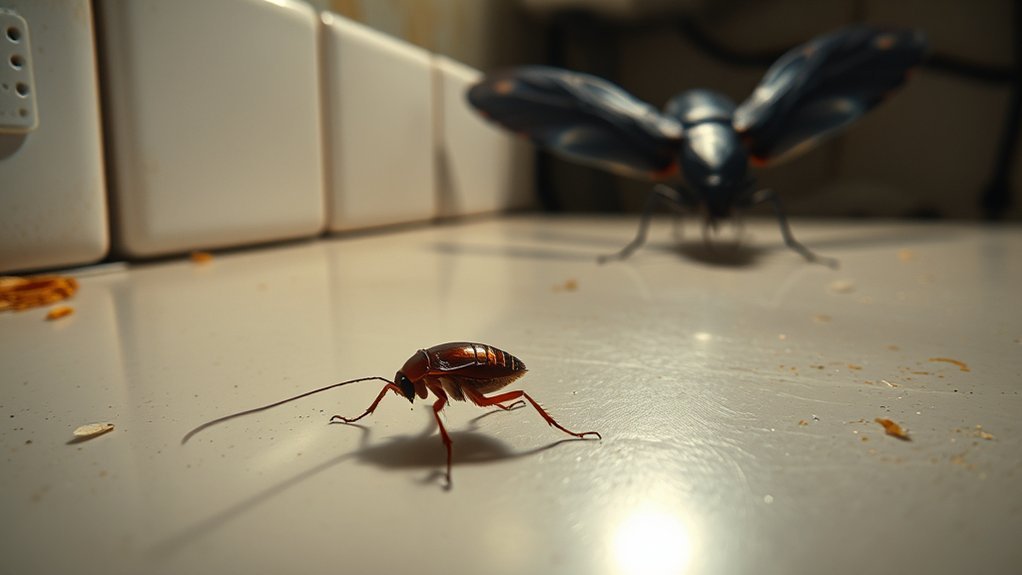
If you’ve ever spotted a cockroach in your home, knowing where each species likes to hide can help you track down the source fast. German cockroaches stick close to warmth, moisture, and food, making your kitchen appliances, bathroom cabinets, and sink areas their preferred hiding spots, while American cockroaches favor outdoor environments like sewers, storm drains, and leaf litter before pushing indoors. Germans typically hitchhike inside through grocery bags, secondhand appliances, or packaged shipments, whereas Americans crawl in through faulty drains, damaged pipes, or missing screens connected to outdoor sewer systems. German cockroaches are originally native to Southeast Asia and have since spread to become widespread urban pests found across North America, Australia, Africa, and beyond.
Preferred Habitats
Both species thrive in warm, humid environments, but they occupy very different spaces. German cockroaches favor indoor locations — kitchens, bathrooms, pantries, and storage closets. You’ll find them hiding in tight cracks as narrow as 1/16 inch, tucked near appliances, under sinks, and behind dishwashers. They prefer wood surfaces, travel along wall edges, and congregate in corners, especially in multi-unit housing.
American cockroaches, by contrast, prefer outdoor and underground environments. They’re common in sewers, storm drains, steam tunnels, and damp basements. You’ll encounter them near zoos, animal-rearing facilities, and water meter boxes. They enter buildings through damaged pipes, missing screens, or faulty drain traps.
While both species seek food, water, and shelter, German cockroaches stay close to humans indoors, while American cockroaches forage inward from outdoor sites. Unlike American cockroaches, German cockroaches spread via shipments and packaging rather than migrating between buildings on their own.
Indoor Entry Methods
Understanding how cockroaches get inside is the first step toward keeping them out. German cockroaches typically hitchhike indoors, hiding in grocery bags, take-out containers, cardboard boxes, and used appliances or furniture. Once inside, they spread through shared plumbing and electrical openings in multi-unit buildings, moving between units through walls and pipes.
American cockroaches more commonly enter from outside, crawling through gaps around windows, doors, and vents. They also squeeze through cracks in baseboards and exploit openings around plumbing and electrical lines.
Both species use the same vulnerabilities in your home’s structure. You can block their access by sealing cracks with caulk, installing door sweeps, adding weather stripping, and inspecting secondhand items before bringing them inside. German cockroaches thrive in warm, moist environments, making kitchens and bathrooms the most common areas where they establish and expand their presence once indoors.
How Do German and American Cockroaches Behave Differently?
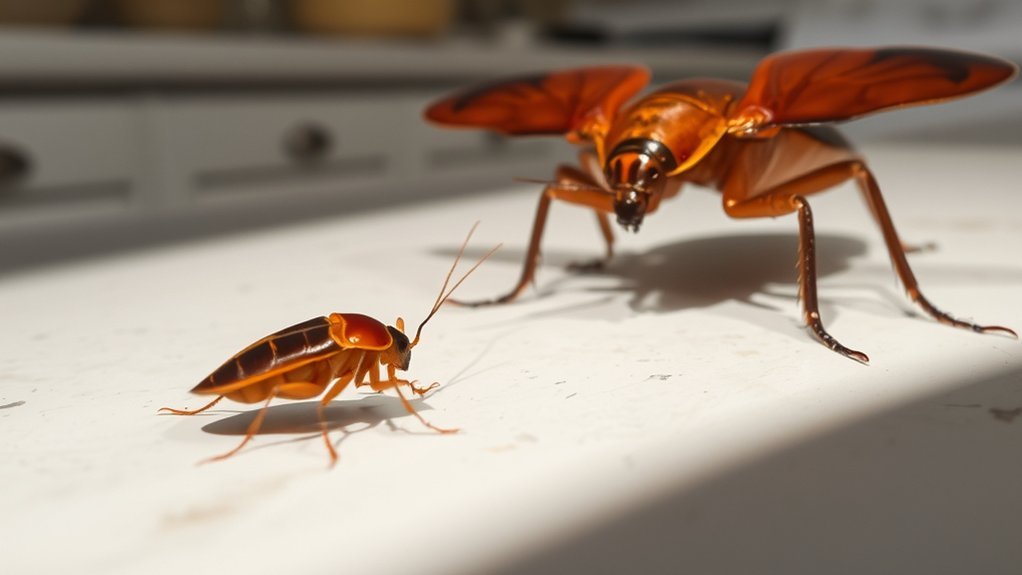
While both species share a preference for warm, moist environments, their behaviors differ in ways that directly affect how they invade your home and how difficult they are to eliminate.
| Behavior | German Cockroach | American Cockroach |
|---|---|---|
| Activity | Nocturnal, stays hidden | Nocturnal, visible in daylight during dry spells |
| Movement | Rarely flies despite wings | Flies and crawls to cover distances |
| Reaction | Retreats deeper indoors when disturbed | Scurries or flies clumsily when spooked |
| Feeding | Targets food prep areas continuously | Seeks food or water indoors sporadically |
| Sighting meaning | Signals serious, established infestation | Often indicates a stray invader |
German cockroaches stay concealed near food sources, making them harder to detect until populations explode. American cockroaches behave more like occasional intruders, entering from outdoor harborages when conditions push them inside. American cockroaches are capable, strong fliers, particularly when temperatures are warm, giving them a wider range of movement than their German counterparts. Understanding these differences helps you identify which species you’re dealing with and respond with the right control strategy.
Which Cockroach Reproduces Faster: and Why That Changes Everything
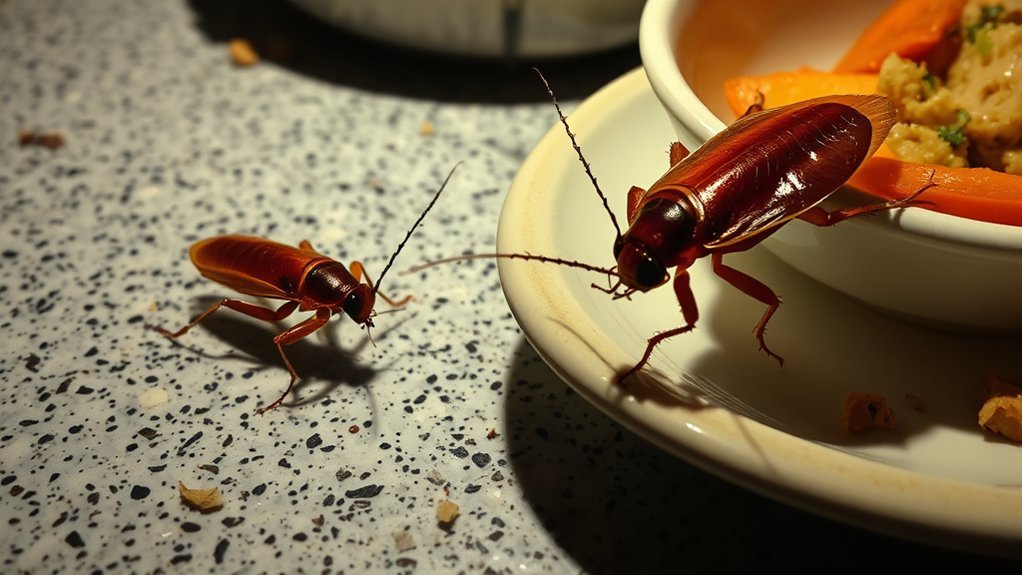
If you’re dealing with a cockroach infestation, the species you’re facing dramatically affects how fast you need to act. German cockroaches reproduce far more aggressively than American cockroaches, with a single female producing up to 30,000 descendants within 12 months. That explosive growth rate means a small German cockroach problem can become a full-blown infestation in just 4-6 months if you don’t intervene quickly.
German Cockroach Reproduction Speed
When it comes to reproduction speed, the German cockroach leaves the American cockroach in the dust. A female German cockroach reaches reproductive maturity just 4-6 days after adulthood, producing her first ootheca within 11-12 days. Each ootheca holds 30-48 eggs with an 80-90% hatch rate, and she’ll carry it attached to her abdomen until two days before hatching—protecting eggs from predators and pesticides.
She produces a new ootheca every 20-30 days, generating up to 400 offspring in her lifetime. Under ideal temperatures of 77-86°F, nymphs mature in just 36-40 days. Even more remarkably, German cockroaches can reproduce without males through parthenogenesis. The result? One female can produce 30,000 descendants within 12 months.
Impact on Infestation Control
Because German cockroaches reproduce 4-8 times faster than American cockroaches, spotting even one pregnant female isn’t just a nuisance—it’s a countdown. That single roach guarantees at least 40 future cockroaches, and without intervention within 21 days, do-it-yourself methods drop below 95% effectiveness rapidly.
German cockroaches also complicate treatment because they carry their egg capsules until hours before hatching, making pesticides far less effective than with American cockroaches, whose exposed oothecae are easier to target directly.
American cockroaches give you more response time. Their slower reproduction, outdoor habitat preferences, and temperature sensitivity mean infestations spread less aggressively. German cockroaches, thriving in climate-controlled spaces, spread building-wide quickly. You can’t afford the same relaxed timeline—faster reproduction demands faster action.
Which Cockroach Is Actually Harder to Get Rid Of?
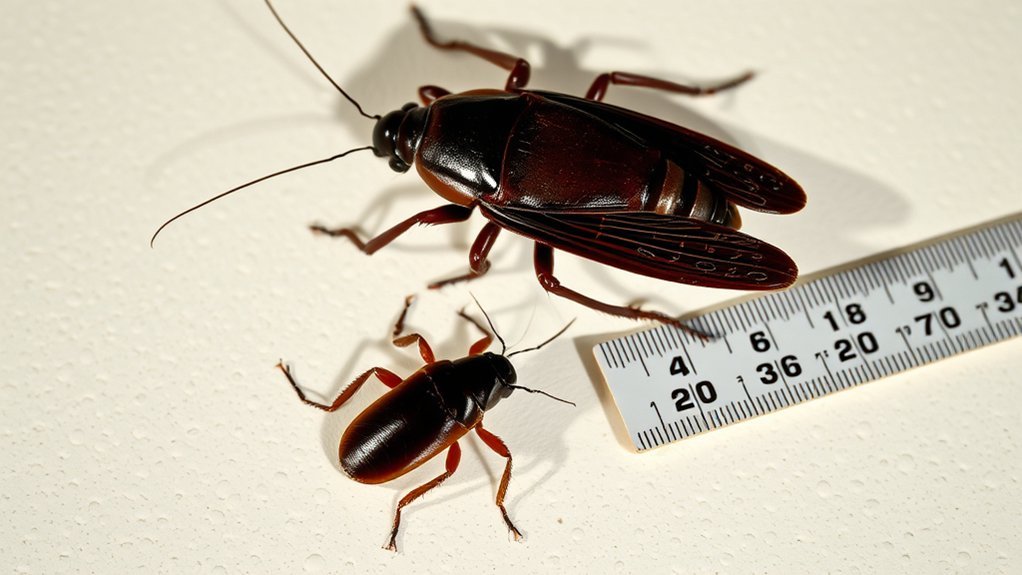
Both cockroaches are tough to eliminate, but German roaches are markedly harder to control. Their rapid reproduction means a small problem escalates quickly. With 3-4 generations per year and up to 40 eggs per case, you’re fighting exponential population growth. They also resist over-the-counter sprays and foggers, feed on almost anything, and rarely venture far from their hiding spots, making surface treatments largely ineffective. You’ll need integrated pest management combining baits and growth regulators to make real progress.
American roaches are more manageable by comparison. You can greatly reduce their presence by sealing entry points, fixing moisture issues, and applying perimeter treatments. Since they develop slowly and often wander in from outdoors, isolated sightings don’t always signal an established colony.
If you’re dealing with German roaches, don’t wait. Every day without targeted treatment gives them more time to multiply and spread deeper into your home.
How to Treat a German Cockroach vs American Cockroach Infestation
Treating a German cockroach infestation demands a more aggressive, layered approach than dealing with American roaches. For Germans, you’ll need gel baits, insecticidal dusts, IGRs, and nightly vacuuming combined. American roaches respond better to barrier sprays and entry-point sealing since they’re entering from outdoors.
| Treatment Method | German Cockroach | American Cockroach |
|---|---|---|
| Gel Bait | Essential; pea-sized spots in harborages | Helpful but less critical |
| Insecticidal Dust | Behind outlets, appliances, baseboards | Perimeter and crawl spaces |
| IGRs | Combine with adulticides to stop reproduction | Less necessary |
| Vacuuming | Nightly in kitchen; every 2-3 days elsewhere | Occasional spot-cleaning |
| Barrier Sprays | Avoid pyrethroids; use non-repellent contact sprays | Effective at entry points |
Apply Delta Dust or BorActin in voids and wall gaps. Avoid synthetic pyrethroids on Germans since they’ve developed strong resistance. Reapply treatments every one to two weeks until the infestation collapses.
Which Species Do You Have: and What Should You Do Next?
Knowing which species you’re dealing with changes everything about how you treat the infestation. Start with size—German cockroaches measure roughly half an inch, while American cockroaches reach up to two inches. Then check the markings: two dark parallel stripes indicate a German cockroach; a yellow figure-eight pattern on the thorax points to an American cockroach.
Location narrows it down further. If you’re spotting them in kitchens or bathrooms, you’re likely dealing with German cockroaches. Basement and drain sightings suggest American cockroaches entering from outside.
Where you spot cockroaches matters—kitchens and bathrooms suggest German cockroaches, while basements and drains point to American cockroaches.
Look for egg cases too. Yellowish, ridged cases signal German cockroaches; dark, pill-shaped ones indicate American cockroaches.
Once you’ve identified the species, document your sightings with photos, note how frequently they appear, and cross-reference with extension resources. Accurate identification guarantees you’re targeting the right species with the right treatment.
Frequently Asked Questions
Can German and American Cockroaches Interbreed or Coexist in the Same Home?
They can’t interbreed since they’re genetically incompatible, but they can coexist in your home. You’ll find German cockroaches in your kitchen while Americans lurk in your basement, creating compounded infestation challenges.
Are Cockroach Infestations Covered Under Standard Homeowner’s Insurance Policies?
Your standard homeowner’s insurance won’t cover cockroach infestations. Insurers classify them as preventable maintenance issues, not sudden perils. You’ll need to pay extermination costs, averaging $100-$400 per treatment, out of pocket.
Do Cockroaches Pose Specific Dangers to Pets or Household Animals?
Yes, cockroaches can harm your pets. They’ll carry parasites like worms and spread bacteria that make animals sick. If your pet eats one, they could experience vomiting or digestive issues.
What Natural Predators Help Control Cockroach Populations Indoors or Outdoors?
Indoors, you’ll find spiders, centipedes, and ants actively hunting cockroaches. Outdoors, lizards, frogs, toads, and birds help control populations. Parasitic wasps also target cockroaches by laying eggs directly on them.
How Do Seasonal Weather Changes Affect Cockroach Activity and Population Growth?
Seasonal weather directly drives cockroach activity in your home. You’ll see surges in spring and summer as warmth accelerates reproduction, while autumn and winter push them indoors seeking heat, moisture, and food sources.
Conclusion
Whether you’re dealing with the quick-spreading German cockroach or the larger American cockroach invading from outside, you can’t afford to wait. Each species demands a different treatment approach, so proper identification is your first step. Once you know what you’re up against, you can target them effectively using the right combination of baits, exclusion methods, and professional treatments. Act fast—the longer you wait, the harder they become to eliminate.
