

How Much Creatine Do You Really Need? Dosing by Body Weight
You need about 0.03 g of creatine per kg of body weight daily to maintain saturated muscle stores. For most adults, that’s 3 to 5 g a day. If you want to load, you’ll take 0.3 g/kg daily for 5 to 7 days, split into smaller servings. You don’t have to load, though. You’ll reach saturation in three to four weeks with steady dosing. Your weight shapes the plan, so stick around for your numbers.
Key Takeaways
- Maintenance dosing is about 0.03 g/kg/day, which preserves saturated muscle creatine stores, though flat doses of 3–5 g/day work for most adults.
- Loading uses 0.3 g/kg daily for 5–7 days, equaling roughly 21 g for a 70 kg person and 30 g for 100 kg.
- Splitting loading doses into four or five smaller servings helps reduce bloating, nausea, diarrhea, and cramping.
- Skipping loading is fine: taking 3–5 g daily from day one saturates muscles in about 3–4 weeks.
- Larger athletes may need 5–10 g daily, while people with kidney issues, those on certain medications, and teens should use caution.
How Much Creatine Per Kg Should You Take?
How much creatine should you take per kilogram of body weight? For maintenance, the most cited figure is 0.03 g/kg/day. Once your muscles are saturated, this dose preserves your creatine stores rather than building them. To reach saturation faster, a loading phase of 0.3 g/kg daily, split into four doses, is typically used for 5-7 days.
Here’s what that looks like in practice:
- 50 kg: 1.5 g/day
- 70 kg: 2.1 g/day
- 90 kg: 2.7 g/day
- 100 kg: 3.0 g/day
Body weight matters because it helps you individualize your dose instead of relying on a fixed amount. Most summaries still recommend a flat 3–5 g/day for adults, and studies commonly report 2–5 g/day. If you’re a larger athlete, you might need more than 5 g/day.
Some reviews also describe 0.1 g/kg/day, or roughly 5–7 g/day, as effective for ergogenic effects.
That’s higher than the classic maintenance figure, but you can treat it as a practical daily target.
Choose the approach that fits your body size and goals, and stay consistent.
What Creatine Loading Dose Fits Your Weight?
When you load creatine, the most cited formula is 0.3 g per kg of body weight per day for 5–7 days. Multiply your weight by 0.3 to find your daily target.
If you weigh 60 kg, you’ll take about 18 g; at 70 kg, about 21 g; at 80 kg, about 24 g; at 90 kg, about 27 g; and at 100 kg, about 30 g.
Flat dosing offers an alternative: 20–25 g per day regardless of size. For many adults, the weight-based formula lands near that range.
If you’re smaller, you may need less than 20 g. If you’re larger, you may need more than 25 g.
Don’t take your daily amount all at once. Split it into 4 or 5 servings throughout the day to improve tolerance. Loading can cause gastrointestinal discomfort and water retention in some people, so smaller, spread-out servings are easier on your system.
A 20 g plan, for example, works out to four 5 g servings.
Then drop to lower maintenance doses.
How Much Creatine Do You Need After Loading?
Once you finish loading, you’ll drop to a maintenance dose of 3–5 g per day. This keeps your muscle creatine stores saturated, so you won’t need to repeat loading cycles.
If you prefer a weight-based approach, aim for about 0.03 g/kg per day. At 82 kg (180 lb), that works out to at least 2.5 g daily. Most people simplify this to 3–5 g.
If you’re a larger athlete, you may need 5–10 g per day to maintain your stores.
Plan to take maintenance doses for weeks to months, and treat them as a long-term daily habit. Studies have used maintenance phases ranging from 28 days to 10 weeks. If you forget a dose, missing one during maintenance rarely causes significant performance declines, so just take your next scheduled dose rather than doubling up.
You can also skip loading entirely. Maintenance-only dosing still saturates your muscles, but it takes about four weeks instead of several days.
Once your stores are full, outcomes don’t differ much between the two routines. Either way, stay consistent.
Can You Skip Creatine Loading Entirely?
Yes, you can skip creatine loading entirely, and you’ll still end up in the same place. Taking 3–5 g of creatine monohydrate daily from day one saturates your muscles just as fully as loading does. It simply takes longer, usually three to four weeks.
Loading changes speed, not the final result. A typical protocol uses about 0.3 g/kg daily for 5–7 days, then drops to at least 0.03 g/kg daily. You’ll reach saturation in about a week instead of a month, but your final muscle creatine level won’t differ.
Skipping loading makes sense if you don’t have a performance deadline. A steady daily dose is simpler than juggling four doses a day, and it may reduce stomach upset and short-term bloating. It suits beginners and general fitness users well.
Stay consistent. An occasional missed dose won’t ruin saturation, but repeatedly skipping doses can lower your stores over time. Keep taking your 3–5 g dose on rest days too, at any time of day.
Is Creatine Loading Safe for Everyone?
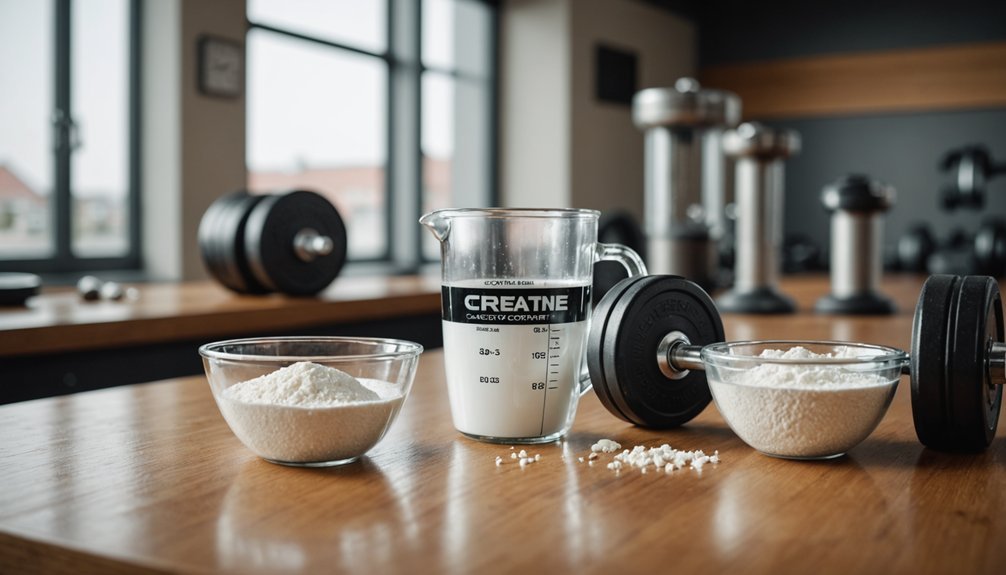
Loading isn’t risky for most healthy adults, but it isn’t right for everyone either. Clinical reviews show limited kidney harm at standard doses, and you’ll likely tolerate 20 grams daily for 5 to 7 days.
Creatine loading isn’t risky for most healthy adults, and clinical reviews show limited kidney harm at standard doses.
Still, you might notice bloating, nausea, diarrhea, cramping, or water retention. Split the dose into four servings and drink plenty of water to reduce those effects. Loading isn’t essential, since a daily dose of 3 to 5 grams can reach muscle saturation more slowly while lowering your risk of side effects.
Skip loading if you have kidney disease, a history of acute kidney injury, a kidney transplant, one kidney, or reduced kidney function.
Creatine can also raise blood creatinine, which complicates lab interpretation. Talk with a clinician first if you have high blood pressure, diabetes, or heart disease, take medications that affect your kidneys, or you’re pregnant or nursing.
Teens and children lack solid safety data, so approach loading cautiously.
Frequently Asked Questions
Does the Time of Day Affect Creatine’s Effectiveness?
Not really. You’ll get the same benefits whether you take creatine morning, afternoon, or evening. Daily consistency matters most, so pick a convenient time you’ll stick with. Taking it near your workout might help slightly.
Should Creatine Be Taken With Food, Carbs, or Caffeine?
You can take creatine with or without food, so pick what’s easiest. A meal may calm your stomach, and carbs or protein can boost uptake. Caffeine doesn’t clearly interfere, though separating doses might ease digestion.
What Happens if You Miss a Day of Creatine?
Nothing much happens if you miss a day. Your muscle creatine stores won’t drop overnight, so you’ll barely notice. Just take your next scheduled dose, and don’t double up. Repeated missed days cause real problems.
Do Women Need Different Creatine Doses Than Men?
No, you don’t need a different dose because you’re a woman. You’ll do well with the same 3–5 grams daily men take, though you can adjust by body weight, since size matters more than sex.
Is Creatine Monohydrate Better Than Other Creatine Forms?
Yes, creatine monohydrate beats other forms for most people. You’ll find the strongest evidence behind it, and no alternative has proven superior. It’s also the cheapest option, so you won’t pay extra for unproven benefits.
Conclusion
Creatine dosing doesn’t have to be complicated. If you want faster results, you can load at about 0.3 grams per kilogram daily for five to seven days, then drop to 0.03 to 0.1 grams per kilogram. If you’d rather skip loading, you’ll still saturate your muscles in about a month with 3 to 5 grams daily. Choose the approach that fits your schedule, stay hydrated, and check with your doctor if you’ve got kidney concerns.