
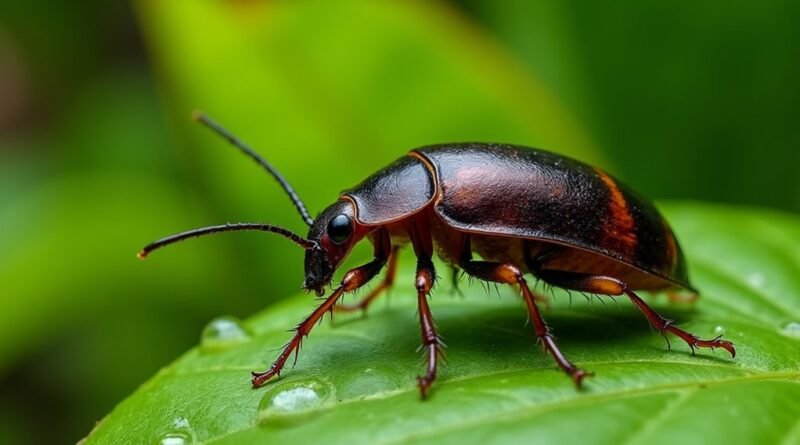
Madagascar Hissing Cockroach: Care, Size, and Facts
Madagascar hissing cockroaches make surprisingly low-maintenance pets that are safe for children and easy to handle. They grow between 2 and 4 inches long and need a secure enclosure with stable temperatures between 80–85°F and humidity around 70–80%. You’ll feed them fresh fruits, vegetables, and protein sources like dog kibble. They’re wingless, calm, and even educational to observe. Keep exploring to uncover everything you need to keep yours thriving.
Key Takeaways
- Madagascar hissing cockroaches are wingless, safe, low-maintenance pets with educational value, producing harmless hissing sounds for communication.
- Adults typically grow 5–7.5 cm long, with males being slimmer and females fuller, weighing up to 22.7 grams.
- They require a 5-gallon enclosure with 70–80% humidity, temperatures of 80–85°F, and secure lids to prevent escapes.
- Their diet includes fresh fruits, vegetables, and protein sources like dog kibble, with hydration provided through water gel crystals.
- Females carry egg cases internally, producing 15–40 live young per brood under optimal breeding temperatures of 90–95°F.
Are Madagascar Hissing Cockroaches Good Pets?
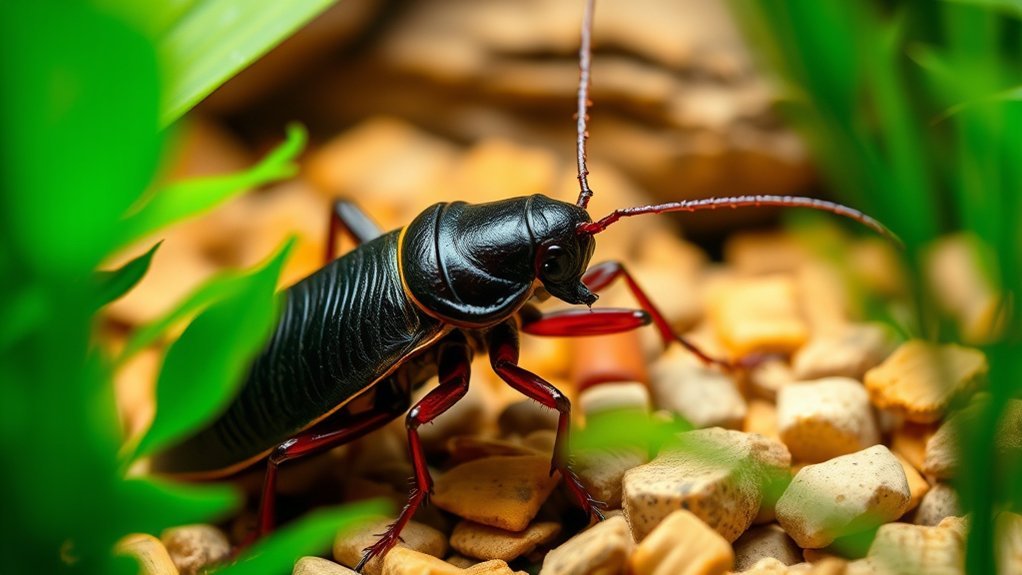
Madagascar hissing cockroaches make surprisingly good pets for both beginners and experienced keepers. They’re wingless, so you won’t worry about escapes by flight. They don’t bite, produce strong odors, or behave aggressively during handling, making them safe choices for children. Their occasional hissing sounds harmless and actually adds to their charm.
You’ll find their care requirements straightforward. A 5-gallon tank, twice-daily misting, and simple foods like fruits, vegetables, and dry dog food are all they need. Compared to other insects, they’re remarkably low maintenance.
Beyond basic companionship, these roaches offer real educational value. You can observe fascinating insect behaviors, teach children responsibility, and even use them in classroom settings. Their hardy nature means they tolerate occasional rough handling without serious consequences. Whether you’re a curious hobbyist or a first-time pet owner, Madagascar hissing cockroaches are a rewarding and practical choice. In the wild, they serve as decomposers in ecosystems, breaking down plant and animal matter to help recycle essential nutrients.
What Is a Madagascar Hissing Cockroach?
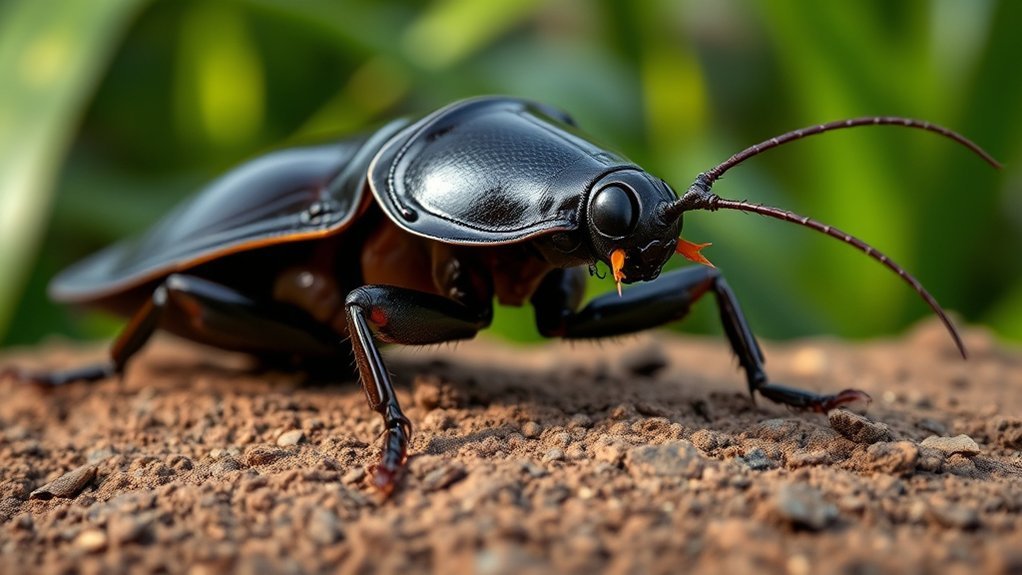
Unlike most cockroaches, it’s completely wingless. Its oval body is shiny brown with dark orange abdominal markings, and it sports a single pair of antennae. You can distinguish males from females by their large pronotal horns and furry antennae, while females have small bumps and smooth antennae.
What makes this species truly unique is its ability to hiss. It forces air through abdominal spiracles to produce sounds reaching 90 decibels, audible up to 12 feet away. It’s considered the only insect capable of making deliberate hissing sounds for communication. It produces three distinct types of hisses: the disturbance hiss, the female-attracting hiss, and the aggressive hiss.
How Big Do Madagascar Hissing Cockroaches Get?
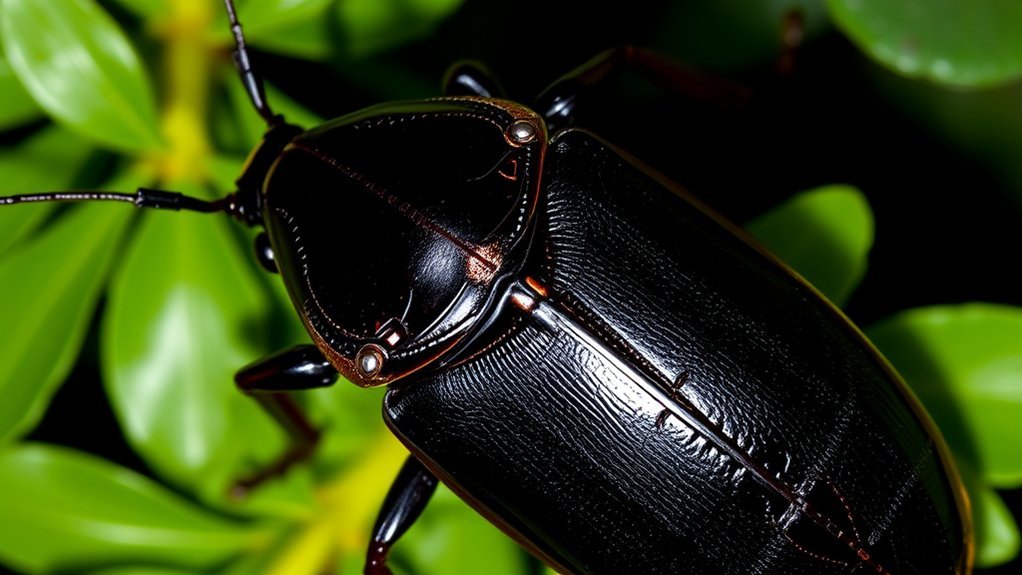
One thing that makes the Madagascar hissing cockroach stand out among insects is its impressive size. As an adult, it typically reaches 5 to 7.5 centimeters (2 to 3 inches) in length, though some individuals grow up to 10.1 centimeters (4 inches). Its flat, oval body measures roughly 1 inch wide, making it one of the largest cockroach species in the world.
You’ll also notice clear size differences between males and females. Males grow larger and develop pronounced pronotal humps, while females have smaller or absent humps. Males also have thicker, hairier antennae.
In terms of weight, these cockroaches can reach up to 22.7 grams (0.8 ounce), comparable to an alkaline AA battery. Their heavily sclerotized, dark brown to black exoskeleton contributes notably to that mass. They reach full size between 5 and 10 months of age. Their hard, waxy exoskeleton is a defining physical feature that gives the body its rigid, protective structure.
What Enclosure Setup Do Madagascar Hissing Cockroaches Need?
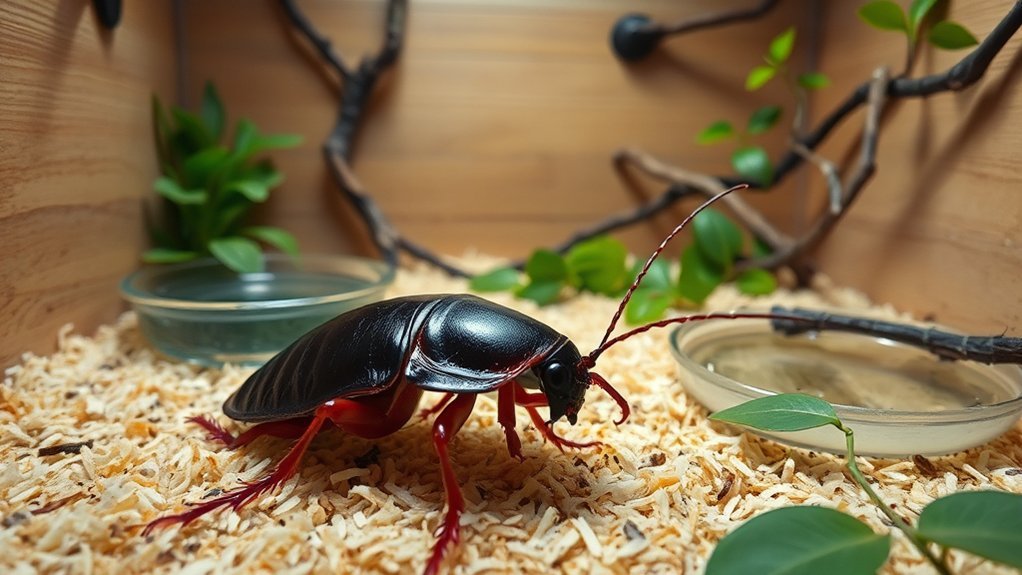
Setting up the right enclosure is one of the most important steps in keeping Madagascar hissing cockroaches healthy. For a single adult, you’ll need at least a 5-gallon aquarium, though larger tanks work better for colonies or multiple adults. You can also use 4-gallon Ziplock Weathertight containers for small groups.
Fill the bottom with 2-3 inches of substrate—coconut fiber, peat moss, or orchid bark all work well. Sprinkle bark chips on top to give nymphs extra security. Add paper towel rolls, egg crates, or cork wood pieces as hides, and include oak branches for texture.
Since hissers climb glass, apply a 2-inch barrier of petroleum jelly around the top rim and use a secure lid. For plastic enclosures, drill or melt ventilation holes rather than leaving cracks. Place food and water dishes inside, and toss in some dead leaves for additional food and cover. During colder months, use a heat pad underneath the enclosure to keep temperatures in the ideal range of 75°F to 90°F.
Temperature and Humidity Requirements for Madagascar Hissing Cockroaches
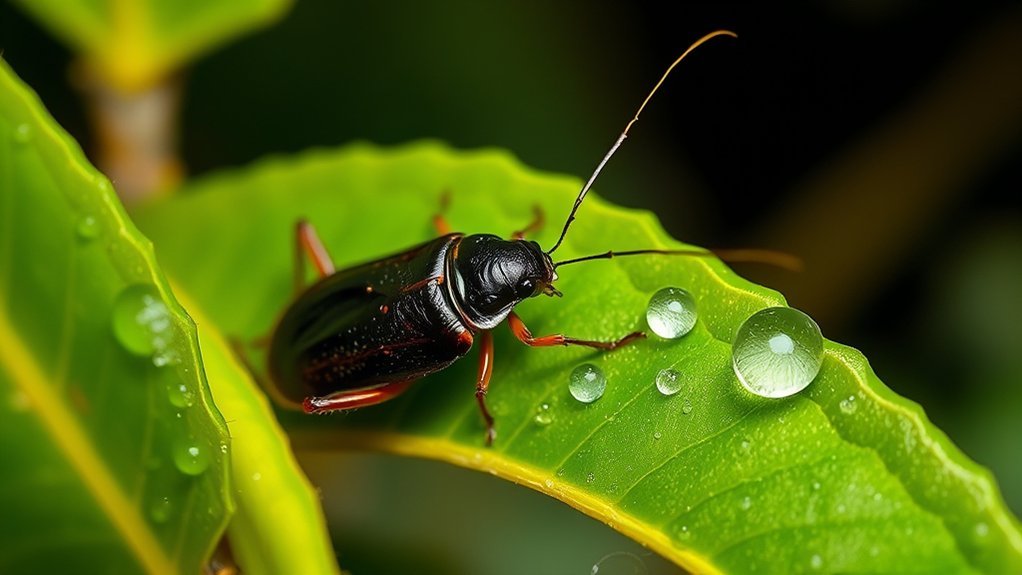
To keep your Madagascar hissing cockroaches healthy and active, you’ll want to maintain daytime temperatures between 80-85°F, dropping to around 75-80°F at night. A nighttime temperature drop is natural and acceptable, but you shouldn’t let it fall below the mid-60s°F, as cooler temperatures will make your roaches sluggish and unlikely to breed. Temperatures exceeding 90°F should also be avoided, as this can lead to increased aggression among your cockroaches. For humidity, you’ll want to keep levels at 70-80%, misting every other day to maintain moisture without creating the damp conditions that encourage mold and bacterial growth.
Optimal Temperature Range
Keeping your Madagascar hissing cockroaches healthy starts with maintaining the right temperature. Aim for a daytime range of 75–85°F, with 77–82°F being the sweet spot for supporting metabolism and immune function. Temperatures closer to 80°F prevent the lethargy that sets in below 70°F, keeping your roaches active and alert.
If you’re focused on breeding, push temperatures toward 80–90°F to encourage rapid colony growth. However, don’t let things climb above 90°F without giving your roaches a cooler area to retreat to. At 95°F, they’ll become hyperactive and begin avoiding the heat entirely.
On the lower end, mid-60s°F allows basic survival, but you shouldn’t let temperatures drop below 50°F, even briefly, as it risks serious harm.
Nighttime Temperature Drops
While daytime temperatures keep your roaches active, nighttime drops play an equally important role in their long-term health. Aim for nighttime temperatures between 18–21°C (65–70°F), mimicking the natural cooling their Madagascar habitat experiences. In the wild, temperatures dip as low as 1°C, though lows typically hover around 10°C for only 2–4 hours nightly.
In captivity, don’t let temperatures fall below 10°C (50°F), as this marks the minimum survival threshold. Your enclosure’s cooler side should stay around 21°C, while the warm end remains at 30°C, giving your roaches the ability to thermoregulate. Watch for lethargy or appetite loss—these signal that nighttime conditions aren’t meeting their needs. A ceramic heat lamp or heat mat helps maintain consistent overnight temperatures reliably.
Maintaining Proper Humidity
Alongside temperature, humidity plays an equally important role in keeping your Madagascar hissing cockroaches healthy. Aim for a minimum of 70% humidity, though 80% or higher better supports their health and breeding. Their tropical origins mean they thrive in moderate to high moisture levels.
Mist the enclosure every other day, or lightly spray the substrate daily. Supplement misting with moist leafy greens and a water dish. Moisture-retaining substrates like peat moss, vermiculite, or sphagnum moss help maintain consistent levels.
However, avoid excess moisture buildup. Pathogens thrive in hot, dark, moist environments, so keep enclosures clean and odor-free. Increase air circulation to prevent condensation or soggy harborage areas. Balanced humidity keeps your cockroaches healthy without creating dangerous conditions.
What to Feed a Madagascar Hissing Cockroach
Madagascar hissing cockroaches are detritivores in the wild, so they thrive on a varied diet of decaying plant matter, fungi, small insects, and animal carcasses. In captivity, you’ll replicate this variety using fresh produce, dry staples, and protein sources.
| Food Category | Examples |
|---|---|
| Fruits & Vegetables | Bananas, oranges, carrots, kale, squash |
| Proteins & Dry Foods | Dog kibble, oatmeal, fish flakes, bee pollen |
Feed your roaches every couple of days, rotating options to prevent obesity and nutritional gaps. Always choose organic produce to avoid pesticide exposure, which can harm them. For hydration, skip open water dishes since they’re drowning hazards. Instead, use water gel crystals or soaked cotton balls. Their moisture needs are largely met through fresh fruits and vegetables you’re already providing.
How Do You Tell Male and Female Madagascar Hissing Cockroaches Apart?
You can quickly tell male and female Madagascar hissing cockroaches apart by checking the pronotum, the area directly behind the head. Males sport large, prominent horns on their pronotum, while females have only small bumps in that spot. Females also tend to be larger overall, so if you’re spotting a noticeably bigger roach without those distinctive horns, you’re almost certainly looking at a female.
Male Hump Identification
How do you tell male and female Madagascar hissing cockroaches apart? Look at the pronotum, the shield-like structure behind the head. Males have two prominent bumps called tubercles on their pronotum’s dorsal surface, while females have much smaller versions of these structures. You might initially mistake these tubercles for eyes, but they’re actually the clearest visual indicator of sex.
Male humps grow larger as the cockroach matures, making the size difference between sexes increasingly obvious with age. Major males develop the most pronounced humps and display distinct anterior notches in their pronotums. Pure stock males reliably show these notches, so you can use hump prominence as a quality indicator when maintaining breeding populations. Females retain proportionally small humps throughout their entire lifespan.
Female Size Differences
While pronotum tubercles offer the clearest sex indicator, size differences between males and females provide another reliable identification method. Females typically grow longer and heavier than males, with adults ranging from 2 to 3 inches, though females can reach 4 inches. Mature width averages approximately 1 inch. You’ll notice these differences once they reach sexual maturity at 5 to 10 months.
| Measurement | Male | Female |
|---|---|---|
| Typical Length | 2–3 inches | 2–4 inches |
| Body Weight | Lighter | Heavier |
| Mature Width | ~1 inch | ~1 inch |
| Body Shape | Slimmer | Fuller/Distended |
| Maturity Onset | 5–10 months | 5–10 months |
Gravid females appear visibly distended abdominally, as they retain egg cases internally until nymphs hatch, making size an especially useful identifier during reproductive cycles.
How Breeding Works and When to Separate Your Madagascar Hissing Cockroaches
Understanding how Madagascar hissing cockroaches breed will help you manage your colony effectively. Males attract females using distinct hissing sounds, defending territories through hissing, pushing, and shoving. Once a male finds a mate, he touches her antennae before they attach rear-to-rear for about 30 minutes. Fertilization occurs internally, and females carry their egg case until nymphs hatch inside them, releasing 15–40 live young per brood.
Nymphs emerge at roughly 1/4 inch long and undergo six to eight molts over six to seven months before reaching adulthood. Hissers reproduce two to three times per year, thriving at 90–95°F with humidity around 60%.
When managing your colony, avoid frequent cleaning since disturbances reduce reproduction rates. Wait several breeding cycles before removing individuals to guarantee stability. Apply Vaseline along container rims to prevent escapes, and provide egg cartons as hiding spots to keep your hissers comfortable.
Frequently Asked Questions
How Long Do Madagascar Hissing Cockroaches Typically Live in Captivity?
In captivity, your Madagascar Hissing Cockroach will typically live 2-5 years after reaching maturity. With exceptional care, it can survive up to 6 years, averaging around 3-5 years overall.
Can Madagascar Hissing Cockroaches Be Handled Safely by Children?
Yes, your children can safely handle Madagascar Hissing Cockroaches! They’re docile, can’t bite or sting, and their flightless nature reduces escape risks. Just teach kids to gently grip the thorax for safe interaction.
Do Madagascar Hissing Cockroaches Carry Diseases or Parasites Harmful to Humans?
You don’t need to worry — Madagascar hissing cockroaches don’t carry diseases or parasites harmful to humans. They’re cleaner than common pest species, and any mites they carry won’t affect you.
How Many Madagascar Hissing Cockroaches Can Be Kept Together?
You can keep up to 5 adult Madagascar hissing cockroaches in a 12″x12″x20″ terrarium. If you’ve got a larger group, you’ll need a 5 to 10-gallon enclosure to accommodate them comfortably.
Are Madagascar Hissing Cockroaches Legal to Own in All States?
No, Madagascar Hissing Cockroaches aren’t legal in all states. They’re banned in Florida and Hawaii, and you’ll want to check your specific state’s regulations, as southern states may have additional restrictions.
Conclusion
If you’re looking for a unique, low-maintenance pet, you can’t go wrong with a Madagascar hissing cockroach. They’re fascinating creatures that don’t require much space or complicated care. As long as you’re providing the right temperature, humidity, and diet, your hissing cockroach will thrive. Whether you’re keeping one as a solo pet or breeding a colony, you’ll find these remarkable insects make surprisingly rewarding companions.
