
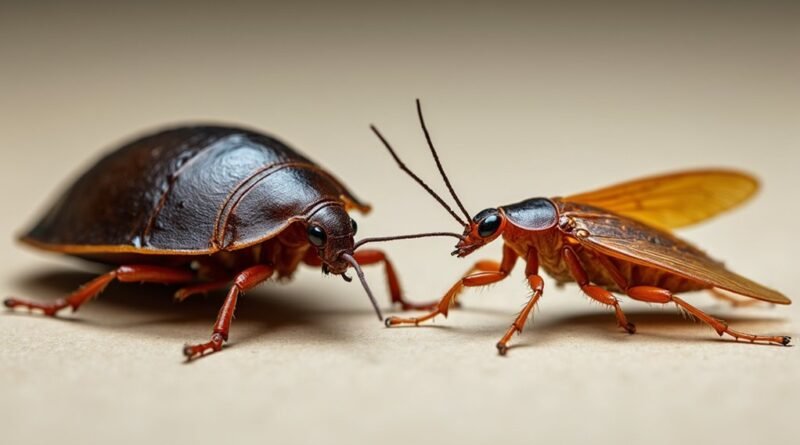
Water Bug vs Cockroach: How to Tell the Difference
You can tell a water bug from a cockroach by checking three things: body size, antenna length, and where you found it. Water bugs are larger, reaching up to 4 inches, while cockroaches max out at around 1.5 inches. Cockroaches have long, whip-like antennae, but water bugs have short, stubby ones. Where you spotted it matters too—cockroaches thrive indoors, while water bugs usually wander in by accident. There’s even more to uncover about these two insects.
Key Takeaways
- Water bugs are larger (2–4 inches) than cockroaches (up to 1.5 inches) and have a matte, grayish-brown appearance versus cockroaches’ shiny reddish-brown.
- Cockroaches have long, whip-like antennae, while water bugs have short, thick, barely visible antennae.
- Water bugs have pincer-like front legs and paddle-shaped hind legs; cockroaches have plain, thin legs designed for running.
- Cockroaches scatter when exposed to light, while cornered water bugs raise their front legs defensively and may bite.
- Water bugs live in freshwater outdoor environments and enter homes accidentally, whereas cockroaches thrive and reproduce indoors.
How to Tell a Water Bug From a Cockroach at a Glance
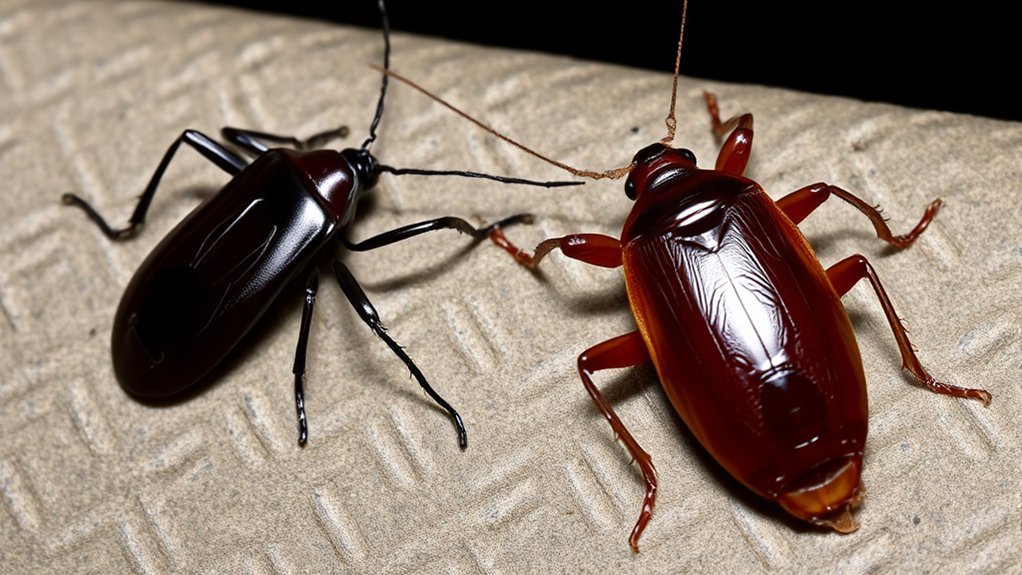
There are five key physical features that can help you tell a water bug from a cockroach at a glance: antennae, legs, wings, body shape, and behavior.
Start with the antennae. Cockroaches have long, thread-like antennae that often hide their heads, while water bug antennae are short and barely visible. Next, check the legs. Water bugs have pincer-like front legs for grabbing prey and paddle-like hind legs for swimming. Cockroaches have plain walking legs.
Water bugs have pincer-like front legs and short antennae, while cockroaches sport long, thread-like antennae and plain walking legs.
For wings, water bugs rest with their wings overlapping in an “X” pattern, while cockroaches only partially cover their abdomen. Body shape won’t help much since both are flat and oval. Cockroaches tend to appear reddish or brown, while water bugs are typically brown or grayish.
Behavior is your clearest indicator. Water bugs hunt, bite, and inject venom. They’ll even play dead when threatened. Cockroaches scavenge, can’t bite humans, and simply run and hide. If it’s biting you, it’s a water bug.
Water Bug vs Cockroach: Size and Color Side by Side
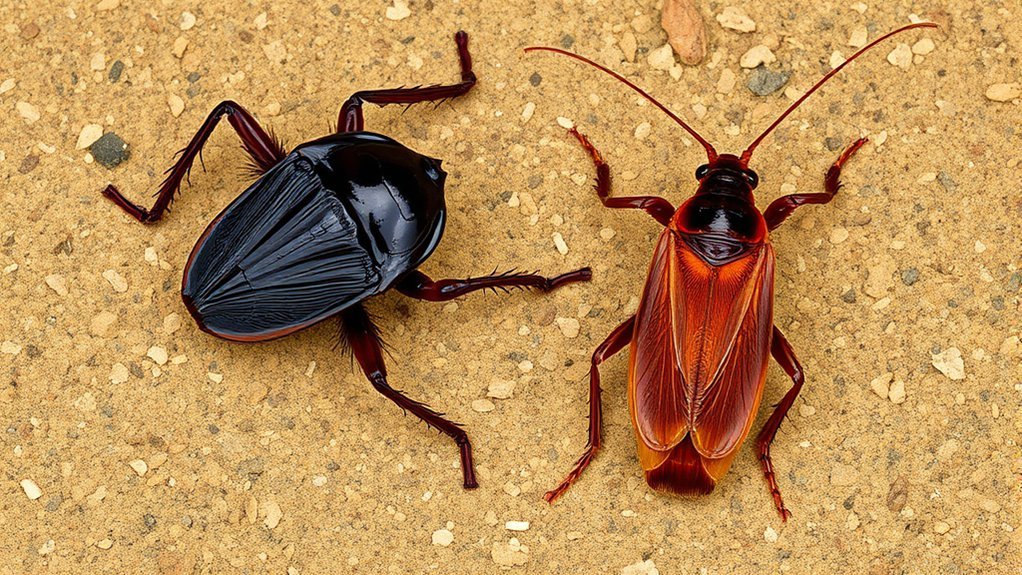
When you place a water bug and cockroach side by side, the size difference alone often settles the debate—cockroaches max out at 1.5 inches, while water bugs routinely reach 2 to 4 inches. You’ll also notice cockroaches carry a reddish-brown hue with a smoother, uniform texture, whereas water bugs lean toward grayish-brown with a flatter, more muted appearance. These two visual cues—body length and color tone—are your fastest tools for telling the two apart without getting too close. Water bugs also have clawed front feet designed for grabbing and securing prey, a feature entirely absent in cockroaches.
Comparing Overall Body Size
Size is one of the clearest ways to tell these two insects apart. True water bugs measure 2 to 4 inches long, while cockroaches typically range from 0.5 to 2 inches. Even the largest residential cockroach species, the American cockroach, maxes out at 2 inches, barely reaching the lower end of a water bug’s size range.
Oriental cockroaches are even smaller, averaging just 1 inch long — less than half the size of a typical water bug. If you’re looking at an insect under 2 inches, you’re almost certainly dealing with a cockroach rather than a true water bug. Giant water bugs frequently double the size of common cockroach species, making size your fastest and most reliable identification tool. Unlike true water bugs, cockroaches have long, thin antennae that extend well beyond their body length.
Color and Texture Differences
Color and texture work together as your next best identification tools after size. Water bugs sport brown or gray tones with a matte, textured finish, while cockroaches lean reddish-brown with a greasy, shiny sheen. That subtle sheen on a cockroach’s exoskeract is a dead giveaway.
| Feature | Water Bug | Cockroach |
|---|---|---|
| Color | Brown, gray, tan | Reddish-brown, black |
| Texture | Matte, hardened shell | Shiny, greasy coating |
| Wing Pattern | Distinctive X-shape | Flat, uniform wings |
You’ll also notice water bugs have pincer-like front legs and oar-shaped hind legs — cockroaches don’t. Cockroaches have smooth, uniform walking legs. Once you spot these texture and color clues together, misidentifying the two becomes nearly impossible. Unlike water bugs, cockroaches are known to carry harmful bacteria and spread diseases, making proper identification an important step in protecting your home.
Identifying Key Visual Traits
Two visual traits — size and color — do the heavy lifting when you’re trying to tell these insects apart at a glance. Use these quick comparisons to nail your identification:
- Oriental cockroaches measure 1–1.25 inches; water bugs start at 2 inches
- American cockroaches reach 1.5–2 inches, still smaller than most water bugs
- Giant water bugs grow to 4 inches — nearly double any cockroach species
- Water bugs carry a flattened, oval, leaf-like shape; cockroaches share the oval build but stay compact
- Any insect under 2 inches almost certainly isn’t a true water bug
If you’re standing over something that stretches past your house key’s length, you’re likely looking at a water bug, not a cockroach. Cockroaches range from light tan to dark brown, while water bugs span a wider spectrum from tan all the way to black.
Antennae and Legs Give It Away Every Time
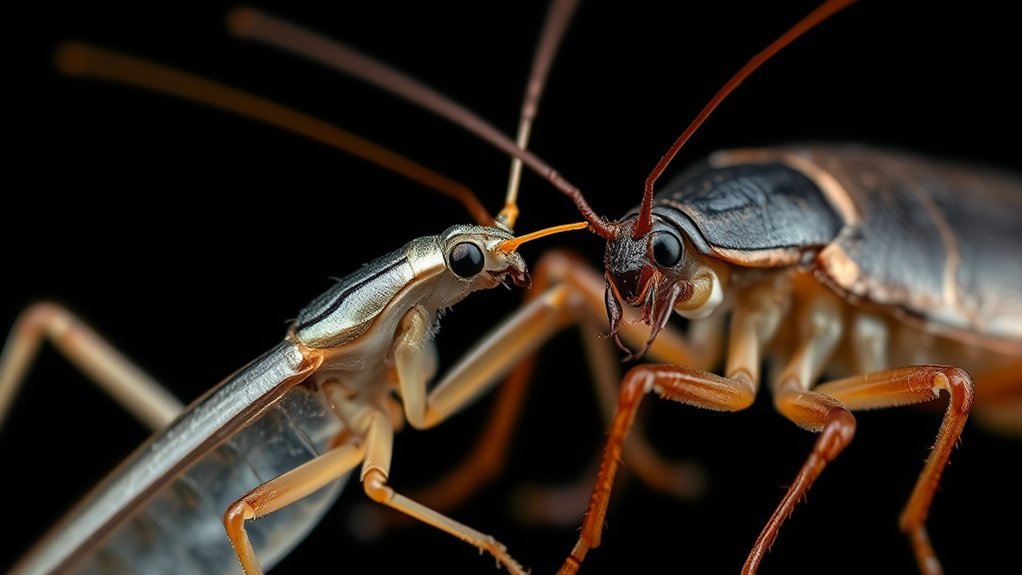
When you spot long, whip-like antennae constantly waving in the air, you’re looking at a cockroach every time. Water bugs, by contrast, carry short, thick, stalk-like antennae that you’ll notice immediately. Where the distinction really locks in, though, is the front legs—if you see pincer-like claws built for snatching prey, you’ve found a water bug, not a cockroach.
Cockroach Antennae Stand Out
Antennae settle the debate instantly — cockroaches have long, whip-like ones that extend well past their heads and move constantly, while water bugs sport short, stubby antennae that are sometimes barely visible at all.
Here’s what you’ll notice when comparing them:
- Cockroach antennae stretch longer than their entire body
- The constant movement makes cockroach antennae impossible to miss
- Water bug antennae appear short, stalk-like, and far less prominent
- Some water bugs show virtually no visible antennae at all
- German, American, and Oriental cockroaches all share this long-antennae trait
You don’t need perfect lighting or a close-up view. If you spot long, actively sweeping antennae, you’re looking at a cockroach. Short or hidden antennae point toward a water bug every time.
Water Bug Legs Differ
Legs tell the second half of this story. Water bug legs are short, thick, and built for water—not floor-crawling. You’ll notice oar-like hind legs that paddle for propulsion, plus pincer-front legs that grab prey. Six legs total, but none resemble a cockroach’s long, spindly runners.
| Feature | Water Bug | Cockroach |
|---|---|---|
| Leg Length | Short, thick | Long, thin |
| Hind Leg Function | Swimming/paddling | Running |
| Front Leg Type | Pincer-like | Standard walking |
| Leg Adaptation | Aquatic movement | Surface navigation |
| Overall Build | Broad, flattened | Narrow, elongated |
When you spot short antennae paired with those oar hind legs, you’re looking at a water bug. Cockroaches never have swimming adaptations—their legs exist purely for speed across dry surfaces.
Front Legs Reveal Identity
Two features end the water bug vs. cockroach debate instantly: antennae and front legs. Look closely at what you’re seeing, and you’ll have your answer.
Here’s what to check:
- Antennae present = cockroach; long, thin, and clearly visible even in dim lighting
- No visible antennae = water bug; they’re either absent or too reduced to see
- Pincer-like front legs = water bug; evolved specifically for grabbing prey
- Uniform walking legs = cockroach; all six legs share the same basic structure
- Large body with pincers = water bug confirmation; they reach 2–2.6 inches
You don’t need both features to confirm your ID—one is usually enough. Together, they make misidentification nearly impossible.
Wing Shape and Flight Habits: Another Clear Difference
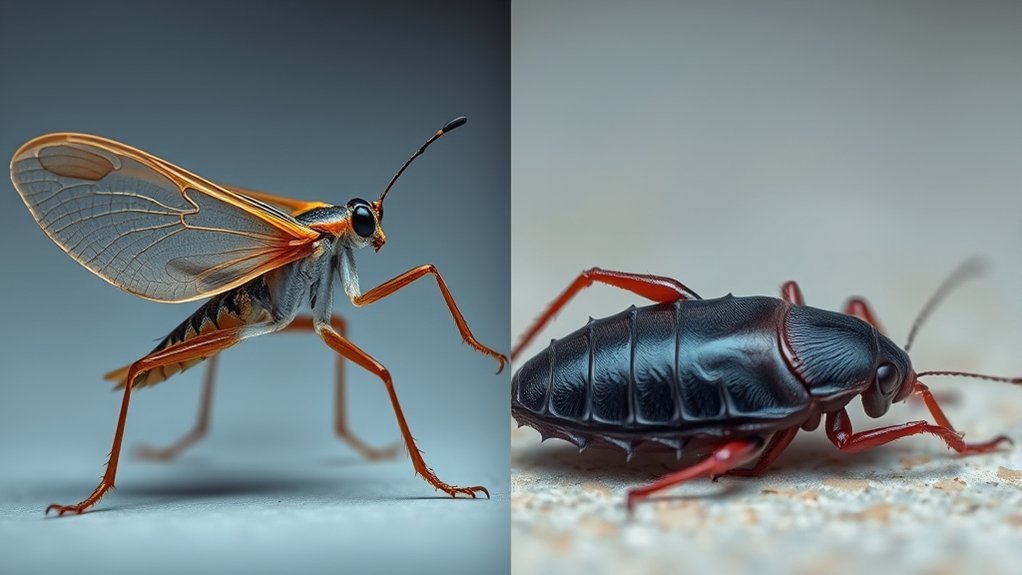
Wing shape and flight habits offer another reliable way to tell these insects apart. Water bugs have overlapping wings that form a distinct “X” pattern when at rest, covering their flying apparatus beneath a hard exoskeleton. They’re strong, capable fliers that move between bodies of water and often appear near lights at night, landing in pools or on patios.
Cockroaches tell a different story. Their wings don’t form any distinct pattern, and many species can’t fly at all. American cockroaches only glide short distances in warm weather, while Oriental cockroaches can’t fly despite having wings. Most cockroaches prefer running and hiding over flying, and they actively avoid light.
If you spot an insect flying toward your outdoor light or pool, it’s almost certainly a water bug. If it’s scurrying away from light instead, you’re likely dealing with a cockroach.
Water Bugs vs Cockroaches: Where Each One Lives
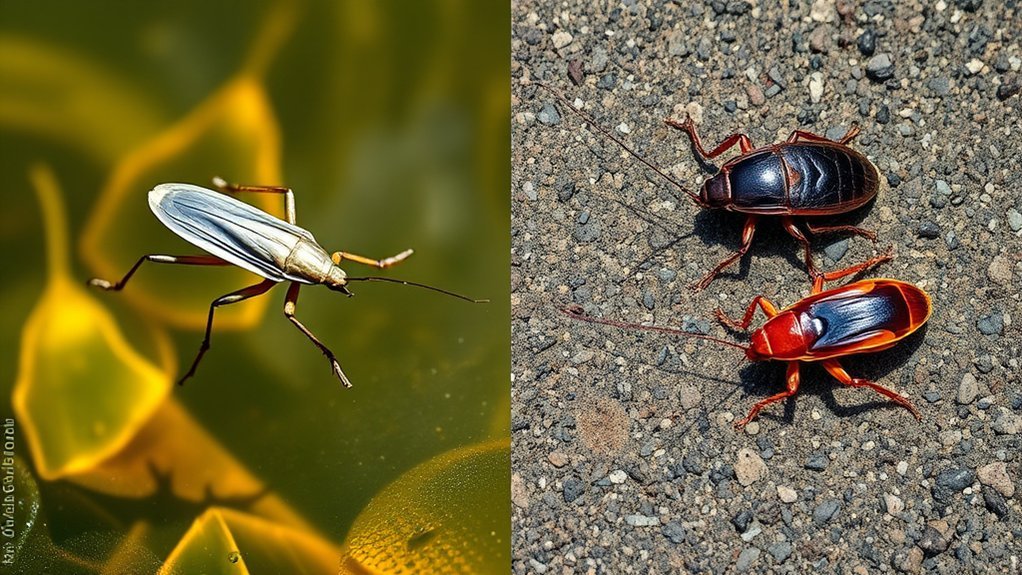
Just as flight behavior can point you toward the right identification, so can habitat. Water bugs live outdoors in freshwater environments, while cockroaches prefer dark, damp indoor spaces near plumbing and food sources.
Here’s where you’ll typically find each one:
- Water bugs hunt in ponds, lakes, slow-moving streams, and marshes with abundant aquatic vegetation
- Cockroaches hide in basements, sewers, crawl spaces, and behind appliances in warm, humid indoor areas
- Water bugs gather near outdoor artificial lights at night and seasonal retention ponds
- Cockroaches stick close to drainage pipes, standing water, and cluttered spaces below 84°F
- Both can enter homes through drains, cracks, and gaps, which is why misidentification happens
If you’re spotting the insect near a body of water outside, it’s likely a water bug. Finding it near your kitchen pipes or basement? That’s almost certainly a cockroach.
Water Bug or Cockroach: Which One Comes Inside?
When an unfamiliar insect shows up inside your home, the first question worth asking is whether it actually belongs there. Cockroaches do. They enter through door gaps, air ducts, utility lines, and foundation cracks, then thrive in kitchens, bathrooms, and basements. They reproduce rapidly, travel in groups, and exploit food scraps, grease, and moisture broadly. Seeing one usually means more are hiding nearby.
Water bugs don’t belong inside. They enter accidentally through open windows or door gaps and can’t survive long without constant moisture. You’ll typically find a single insect, not a group, and it won’t reproduce indoors.
Here’s the catch: what you’re calling a water bug is probably an oriental or American cockroach near a water source. True water bugs indoors signal accidental entry. Cockroaches indoors signal an infestation. That distinction changes how you respond.
Aggression vs. Fleeing: How Each One Reacts to You
Knowing whether you’re dealing with a cockroach or a water bug changes more than your pest control strategy—it changes how you should physically react when you encounter one.
Cockroaches flee immediately. Water bugs may come at you. Here’s what each one actually does when you’re nearby:
- Cockroaches scatter the moment light hits them, racing toward cracks, appliances, or dark corners without hesitation.
- Water bugs pause before reacting, raising their front legs defensively before deciding to bite or hide.
- A cornered cockroach runs harder; a cornered water bug bites.
- Water bugs inject digestive enzymes when they bite, making contact genuinely painful.
- Groups of roaches disperse in every direction, while a lone water bug stands its ground.
If something runs from you, it’s likely a roach. If something faces you, give it space—water bugs bite, and they don’t need much provocation.
Which One You Have: and What to Do Next
By now, you’ve seen how these two insects behave differently—but behavior alone doesn’t always give you a definitive answer. Check these physical clues to confirm what you’re dealing with.
If it’s indoors, it’s almost certainly a cockroach. True water bugs rarely enter homes. Look for long, thin antennae, reddish-brown or shiny black coloring, and standard walking legs. American cockroaches reach 1.5–2 inches with a figure-eight head pattern; Oriental cockroaches are smaller, darker, and prefer cool basements.
If you’ve confirmed cockroaches, act quickly. Apply baits or gels, seal entry points, reduce moisture, and eliminate food sources. Rapid reproduction makes professional pest control worth considering.
If you spotted the insect outdoors near a pond or stream, and it had pincer-like front legs, oar-like hind legs, and overlapping wings, relocate it—it’s a water bug and needs no indoor treatment.
Frequently Asked Questions
Can Water Bugs and Cockroaches Ever Share the Same Habitat?
Yes, they can briefly share damp spaces like basements or crawl spaces, but you won’t see true cohabitation. Water bugs can’t survive indoors long-term without aquatic conditions, making sustained overlap unlikely.
Do Water Bugs Carry the Same Diseases as Cockroaches Do?
No, water bugs don’t carry the same diseases as cockroaches. Cockroaches contaminate your food and surfaces with *Salmonella* and *E. coli*, while water bugs stay outdoors in aquatic environments and don’t transmit pathogens to you.
Are Water Bug Bites Dangerous to Humans or Household Pets?
Water bug bites aren’t typically dangerous to you or your pets, but they’re extremely painful. You may experience swelling, redness, and numbness. Rarely, you’ll have allergic reactions requiring medical attention.
How Long Do Water Bugs and Cockroaches Typically Live?
You’ll find that cockroaches typically live six months to one year, while water bugs don’t survive long indoors. Cockroaches reach adulthood in 40 to 160 days, whereas water bugs complete three lifecycle stages outdoors near freshwater.
Can Cockroaches Learn to Swim Like Water Bugs Can?
You can’t train cockroaches to swim like water bugs. They’re built differently—cockroaches frantically paddle to survive, while water bugs have streamlined, aquatic bodies that allow true, coordinated swimming. Evolution, not learning, determines their water abilities.
Conclusion
Now that you know the key differences, you can confidently identify what’s sharing your space. If it’s a cockroach, you’ll want to act fast since they multiply quickly and spread germs. If it’s a water bug, you’re likely dealing with an outdoor wanderer that strayed inside. Either way, don’t ignore it. Seal your entry points, eliminate moisture, and call a pest professional if you’re seeing them regularly.
