
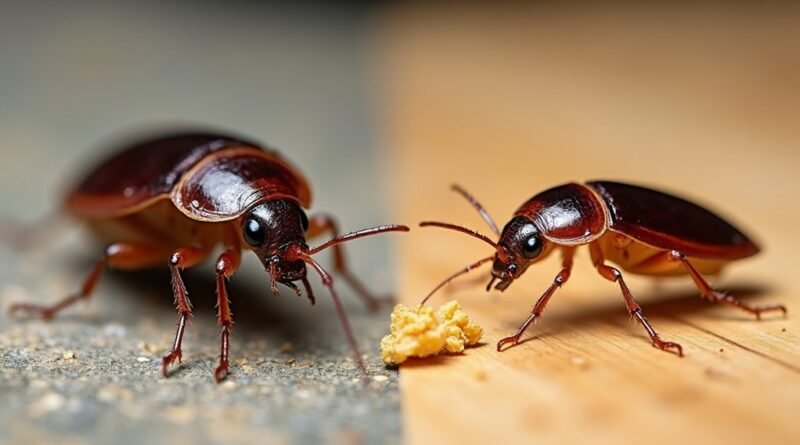
American Cockroach vs German Cockroach: Which Is Harder to Get Rid Of?
German cockroaches are harder to get rid of than American cockroaches. They’re smaller, reproduce faster, and hide deeper in tight spaces near your kitchen and bathroom. A single female can generate up to 30,000 descendants in a year, turning a minor problem into a full infestation within months. American cockroaches, while larger, tend to scatter in visible areas, making them easier to treat. Keep going to find out exactly what you’re dealing with and how to handle it.
Key Takeaways
- German cockroaches are harder to eliminate due to rapid reproduction, producing up to 30,000 descendants annually compared to American cockroaches’ much slower breeding rate.
- German cockroaches hide deep in tight spaces near kitchens and bathrooms, making detection and treatment significantly more difficult than American cockroaches.
- American cockroaches scatter visibly, making them easier to treat, while German cockroaches remain concealed until infestations become severe.
- German cockroaches can establish full infestations within 4-6 months, requiring early, targeted intervention including gel baits and insecticidal dusts.
- American cockroaches are controlled more easily through entry point sealing, leak repairs, and residual sprays due to their predictable, visible behavior.
How to Tell a German Cockroach From an American Cockroach
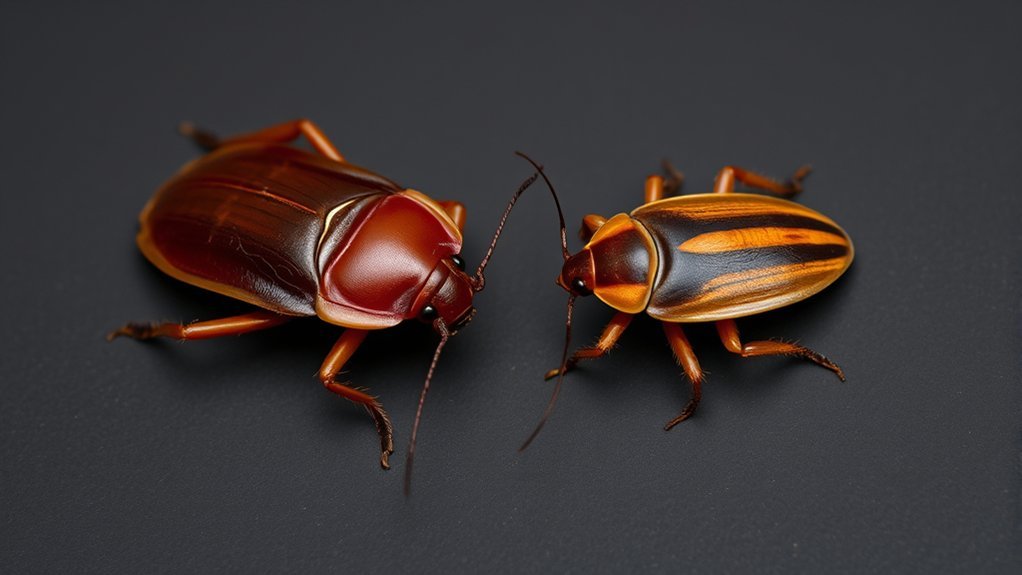
Telling a German cockroach apart from an American cockroach is easier than you’d think, starting with size. German cockroaches are roughly penny-sized, measuring ½ to ⅝ inches long. American cockroaches are much larger, closer to thumb-sized, ranging from 1.25 to 2 inches long.
Color and markings also set them apart. German cockroaches are light brown to tan with two dark, parallel stripes running from their head down their back. American cockroaches are reddish-brown, featuring a yellowish figure-eight pattern behind the head and a faded yellow edge along the thorax.
Behavior offers additional clues. German cockroaches move fast, staying close to food and moisture while hiding in tight cracks. American cockroaches venture both indoors and outdoors and can actually fly short distances, especially in warm weather, while German cockroaches rarely use their wings despite having them. When it comes to where you spot them, German cockroaches are most commonly found in kitchens and bathrooms, while American cockroaches tend to show up in basements and around drains.
Where German and American Cockroaches Hide in Your Home
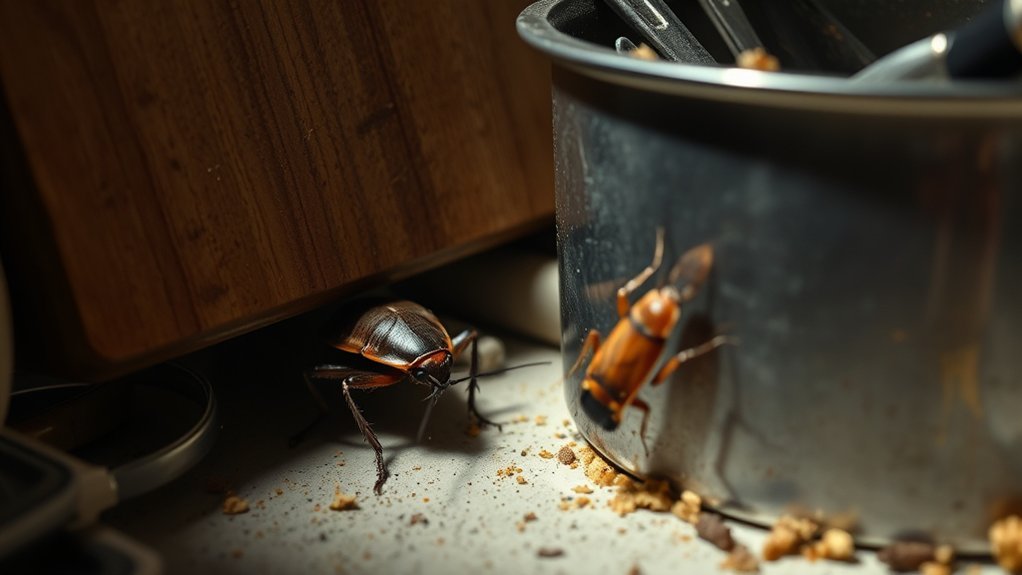
Now that you can spot the difference between these two species, knowing where each one hides helps you track down an infestation faster.
German cockroaches stick close to food, moisture, and warmth. Check under kitchen sinks, behind refrigerators, inside cabinet gaps, and around dishwashers. They’ll also hide behind stoves, inside microwaves, and within electronics like coffee makers and TVs. In bathrooms, look around plumbing lines, behind toilets, near leaky faucets, and around floor drains. They squeeze into wall voids, behind baseboards, through electrical outlets, and along crown molding gaps.
German cockroaches never stray far from food, moisture, and warmth — your kitchen and bathroom are their first home.
American cockroaches prefer darker, less-trafficked spaces. You’ll find them in attics with heavy clutter, crawl spaces, garages, and near water heaters. They thrive in basements and utility areas where moisture collects and human activity stays low.
Both species exploit clutter, leaks, and neglected spaces, so eliminating moisture and sealing entry points cuts off their most reliable hiding spots. Counter backsplash gaps and seams give roaches easy access to countertops where food and water sources are readily available.
Do German or American Cockroaches Reproduce Faster?
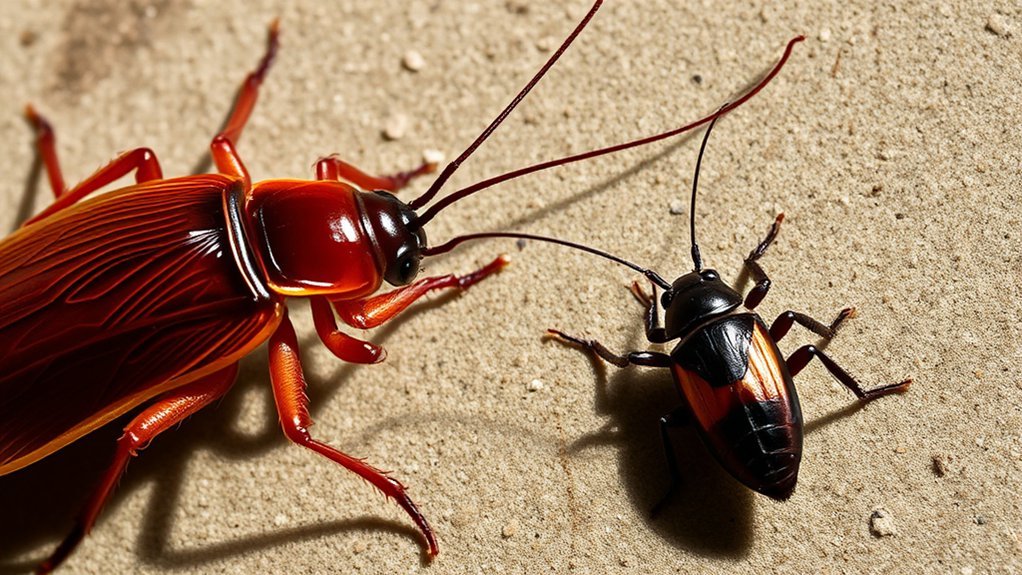
When comparing reproduction rates, the German cockroach wins by a wide margin, producing 30-48 eggs per case every 20-30 days while the American cockroach lays only 14-16 eggs per case at a much slower pace. A single German female can generate up to 30,000 descendants within a year, reaching breeding age in just 70-100 days compared to the American cockroach’s 6-12 month development timeline. This faster life cycle means a German cockroach infestation can spiral from a handful of insects to thousands in as little as 4-6 months, making early intervention critical. Female German cockroaches also carry their egg capsules on their bodies until they are ready to hatch, further protecting offspring survival rates.
German Cockroach Egg Production
German cockroaches reproduce faster than any other common household cockroach species, and the numbers behind their egg production make that clear. Each female produces 5–8 egg cases in her lifetime, with every case containing 30–48 eggs at an 80–90% hatch rate.
| Metric | Details |
|---|---|
| Eggs per case | 30–48 eggs |
| Lifetime egg cases | 5–8 per female |
| Total lifetime eggs | 200–250 eggs |
A new egg case develops every 20–30 days, and females carry each case for roughly three weeks before it hatches. Temperature plays a major role—at 86°F, eggs hatch in 28 days, but drop to 70°F and that stretches to 60 days. One female can ultimately generate up to 400 offspring in her lifetime. German cockroaches also boast a near 90–95% survival rate, making their populations especially difficult to control once established.
American Cockroach Breeding Timeline
Compared to the German cockroach, the American cockroach reproduces at a noticeably slower pace across every stage of its lifecycle. Its eggs take 6–8 weeks to hatch, and nymphs need 6–12 months to reach adulthood. That’s considerably longer than the German cockroach’s roughly 100-day development window.
Females produce only 9–10 oothecae in their lifetime, each containing 12–16 eggs. Mated females drop a new ootheca every 4 days, while unmated ones take 10 days. If you’re dealing with an infestation, you’ll notice population growth is slower but still persistent. Adults live 1–2 years, meaning each cockroach contributes to reproduction over an extended period, making elimination a long-term effort despite the species’ comparatively slower breeding pace. Unlike the German cockroach, which thrives in heated indoor environments year-round, the American cockroach’s reproductive activity is more vulnerable to temperature fluctuations and cooler conditions.
Life Cycle Speed Comparison
Now that you’ve seen how both species breed individually, putting their timelines side by side makes the speed gap impossible to ignore. German cockroaches reach adulthood in roughly 100 days, while American cockroaches take 6–12 months. That difference compounds fast once a population establishes itself indoors.
| Factor | German Cockroach | American Cockroach |
|---|---|---|
| Egg-to-adult timeline | ~100 days | 6–12 months |
| Lifetime eggs per female | 200–400 | 140–160 |
| Egg cases per female | 5–8 | 10 |
| Breeding speed | 2–4x faster | Considerably slower |
German cockroaches breed year-round in heated spaces, meaning populations double faster and recover more quickly after treatment. If you’re dealing with German roaches, you’re fighting a species that’s biologically designed to outpace your control efforts.
Why German Cockroaches Are Harder to Eliminate Than American Cockroaches
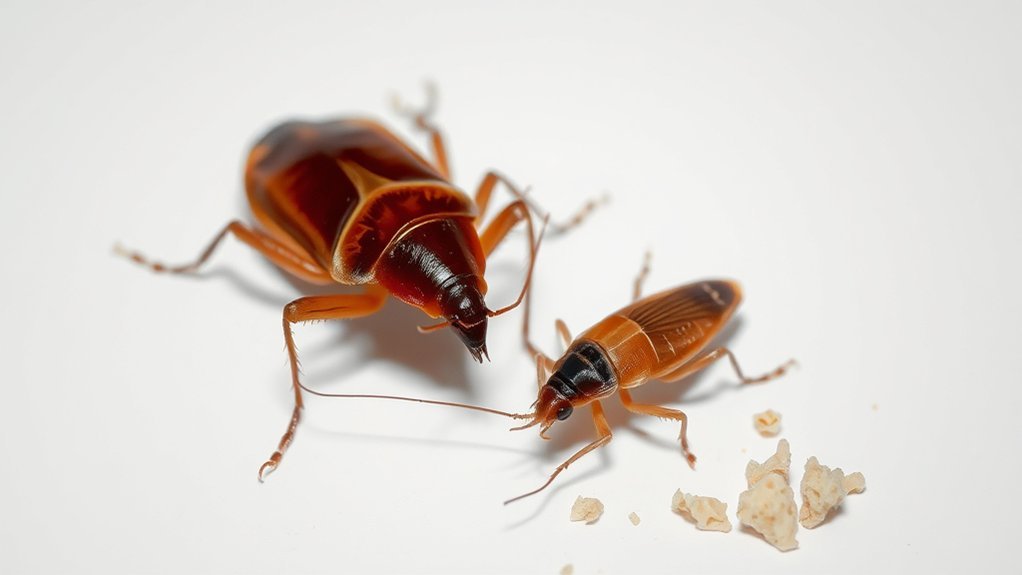
When you’re dealing with German cockroaches, their rapid reproduction cycle works directly against you—a single female can produce up to 400 offspring, and populations can explode within months before you even realize there’s a problem. Unlike American roaches, which tend to scatter in visible areas where treatment is more straightforward, German cockroaches stay buried in tight cracks behind appliances, inside cabinets, and near moisture sources where sprays and foggers can’t reach them. These two factors—unchecked breeding and deep hiding behavior—combine to make German cockroach infestations notably harder to control than American roach problems.
Fast Reproduction Cycles
German cockroaches reproduce faster than American cockroaches, and that speed is a big reason they’re so much harder to eliminate. A German female carries her ootheca until just before hatching, protecting 30–40 eggs per capsule. She produces 4–8 oothecae in her lifetime, with a new one forming every few weeks. Once deposited, those eggs hatch within hours.
American cockroaches drop their oothecae shortly after formation, leaving eggs more vulnerable. Each capsule holds only 14–16 eggs, and hatching takes 6–8 weeks.
German nymphs can mature in as little as six weeks, keeping populations dense—about 75% of a German cockroach population consists of nymphs at any given time. That constant cycle of reproduction makes every missed egg a future infestation.
Deep Hiding Behavior
Size alone explains much of why German cockroaches are so stubborn to eliminate. Measuring only ½ to ⅝ inch long, they squeeze into cracks and crevices that American cockroaches, at 1.5 to 2 inches, simply can’t reach. You’re dealing with insects that disappear into cabinet hinges, electrical outlets, dishwasher panels, and wall voids the moment you disturb them.
Their nymphs are even smaller and light-colored, making detection nearly impossible in concealed spaces. When you spot one during daylight, hundreds more are already hiding nearby. Surface treatments rarely penetrate deep enough to reach these harborages. German cockroaches concentrate within 16 feet of water sources, forming dense colonies in warm, humid spots that standard pest control methods struggle to access effectively.
How to Treat a German Cockroach Infestation
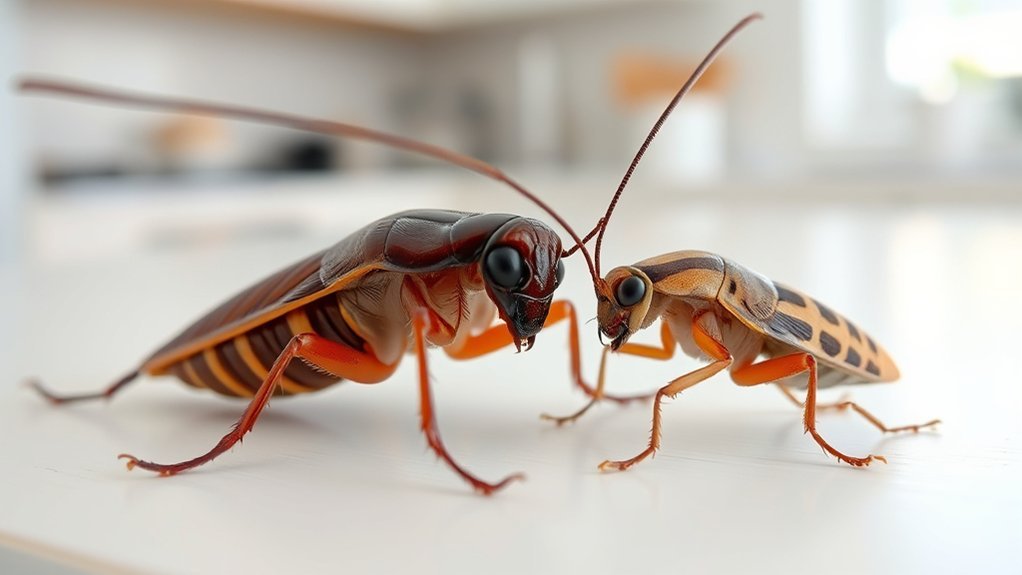
Treating a German cockroach infestation starts with a thorough inspection — check under sinks, behind refrigerators, and around washing machines to gauge the severity. Look for egg capsules too, since one capsule alone can produce 30–50 roaches.
Next, vacuum up roaches, egg capsules, and debris using a shop vac — this alone can reduce heavy infestations by 98%. Declutter, seal cracks and crevices, and eliminate any sanitation issues.
A shop vac alone can eliminate up to 98% of a heavy German cockroach infestation.
For treatment, apply Advion gel bait in pea-size spots at hiding places, using larger amounts in heavily infested areas. Combine baits with insecticidal dusts like boric acid or diatomaceous earth behind appliances. Add Gentrol IGR disks under sinks to disrupt roach development.
Avoid wet sprays near active baits, as German cockroaches resist them and they’ll repel rather than kill. Re-apply baits at 3, 6, 9, and 12 months, and follow 90-day inspection cycles to prevent re-establishment.
How to Get Rid of American Cockroaches
Getting rid of American cockroaches starts with a thorough inspection — use UV lights and moisture meters to locate colonies in wall voids, crawl spaces, basements, and behind appliances. Check baseboards, drains, pipe openings, and floor drains for entry points, then seal them with caulk, steel wool, or foam spray. Install door sweeps and mesh screens to block additional access.
Eliminate what attracts them by fixing leaks, storing food in airtight containers, cleaning drains weekly, and removing clutter or rotting debris. Keep firewood elevated and away from your home.
For treatment, apply D-Fense Dust in wall voids and crevices, use residual sprays like Cyzmic CS along baseboards and a 3–6 foot perimeter band, and deploy Advion Gel in hotspots. Conduct multiple treatments spaced 1–2 weeks apart, and monitor with sticky traps for 30–60 days post-treatment to confirm full elimination.
German vs American Cockroach: Which Is the Bigger Infestation Threat
When comparing these two species, German cockroaches pose the far greater infestation threat. Their rapid reproduction and indoor persistence make them far harder to control than American cockroaches.
Here’s why German cockroaches are more dangerous:
- Reproduction speed – A single female produces up to 30,000 nymphs per year, creating exponential indoor population growth.
- Indoor permanence – They establish hidden colonies near food and moisture, requiring multi-step treatments targeting every life stage.
- Daytime activity – Spotting them during daylight signals a severely overcrowded infestation already underway.
American cockroaches, by contrast, are mostly occasional invaders from outdoor harborages. You can control them with perimeter treatments and by sealing entry points. They don’t establish permanent indoor colonies the way German cockroaches do.
If you’re dealing with German cockroaches, expect a more intensive eradication process. Early action is critical before populations spiral out of control.
When to Call a Professional for Cockroach Extermination
Knowing you’re facing a German cockroach infestation is one thing — knowing when to stop fighting it yourself is another. Both species signal serious problems when infestations escalate beyond DIY control.
Call a professional when you notice these warning signs:
| Warning Sign | What It Means | Action Required |
|---|---|---|
| Multiple roaches spotted | Active infestation present | Immediate professional inspection |
| Egg cases in multiple locations | Hidden breeding sites exist | Thorough professional treatment |
| Failed DIY treatments | Possible insecticide resistance | Commercial-grade intervention needed |
| Health symptoms worsening | Pathogen exposure risk increasing | Swift professional extermination |
| Daytime roach sightings | Severe overcrowding in colony | Emergency professional assessment |
Professional extermination typically costs $100–$400, though severe infestations can reach $6,000. Delaying professional help only expands the infestation and raises your costs. Since female cockroaches produce over 10,000 descendants annually, acting fast isn’t optional — it’s essential.
Frequently Asked Questions
Can German and American Cockroaches Interbreed or Coexist in the Same Home?
They can’t interbreed since they’re different genera with incompatible genitalia, but they can coexist in your home, competing for food and space while remaining completely separate populations.
Are German or American Cockroaches More Likely to Spread Disease?
German cockroaches are more likely to spread disease in your home. They’re reproducing faster, carrying bacteria on every body part, and they’re contaminating your food surfaces, dry goods, and utensils with a single touch.
Do Cockroach Infestations Affect Property Value or Real Estate Transactions?
Yes, cockroach infestations can seriously hurt your property’s value and complicate real estate transactions. They’ll deter buyers, trigger price reductions, delay sales, and create health code violations that could even shut your property down.
Can Pets Like Cats or Dogs Help Detect or Deter Cockroaches?
Your pets can help detect and deter cockroaches! Dogs sniff out infestations with up to 96% accuracy, while cats chase roaches instinctively. However, they can’t eliminate established colonies effectively.
Are German or American Cockroaches More Resistant to Common Pesticides?
German cockroaches are harder to kill with common pesticides. They’ve developed resistance up to 358-fold against pyrethroids, and you’ll find they survive 10x the label rate of many insecticides other species can’t withstand.
Conclusion
Whether you’re dealing with German or American cockroaches, you’ll want to act fast before an infestation grows out of control. German cockroaches are harder to eliminate due to their rapid reproduction and resistance to pesticides, but neither species should be ignored. If DIY treatments aren’t working, don’t hesitate to call a professional exterminator. The sooner you tackle the problem, the better your chances of reclaiming your home.
