
Cockroach Nymph: How to Identify Baby Roaches at Every Stage
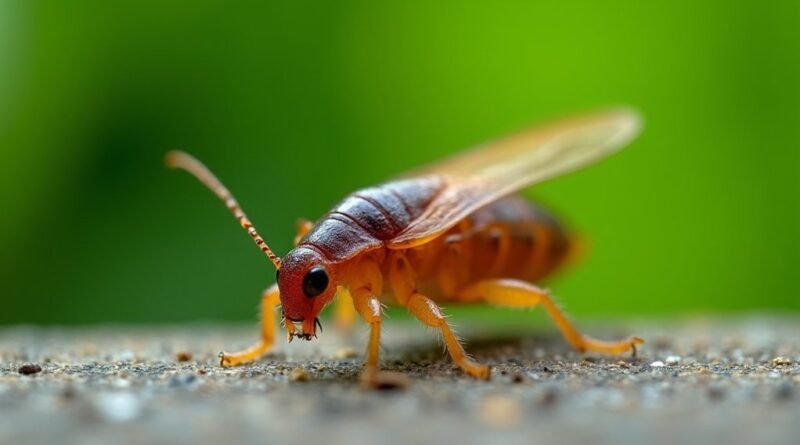
Cockroach nymphs look like smaller, wingless versions of adults, with flat oval bodies, long antennae, and six spiny legs. They hatch white or transparent, then darken within hours into species-specific colors. German nymphs start at just 1/8 inch, while American nymphs hatch closer to 1/4 inch. Color, size, and body shape help you pinpoint the exact species you’re dealing with. Keep going to learn what every stage reveals about your infestation.
Key Takeaways
- Cockroach nymphs resemble adults but are smaller, lack fully developed wings, and have proportionally longer legs with thread-like antennae.
- Newly hatched nymphs appear white or transparent, darkening within hours to species-specific colors like brown, reddish-brown, or black.
- Size helps identify species: German nymphs hatch at 1/8 inch, while American and Oriental nymphs hatch closer to 1/4 inch.
- A temporary white phase occurs after each molt, making recently molted nymphs distinguishable regardless of their development stage.
- Mixed nymph sizes indicate overlapping generations, while tiny nymphs alone suggest an early-stage infestation requiring immediate attention.
What a Cockroach Nymph Actually Looks Like
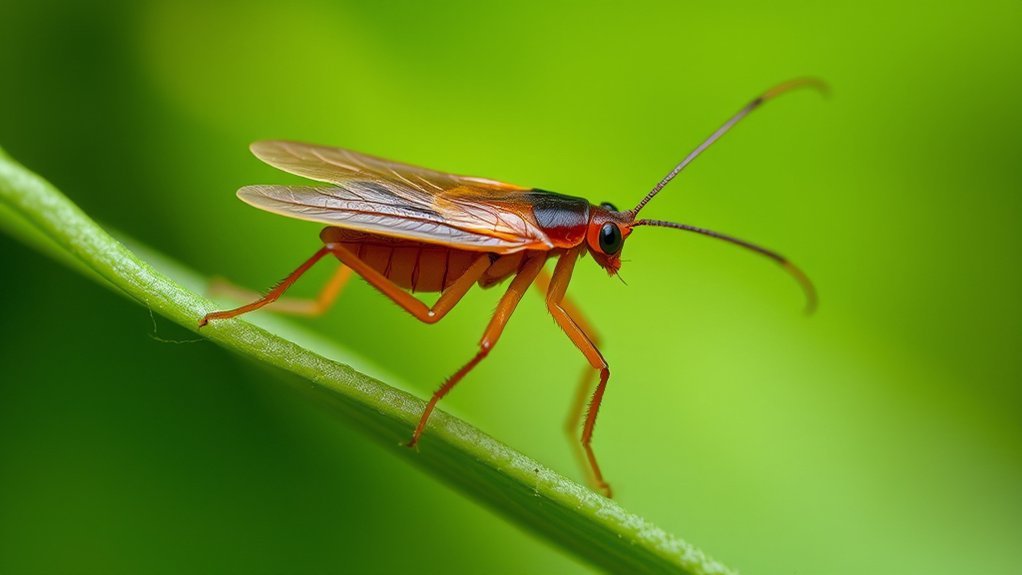
Baby cockroaches, known as nymphs, share the same flattened, oval-shaped body as adults but are noticeably smaller and lack fully developed wings. You’ll notice three distinct segments — head, thorax, and abdomen — along with long, thread-like antennae and six spiny legs. Their legs are proportionally longer than an adult’s relative to body size, making them fast and difficult to catch.
One detail that often surprises homeowners is the nymph’s color right after molting. For a brief period, they appear white or nearly transparent before their exoskeleton hardens and darkens within hours. Nymphs hatch from protective egg capsules called ootheca, which can contain multiple eggs at once.
As nymphs grow, their coloration shifts depending on species. German cockroach nymphs carry two dark parallel bands down their backs. American nymphs gradually darken from grayish to reddish-brown. Oriental nymphs shift from reddish-brown to glossy black. These color patterns, combined with wingless bodies, are your clearest visual clues you’re dealing with nymphs, not adults.
How Big Are Cockroach Nymphs at Each Stage?
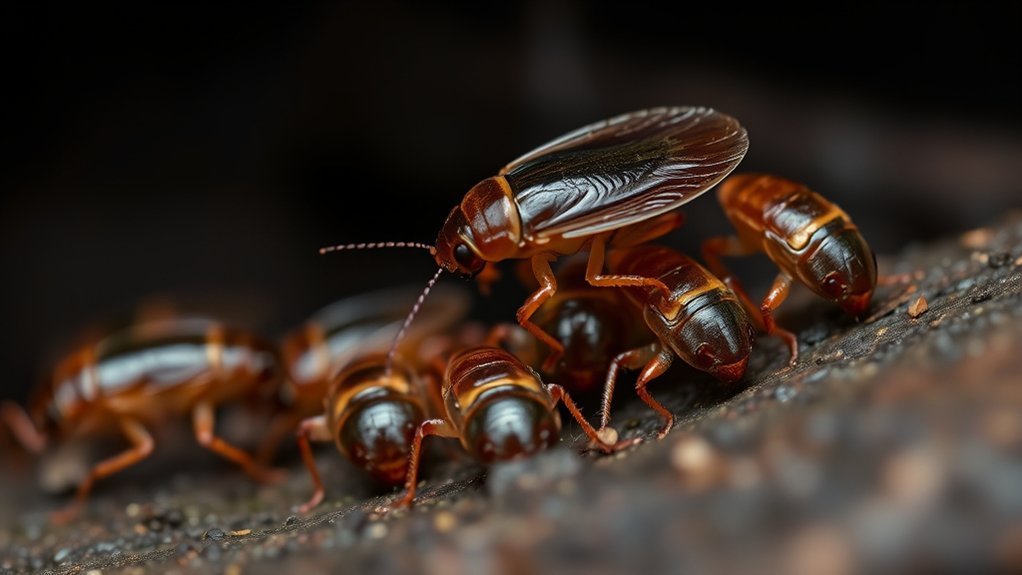
Nymph size varies considerably by species, and knowing what to expect at each stage helps you gauge how established an infestation might be.
American and Oriental cockroach nymphs both hatch at roughly 1/4 inch, making them the largest at emergence. Smoky brown nymphs start slightly bigger at 3/8 inch, though they’re still well below their 1.5-inch adult size. German and brown-banded nymphs hatch at just 3 mm, or 1/8 inch, making them the hardest to spot early on.
Development timelines differ just as much as size. Oriental nymphs take the longest, developing up to 600 days, while American nymphs range from 65 to 400 days. German and brown-banded nymphs mature faster, completing development in around 100 to 300 days.
Oriental nymphs can take up to 600 days to mature—nearly twice as long as most German or brown-banded roaches.
If you’re spotting tiny 3 mm nymphs, you’re likely dealing with German or brown-banded roaches. Larger nymphs suggest American, Oriental, or smoky brown species. When nymphs first hatch, they appear white before darkening over the course of several hours as their exoskeletons toughen up.
How Cockroach Nymph Color Changes as They Grow
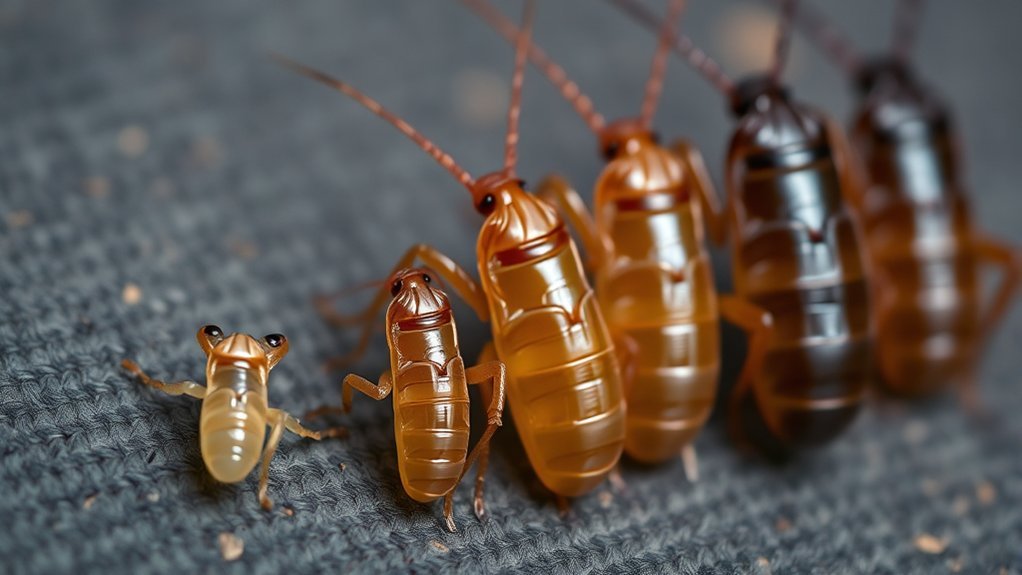
When a cockroach nymph first hatches, it appears white or pale before its exoskeleton hardens and darkens within hours. As it progresses through each instar, its color shifts in ways unique to its species—American cockroaches move from gray-brown to reddish-brown, German cockroaches darken from brown-black while retaining their signature head bands, and Oriental cockroaches deepen from reddish-brown to nearly black. Recognizing these species-specific color patterns at each stage can help you identify exactly what you’re dealing with before the roach reaches adulthood. Oriental cockroaches are also notable for their shiny appearance, which becomes more pronounced as they darken through successive molts.
Freshly Hatched White Phase
Freshly hatched cockroach nymphs emerge white or pale because their exoskeletons haven’t hardened yet. This white phase lasts only a few hours before the exoskeleton hardens and species-typical coloration develops. You’ll notice the same temporary whiteness after each molt, not just at hatching.
Each species alters differently once hardening begins. German cockroach nymphs shift to dark brown or black while retaining their signature head bands. American cockroach nymphs turn gray-brown first, then develop reddish-brown tones through later molts. Oriental cockroach nymphs move from white to red-brown, eventually darkening to nearly black. Smoky brown nymphs develop dark brown to black coloring with white bands, with antennae tips remaining white in the early hardened stage.
Recognizing this brief white phase helps you identify nymphs before their permanent coloration develops. The nymph phase lasts about one to three months before the final molt transforms them into reproductive adults.
Progressive Darkening by Instar
After each molt, cockroach nymphs pass through a brief white phase before their exoskeleton hardens and darkens into species-typical coloration. Tracking these color shifts helps you pinpoint which species you’re dealing with and how far along its development it is.
American cockroach nymphs start grayish-brown, then gradually develop a reddish-brown hue across 10–13 molts. German cockroach nymphs hatch at 3 mm, darken to nearly black, and reveal two parallel lines on the pronotum by later instars. Brown-banded nymphs maintain dark brown coloration with two yellow bands throughout their 6–8 molts. Smoky brown nymphs begin dark brown to black with white bands, then lighten to reddish-brown in later instars. Each species follows a predictable color progression that ends at the final molt with full adult coloration. German cockroach nymphs are wingless throughout all of their instars, undergoing six to seven molts before reaching the adult stage.
Species-Specific Color Patterns
Each cockroach species follows its own color progression from hatching to adulthood, and recognizing these patterns is one of the most reliable ways to identify what you’re dealing with.
| Species | Nymph Color | Adult Color |
|---|---|---|
| German | Tan with dark stripes | Darker brown with stripes |
| American | Gray-brown to reddish-brown | Reddish-brown |
| Oriental | Reddish-brown to dark brown | Jet-black |
| Smoky Brown | Dark brown with white bands | Uniform mahogany |
Brown-banded nymphs stand out with their dark brown bodies and two distinct light-colored bands across the abdomen and thorax—bands that actually sharpen as they mature. If you spot those contrasting bands early, you’ve already narrowed your identification considerably.
German vs. American Cockroach Nymph: Key Visual Differences
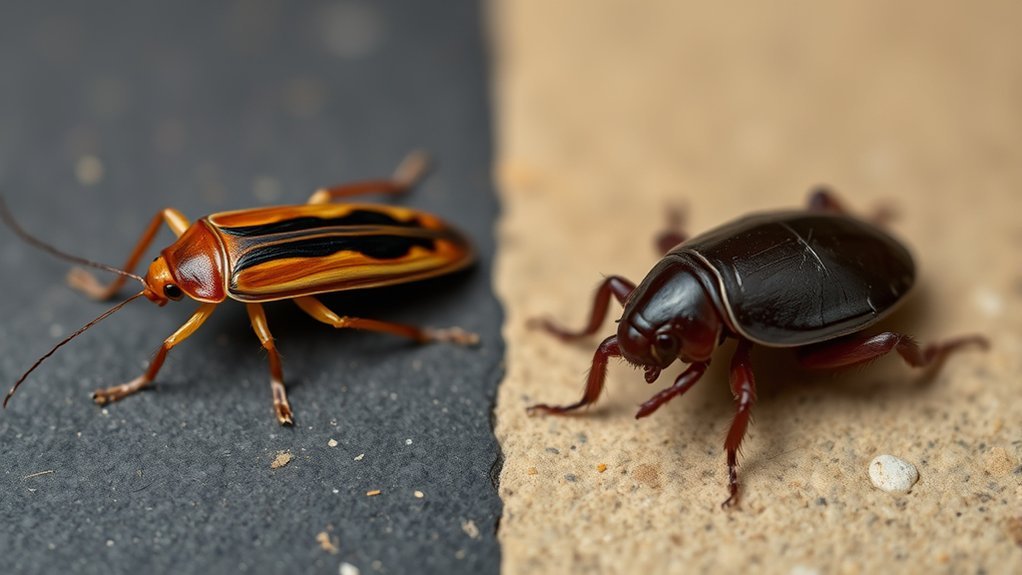
When you spot a baby roach, two visual clues help you identify the species fast: color markings and size. German cockroach nymphs display two dark parallel stripes on their thorax and stay noticeably small, while American nymphs show no stripes but carry a distinctive yellow head marking and already rival the size of an adult German roach. You’ll find that American nymphs grow considerably larger throughout their development, making size alone a reliable distinguishing factor even in early stages.
Markings and Color Differences
Two key visual differences set German and American cockroach nymphs apart: their stripe patterns and color progressions. German nymphs display two bold dark stripes running from head to wings, while American nymphs show no stripes at all.
Here’s what you’ll notice as each species matures:
- German nymphs hatch white, darken within hours, and develop a visible light patch on their back
- American nymphs hatch whitish, shift to gray-brown, then gradually redden
- German nymphs retain their stripes and lighter body contrast throughout all stages
- American nymphs experience uniform color darkening without distinct markings
- German nymphs stay smaller and darker; American nymphs grow larger and develop reddish-brown tones
Recognizing these differences helps you identify which species you’re dealing with quickly and accurately.
Size and Growth Rates
Size tells you a lot about which cockroach nymph you’re dealing with. German nymphs hatch at just 1/8 inch—roughly rice-sized—and max out around 3/8 inch before molting into adults. They’re tiny throughout every stage, which often leads to misidentification. American nymphs, by contrast, hatch between 1/4 and 5/16 inch and grow up to 30 mm before reaching adulthood at 1.5–2 inches.
Growth rates differ just as sharply. German nymphs complete their nymph stage in weeks, cycling through 5–7 molts at a rapid pace. American nymphs develop slowly over several months, with eggs taking 50–55 days just to hatch. If you spot a large, oval-shaped nymph, it’s almost certainly American. A tiny, fast-moving one is likely German.
What Cockroach Nymph Size Reveals About Your Infestation
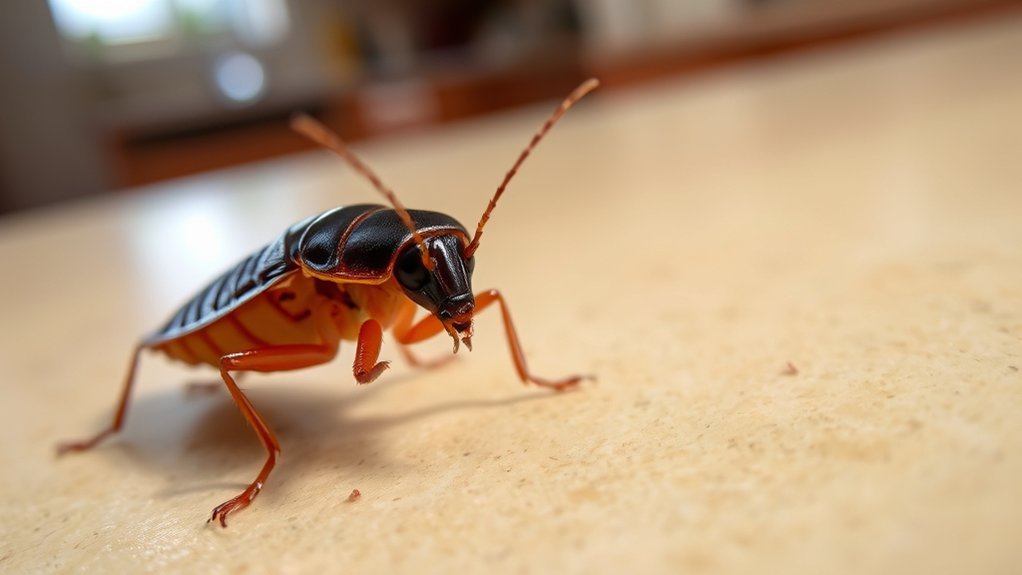
Cockroach nymph size tells you more than you might expect—it’s one of the clearest indicators of how far an infestation has progressed. When you spot nymphs, their size reveals the colony’s current development stage:
- 3–10 mm German nymphs signal an early-stage infestation with active reproduction
- American nymphs approaching 30 mm confirm multiple generations and advanced colony establishment
- Brown-banded nymphs under 10 mm indicate recent hatching activity
- Mixed sizes within one infestation suggest overlapping generations and a well-established colony
- Larger nymphs across all species mean reproduction has continued unchecked for weeks or months
If you’re seeing only tiny nymphs, you’ve likely caught the infestation early. However, spotting a range of sizes—from freshly hatched to near-adult—means the colony has been breeding for some time. Act quickly regardless, since even small nymphs reach reproductive maturity faster in warm, humid environments.
Why Seeing Nymphs Means the Colony Is Already Established
Beyond what nymph size reveals about infestation timing, the presence of nymphs at all carries an even more urgent message—the colony is already established. Spotting even one nymph confirms that adult males and females are already breeding nearby. Nymphs don’t travel far from their hatching site, so where you see one, dozens more are hiding in cracks and crevices.
The infestation didn’t start recently. Adults already found suitable conditions, established a nest, and completed at least one full reproductive cycle before you noticed anything. A single female can lay multiple egg cases after just one mating, each containing up to 50 eggs, ensuring continuous hatching.
You’re also likely dealing with multiple life stages simultaneously. Different nymph sizes mean reproduction has been happening over time, not as a single event. Acting immediately matters because German cockroaches mature in as little as 50–60 days, rapidly expanding the colony.
Frequently Asked Questions
How Long Does a Cockroach Nymph Live Before Becoming an Adult?
You’re looking at a nymph stage that lasts anywhere from a few months to over a year, depending on the species, with German cockroaches maturing fastest at around 103 days and Oriental cockroaches taking up to 800 days.
Can Cockroach Nymphs Reproduce Before Reaching the Adult Stage?
No, cockroach nymphs can’t reproduce before reaching adulthood. They must complete all their molts first. You’ll only see reproduction begin after a nymph completes its final molt and becomes a fully mature adult.
What Do Cockroach Nymphs Eat to Survive and Grow?
Cockroach nymphs eat a varied diet to survive and grow. You’ll find they consume fruits, vegetables, proteins, and carbohydrates, while their symbiotic bacteria help them thrive even on nutritionally poor food sources.
Are Cockroach Nymphs Harmful to Humans or Capable of Spreading Disease?
Yes, cockroach nymphs can harm you by spreading dangerous pathogens like Salmonella, E. coli, and Staphylococcus. They’ll contaminate your food and surfaces, triggering allergies, asthma, and serious diseases, including typhoid fever and dysentery.
Where Do Cockroach Nymphs Typically Hide Inside a Home?
Cockroach nymphs hide in your kitchen’s darkest corners, under appliances, inside cabinet hinges, near leaky pipes, and within wall voids. They’ll squeeze into cracks as tiny as 1/16 inch, favoring warm, moist, confined spaces.
Conclusion
If you’re spotting cockroach nymphs, don’t wait to act. You’ve already learned how to identify them by size, color, and species, so use that knowledge to assess how serious your infestation really is. Finding nymphs means a breeding colony is actively growing in your home. The sooner you treat the problem, the better your chances of stopping it before it spreads. Don’t let small roaches become a much bigger issue.
