
Creatine and Weight Gain: Water, Muscle and What the Scale Shows
You’ll likely see the scale climb 0.7 to 1.6 kg in your first weeks on creatine, but that’s water, not fat. Creatine pulls water into your muscle cells, and stores saturate within two to four weeks. Real muscle growth shows up between weeks four and twelve if you train consistently. Creatine has no calories, so only a surplus adds fat. Stick around, and you’ll soon find out how to track your results beyond the scale.
Key Takeaways
- Creatine typically raises scale weight by 0.7 to 1.6 kg in the first weeks, mainly because muscle cells pull in extra water.
- A 5-7 day loading phase can add up to 1 liter of water, and this often happens before any visible muscle growth.
- Creatine contains no calories, so it does not add body fat; fat gain comes only from a sustained caloric surplus.
- Real lean mass gains usually appear between weeks four and twelve, and only with consistent resistance training and adequate nutrition.
- Track strength, jump height, sprint times, body-fat percentage, and DEXA scans rather than relying on daily scale fluctuations.
Does Creatine Cause Weight Gain?
Does creatine make the number on your scale go up? Usually, yes, but it doesn’t add body fat. Creatine contains no calories, so it can’t directly drive fat storage.
Instead, you’re seeing water and muscle. Creatine pulls water into your muscle cells, and you’ll typically gain about 0.7 to 1.6 kg in the first weeks. That early jump often shows up before you notice any visible muscle growth. A loading phase of 5-7 days at higher doses can cause up to 1 liter of water retention.
Creatine pulls water into your muscle cells, so expect to gain 0.7 to 1.6 kg in the first weeks, often before any visible muscle growth.
Over time, creatine helps you train harder, which supports lean mass. When you pair it with resistance training, meta-analyses show you’ll build more lean tissue than placebo alone, and some studies also report lower body fat percentage.
Creatine alone, however, doesn’t markedly change body composition.
How Much Water Weight Does Creatine Add in Week One?
You’ll see the biggest scale jump in week one, especially if you load. Most people gain about 1 to 3 kg on a 20 g/day loading phase for 5 to 7 days, though many land closer to 1 to 2 kg. Without loading, you’ll gain more slowly and less.
That gain is water, not fat. Creatine pulls water into your muscle cells, so your total body water rises. One study measured a 1.37 L increase in the first week.
Here’s what to expect:
- Don’t panic when the scale jumps; your body is hydrating your muscles, not storing fat.
- Feel reassured: one trial’s 0.5 kg early lean-mass edge faded toward control levels later.
- Expect variety; some of you’ll gain a lot, others barely anything.
- Enjoy the payoff: your muscles may look slightly fuller, not puffy.
Your scale reflects fluid shifts early, so judge progress by weeks, not days. In a 12-week UNSW-led trial of 54 participants, both the creatine and non-creatine groups gained an average of 2 kg of lean mass.
When Does Creatine Water Weight Turn Into Muscle?
Creatine water weight doesn’t actually turn into muscle; it shows up first, and real muscle growth follows only if you train consistently.
In week one, you’ll mostly gain water. Creatine pulls fluid into your muscle cells, and your scale climbs before you’ve built any new contractile tissue. This temporary gain is usually only 1 to 2 kg, and it is not a sign of fat gain.
Body-composition scans like DXA can count that fluid as lean mass, so you might think you’ve gained muscle when you haven’t.
Your stores saturate within two to four weeks, and the water-related changes stabilize. From there, progressive resistance training drives the real change. Expect training-related gains between weeks four and twelve, totaling 1 to 3 kg of lean mass, depending on your training status and nutrition.
Both effects overlap, so you won’t see a clean handoff. Over time, the intracellular water tracks with your muscle mass rather than staying separate.
Judge progress by your strength and measurements, not the scale alone.
Can Creatine Weight Gain Be Body Fat?
If the scale keeps climbing, it’s natural to wonder whether some of that weight is fat. The evidence says creatine isn’t the culprit. It contains no calories, and randomized trials lasting one week to two years haven’t shown increased fat mass. Your early jump of 1–3 kg usually reflects water inside your muscle cells. This initial increase in body weight comes from water retention, not fat.
Consider what that means for you:
- You’re not “getting fatter”; you’re hydrating your muscles.
- Your training is building lean tissue that raises your weight.
- You’ve earned that progress, so don’t panic or quit.
- Your body fat can stay stable or even fall.
Fat gain can still happen, but calories cause it, not creatine. If you eat more than you burn, you’ll store fat regardless of supplements.
Track your body-fat percentage closely alongside your scale weight. If your weight rises while your body-fat percentage holds steady or improves, you’re seeing composition change, not fat accumulation.
How Can You Track Creatine Results Beyond the Scale?
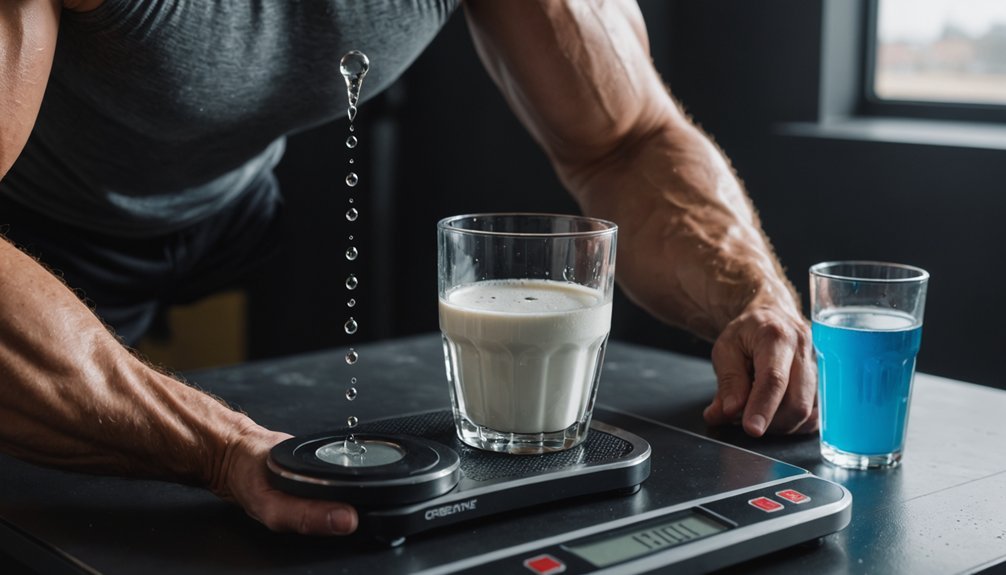
How do you know creatine is working when the scale can’t tell you? Track performance markers instead. Log repeated strength tests on the same lifts, and note your reps, load, and total volume. Jump height, sprint time, and bar speed can reveal power gains the scale misses. Compare sessions under similar sleep, food, and training conditions, and focus on trends rather than day-to-day swings.
Measure body composition. Fat-free mass tells you more than body weight, since early gains of about 1–3 kg often come from water. DEXA and bioelectrical impedance can detect lean mass changes, but hydration affects both, so you’ll want trends across several measurements, not one scan.
Watch hydration signals. Keep your fluid intake consistent, and check urine color. Interpret early scale jumps alongside these signals.
Check whether you’re completing more sets or reps at the same perceived effort; that’s a sign your work capacity‘s improving.
Frequently Asked Questions
Will the Water Weight Go Away if I Stop Taking Creatine?
Yes, you’ll lose the water weight after you stop creatine. Your muscles will release the extra water as creatine levels fall, usually over four to six weeks. You won’t lose muscle if you keep training.
Do I Need a Loading Phase to See Results?
No, you don’t need a loading phase. Taking 3 to 5 grams daily still saturates your muscles, though it takes about four weeks. Loading speeds things up, and it might cause water weight or bloating.
Does Creatine Cause Bloating or Stomach Discomfort?
It can, but you won’t always notice. You may feel temporary water puffiness, especially during loading, and large single doses over 10 grams can upset your stomach. Skip loading, split servings, take it with meals.
Can I Take Creatine While Trying to Lose Weight?
Yes, you can take creatine while losing weight. It won’t cause fat gain, though you might see temporary water weight early on. Keep your calorie deficit, lift weights, and track waist measurements, not the scale.
Does Creatine Affect Men and Women Differently?
Yes, slightly. You’ll likely see bigger strength and lean-mass gains if you’re a man, while women often start with lower creatine stores. You’ll both gain temporary muscle water weight, not fat, and you’ll both benefit.
Conclusion
Creatine can raise your scale weight, but it’s rarely a sign you’re gaining fat. You’ll likely see a quick jump from water pulled into your muscles, followed by slower gains as training builds real tissue. Don’t panic over early numbers. Instead, track your lifts, take measurements, snap progress photos, and watch how your clothes fit. If you stay consistent with your workouts and nutrition, you’ll see what the scale can’t always show you.