

How Lifters Can Choose a Creatine Without Overpaying
Choose creatine monohydrate, because it’s the most studied form and usually costs the least. You don’t need pricey upgrades like HCl or buffered creatine, since they haven’t shown better results. Aim for 3 to 5 grams daily, and check the grams per serving on the label. Compare cost per serving, not per tub, and look for NSF or Informed Choice seals. The details below will help you spot every sneaky red flag before you buy.
Key Takeaways
- Choose creatine monohydrate, since it is the most studied and effective form and costs less than premium alternatives.
- Skip pricier forms like HCl, ethyl ester, and buffered creatine, which offer no proven advantage over monohydrate.
- Check grams per serving and aim for 3–5 grams daily, because vague “scoop” or tablet counts can hide underdosing.
- Compare cost per effective dose by dividing price by servings, noting that capsules often cost more and large tubs aren’t always cheaper.
- Choose products with NSF Certified for Sport or Informed Choice seals and clear labels, avoiding proprietary blends and terms like “matrix.”
Choose Creatine Monohydrate First
If you’re shopping for creatine, start with monohydrate. It’s the most studied form, and reviews consistently call it the most effective option for boosting high-intensity exercise capacity and lean body mass. Hundreds of clinical trials back it, and researchers have reported few side effects in healthy users.
You’ll likely notice the benefits in your training. Monohydrate raises muscle creatine stores by roughly 15% to 40%, which helps you squeeze out more repetitions at a given weight and complete more total volume. Its absorption rate is over 99%, so alternatives like creatine ethyl ester have no proven advantage in how well your body takes them up.
Studies report improvements of about 5% to 15%, mostly in short, intense efforts rather than endurance work.
Safety is straightforward. It’s Generally Recognized as Safe in the United States, and healthy users haven’t shown adverse effects on kidney function. You might gain 1 to 2 kg of water weight in the first month.
If you have kidney disease, talk with your doctor first. It’s also the cheapest.
Skip Pricey Creatine Upgrades You Don’t Need
Monohydrate already does the job, so you can skip most of the other creatine products on the shelf. Premium forms mostly sell marketing, not measurable results. Don’t pay extra for these:
Creatine monohydrate already delivers results, so skip the premium forms, which mostly sell marketing instead of measurable gains.
- Creatine HCl: Recent studies show it doesn’t beat monohydrate, and researchers have called superiority claims “unfounded and misleading.” One mouse study on traumatic brain injury did find that Creatine HCl led to reduced brain cell damage, but those preclinical results still need human validation.
- Creatine ethyl ester: It raises muscle creatine less effectively and can convert to creatinine, so you’re buying instability.
- Buffered creatine: You’re paying for pH stability, not better training outcomes.
- Multi-ingredient blends: Extra ingredients raise the cost per serving faster than the creatine content, and they muddy price comparisons.
Branding deserves the same skepticism. Fancy tubs and influencer endorsements raise prices, but results depend on the creatine form and dose, not the packaging.
Choose powder over capsules or specialty delivery systems, since it costs less per serving. Prioritize third-party testing and transparent labels over luxury branding. They protect your wallet.
Know the Creatine Dose You’re Paying For
Two numbers decide what you’re really paying for: the grams of creatine in each serving and the number of servings you need per day.
Ignore pill counts, scoops, and stick packs. Check grams per serving.
Most guidance targets 3 to 5 grams daily for maintenance. If you load, you’ll take 20 to 25 grams daily for 5 to 7 days, or 0.3 grams per kilogram of body weight. Loading empties a tub fast. Skipping it works too, but buildup takes longer. Research shows that taking just 3 grams daily can reach similar muscle saturation in 28 days.
Read labels carefully. Three tablets might deliver only 3.6 grams, while a product with 1-gram tablets forces you to swallow several to reach a useful dose. A 5-gram serving fits maintenance neatly.
“Pure creatine monohydrate” doesn’t guarantee a generous serving, and a premium format won’t change the target dose.
Before you buy, divide the container’s total grams by your daily dose. That gives you days of use.
Compare Creatine Cost Per Serving, Not Per Tub
Divide the tub’s price by the number of servings to get your cost per serving. A 60-serving tub at $27.99 runs $0.47 per serving, while a 181-serving tub at $74.99 drops to $0.41, so the bigger tub isn’t always a bargain.
Check the serving size too, because you’re not getting a deal if a cheap product’s “serving” contains less creatine than the dose you actually need.
Calculate Price Per Serving
Don’t judge a creatine by the price on the tub. Container sizes and serving counts vary widely, so a cheaper tub can cost you more per dose. Use this process instead:
- Find the servings. Check the label for servings per container.
- Divide. Take total price divided by servings: $27.99 for 60 servings equals $0.47 per serving.
- Match the dose. If the label lists grams, convert to cost per gram, then compare standard 3–5g servings.
- Compare. Pick the lowest cost per standard dose, not the lowest sticker price.
Capsules often cost more per serving because you’ll need more of them to reach the same dose.
You’ll also see prices range from about $0.30 to $2.00 per serving, so the math really matters before you buy. Across the creatine products tracked on Amazon US, the median price is $0.299 per dose.
Spot Underdosed Products
How do you know a creatine product actually gives you a full dose? Skip the tub size and the unit count. Find the grams of creatine monohydrate per serving, and look for 5 g, or 5,000 mg.
Serving sizes below 5 g signal trouble. Labels list 4.2 g, 3.6 g, and 3 g servings, and capsules and tablets underdeliver most often. One product needs four capsules to reach just 3 g; another gives 3.6 g across three tablets. You’ll still pay for servings that don’t deliver.
Scrutinize labels using “about,” “approx.,” or teaspoon measures, since fill levels vary. Terms like “micronized,” “Creapure,” or “pure” describe form or source, not dose.
Prefer exact gram servings, then divide price by servings that truly deliver 5 g.
Look for Third-Party Tested Creatine
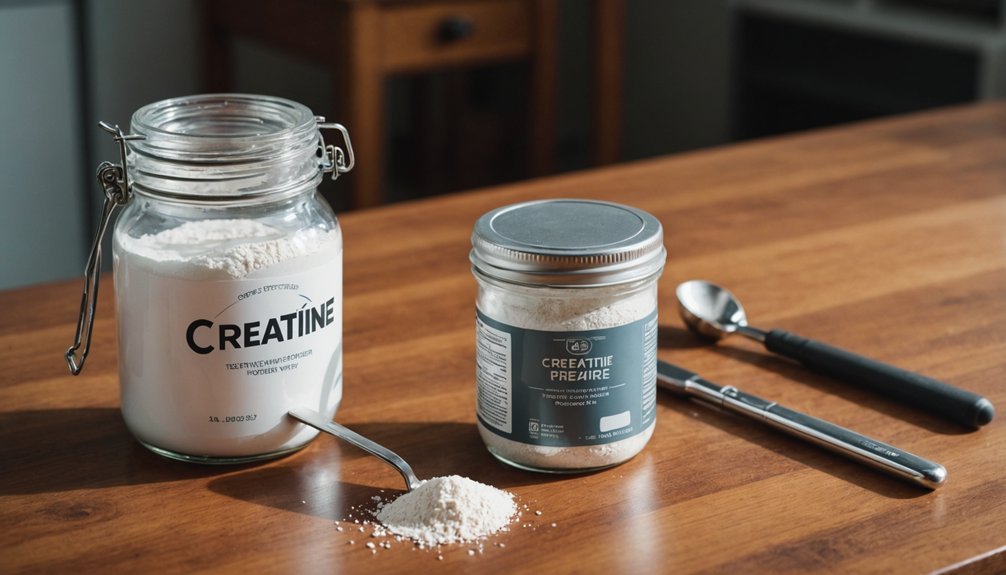
A creatine label can say “third-party tested” and still leave you guessing about what that means. A certification seal gives you stronger evidence, because you can check the product in a public listing. If you’re a drug-tested athlete, that verification matters most.
Use these steps before you pay a premium:
- Choose recognized programs. NSF Certified for Sport, Informed Choice, and BSCG screen for banned substances.
- Verify the listing. Search the registry for the exact product you’re considering.
- Compare price per serving. Most creatine servings are 5 g, so cost per serving shows the real price.
- Skip add-ons. If you want plain monohydrate, don’t pay extra for blends or flashy packaging.
Certification costs money, and that overhead often explains the higher price, not a better creatine molecule.
If you don’t compete in tested sports, a cheaper product with clear third-party verification may still serve you well. If you’re considering gummies, Lemme Inc. offers creatine gummies in Blue Raspberry and Sour Apple flavors, so check each listing for a certification seal before you buy.
Read the Creatine Label for Red Flags
Even after you’ve confirmed a product is third-party tested, the label can still reveal problems that make a creatine hard to trust.
You’ll want to watch for proprietary blends that hide the actual dose, serving sizes that don’t match the front-panel claims, and testing documentation that’s missing or vague.
Checking these three things takes just a minute and can keep you from paying for a product that doesn’t deliver what it promises.
Proprietary Blends and Hidden Doses
When you flip a creatine tub around, the first thing to look for is the phrase “proprietary blend.”
It’s the clearest red flag on the label, because it tells you the total weight of the blend but not how much of each ingredient is inside.
That means a product can contain 1–2 grams of creatine and still call itself a creatine supplement.
Check these four things before you buy:
- Find creatine listed as its own ingredient with an exact gram amount.
- Confirm the form is creatine monohydrate.
- Skip names like “matrix,” “complex,” or “performance blend,” because they’re marketing terms, not proof of dose quality.
- Look for a clear 3–5 gram creatine dose; if you can’t find one, treat the product as an underdose risk.
Unclear Serving Sizes
Once you’ve ruled out proprietary blends, check the serving size, because a label can hide a weak dose behind a vague measure.
Look for grams. Labels may say “5 gram(s),” “1 scoop,” or “1 tsp [5g],” but only the gram value tells you the dose. “1 scoop” alone is a red flag, since scoop sizes vary and you can’t verify the amount.
Teaspoons are just as shaky: one brand calls 5 g “1 tsp,” another says “about 2 tsp,” and others say “1.5 level teaspoons” or “1 rounded teaspoon.” Packing density changes the result.
Pills deserve extra scrutiny: some products need up to 6 to reach a serving, so cheap bottles can cost more per dose.
Compare cost per gram or per 5 g.
Missing Testing Documentation
A label can look polished and still give you nothing to verify, so check for testing documentation before you trust any purity claim. You shouldn’t accept vague wording like “lab tested” when a named certifier can back it up.
Scan the tub for these four gaps:
- No certifier seal: Look for NSF Certified for Sport or a similar named mark.
- No lot number: Without a batch ID, you can’t tie your tub to a certified production run.
- No brand or product details: You can’t match the package to a public listing.
- No proof of current status: Check the certifier’s live listing, because a printed seal doesn’t prove active certification.
Buy only creatine you can match to a named certifier, current listing, and lot number.
Frequently Asked Questions
Can I Mix Creatine Powder With Coffee or Other Hot Drinks?
Yes, you can mix creatine into coffee or other hot drinks. Just don’t let it sit, since heat and acidity convert creatine to creatinine over time. Let scalding drinks cool slightly, stir and drink promptly.
Does the Time of Day I Take Creatine Matter?
Not really. You don’t need to stress about timing, since research shows no clear advantage for pre- versus post-workout doses. You’ll get results by taking creatine consistently every day, so pick whatever time you’ll remember.
Should Women Take Creatine at the Same Dose as Men?
Yes, you can take the same maintenance dose as men: 3–5 grams of creatine monohydrate daily. You don’t need loading. If you’re sensitive to bloating, you’ll do better starting at 2–3 grams and increasing gradually.
How Should I Store Creatine to Keep It Fresh?
Keep your creatine in a cool, dry cabinet away from heat, sunlight, and humidity. Seal the original tub tightly after every use, grab a dry scoop, and don’t refrigerate it, since condensation’s your biggest enemy.
Do I Need to Cycle off Creatine Periodically?
No, you don’t need to cycle off creatine. Research shows steady daily dosing of 3–5 grams keeps your muscle stores saturated without harming healthy people. If you’ve got any kidney concerns, ask your doctor first.
Conclusion
You don’t need a fancy formula to get results. Stick with creatine monohydrate, take the standard 3–5 gram dose, and ignore the pricey upgrades that promise more than they deliver. Compare cost per serving, choose a product that’s third-party tested, and scan the label for red flags like proprietary blends or inflated claims. When you shop smart, you’ll save money, protect your health, and put every dollar toward the gains you’re chasing.