
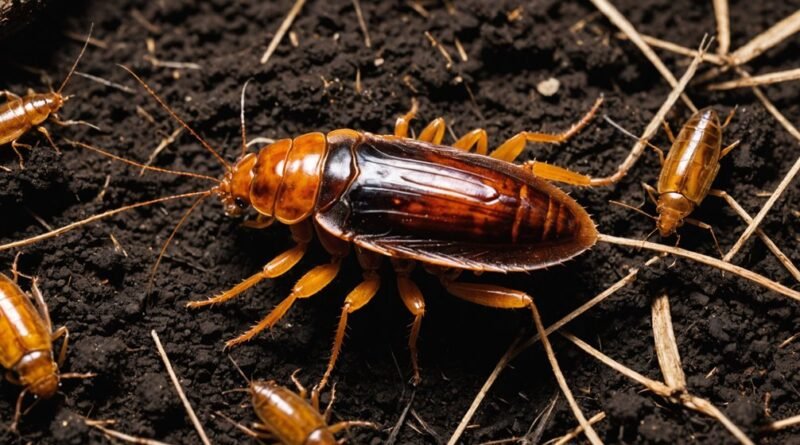
Cockroach Metamorphosis: How They Develop From Egg to Adult
Cockroach metamorphosis is simple but fast: you’re dealing with just egg, nymph, and adult. After mating, a female forms a tough egg case (ootheca) holding 10–50 embryos. Nymphs hatch pale and soft, then harden and grow by molting 5–18 times over weeks to months. Warm, humid, food-rich homes speed this process, so small problems explode quickly. When you understand each stage, you can see exactly why a few roaches turn into thousands.
Key Takeaways
- Cockroach metamorphosis is gradual (incomplete), progressing through three stages: egg, nymph, and adult without a pupal stage.
- Females produce an ootheca (egg case) containing 10–60 embryos, which incubate for 2–14+ weeks depending on species and temperature.
- Newly hatched nymphs are pale and soft, then darken and harden; they resemble small wingless adults and molt 5–18 times as they grow.
- The nymph stage typically lasts 1–3 months but can approach a year, strongly affected by temperature, humidity, food, and crowding.
- Different species develop at different speeds, with German cockroaches among the fastest and smoky-brown cockroaches having the longest development times.
Cockroach Metamorphosis 101: Egg, Nymph, Adult

Although cockroaches never enter a true pupal stage like butterflies, they still pass through three distinct phases—egg, nymph, and adult—that drive their rapid population growth. You’ll first see this in the egg stage, where a protective ootheca shields embryos from surface pesticides and environmental stress. Depending on species and temperature, incubation can last from about two weeks to several months, a core survival strategy that lets populations persist in many climates. Early detection of these hidden oothecae is crucial for preventing small problems from developing into full infestations.
When nymphs emerge, their cockroach anatomy changes quickly. They hatch nearly white and soft, then harden and darken within hours. At roughly 2 millimeters, they grow to around 15 millimeters through 5–7 molts, leaving cast-off shells that signal active infestations. Under warm, humid conditions, they can reach adulthood in one to three months.
As adults, females begin producing new oothecae within days, and their offspring reach maturity in four to six months, enabling exponential population expansion.
From Mating to Egg Case: Starting Cockroach Metamorphosis

Cockroach metamorphosis starts well before you ever see a nymph; it begins the moment adults mate and the female starts building an egg case. When you observe their mating behaviors, the male transfers a spermatophore into the female’s genital opening, where fertilization happens internally. Depending on the species, mating can last minutes or even hours, and German cockroach females often mate multiple times to guarantee steady egg production. Early detection is crucial because even a single fertilized female can produce multiple egg cases and trigger a hidden infestation within weeks.
Within days, the female begins forming an ootheca, a leathery capsule secreted from specialized glands over 1–2 days. Inside, she arranges 10–50 eggs in tight double rows—about 30–48 in German cockroaches and 14–16 in American cockroaches.
You’ll then see different strategies for egg protection. German females carry the ootheca for weeks, while American and Oriental females hide or glue cases in warm, humid cracks. Once she deposits a case, the reproductive cycle quickly starts again.
Inside the Egg Stage of Cockroach Metamorphosis

While the ootheca might look like a simple brown capsule glued to a surface, it’s actually a highly organized nursery where cockroach embryos develop in safety. When you examine the egg capsule structure, you’ll find a compact case only 6–9 millimeters long, yet it can hold 10–60 embryos, depending on the species. They’re packed shoulder‑to‑shoulder in two neat rows, heads pointing toward a ridged keel that later splits open.
Inside, embryo development unfolds over 14–100 days, typically 20–60 under normal indoor conditions. Warmer temperatures speed everything up. American oothecae hold about 15–16 embryos and take roughly 44 days to hatch; brown‑banded capsules contain around 16 eggs and need about 50 days. American cockroach females typically produce between 6 and 14 of these oothecae in their lifetime, allowing one female’s egg output to seed a substantial indoor infestation.] As hatching nears, dark gut patches become visible through the case. Finally, the capsule opens along its seam and the pale, newly emerged nymphs shimmy out together before they darken and harden.
Nymph Metamorphosis: Molting Their Way to Adulthood
As soon as the egg case splits and the young roaches wriggle free, the nymph stage begins—a long, incremental climb toward adulthood powered by repeated molts. You see bright white, almost translucent nymphs whose soft cuticle quickly hardens and darkens to browns or blacks with bands or stripes, depending on species. They already resemble smaller, wingless adults, sharing the same hiding spots and omnivorous nymph feeding habits. In warm, damp environments, these nymphs develop especially quickly, taking full advantage of plentiful food and moisture.
As they grow, you can track nymph behavior through their cast-off shells. Each instar ends with a molt: the nymph splits its exoskeleton, emerges pale or white, then the hormone bursicon hardens and darkens the new cuticle within hours. German cockroach nymphs usually molt 6–7 times, American 10–13, Oriental 7–10, and brown-banded 6–8, with some species ranging up to 18 instars. This wingless nymph phase typically lasts from 1–3 months, but can stretch close to a year.
Environmental Factors That Speed Up or Slow Cockroach Metamorphosis
As you watch nymphs molt toward adulthood, you’ll see that temperature, humidity, food availability, and crowding can speed up or slow that entire process. Warm, moist conditions and abundant resources push cockroaches through their life stages faster, increasing both their survival and their numbers. When conditions turn cooler, drier, or more competitive, development drags out and fewer nymphs make it to adulthood. In cities, urban heat islands and persistently damp, sheltered structures can extend the season in which cockroaches develop and breed rapidly.
Temperature And Humidity
Even small shifts in temperature and humidity can dramatically speed up or slow cockroach metamorphosis, because these insects run on finely tuned physiological limits. When you keep German cockroaches near 25–30°C, temperature effects are obvious: nymphs complete development in about 40–60 days, and eggs reach adults in roughly 70–100 days. Push temperatures much above 31°C, though, and prolonged exposure quickly becomes lethal as metabolism and respiration break down.
Humidity levels are just as critical. At ideal warmth with high humidity, oothecae incubate in only 20–30 days, and nymphs molt reliably. If the air’s too dry or excessively damp, water loss, mold, and altered lipid metabolism slow development. Indoors, stable, moderate humidity lets populations expand by supporting continuous, efficient metamorphosis.
Food Availability And Crowding
Stable warmth and humidity only set the stage; how much food roaches find and how tightly they pack together ultimately dictates how fast they grow up. When crumbs, grease, and moisture stay available, German cockroaches can race from egg to adult in about 70–100 days. In sewers or cluttered kitchens, strong nutritional balance and steady resource distribution push population dynamics toward explosive growth.
By contrast, food scarcity and habitat competition stretch nymphal stages from weeks into months, especially when crowding effects cut per-capita intake.
- Abundant, shared food accelerates metamorphosis and infestation spread.
- Poor nutrition and crowding increase instar number and delay maturity.
- Overcrowded harborages force wider, riskier foraging, slowing development.
- Managing food, clutter, and cracks directly disrupts cockroach life cycles.
Cockroach Molts: Species-by-Species Differences
Although all cockroaches share the same basic pattern of gradual metamorphosis, each common household species follows a distinct molting timetable and visual transformation. When you look at instar duration, molting frequency, and size variation, the German cockroach stands out for fast developmental stages and high egg production in warm, humid environmental preferences. Its pale, post-molt nymph coloration quickly darkens, unlike the slower, larger Oriental cockroach, whose soft white molts harden over many months. This species comparison shows how temperature stretches or compresses growth.
American cockroaches add more molts and longer timelines, with reddish-brown nymphs after each shed. Brown-banded cockroaches develop faster, with fewer molts, clear early nymphs, and small adult size. Smoky-brown cockroaches stretch development the longest, with multiple instars and gleaming brownish-black adults after the final molt. By tracking these contrasting molting patterns, you can better recognize which species you’re dealing with indoors.
How Cockroach Metamorphosis Fuels Infestations
When you’re facing cockroaches, their metamorphosis isn’t just a biological process—it’s the engine behind rapid reproductive cycles that quickly overwhelm a space. Because nymphs look and behave like small adults and mature in weeks to months, each generation starts breeding almost as soon as the last one peaks. You end up with overlapping generations of egg, nymph, and adult stages all reproducing at once, driving explosive infestation growth.
Rapid Reproductive Cycles
Few things drive cockroach infestations faster than their rapid, almost assembly-line reproductive cycles. When you understand their breeding habits, you see how quickly population dynamics shift against you. A single German female can generate 200–300 eggs a year, potentially leading to 30,000 descendants if conditions stay ideal. She carries an ootheca packed with 30–40 eggs for nearly a month, then quickly starts again.
You’re not dealing with slow, occasional reproduction, but a constant biological conveyor belt:
- German females produce eggs every 20–30 days.
- American females form new oothecae as often as every 4 days.
- Each ootheca can hold 10–40 eggs, depending on species.
- Adults resume ootheca production within days of reaching maturity.
Overlapping Generational Growth
A cockroach infestation doesn’t grow in neat, separate waves of babies, juveniles, and adults—it piles generations on top of each other. You’re dealing with generation dynamics where adults, nymphs, and fresh oothecae all share the same cracks, food, and harborage. German cockroaches can hit adulthood in about 70–100 days, while adults live long enough to overlap several offspring cycles, driving indoor populations beyond 30,000 in six months.
All stages feed together, so there’s no pause in damage. Nymphs and adults eat the same proteins and scraps, compounding pressure on your space.
| Overlap Factor | Infestation Impact |
|---|---|
| Lifespan stacking | Constant egg and nymph influx |
| Shared diets | Continuous resource drain |
| Continuous mating | Compounding reproductive output |
| Aggregation movement | Multi-unit infestation strategies |
Frequently Asked Questions
Can Cockroach Metamorphosis Be Stopped or Reversed With Household Pest Control Methods?
You can’t stop or reverse cockroach metamorphosis with household methods. Pest control effectiveness comes from killing eggs, nymphs, and adults. Chemical treatments only reduce populations; they don’t halt molting or change the insects’ developmental path.
Do Cockroaches Feel Pain or Stress While Molting During Metamorphosis?
They probably don’t feel pain like you do, but evidence suggests pain perception–like responses and strong molting stress. You’d see delayed molts, altered hormones, and stress physiology rather than obvious suffering behaviors familiar in mammals.
How Does Cockroach Metamorphosis Compare to Butterfly Complete Metamorphosis Biologically?
You compare cockroach incomplete metamorphosis to butterfly complete metamorphosis by noting cockroach nymphs resemble adults and share habitats, while butterfly larvae and pupae differ radically, giving butterflies evolutionary advantages in specialization, resource partitioning, and reduced intraspecific competition.
Are There Visible Signs Indicating When a Cockroach Is About to Molt?
You’ll see clear molting signs: the roach looks plumper, moves less, then turns white and soft right after shedding. You won’t see egg stages then, but hollow, light skins nearby confirm active molting and infestation.
Can Cockroaches Reproduce Before Completing Their Full Metamorphosis Cycle?
No, they can’t. You only see reproductive maturity after the final molt, when they’re adults. Until then, nymphs can’t mate or contribute to egg development, so no oothecae form before the full metamorphosis cycle.
Conclusion
When you understand cockroach metamorphosis, you see how quickly an unnoticed egg case can become a full-blown infestation. Eggs, nymphs, and adults can overlap in your home, making control tougher the longer you wait. By recognizing each stage and how environmental conditions speed things up, you’re better prepared to interrupt their life cycle. Act early, target all stages, and you’ll have a much better chance of keeping cockroaches from taking over.
