
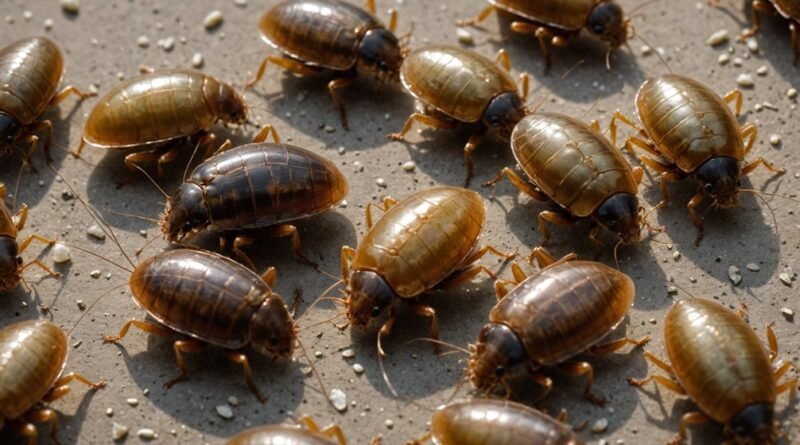
Cockroach Egg Cases, Hatch Time, Appearance and Early Stage Development
Cockroach oothecae are tough, zipper-crested egg cases made from hardened proteins that protect rows of tiny, bean-shaped eggs. You’ll see species differences: German (tan, 30–50 eggs, carried to hatching), American (dark, 14–16), Oriental (reddish-brown, ~16), and brown-banded (small, 10–18). Hatch times run 20–60 days—faster in warm, humid conditions, slower and riskier when cool and dry. Inside, eggs start pale and darken as nymphs form, turning opaque near hatch. There’s more that can help you identify and time control.
Key Takeaways
- Cockroach egg cases (oothecae) are hardened protein pouches with compartments that protect eggs while allowing gas exchange.
- Hatch time ranges 20–60 days, speeding up in warm, humid conditions and slowing in cool, dry environments.
- German oothecae are tan, purse-like, hold 30–50 eggs, and are carried until near hatching.
- American, Oriental, and brown-banded oothecae vary in size, color, eggs per case, and whether females carry or hide them.
- Inside, tiny bean-shaped eggs darken as embryos mature; near hatching, eggs appear opaque with visible nymphs.
What Is an Ootheca and How It Protects Eggs
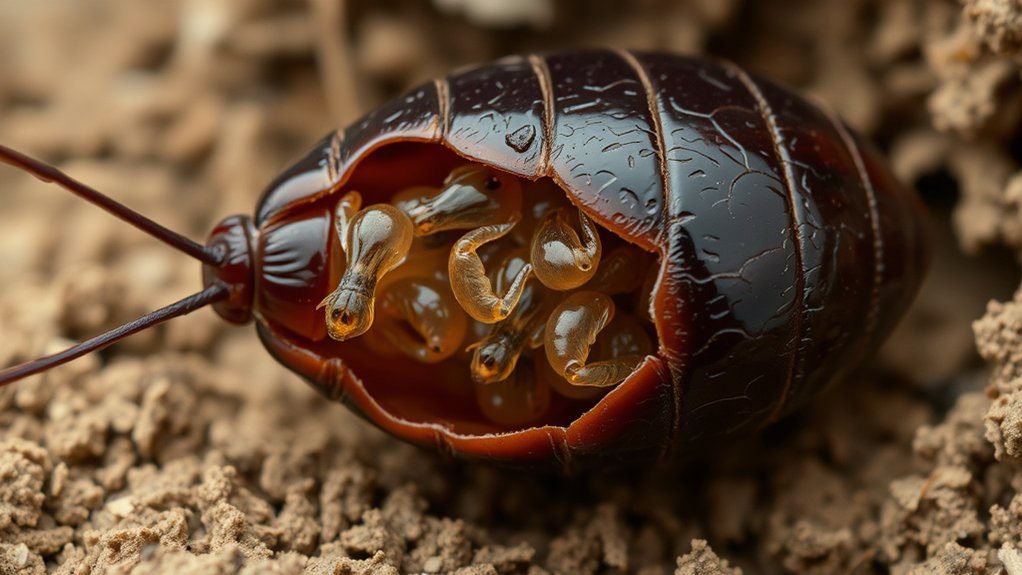
An ootheca is the cockroach’s protective egg case—an oblong, semicylindrical shell formed from secretions of the large and small colleterial glands and rapidly hardened after laying. You’ll see a compact capsule about 8 mm long, 3 mm high, and 2–3 mm wide that encloses segmented compartments, each holding eggs shielded from direct predator contact.
Inside the genital vestibulum, secretions mix and set into a stiff, waxy casing that resists damage and desiccation. Females of the German cockroach often carry the ootheca until just before or during hatching, which helps maintain ideal incubation conditions.
You benefit from understanding its chemistry: vitellogenins and proline- and glycine-rich proteins dominate the shell, then sclerotize and melanize via pathways involving protocatechuic acid and dopaminechrome. This tanning produces a dark, tough barrier that blocks microbes and parasites while protecting against temperature swings and mechanical injury.
Despite its toughness, the ootheca still breathes. Zipper‑like crests and toothed rails enable gas exchange without sacrificing defense.
Females often carry the case at the abdomen tip, relocating it to favorable microhabitats and timing deposition to optimize incubation conditions.
Species Differences in Egg Cases and Egg Counts
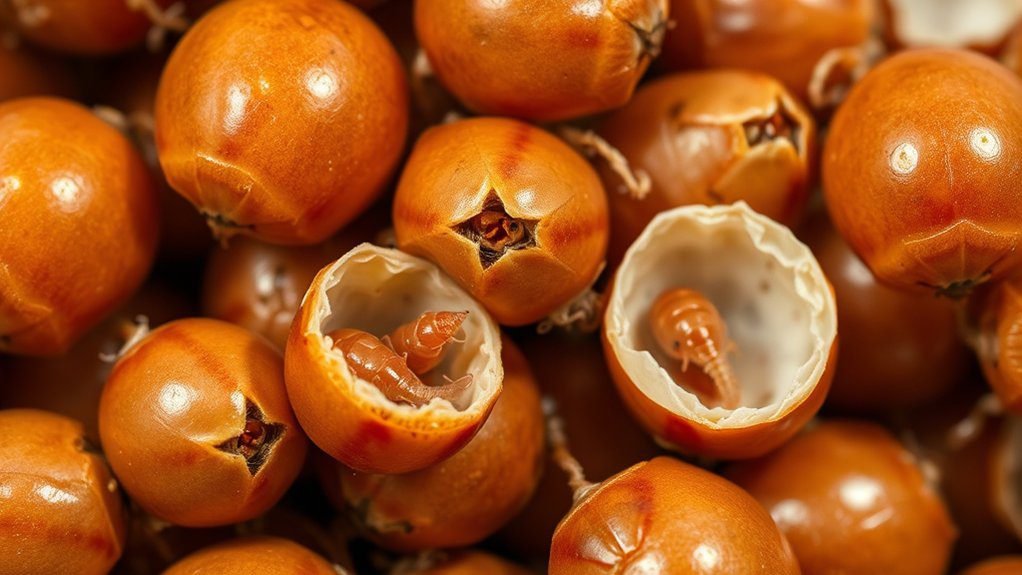
Four common pest species showcase striking contrasts in their oothecae—size, color, carrying behavior, and egg counts—all of which shape how fast infestations build. Roach egg cases are typically hidden in warm, dark, and moist areas, which helps protect developing nymphs until they hatch.
You’ll recognize German cockroach cases by their tan, purse‑like look and bumpy ridge; they’re small (under 6–9 mm) yet packed, holding 30–50 eggs, and females usually carry them until just before hatching.
American cockroach oothecae are darker and larger (about 8 mm), with only 14–16 eggs; females briefly carry them, then glue them in moist, hidden spots.
Oriental cockroach cases are dark reddish‑brown to nearly black, inflated, and 8–10 mm, with roughly 16 eggs; females deposit them in sheltered areas and don’t carry them long.
Brown‑banded oothecae are lighter, about 5 mm, with 10–18 embryos, hidden in protected sites.
Lifetime output varies: German ~8 cases, brown‑banded up to 20, Oriental 1–18, American 6–90 (typically near 10).
These differences drive contrasting population trajectories.
Hatch Time and Factors That Influence Development
Although timing varies by species and setting, cockroach eggs generally hatch in 20–60 days, with warmer, humid conditions pushing the pace.
You’ll see faster schedules from German cockroaches (about 20–30 days, often indoors), while American cockroaches average ~44 days.
Oriental cockroaches run longer, roughly 1.5–2 months, especially in cooler spots. Brown-banded cockroaches fall between, about 24–38 days.
Temperature and moisture drive the clock. At 75–85°F with high humidity (≥70%), development accelerates and hatch success rises.
Cooler, drier conditions delay hatching and increase mortality; extremes in either direction cut survival.
Behavior matters too: German females carry the ootheca until just before hatching, shielding eggs from hazards and stabilizing timing.
Key influences you can expect:
- Temperature: small shifts change hatch time by weeks; warmth speeds, cold slows.
- Humidity: moisture maintains egg water balance and boosts success.
- Egg protection: carrying or hiding reduces losses.
- Nutrition/social cues: ample food and crowding hasten cycles.
Newly hatched cockroaches are initially clear and turn brown within hours, reflecting early-stage development after emergence.
What Cockroach Eggs Look Like Inside the Case
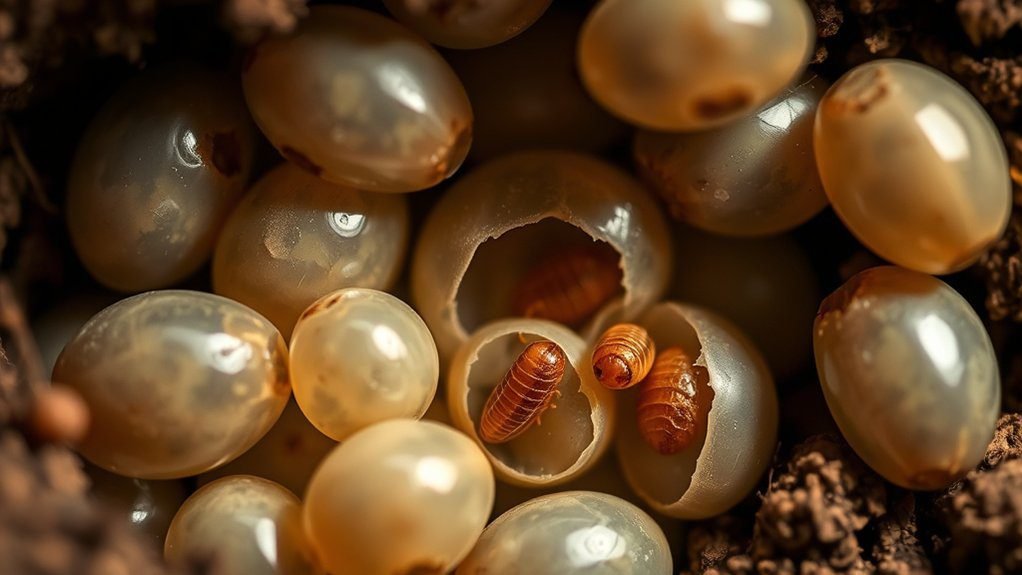
Open the ootheca in your mind and you’ll find a compact cartridge of tiny, bean‑shaped eggs arranged in tidy rows. You see a hardened protein envelope—soft at first, leathery within hours—shielding them from drying, predators, and shocks. Inside, the eggs sit in one or two snug rows, each in its own compartment. Those separations form the ridges or banded indents you notice outside. Color ranges by species and age: pale or translucent early, deepening to browns or nearly black as embryos mature. Female cockroaches may carry the ootheca until hatching or attach it to hidden surfaces, depending on species.
| Species cue | Inside appearance |
|---|---|
| German | Light brown, somewhat translucent; 30–40 neatly lined eggs |
| American | Dark brown to black; 14–16 eggs in a purse‑like case |
| Oriental | Reddish‑brown to near black; ~16 tightly packed eggs |
| Brown‑banded/Florida woods | Dark bands or smooth, shiny, larger eggs |
As development advances, internal tones darken. Near hatching, opacity drops; you may faintly see nymphs poised to emerge, still protected yet breathing through the permeable shell.
Female Reproductive Biology and Ootheca Production
A female cockroach’s reproductive system is a compact assembly line that builds, fertilizes, and packages eggs into a protective ootheca. You’ve got paired ovaries feeding ovarioles with a germarium for oogonia and a vitellarium for maturing oocytes. The ovaries are elongated organs extending from the 2nd to 7th abdominal segments.
Muscular lateral oviducts merge into a common vagina opening to the genital pouch (gynatrium), where the genital and oothecal chambers assemble the case. Collaterial glands empty here, secreting proteins that harden the purse-shaped ootheca.
Lateral oviducts meet at the gynatrium, where glands mold and harden the purse-like ootheca.
After mating, a two-layered spermatophore attaches to your spermathecal aperture; a third hardened layer forms, reducing receptivity and activating ovarian hormones.
Corpus allatum signals accelerate yolk loading; within about seven days, oocytes pass the bursa, fertilize, and you package 12–16 eggs, each encased individually.
- 1) Anatomy: ovaries, oviducts, vagina, genital pouch, collaterial glands, spermathecae.
- 2) Oocyte growth: to ~1 mm, then vitellogenesis post-mating.
- 3) Mating control: single clutch, unreceptive until young emerge.
- 4) Output: ~9–10 oothecae, monthly; deposit near food, darken in 1–2 days.
Frequently Asked Questions
Where Are Oothecae Commonly Found Inside Homes or Buildings?
You’ll find oothecae in kitchens, bathrooms, pantries, and under sinks; inside cabinets, drawers, and baseboards; near plumbing, appliances, and trash. Check basements, laundry rooms, water heater closets, cluttered storage, cardboard boxes, and cracks behind refrigerators, stoves, or under countertops.
How Can I Safely Dispose of a Discovered Cockroach Ootheca?
Wear disposable gloves, gently vacuum or pick it up with tissue, seal it in a bag, crush or puncture it, then discard in an outdoor bin. Bag and discard vacuum contents. Don’t compost. Consider heat, boric acid, or IGRs.
Do Household Cleaners or Pesticides Affect Unhatched Oothecae?
Yes, but results vary. Direct pesticide contact can kill embryos; IGRs disrupt development; pyrethrins alone don’t last. Cleaners rarely penetrate; bleach might if contacted. Prioritize crushing or vacuuming, moisture control, sanitation, and targeted crack-and-crevice treatments for best ootheca suppression.
Can Oothecae Survive Freezing or Extreme Heat Treatments?
No. You can’t expect oothecae to survive freezing below about -9°C or sustained -10°C, or extreme heat above 49–50°C. Use prolonged freezing or heat/steam treatments to denature proteins, penetrate hiding spots, and guarantee complete egg mortality.
What Signs Indicate an Ootheca Has Already Hatched?
You’ll see a pale, lighter, sometimes deflated shell with slits at one end. Spot tiny wingless nymphs nearby, shed skins, pepper-like droppings, stronger musty odor, and multiple empty cases clustered in warm, hidden crevices.
Conclusion
You’ve now got a clear picture of cockroach oothecae: what they are, how they shield eggs, and why species matter for case shape and egg counts. You understand how temperature, humidity, and parental biology shape hatch time and early development. You can even recognize what’s inside a case and anticipate nymph emergence. Use this knowledge to identify infestations early, target the right species, and time interventions. Stay observant, act quickly, and you’ll break the reproductive cycle.
