
Cockroach Life Cycle by Species, German, American and Oriental Timelines
You’ll see cockroaches progress through egg, nymph, and adult stages, but timelines vary dramatically by species. Understanding the cockroach life cycle by species is the foundation of effective pest control — the wrong timing, the wrong treatment, or the wrong target stage means the infestation continues. German roaches carry 30–40 eggs; they incubate ~28 days and mature in 40–65 days, breeding at explosive speed. American roaches lay oothecae with ~15 eggs; incubation is 24–56 days, nymphs take 6–12+ months, adults live up to 2 years. Oriental roaches have ~16 eggs per case; incubation is ~50–80 days, nymphs need ~10–12 months, adults live months. The biology, behavior, and habitat preferences of each cockroach species shape both how fast populations grow and which pest control approaches work. Here’s a full breakdown of counts, molts, timelines, and lifespans.
Key Takeaways
- All cockroaches develop through egg (ootheca), nymph, and adult stages in a form of incomplete metamorphosis; temperature and humidity strongly affect timing.
- German cockroach: 30–40 eggs/ootheca; eggs hatch in ~28 days; nymphs mature in 40–65 days; adults live 5–7 months — the fastest cockroach life cycle of any common species.
- American cockroach: ~14–16 eggs/ootheca; eggs incubate 24–56 days; nymphs mature in 6–12+ months; adults live 6–15 months.
- Oriental cockroach: ~16 eggs/ootheca; eggs hatch in 50–80 days; nymphs mature in ~10–12 months; adults live 5–26 weeks.
- Reproduction rates: German fastest and most prolific; American moderate with the longest lifespan; Oriental slower, favoring cool, damp habitats.
- For homeowners and businesses, knowing which cockroach species is present — and where it is in its life cycle — is essential for targeting pest control at the right stage.
Understanding the Cockroach Life Cycle: Egg, Nymph, Adult
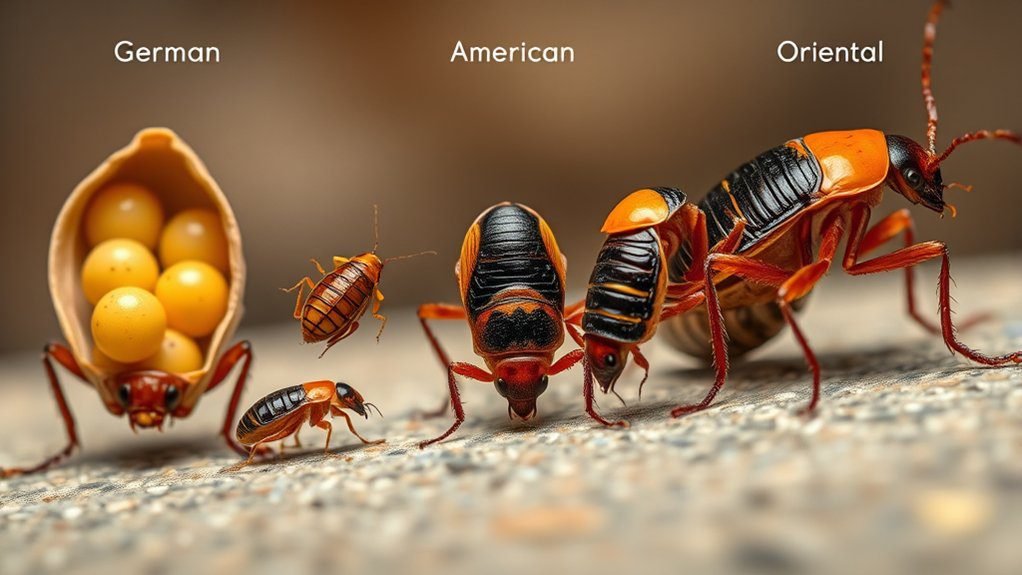
Although timelines vary by species, all cockroaches follow the same three-stage life cycle — a form of incomplete metamorphosis that takes them from egg to nymph to adult without a pupal stage. This biology distinguishes them from insects like butterflies and beetles that undergo complete metamorphosis. You’ll first encounter the egg stage inside a protective ootheca, which can hold roughly 6 to 50 eggs depending on species.
Females may carry the case for hours or days, then hide it in warm, sheltered places — behind furniture, inside cabinets, along walls, in crevices, and in closets — or drop it near food and moisture to boost offspring survival. Incubation ranges from about 14 to 100 days, speeding up with higher temperatures and humidity. Early detection is crucial because infestations can grow rapidly — a single female can produce thousands of offspring over her lifetime under ideal conditions.
When cockroach nymphs hatch, they’re white and soft, then darken to tan, brown, or black within hours to days as their exoskeleton hardens. Their appearance closely resembles small adults, but they lack wings and sexual maturity. The color and size of newly hatched cockroach nymphs vary by species — a useful ID cue when assessing an active cockroach infestation.
Cockroach nymphs immediately forage, contaminate food and surfaces, and molt repeatedly — passing through anywhere from 5 to 14 instars — until adulthood. Each molt involves shedding the old exoskeleton, briefly appearing pale before the new one hardens. Warmer, humid conditions shorten development; cooler, dry conditions slow it significantly. Adults have wings (flight varies by species), reproduce by producing multiple oothecae, and typically live 6 to 12 months, sometimes up to two years. Their saliva, droppings, and shed exoskeleton skins are the primary sources of allergens that trigger health problems in homes and buildings.
German Cockroach Timeline and Reproductive Speed
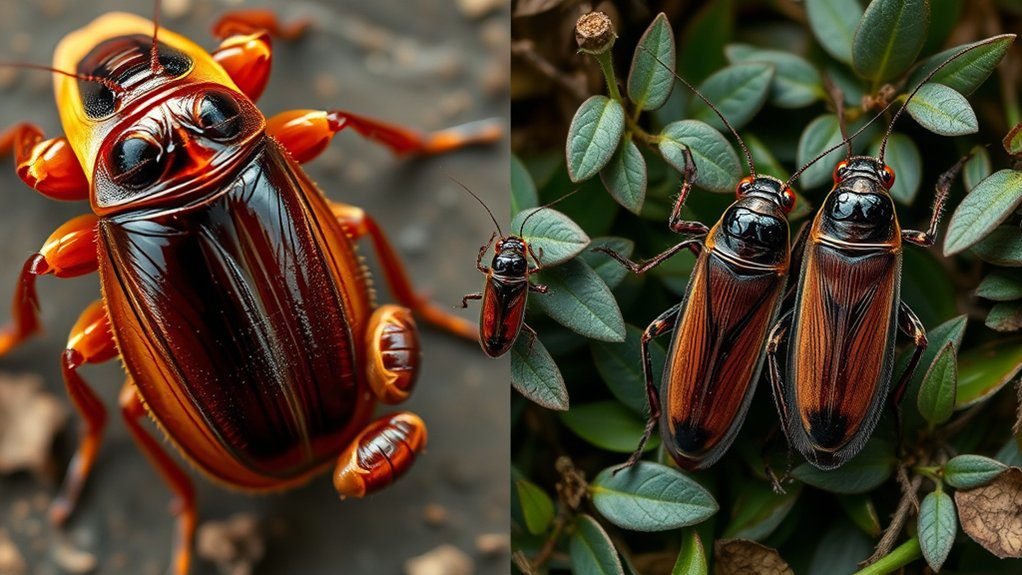
Even under modest indoor warmth, German cockroaches race from egg to reproducing adult in a matter of weeks, making them the fastest-growing cockroach species and the most challenging infestation for homeowners and pest control professionals to manage.
You’ll see females carry an ootheca with 30–40 eggs for about 20–30 days, then tuck it away a couple of days before hatching — in crevices behind appliances, inside cabinets, under sinks, or along walls in bathrooms. At around 80°F, eggs incubate in roughly 28 days. Cockroach nymphs emerge pale and wingless, rely on adult saliva and feces for nutrients, and pass through 5–7 instars over 40–65 days, with males maturing slightly faster. Physical contact with other roaches speeds their molting. Under ideal warmth and humidity, the entire life cycle can compress to 50–60 days; otherwise it typically spans 70–100 days. German cockroach populations are typically 75–80% nymphs at any given time — evidence of the rapid breeding that makes this pest so persistent in homes, businesses, and commercial buildings. They thrive in warm, humid spots near food and water, commonly hiding around appliances, under sinks, and in pantries to exploit shelter and moisture.
- Females produce 4–8 oothecae, totaling roughly 200–400 eggs — an average of 30–40 offspring per case.
- Adults live 5–7 months and start reproducing 4–6 days after the final molt.
- Warmer (77–86°F) rooms accelerate development.
- Population numbers skew 75–80% nymphs, reflecting rapid turnover.
- Disrupt egg and nymph stage early to curb exponential growth — the key steps in German cockroach control.
American Cockroach Development and Lifespan
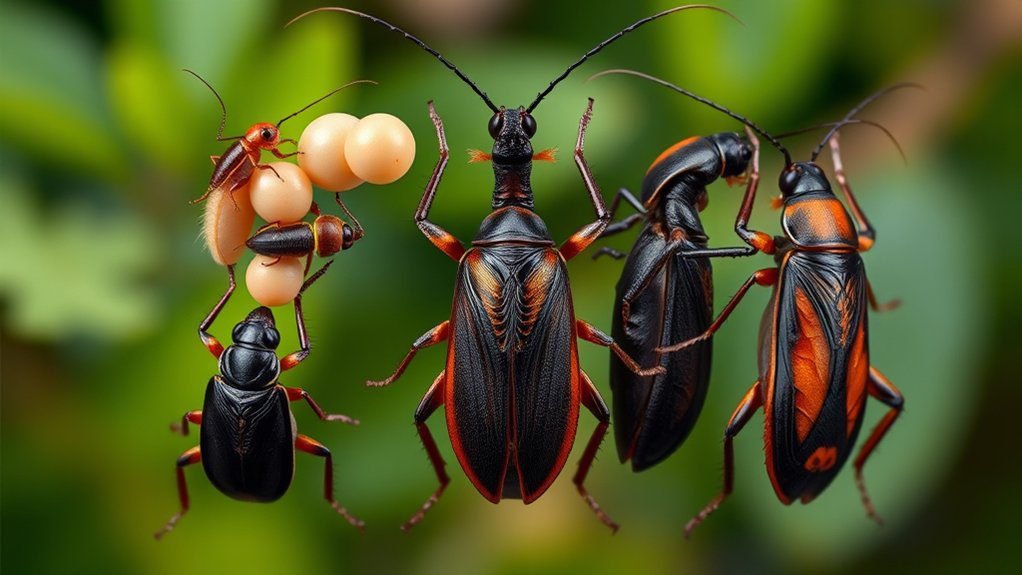
While they grow far slower than German roaches, American cockroaches follow a steady, long-lived life cycle driven by warmth and moisture — an adaptation that suits their preferred habitat of sewers, basements, crawl spaces, and utility buildings. You’ll spot their dark brown, purse-shaped oothecae — about 0.9 cm in length — each holding roughly 14–16 eggs. The dark reddish-brown color and distinctive size of American cockroach egg cases are reliable ID cues that help distinguish this species from German or Oriental cockroaches during an inspection.
Females carry an ootheca briefly, then stash it in a warm, protected crevice near food and moisture; incubation ranges from about 24 days to nearly 8 weeks, depending on temperature and humidity. They thrive at high temperatures around 29°C and are intolerant of low temperatures. Their biology makes them one of the most habitat-specific cockroach species — rarely establishing indoors without consistent access to moisture and warmth.
American cockroaches: slow-growing survivors with a long lifespan, thriving on warmth, moisture, and hidden, purse-shaped egg cases tucked into sewers, basements, and buildings.
A single female typically produces 9–10 oothecae, sometimes 6–14, and under ideal conditions may far exceed that — generating hundreds of offspring over her lifetime. When cockroach nymphs hatch, they’re white, then harden to reddish-brown color and pass through about 10–14 instars, commonly 13. This nymph stage lasts from roughly 6 months to over a year (about 160–971 days), with development accelerating with ample food, heat, and moisture. The long nymph stage means American cockroach infestations build slowly but become deeply entrenched in the bodies of older buildings before homeowners often notice them.
Adults are reddish-brown with limited flight and a distinctive yellowish figure-eight marking — key appearance and color features for species ID. They mate soon after the final molt and can live 6–15 months, longer with steady water. Drought shortens life and reduces reproduction. American cockroach populations in homes and commercial buildings are often harbored in walls, pipes, sewers, and under floors — places that are difficult to reach without professional pest control services.
Oriental Cockroach Growth Stages and Seasonal Activity
Because Oriental cockroaches favor cool, damp niches, their growth slows and speeds with the season, shaping a distinct, long-cycle pattern. This seasonal behavior and habitat dependence makes them one of the most environment-sensitive cockroach species — an important factor in planning effective cockroach control.
You’ll see oothecae — dark reddish-brown, 8–12 mm, slightly inflated — dropped in moist, protected spots near food. Their dark color and inflated size distinguish them from the cases of other cockroach species. Each holds about 16 eggs; a female produces 8–16 in her lifetime. Incubation ranges 42–81 days, fastest around 29.5°C; freezing ruins viability. This temperature sensitivity is a biological adaptation that ties Oriental cockroach breeding activity tightly to seasonal conditions — particularly moisture levels and ambient warmth.
Cockroach nymphs hatch ready to forage in dark, wet zones like mulch, debris, and leaf litter. They resemble adults in appearance without wings and pass through 7–10 instars over roughly one year, but the span can run 150 to 500+ days depending on temperature and moisture. Females trend broader and heavier as nymphs — a size and anatomy difference that becomes more pronounced in later instars.
Adults reach about an inch in length, glossy dark brown to black in color. Males have short wings; females’ are tiny and nonfunctional — one of the clearest anatomy differences between sexes in any common cockroach species. Adults live 5–26 weeks, thriving in basements, crawl spaces, and sewers. In homes, they are often found near damp areas such as toilets, sinks, and pipes — places where consistent moisture sustains their life cycle. Populations peak late spring to early summer; late-summer heat drives retreat and mortality, a seasonal pattern homeowners and pest control professionals can use to time interventions for maximum effect.
- Egg timing shifts with temperature — a key behavior that makes Oriental cockroach populations highly seasonal.
- Nymph development accelerates in rainy months when moisture is abundant.
- Overwintering nymphs mature in spring — a sign a cockroach infestation is entering its peak breeding phase.
- Adults avoid hot, dry periods by moving to cooler damp places like sewers, basements, and crawl spaces.
- Seasonal moisture steers the whole life cycle — targeting Oriental cockroaches before spring emergence is the most effective pest control step.
Side-by-Side Timeline Comparison Across Species
Across German, American, and Oriental cockroaches, the timelines diverge in ways that drive very different population trajectories — and require different pest control approaches. Here’s how the three main cockroach species compare:
You’ll see German roaches hatch fastest: eggs incubate about 28–50 days, and each female carries 4–8 oothecae with roughly 30–40 cockroach eggs. American roaches incubate 24–38 days with 6–14 oothecae, about 15 embryos each. Oriental eggs take 50–60 days, about 16 per ootheca, often produced weekly in warm, sheltered sites. All three cockroach species place oothecae in humid, protected zones — in cracks, crevices, behind furniture, inside walls, in cabinets, and near food sources. Female cockroaches often hide egg cases in protected locations to safeguard developing embryos.
After hatching, German cockroach nymphs mature in roughly 40–125 days with 5–7 instars. American cockroach nymphs are the slowest — about 134–1031 days, averaging near 600, with 9–14 instars. Oriental cockroach nymphs develop in about 300–800 days, fewer instars than Americans, and peak activity in spring and summer.
As adults, German cockroaches live 3–4 months and can exceed 300 offspring per year — driving explosive population growth in homes, businesses, and buildings. Americans live 1–2 years, population numbers increasing steadily. Orientals live 1–1.5 years, growing moderately and seasonally. For pest control, this means German cockroach infestations escalate to thousands of insects within months, while American and Oriental infestations build more slowly — but can be just as difficult to eradicate once entrenched in the structure of older buildings.
| Cockroach Species | Eggs/Ootheca | Incubation | Nymph Stage | Adult Lifespan |
|---|---|---|---|---|
| German | 30–40 | ~28 days | 40–65 days | 5–7 months |
| American | 14–16 | 24–56 days | 6–12+ months | 6–15 months |
| Oriental | ~16 | 50–80 days | ~10–12 months | 5–26 weeks |
Pest Control by Life Cycle Stage
Knowing the cockroach life cycle by species isn’t just interesting biology — it’s actionable pest control intelligence. The most effective cockroach control programs target multiple life cycle stages simultaneously, accounting for the fact that at any given time, a cockroach infestation contains eggs, cockroach nymphs, and adults — not just the adults you can see.
For German cockroach infestations: gel baits and Insect Growth Regulators (IGRs) are the most effective treatments, as IGRs specifically disrupt the nymph stage and prevent development into reproducing adults. For American and Oriental cockroaches: moisture control, sealing crevices, and treating sewers, pipes, and crawl spaces address the habitat conditions that sustain these species. Identifying which cockroach species is present — and which stage of the life cycle is dominant — is the most important step homeowners and pest control professionals can take before choosing a treatment approach.
Signs that a cockroach infestation is in an active breeding phase include: shed exoskeleton skins in crevices and behind appliances, oothecae in cabinets or along walls, small pale cockroach nymphs near food sources, and increasing numbers of adults visible in bathrooms or kitchens. Professional pest control services that inspect for all three life cycle stages deliver the most reliable results — particularly for infestations in multi-unit buildings, businesses, and homes with hard-to-reach harborage places.
Frequently Asked Questions
How Do Temperature and Humidity Changes Affect Cockroach Sex Ratios?
They mostly shift sex ratios indirectly. You adjust temperature or humidity, and you change mating success, fecundity, survival, and development. Cooler, drier conditions depress reproduction and bias outcomes; extreme heat or humidity can differentially affect sexes with lower tolerance. This behavior is relevant to pest control because seasonal changes in temperature and moisture can alter the population dynamics of an infestation — sometimes driving cockroaches indoors into homes and buildings when outdoor conditions become unsuitable.
Do Cockroach Oothecae Survive Household Cleaning Chemicals?
Yes, they usually survive. Oothecae shield cockroach eggs from soaps, sprays, and typical cleaners — their hardened protein exoskeleton resists most common household products. You’ll reduce roaches by sanitation, but you won’t kill eggs this way. Use IGRs, baits, targeted dusts, steam, and crevice vacuuming, with repeated treatments as cockroach nymphs hatch. This is why professional pest control services that account for the full cockroach life cycle — including egg stages — are more effective than surface cleaning alone.
Can Home Lighting Schedules Alter Cockroach Molting Frequency?
Yes. If you run constant bright light or total darkness, you disrupt circadian and endocrine cues, delaying or irregularly timing molts. Stable, dark nights and moderate days are the environmental conditions that support normal development through instars. This biology is relevant to homeowners — avoiding relentless illumination or erratic on-off schedules won’t stop a cockroach infestation, but it reflects how tightly cockroach behavior and development are tied to environmental cues.
What Pheromones Influence Aggregation During Nymph Stages?
Aggregation is driven by fecal pheromones, especially periplanolide-E (PLD-E), plus nitrogenous compounds, hydrocarbons, and volatile fatty acids. Cockroach nymphs are far more sensitive to aggregation pheromones than sex pheromones — a biology and behavior pattern that explains why nymph stage populations cluster so densely in tight crevices and behind appliances. Understanding this behavior helps pest control professionals target bait placement where cockroach nymphs aggregate rather than where adults are most visible.
How Do Diet Types Impact Adult Cockroach Wing Development?
Diet type shapes adult wing development by altering hormones, cuticle synthesis, and muscle growth. Cockroaches thrive on balanced protein-to-carbohydrate ratios; excess protein or poor-quality nymph diets delay maturation, weaken sclerotization, impair flight muscles, and — in females — shift resources toward offspring production rather than structural development. This biology explains why cockroach populations in food-rich environments like restaurant kitchens and homes with poor sanitation develop faster and produce more offspring than those in food-scarce settings — one of the core reasons consistent pest control and food management go hand in hand.
Conclusion
You’ve seen how cockroaches progress from egg to nymph stage to adult, and how timelines, behavior, and habitat preferences differ dramatically across cockroach species. German cockroaches reproduce fastest, demanding quick pest control action before population numbers reach thousands. American cockroaches develop slower but live longer, often establishing infestations in basements, sewers, and the structural bodies of older buildings. Oriental cockroaches favor cool, damp habitats and peak seasonally. When you know their timelines, biology, and hotspots, you can target cleaning, sealing, and baiting at the right life cycle stages. Homeowners who act at the first sign of a cockroach infestation — before breeding populations compound — consistently spend less on pest control and achieve better long-term results. Stay proactive, monitor regularly, and you’ll break the cockroach life cycle before populations explode across your home or buildings.
