

Regulations & Compliance for Commercial Pest Control
If you run a commercial pest control operation in Texas, you’re responsible for more than killing bugs—you must navigate licensing, strict recordkeeping, and safety rules set by TDA, TDLR, EPA, and OSHA. You’ll also need to document every application, follow IPM, train your team, and pass audits. Labels, storage, and facility compliance all matter. Miss a step, and penalties add up fast. Here’s what you need to get right—starting with your licenses…
Key Takeaways
- Obtain proper licenses (business and individual), register employees/locations, and maintain insurance; meet continuing education and Responsible Certified Applicator requirements.
- Keep pesticide application and disposal records for at least two years, including product details, EPA numbers, amounts, sites, and target pests.
- Follow EPA/FIFRA labels, OSHA PPE/training, and FDA/USDA standards in food facilities; implement Integrated Pest Management practices.
- Prepare for audits/inspections by maintaining accurate logs, using inspection checklists, employing digital recordkeeping, and filing prompt incident reports when issues occur.
- Conduct routine inspections, deploy monitoring devices, analyze trends, and ensure treatments don’t obstruct accessibility or violate local fire and safety codes.
Licensing and Certification Requirements for Pest Control Businesses
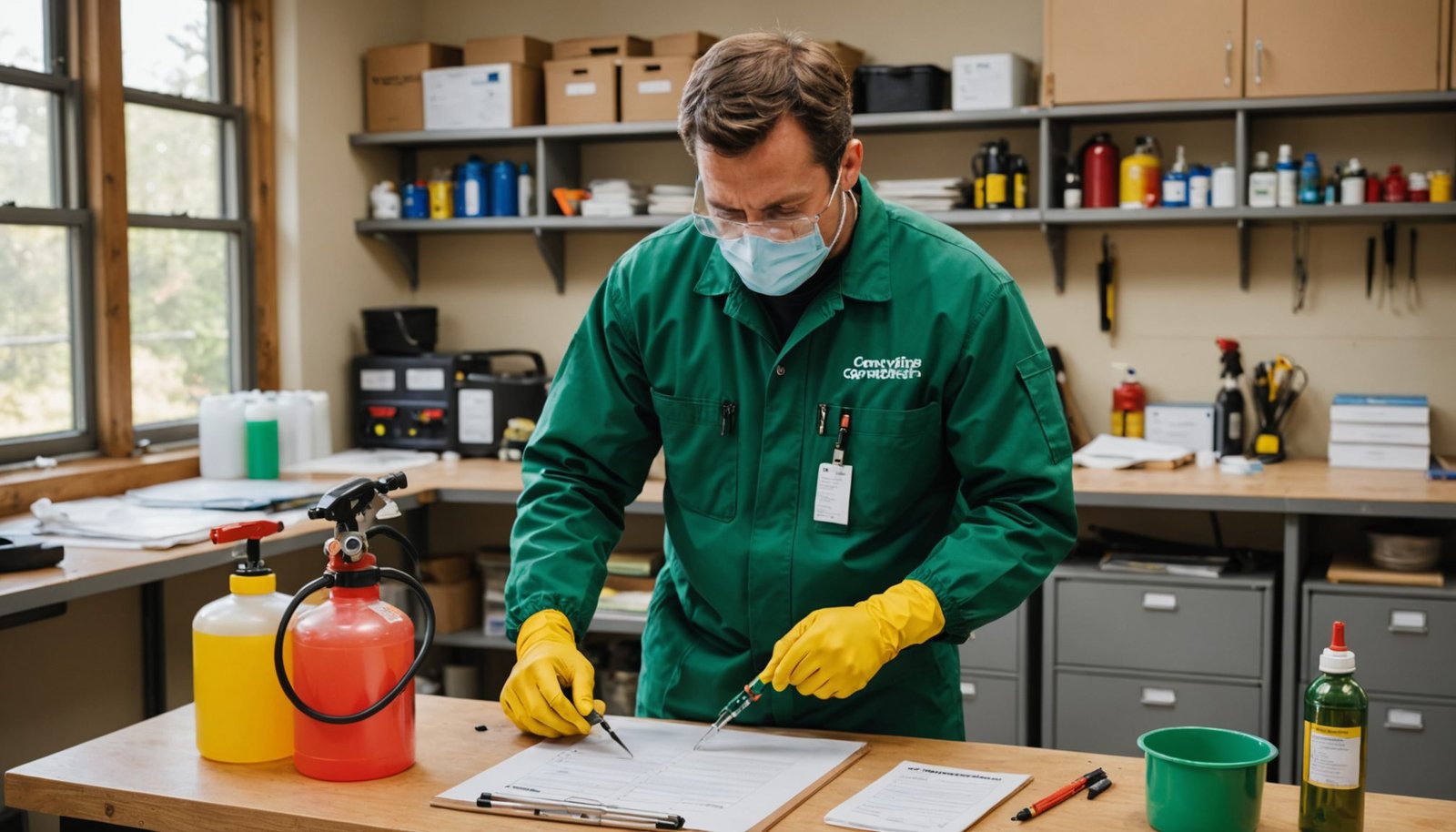
Before you offer commercial pest control in Texas, you need the right licenses for both your people and your business. The Texas Department of Agriculture (TDA) oversees commercial and noncommercial applicators, while the Texas Department of Licensing and Regulation (TDLR) handles structural pest control under the Structural Pest Control Act (Texas Occupations Code, Chapter 1951). Check TDA/TDLR sites for current fees and requirements. A license is required to perform pest control services in Texas, and it is issued by the Texas Department of Agriculture.
For individuals, you must be 18+, a U.S. citizen or legal resident, pass a background check, complete approved training, and pass category exams (typically 70%+; fees about $60–$125). You’ll also need supervised experience or a relevant degree.
License paths include Apprentice, Structural Technician, Certified Commercial Applicator, and Responsible Certified Applicator.
For businesses, obtain a separate license, appoint a Responsible Certified Applicator, maintain required insurance (commonly $500,000/$1,000,000 aggregate), register employees, and license each location.
Recordkeeping and Documentation Standards
Paper trails matter. You must keep pesticide application records for at least two years for restricted use pesticides, and longer if your state or tribe requires it. Organized record-keeping systems are essential for efficient pest control businesses, streamlining scheduling, billing, and service documentation.
Capture customer name and address, site location, target pest(s), crop or site treated, and the application’s date and time. Record the pesticide trade name, EPA registration number, amount applied, and active ingredient concentration. Track every use, including spot applications under 1/10 acre, and clearly label them.
Record customer/site details, pest targets, pesticide identifiers, amounts, concentrations, and all applications—even small spot treatments.
Document disposal: amount and type discarded, method, date(s), and disposal site. Many states require records for all applications and add weather details like wind speed, direction, and temperature, plus strict completion deadlines.
Supervising certified applicators must log qualifications of noncertified staff. Keep records organized and promptly accessible to EPA, state, tribal officials, and medical professionals.
Safety Protocols and Environmental Compliance

With records in order, you now need to run treatments that meet safety and environmental rules on the ground.
Follow EPA/FIFRA directions by adhering to label sites, rates, and methods, and meet OSHA worker-safety standards with required PPE and training.
In food facilities, align practices with FDA and USDA expectations to protect products. Regular pest management assessments can help maintain compliance and prevent infestations that jeopardize operations.
Meet state Structural Pest Control rules on signage, service-container labeling with product name and EPA registration number, and application standards.
Prioritize IPM: inspect, identify, and correct conditions with sanitation, moisture control, exclusion, and landscape fixes.
Use baits and crack-and-crevice applications to minimize exposure, selecting least toxic, targeted options.
Post legal warning signs, restrict access during and after service, and keep SDS accessible.
Establish spill and exposure response procedures, handle disposal per environmental regulations, monitor with traps, and issue detailed service reports and compliance audits.
Pesticide Product Registration and Labeling Rules
Although registration can feel procedural, pesticide product approval hinges on precise applications and compliant labels. You must submit EPA Form 8570-1 with fees, administrative data, scientific support, and EPA Form 8570-4 disclosing the Confidential Statement of Formula per 40 CFR 152.40–152.55.
File separate registrations for each product, including manufacturing use and end-use formulations. If a formulation changes beyond certified active ingredient limits, seek a new registration. In California, retailers selling pesticide-impregnated materials must register and obtain a pesticide broker’s license, and pay a 2.1% mill assessment on the entire cost of the finished product.
Labeling drives acceptance. Provide truthful ingredient lists, clear directions for use, and precautionary statements consistent with FIFRA and EPA standards. State if it’s manufacturing use only or end-use.
Labeling drives acceptance: truthful ingredients, clear use directions, and FIFRA-consistent precautions, declaring manufacturing or end-use.
When revising labels, submit the new label and a change list; keep claims and branding consistent across “same” products.
Pay required federal fees, annual maintenance fees, and applicable state fees; nonpayment risks penalties or denial.
Property and Facility Compliance Considerations

As you plan pest control, guarantee treatment areas, exits, and emergency routes meet accessibility and safety codes, including signage, ventilation, and safe storage for chemicals.
You should coordinate with your provider to verify compliant application methods, PPE use, and hazard communication that won’t obstruct ADA access or fire egress. Include systems for comprehensive documentation of service records and treatment logs to support regulatory compliance.
If you’re pursuing sustainable pest management certifications, align your IPM plan with recognized standards (e.g., GreenPro, LEED credits) and document practices to pass audits.
Accessibility and Safety Codes
Even before you choose products or schedules, accessibility and safety codes set the baseline for compliant commercial pest control. You must design barrier-free access—ramps, wide doors, and clear paths per 2010 ADA Standards—so technicians, tenants, and auditors can reach service areas.
Build storage and mixing rooms as separated, ventilated spaces; add clean-change areas with water, soap, and emergency wash stations aligned with occupational rules like 3CCR 6732.
Use licensed operators, guarantee annual training for registered technicians, and restrict chemicals in sensitive settings to meet healthcare and food service standards.
Maintain current labels on-site, provide PPE, and follow proper container disposal. Post accessible signage and communication for treatment schedules and emergencies.
Keep audit-ready records and housing-code-compliant response plans, including HUD timelines for multi-family infestations.
Sustainable Pest Management Certifications
You’ve set the compliance foundation with accessibility and safety codes; now align your program with third-party sustainable pest management standards that auditors recognize.
Target certifications that validate Integrated Pest Management (IPM), documentation, and measurable outcomes.
Pursue LEED credits by adopting written IPM policies, preventive tactics, and indoor/outdoor monitoring.
Leverage WELL to tie pest prevention to occupant wellness.
Use BOMA 360 to frame facility-wide performance.
In food facilities, meet AIB’s stringent pest controls.
Select certified providers: GreenPro (NPMA), EcoWise, and Green Shield Certified—also available for buildings, landscapes, and campuses.
Expect on-site evaluations of IPM, pesticide selection, and environmental practices.
Certified firms gain marketing support and recognizable logos.
Maintain compliant operations: conduct routine inspections, deploy monitoring devices, analyze trends, and document actions.
Align with local licenses, fire codes, and accessibility, ensuring treatments never impede access.
Regulatory Enforcement, Reporting, and Continuing Education
You should expect routine audits and inspections from agencies like EPA, FDA, USDA, and OSHA to verify pesticide use, sanitation, and documentation.
You must maintain accurate records and submit incident reports for fumigations, significant pesticide applications, and any outbreaks or compliance breaches.
You’ll reduce penalties and protect licenses by proving corrective actions, training updates, and readiness for unannounced oversight.
Audits and Inspections
From pre-audit prep to post-inspection follow‑through, audits and inspections anchor regulatory compliance in commercial pest control. You’ll prove readiness with accurate pesticide usage logs, pest sighting logs, and complete documentation—licenses, certifications, insurance, and SDS.
Use thorough inspection checklists and pre-audit reviews of trends and monitoring reports to fix gaps before regulators arrive. Digital tools—barcode scanning and e‑logbooks—boost data accuracy and speed record retrieval, which auditors expect under FIFRA and state/local rules.
In food facilities, align programs with GFSI, HACCP, and FDA/USDA requirements.
1) Documentation discipline: If it’s not documented, it didn’t happen; maintain current logs, calibration records, labels, and disposal data.
2) Field execution: Inspect interiors/exteriors, entry points, drains; assess droppings, gnawing, and device condition.
3) Competency: Keep technicians’ continuing education current and verifiable.
Incident Reporting Duties
Audit-ready records don’t just satisfy inspectors; they feed into your incident reporting duties when a pesticide causes exposure, off‑target effects, or other adverse outcomes. You must submit electronic incident reports on designated forms (e.g., PMRA in Canada), focusing on accurate facts; you’re not required to investigate, though concise commentary helps. File promptly after discovery, and keep application, threshold, and incident records for years. If one active ingredient hits 10+ incidents for the same organism category in a calendar year, prepare an annual summary. Expect enforcement follow‑ups when incidents suggest labeling or safety violations. Maintain licenses, complete CE, and update PDMPs when thresholds or emergencies apply.
| Requirement | Your Action |
|---|---|
| Designated forms | Submit electronically |
| Timelines | Notify promptly |
| Annual summaries | Trigger at ≥10 incidents |
| Record retention | Keep ~5 years |
| CE and licensing | Maintain/renew regularly |
Conclusion
Staying compliant isn’t optional—it’s how you protect customers, employees, and your business. Secure the right licenses, keep meticulous records, follow labels, and integrate IPM to reduce risk and liability. Train your team, document everything, and align with OSHA, EPA, TDA, and TDLR requirements. Audit routinely, correct gaps fast, and keep up with continuing education. When you build compliance into daily operations, you’ll safeguard the environment, strengthen your reputation, and position your pest control company for sustainable growth.
