
Cockroach Reproduction Facts: 10 Things That Explain Why Infestations Grow So Fast
{
“@context”: “https://schema.org”,
“@type”: “FAQPage”,
“mainEntity”: [
{
“@type”: “Question”,
“name”: “How fast can a cockroach infestation grow?”,
“acceptedAnswer”: {
“@type”: “Answer”,
“text”: “A single German cockroach female can produce over 300 offspring in one year from her own egg cases alone. Because many of those offspring reach reproductive maturity within 3 to 4 months, a single undetected female and her descendants can theoretically number in the thousands within a year under optimal home conditions.”
}
},
{
“@type”: “Question”,
“name”: “Can a single cockroach start an infestation?”,
“acceptedAnswer”: {
“@type”: “Answer”,
“text”: “Yes. A single mated female is enough to establish a fully self-sustaining population. Female cockroaches store sperm from one mating event and use it to fertilise multiple egg cases over the rest of their lives, so no further contact with a male is needed. Some species can also reproduce without mating at all through a process called parthenogenesis.”
}
},
{
“@type”: “Question”,
“name”: “Why do cockroaches come back after treatment?”,
“acceptedAnswer”: {
“@type”: “Answer”,
“text”: “The most common reason is that the treatment killed adult cockroaches but left egg cases behind. Most contact sprays have no effect on the tough protein casing of an ootheca. Those egg cases hatch 2 to 8 weeks later, and the new nymphs restart the cycle. Effective treatment must address all three life stages: adults, nymphs, and egg cases.”
}
},
{
“@type”: “Question”,
“name”: “How long should cockroach treatment continue after the last sighting?”,
“acceptedAnswer”: {
“@type”: “Answer”,
“text”: “Treatment should continue for a minimum of 8 weeks after the last visible cockroach sighting. This ensures that any nymphs hatching from remaining egg cases are eliminated before they reach reproductive maturity and restart the infestation cycle.”
}
}
]
}
Most people underestimate how quickly a cockroach problem can grow. What looks like a handful of insects can become a full infestation within months, and in some cases weeks, because of reproductive traits that are genuinely unlike most household pests.
Understanding cockroach reproduction is not just biology trivia. Each fact below has a direct implication for how you treat an infestation, when you need to act, and why certain products fail while others work. Every section includes a Control Implication so the science connects directly to action.
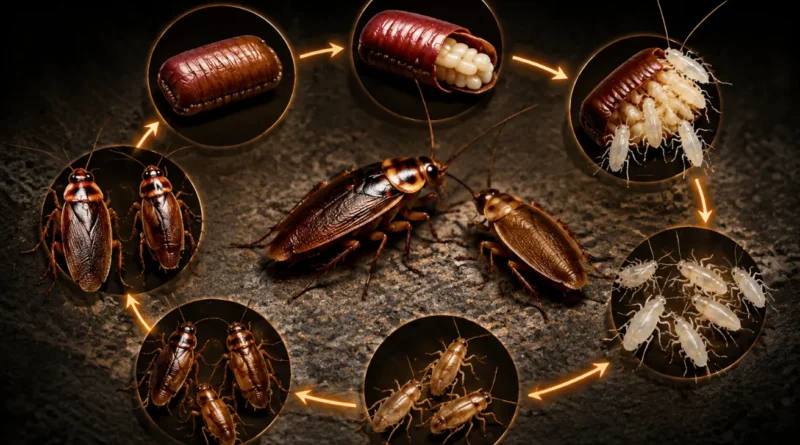
For a full walkthrough of the three life stages — egg, nymph, and adult — see our detailed guide to the cockroach life cycle explained. This article focuses specifically on reproduction: the facts that drive infestation growth and the ones most homeowners do not know until it is too late.
1. A Single Female Can Produce 300+ Offspring Per Year
A female German cockroach produces an ootheca (egg case) every 4 to 6 weeks throughout her adult life. Each case contains 30 to 50 eggs, and she can produce 4 to 8 cases in total. That means a single female can be directly responsible for over 300 new cockroaches in a year from her own egg cases alone.
This number compounds further because many of those offspring will mature and begin reproducing themselves within 3 to 4 months. Within one year, a single undetected female and her descendants can theoretically number in the thousands under optimal home conditions.
The American cockroach is slower, producing around 9 to 10 oothecae with 14 to 16 eggs each, but with a lifespan of up to 2 years, the total lifetime output is still substantial.
2. A Female Only Needs to Mate Once to Reproduce Indefinitely
Female cockroaches are capable of storing sperm from a single mating event and using it to fertilise multiple egg cases over the remainder of their lives. For American cockroaches, a single successful mating can be enough to produce the full lifetime output of oothecae without any further contact with a male.
This means that even if you eliminate every male cockroach in a space, the females already present can continue producing fertile egg cases for months or longer. A single pregnant female introduced via a grocery bag, a secondhand appliance, or a neighbour’s infestation is enough to establish a fully self-sustaining population.
3. Certain Species Can Reproduce Without Mating at All
Some cockroach species, including the American cockroach, are capable of parthenogenesis: a form of asexual reproduction in which unfertilised eggs develop into viable offspring without any male involvement. The offspring produced this way are all female.
Parthenogenesis is not the primary reproductive strategy for any common house species, but it has been documented under laboratory conditions and in isolated populations. The significance for pest control is this: even in the complete absence of males, a population of females may not collapse as predictably as expected.
4. Temperature Directly Controls How Fast Cockroaches Reproduce
Cockroach reproduction is highly temperature-dependent. At optimal temperatures of 28 to 30°C (82 to 86°F), the German cockroach’s development from egg to breeding adult takes approximately 60 to 100 days. At 20°C (68°F), the same process can take 150 days or longer — a difference of nearly 40% in development speed.
Humidity plays a similar role. At 70% relative humidity, egg survival rates increase and nymph development is faster. This is why kitchens and bathrooms, which are consistently warm and humid, are the most common sites for German cockroach infestations.
5. There Is No Vulnerable Pupal Stage
Unlike butterflies, beetles, or flies, cockroaches do not go through a pupal stage. They undergo incomplete metamorphosis: egg, nymph, adult. There is no chrysalis or cocoon state during which the insect is immobile and particularly vulnerable to chemical treatment.
Cockroach nymphs hatch looking like miniature wingless versions of adults and are immediately mobile, capable of feeding, and capable of spreading bacteria. By the 6th or 7th nymphal stage, the German cockroach is fully developed internally and only lacks reproductive maturity, which arrives with the final moult.
6. Cockroach Egg Cases Are Designed to Survive Chemical Exposure
The protein casing of an ootheca is one of the toughest biological structures produced by any common household pest. It resists desiccation, physical pressure, and the vast majority of contact insecticides. Most aerosol sprays and surface treatments that kill adult cockroaches on contact have no effect whatsoever on a mature ootheca sitting a few centimetres away.
This is one of the primary reasons homeowners report that their treatment worked for a few weeks and then the problem returned. They eliminated the visible adult population but left viable egg cases behind, which hatched 3 to 6 weeks later and restarted the cycle.
7. German Cockroaches Can Evolve Pesticide Resistance Within a Single Generation
German cockroaches have one of the fastest documented pesticide resistance development rates of any urban pest. In laboratory studies, populations exposed to glucose-based gel baits developed an aversion to glucose — the attractant used in most commercial gel formulations — within a single generation. Cockroaches that survived the initial exposure bred offspring that simply avoided the bait entirely.
This resistance has been documented in field populations across the United States and Europe, and it is why pest control professionals rotate bait formulations regularly.
8. Nymphs Contaminate Surfaces Immediately After Hatching
Cockroach nymphs emerge from the ootheca already carrying bacteria and are immediately capable of moving, feeding, and spreading contamination. A newly hatched German cockroach nymph is roughly 3mm long and pale white, darkening within hours as its exoskeleton hardens. It will seek food and water within the first few hours of life and will be indistinguishable in behaviour from an older nymph by day two.
9. Female Cockroaches Keep Laying Eggs Throughout Their Entire Adult Life
Unlike some insects that die after a single reproductive event, female cockroaches continue producing oothecae repeatedly throughout their adult lifespan. A German cockroach female lives 100 to 200 days as an adult and produces a new egg case roughly every 4 to 6 weeks during that time. Her egg production rate does not slow significantly with age under good environmental conditions.
This continuous production means that partial treatments — those that reduce but do not eliminate the adult population — do not stop reproduction. Surviving females simply continue producing oothecae at the same rate.
10. Cockroaches Use Chemical Signals to Accelerate Colony Growth
Cockroaches produce aggregation pheromones in their droppings that attract other cockroaches to the same harborage areas. This is partly why cockroach populations cluster tightly rather than spreading evenly through a building, and why droppings accumulate rapidly in specific spots.
These pheromones also accelerate reproduction. Proximity to other cockroaches in dense aggregations has been shown to speed nymph maturation and increase breeding frequency in adults. The more cockroaches present in an area, the stronger the chemical signals drawing in more individuals.
Reproduction Data by Species
| Species | Eggs per Case | Cases per Lifetime | Hatch Time | Nymph to Adult | Adult Lifespan |
|---|---|---|---|---|---|
| German | 30–50 | 4–8 | ~28 days | 60–100 days | 100–200 days |
| American | 14–16 | 9–10 | 44–55 days | Up to 600 days | 360–400 days |
| Oriental | 16–18 | ~8 | ~60 days | Up to 900 days | ~180 days |
| Brown-Banded | 10–18 | 10–20 | 49–70 days | Up to 276 days | Up to 45 weeks |
The German cockroach has the shortest time from egg to breeding adult of any common house species, which is the primary reason German cockroach infestations are so much harder to control than American or Oriental cockroach problems.
Why Standard Treatments Often Fail to Stop Reproduction
Most over-the-counter sprays are designed to kill adult cockroaches on contact. They are broadly effective at doing exactly that. The problem is that killing adult cockroaches is only one part of the reproductive cycle.
A single treatment round that eliminates all visible adults will still leave behind active egg cases. Depending on the species, those cases will hatch anywhere from 2 to 8 weeks after the adults are eliminated. The new nymphs will find any untreated harborage areas, feed on residual food sources, and mature into breeding adults within 2 to 10 months depending on species and conditions.
The most effective treatment programmes target all three life stages simultaneously:
- Adults — gel bait, boric acid bait, contact spray for visible individuals
- Nymphs — gel bait (nymphs feed on it as readily as adults), boric acid in harborage areas
- Egg cases — Insect Growth Regulators (IGRs) prevent nymphs from developing into breeding adults; physical removal and destruction of located oothecae
The Conditions That Accelerate Cockroach Reproduction
Cockroach reproduction does not happen at the same rate in every home. The following conditions directly accelerate the breeding cycle and are all controllable with straightforward changes.
- Indoor temperature above 25°C (77°F) — at this threshold, German cockroach nymph development accelerates significantly. Central heating, underfloor heating, and appliance heat all contribute.
- Relative humidity above 60% — increases egg survival rates and speeds nymph development. Poor ventilation in kitchens and bathrooms is the primary driver.
- Consistent access to food residues — grease, crumbs, and food debris do not just attract cockroaches; they sustain the breeding population and allow it to grow faster.
- Undisturbed clutter and cardboard — provides stable harborage close to food and warmth, which is the primary environmental requirement for egg-laying.
- Accumulated droppings in harborage areas — the aggregation pheromones in droppings draw more cockroaches to the same location and accelerate maturation in nymphs already present.
Frequently Asked Questions
How fast can a cockroach infestation grow?
A single German cockroach female can produce over 300 offspring in one year from her own egg cases alone. Because many of those offspring reach reproductive maturity within 3 to 4 months, a single undetected female and her descendants can theoretically number in the thousands within a year under optimal home conditions.
Can a single cockroach start an infestation?
Yes. A single mated female is enough to establish a fully self-sustaining population. Female cockroaches store sperm from one mating event and use it to fertilise multiple egg cases over the rest of their lives, so no further contact with a male is needed. Some species can also reproduce without mating at all through a process called parthenogenesis.
Why do cockroaches come back after treatment?
The most common reason is that the treatment killed adult cockroaches but left egg cases behind. Most contact sprays have no effect on the tough protein casing of an ootheca. Those egg cases hatch 2 to 8 weeks later and the new nymphs restart the cycle. Effective treatment must address all three life stages: adults, nymphs, and egg cases.
How long should cockroach treatment continue after the last sighting?
Treatment should continue for a minimum of 8 weeks after the last visible cockroach sighting. This ensures that any nymphs hatching from remaining egg cases are eliminated before they reach reproductive maturity and restart the infestation cycle.
Cockroach Care provides science-based guidance on cockroach identification, prevention, and control. Reproduction data in this article reflects published entomological research under standard laboratory and field conditions. Actual reproduction rates in any home environment will vary based on temperature, humidity, food availability, and species present.
