
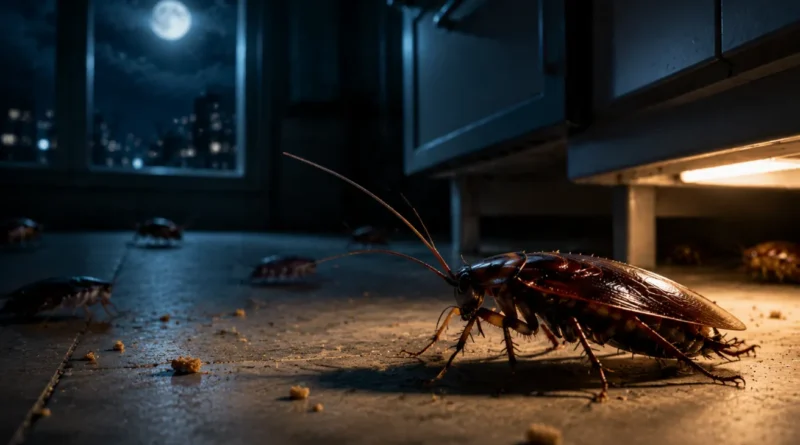
Why Do Cockroaches Come Out at Night?
You turn on the kitchen light after midnight and a cockroach vanishes under the refrigerator in under a second. It is a scene most people recognise, but few understand. Cockroaches are not simply shy about humans. Their nocturnal behaviour is driven by a combination of hard-wired biology, environmental preferences, and millions of years of evolutionary pressure — and understanding it changes how you inspect, treat, and prevent infestations.
This article covers why cockroaches are nocturnal at a biological level, what they are doing during those nighttime hours, where they hide during the day, and — most importantly — what daytime sightings actually tell you about the severity of what is happening inside your walls.
For the full picture of how nocturnal patterns vary by species, see our dedicated guide on when and why cockroaches come out. This article focuses on the science behind the behaviour and the practical implications for control.
Consistent nighttime sightings mean an established population. Our removal guide covers what to do next.
The Biology Behind Cockroach Nocturnal Behaviour
Cockroach nocturnality is not a learned habit or a simple preference. It is controlled by an internal biological clock called a circadian rhythm, the same fundamental mechanism that governs sleep and wake cycles in mammals, including humans.
This internal clock runs independently of whether the cockroach has recently eaten, whether threats are present, or whether the temperature has changed. Even cockroaches kept in constant darkness in laboratory conditions maintain a roughly 24-hour activity rhythm, demonstrating that the behaviour is endogenous rather than purely reactive to environmental cues.
The term for a cockroach’s aversion to bright light is negative phototaxis. It does not mean cockroaches are afraid of light in the way that word implies. It means their nervous system has a hard-wired aversion response that causes them to move away from high-intensity light sources when exposed. This is why a cockroach hit by a kitchen light will run immediately rather than freeze — the response is neurological and nearly instantaneous.
5 Reasons Cockroaches Are Active at Night
1. Their Internal Clock Is Wired for Darkness
The circadian rhythm described above is the primary driver of nocturnal behaviour. Cockroaches do not decide to come out at night — they are biologically compelled to. Their peak foraging activity is hardwired to the hours between dusk and roughly 2 to 4 hours after dark, making the early part of the night the period of highest movement and activity in any infestation.
2. Predator Avoidance Over Millions of Years
Cockroaches have been nocturnal for an estimated 300 million years. During daylight hours, the animals that preyed on cockroaches — birds, lizards, larger insects, and eventually humans — were most active. Nocturnal foraging reduced the risk of predation dramatically. The behaviour that evolved as a survival strategy in prehistoric environments is still fully active in the cockroaches living inside modern homes, even though their predation risk there is effectively zero.
3. Temperature and Humidity Favour Night
Cockroaches are ectothermic, meaning they cannot regulate their own body temperature. They are most active at ambient temperatures of 27 to 28°C and rely on environmental humidity to prevent dehydration. In most homes, nighttime brings slightly cooler temperatures and higher relative humidity as daytime evaporation slows. This makes the thermal and moisture conditions at night marginally more favourable for sustained activity than the warmer, drier daytime environment.
4. Kitchens Are Quiet and Undisturbed
Cockroaches are highly sensitive to vibration and air movement. Human activity — walking, cooking, running water — creates constant vibration that keeps cockroaches suppressed in their harborage areas during the day. At night, when the household is stationary and quiet, the vibration signals that indicate danger disappear. Cockroaches emerge in this quiet environment because the sensory triggers that suppress their activity during the day are absent.
5. Mating and Reproduction Happen at Night
Cockroach mating activity is concentrated during peak nighttime foraging hours. Male cockroaches follow pheromone trails left by females and compete for mating opportunities during the period of highest activity. Female cockroaches also deposit oothecae during nighttime activity cycles. This means that an infestation is not just feeding at night — it is actively breeding during those hours, which is why the nighttime period is the reproductive engine of the entire population cycle.
What Cockroaches Are Actually Doing During the Night
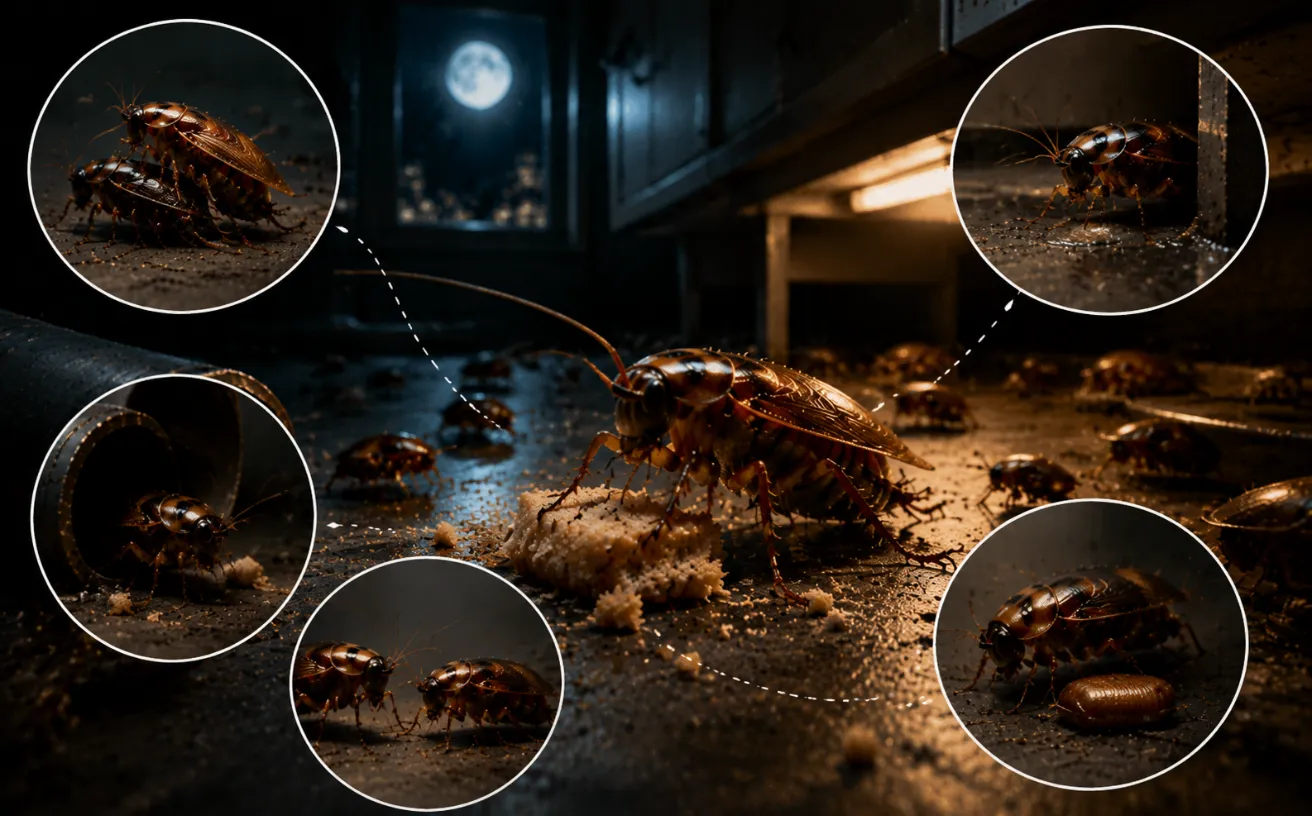
When cockroaches emerge from their harborage areas after dark, they are doing far more than just crossing your kitchen floor. Understanding the full range of nocturnal activity explains why infestations spread so rapidly and why morning cleaning alone is not sufficient.
Dusk — First 2 Hours of Dark
Peak Foraging and Exploration
The highest concentration of movement occurs in the first two hours after dark. Cockroaches leave harborage areas, follow pheromone trails to food and water sources, and spread to new areas of the home. This is when they are most likely to cross open surfaces.
Middle of Night
Mating and Ootheca Deposition
After initial foraging, mating activity intensifies. Females that are ready to deposit egg cases do so during this period, choosing concealed harborage areas that will remain undisturbed during daylight hours.
Pre-dawn — 2 to 3 Hours Before Light
Secondary Foraging Window
A second, smaller peak of activity occurs before dawn. Cockroaches make a final foraging round before retreating to harborage as light levels begin to rise. This window is shorter and less intense than the dusk peak.
Daytime
Harborage and Rest
During daylight hours, cockroaches wedge themselves into tight spaces where all sides of their body are in contact with a surface. This thigmotactic behaviour — seeking continuous body contact with surfaces — provides physical security and helps maintain body temperature and moisture.
Where Cockroaches Hide During the Day
Because cockroaches spend up to 75% of their time in harborage, understanding daytime hiding locations is as important as understanding nighttime behaviour. Each species gravitates toward specific locations, which is also why cockroach identification is the essential starting point before any treatment.
Kitchen Behind and under the refrigerator Motor heat keeps this area consistently warm. One of the most common German cockroach harborage sites. | Inside cabinet hinges and door frames The gap inside a cabinet hinge provides full body contact on all sides — ideal cockroach harborage conditions. |
Behind and under the oven The gap between the oven and counter, and the underside of the oven drawer, are warm and rarely cleaned. | Bathroom Under the sink cabinet Pipe moisture and warmth make this a high-priority harborage for both German and Oriental cockroaches. |
Behind toilet and pipe entry points Wall voids near water pipes provide the moisture and darkness cockroaches seek during daylight rest. | Throughout Home Inside electronics and appliances Brown-banded cockroaches particularly favour electronics. Warmth from circuit boards creates a stable microclimate. |
Basement Near floor drains and wall cracks American and Oriental cockroaches prefer damp basement areas, especially near drain access points. | Attic / Roofline Roof voids and attic insulation Smokybrown cockroaches prefer elevated outdoor and attic locations, entering via roofline gaps at night. |
What Your Sighting Time Tells You About the Infestation
When you see a cockroach matters as much as the fact that you saw one. The timing of a sighting is one of the most reliable indicators of infestation severity available to a homeowner without specialist equipment.
Nighttime Sighting Seeing cockroaches in the first few hours after dark, particularly in the kitchen or bathroom, is consistent with standard foraging behaviour. It confirms an active infestation but does not necessarily indicate a large one. Begin treatment promptly but the situation is likely still manageable. | Daytime Sighting — Warning Sign Cockroaches are suppressed into harborage during daylight by their circadian rhythm. A daytime sighting usually means the harborage areas are so overcrowded that individuals are being pushed out into the open despite the biological drive to stay hidden. This is a serious warning sign requiring urgent treatment. |
The same principle applies to locations. Seeing a cockroach in a bedroom or living area when the infestation is otherwise kitchen-based suggests the population has grown large enough to push individuals into secondary areas of the home in search of food and harborage space. For more on what specific types of cockroaches in homes mean for infestation patterns, see our species guide.
How to Use Nocturnal Behaviour to Treat More Effectively
Time Your Inspection Correctly
The single most effective time to inspect for cockroach activity is in the first 30 to 60 minutes after switching off the lights in the kitchen at night. Wait 20 to 30 minutes in a dark, quiet room, then use a flashlight to quickly scan harborage areas. The cockroaches will be mid-activity and easier to observe and count, giving a far more accurate picture of population size and specific hiding locations than any daytime inspection can provide.
Apply Gel Bait Just Before Dark
Gel bait is most effective when freshly applied and positioned along active movement routes. Applying bait in the 30 to 60 minutes before the household’s usual lights-out time means the bait is at its peak freshness and moisture content exactly when cockroaches enter their highest-activity foraging window. Bait applied in the morning will have been drying for 12 to 14 hours before cockroaches are most active at it.
Clean Harborage Areas During the Day
Since cockroaches are in harborage during daylight, thorough cleaning, including removing droppings, old oothecae, and food debris from cabinet interiors, should be done during the day when cockroaches are least mobile. This disrupts harborage and removes the aggregation pheromones in droppings that attract more individuals to the same areas.
Do Not Rely on Daytime Visual Checks Alone
Checking for cockroaches during the day and seeing none does not mean the infestation is resolved. A population of hundreds can be completely invisible during daylight hours if their harborage areas are undisturbed. Always supplement visual checks with sticky monitoring traps, which capture individuals regardless of time of day, for a more accurate ongoing assessment.
What Cockroaches Are Leaving Behind Each Night
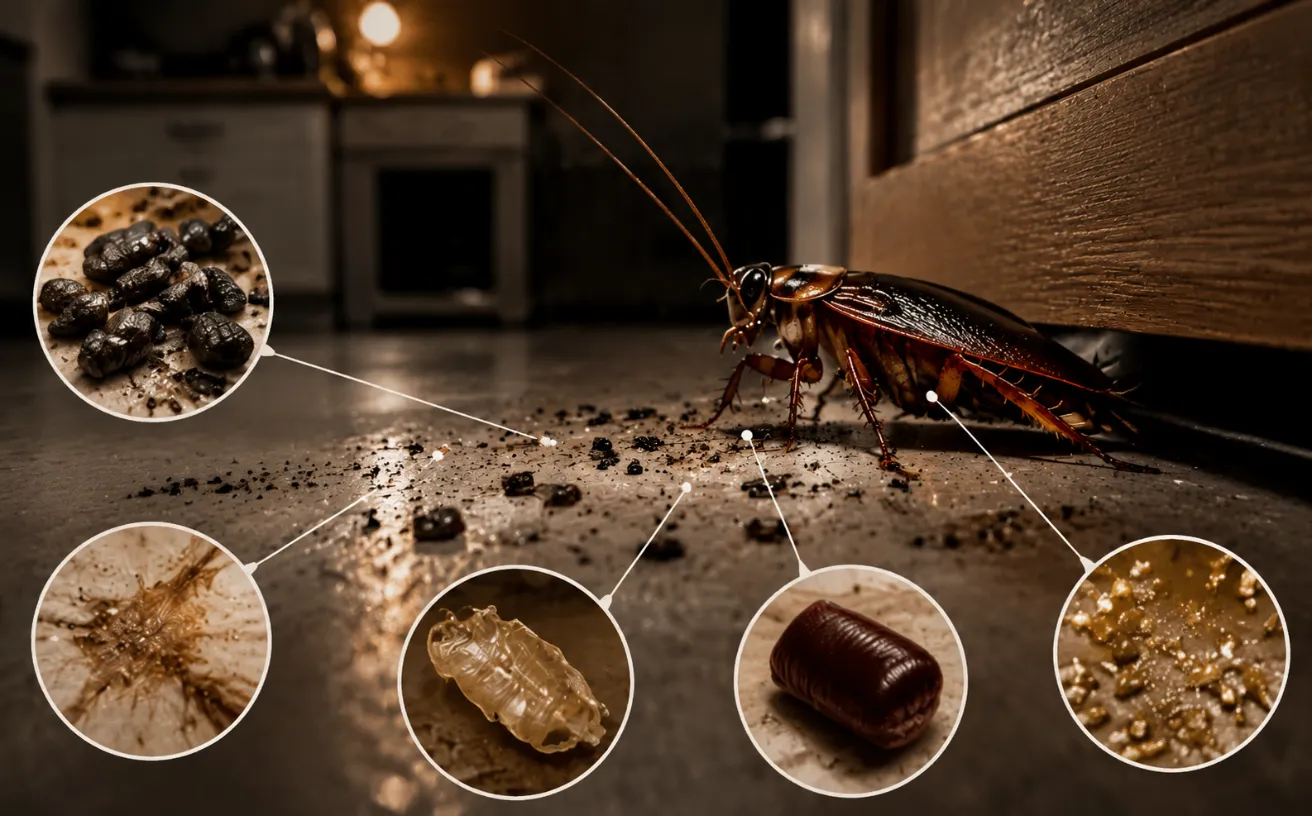
The health risk from a cockroach infestation is not just the insects themselves. Every nighttime foraging run across kitchen surfaces deposits bacteria from wherever that cockroach has been, including drains, bins, and sewage entry points.
During each night’s activity, cockroaches leave behind droppings, shed skin fragments, and salivary secretions on every surface they cross. Each of these contributes to the allergen load in the home, which accumulates over time regardless of how clean the kitchen appears in the morning. This is why regular cleaning is a necessary but not sufficient response to an active infestation.
For a full breakdown of the specific health risks by species, including which cockroaches carry the most dangerous pathogens and allergens, see our article on health risks from cockroach species.
- ✓Wipe down all kitchen surfaces with a disinfectant each morning, not just visible crumbs but the full counter surface, stovetop, and appliance exteriors.
- ✓Store all food in sealed containers before the nighttime activity window begins.
- ✓Empty and seal kitchen bins before bedtime to remove the primary overnight food source.
- ✓Run sticky monitoring traps to track nightly activity levels and assess whether treatments are reducing the foraging population.
- ✓After treatment, continue surface cleaning for at least 8 weeks to manage residual allergen levels as the population declines.
If nighttime sightings are frequent or have spread to multiple rooms, professional treatment is likely the most effective next step. Our overview of professional cockroach treatment options covers what a full treatment programme involves and what to expect at each stage.
Frequently Asked Questions
Why are cockroaches only active at night?
Cockroach nocturnal behaviour is controlled by an internal biological clock called a circadian rhythm. Specialised neurons in their optic lobes respond to light and dark signals, triggering peak foraging activity in the first few hours after darkness falls. This is not a learned habit or preference. It is a hard-wired biological compulsion that runs independently of food availability, temperature, or the presence of threats.
What are cockroaches actually doing during the night?
Cockroaches are doing far more than crossing your kitchen floor. In the first two hours after dark, they leave harborage areas, follow pheromone trails to food and water sources, and spread to new areas of the home. Later in the night, mating activity intensifies and females deposit egg cases in concealed locations. A second, smaller foraging window occurs just before dawn before they retreat back into hiding as light levels rise.
Where do cockroaches hide during the day?
Cockroaches spend up to 75 percent of their time in harborage during daylight hours. Common hiding locations include behind and under the refrigerator, inside cabinet hinges, behind the oven, under bathroom sinks, and around pipe entry points in walls. German cockroaches favour kitchen warmth sources, Oriental cockroaches prefer damp basement areas, and brown-banded cockroaches are frequently found inside electronics and appliances.
What does it mean if you see a cockroach during the day?
A daytime sighting is a serious warning sign. Cockroaches are biologically suppressed into harborage during daylight hours by their circadian rhythm. If one is visible during the day, it typically means the harborage areas are so overcrowded that individuals are being pushed out into the open despite their instinct to stay hidden. This strongly suggests the infestation has grown large and professional assessment is recommended.
What is the best time to inspect or treat for cockroaches?
The most effective inspection window is in the first 30 to 60 minutes after switching off the kitchen lights at night. Wait 20 to 30 minutes in a dark, quiet room, then use a flashlight to scan harborage areas while cockroaches are mid-activity. For gel bait treatments, apply in the 30 to 60 minutes before lights-out so the bait is at peak freshness exactly when cockroaches enter their highest-activity foraging window.
Cockroach Care provides science-based guidance on cockroach identification, prevention, and control. Behavioural data in this article is based on published entomological research. Individual cockroach behaviour may vary by species, environment, and infestation density.
