
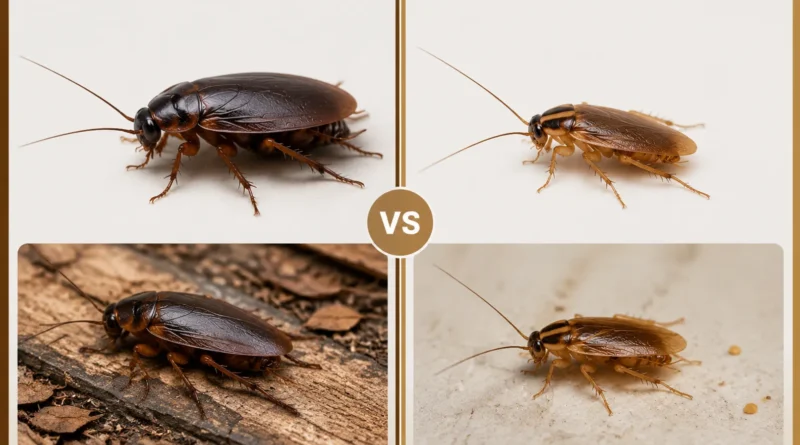
Wood Cockroach vs German Cockroach: Key Differences That Actually Matter
Wood cockroaches and German cockroaches are two entirely different insects that require completely different responses. Wood cockroaches are outdoor wanderers that rarely survive indoors, while German cockroaches are aggressive indoor pests that breed fast, hide deep, and are genuinely difficult to eliminate.
Confusing the two is one of the most common mistakes homeowners make, and it leads to either unnecessary panic or dangerously underestimating an infestation. This guide breaks down every meaningful difference between these two species so you can identify what you are dealing with and respond correctly.
Why Getting the Identification Right Matters
Treating your home for the wrong species wastes time, money, and effort. A wood cockroach found on your porch during summer is a very different situation from a German cockroach spotted near your kitchen sink at midnight.
The stakes here are real. German cockroaches reproduce at a rate that can turn a single pair into hundreds of insects within weeks. Wood cockroaches, by contrast, cannot breed indoors at all. Before reaching for any product or calling anyone, identifying which cockroach species you are actually dealing with is the single most important step you can take.
Size and Physical Appearance
The first place most people look is the body itself, and there are clear differences once you know what to observe.
Wood cockroaches typically measure between 3/4 inch and 1.25 inches in length. They are chestnut brown with a distinctive pale, creamy border running along the outer edges of their wings and thorax. This light edging is a reliable visual marker that separates them from most indoor species. Males have long, fully developed wings that extend past their abdomen, giving them a noticeably winged appearance even at rest.
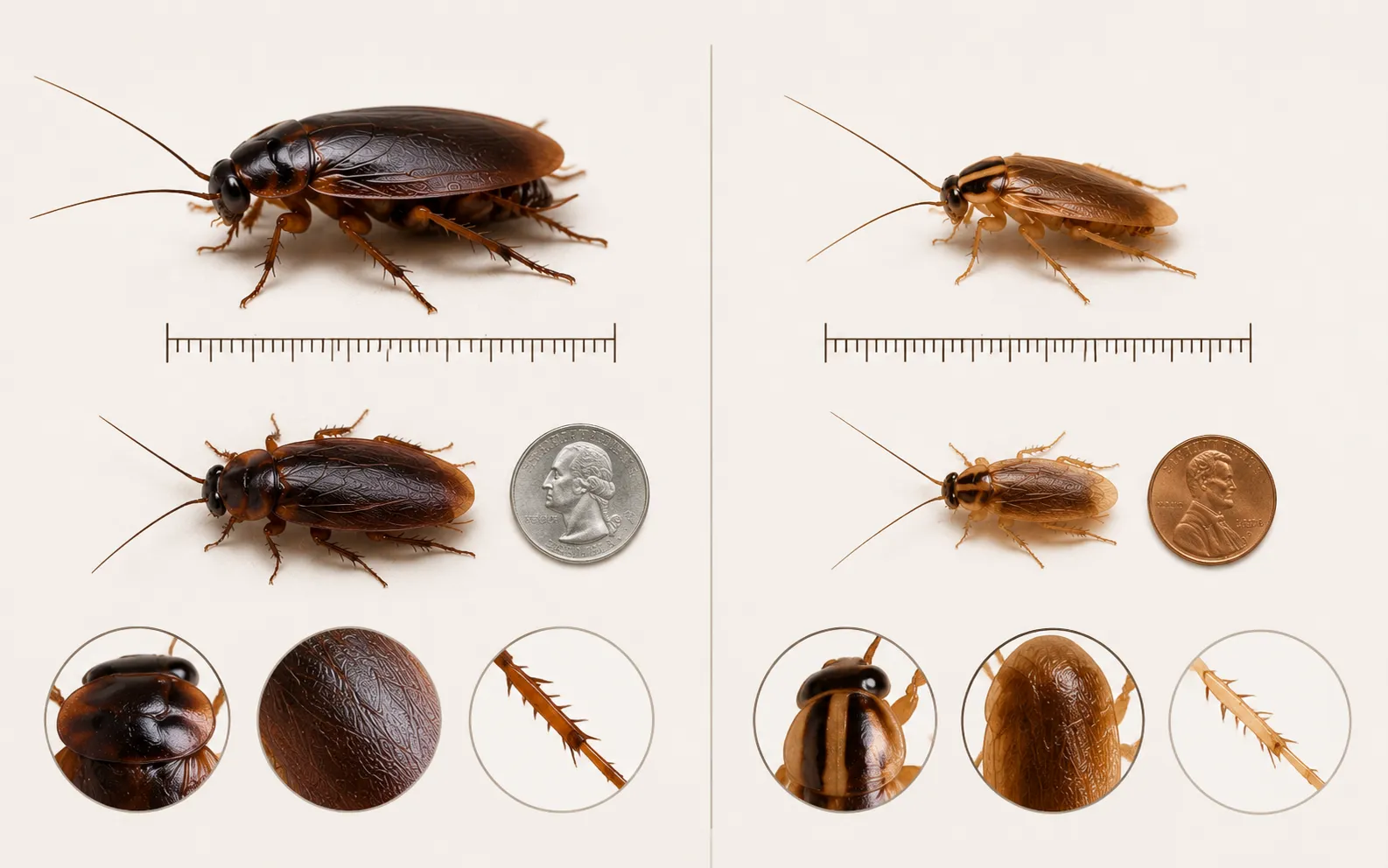
German cockroaches are smaller, usually between 1/2 inch and 5/8 inch long. They are a lighter tan or golden-brown color and carry two dark parallel stripes running lengthwise behind their head on the pronotum. Those twin stripes are the single fastest identification marker for this species. Despite having wings, German cockroaches almost never fly.
For a more detailed breakdown of physical features across species, comparing cockroach body shapes and sizes helps put both of these insects in broader context.
Color and Markings Side by Side
Color alone is not enough to make a definitive identification, but it narrows things down quickly when combined with other features.
Here is how the two species compare visually:
- Wood cockroach: Chestnut to medium brown, pale cream border on wings and thorax, no stripes, slightly flattened body
- German cockroach: Light tan to golden-brown, two dark parallel stripes behind the head, smooth coloring across the body, very flat and fast-moving
If the insect you found has those two dark lines running down its back near the head, it is almost certainly a German cockroach. If it has a pale outline around the wing edges and a more matte brown appearance, you are likely looking at a wood roach.
Behavior Indoors
This is where the two species diverge most dramatically, and it is the most practically useful distinction for homeowners.
Wood cockroaches behave like disoriented visitors indoors. They move slowly, tend to wander in open spaces rather than along walls, and are commonly found in daylight hours. They do not seek out food in kitchens and show no interest in hiding under appliances or inside cabinets. A wood cockroach in your living room is almost always a stray that wandered in through a gap or was carried in with firewood.
German cockroaches behave like seasoned survivors. They are fast, strongly nocturnal insects that avoid light and scatter instantly when disturbed. They gravitate toward heat sources, moisture, and food residue, which is why they concentrate in kitchens and bathrooms. Seeing even one German cockroach during daylight is often a sign that the population behind your walls has grown large enough to push individuals out into the open.
Habitat and Where Each Species Lives
Where the cockroach came from tells you nearly as much as what it looks like.
Wood cockroaches are native to wooded, outdoor environments. They live under bark, inside rotting logs, in leaf litter, and around wood debris. They are found most often in suburban or rural homes near tree lines, wooded lots, or properties that store firewood. They enter homes accidentally and have no ability to sustain themselves indoors long-term.
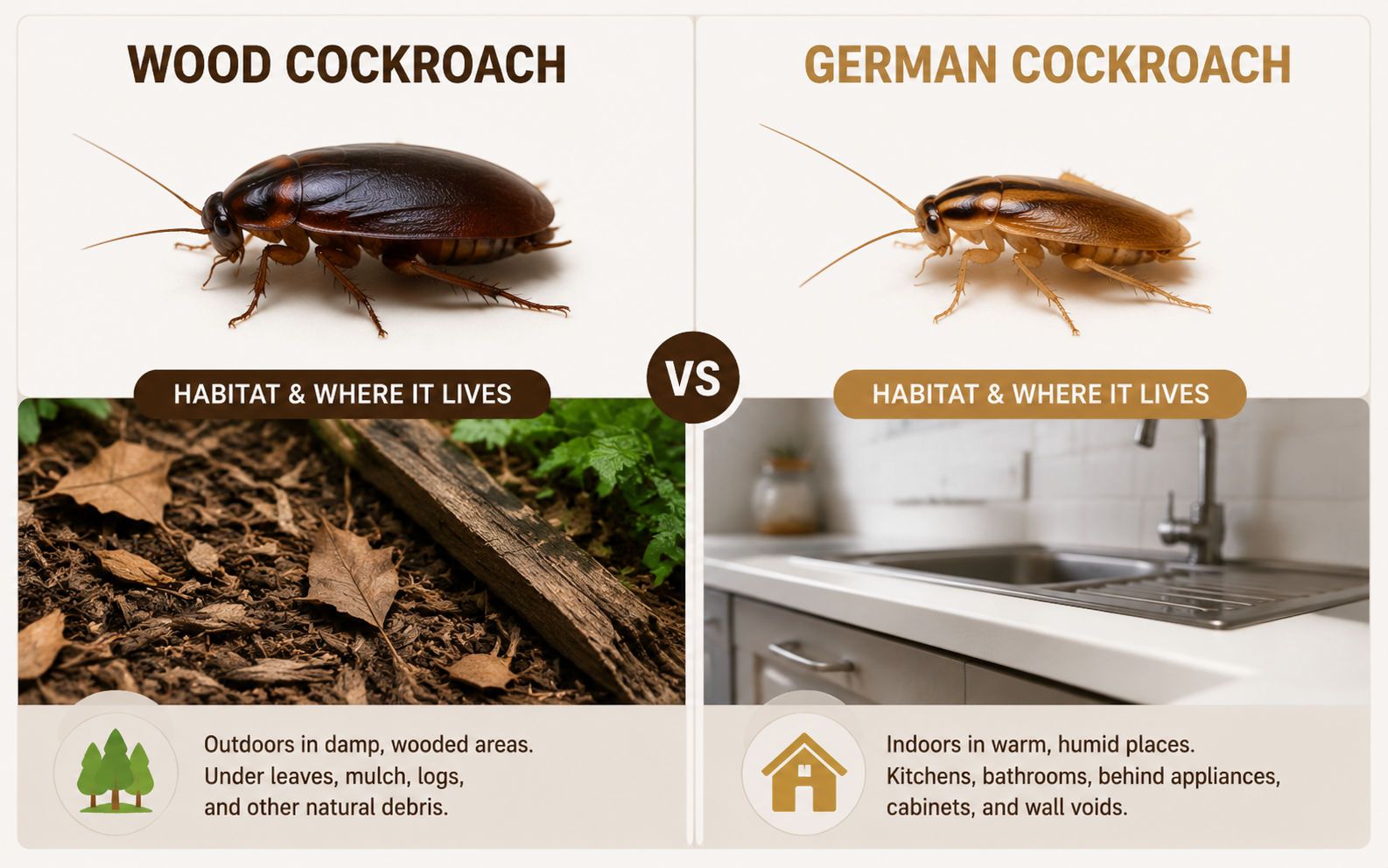
German cockroaches are exclusively indoor pests. They live inside wall voids, behind refrigerators and stoves, under sinks, inside cabinet hinges, and in any warm, humid crevice close to food. They do not survive well outdoors and depend entirely on human structures. Understanding where German cockroaches specifically nest and hide is essential for treatment planning.
Reproduction Rate: The Most Critical Difference
If there is one number that separates these two species in terms of urgency, it is how fast they multiply.
Wood cockroaches reproduce outdoors, seasonally, and cannot complete their life cycle inside a home. Even if a female enters your house, she will not successfully reproduce indoors. The population you see is the population you have.
German cockroaches are among the fastest-reproducing cockroach species in existence. A single female carries an egg case containing roughly 30 to 40 eggs, and she can produce a new case every few weeks. Understanding how rapidly German cockroach populations expand explains why a small sighting becomes a large infestation in a matter of weeks without intervention.
- Wood cockroach eggs hatch outdoors in decaying wood
- German cockroach females carry their egg case on their body until just before hatching
- A German cockroach population can double multiple times in a single season indoors
Health Risks Associated with Each Species
Both species can carry bacteria on their legs and bodies, but the level of risk differs substantially based on how long they spend in your living environment.
Wood cockroaches pass through briefly and rarely contact food preparation areas, so their health impact is minimal. German cockroaches, by contrast, live continuously in spaces where food, dishes, and surfaces are present. Their droppings, shed skins, and saliva accumulate over time and become potent allergens. The health risks tied to German cockroach infestations include triggering asthma attacks, spreading bacteria like Salmonella, and contaminating food sources on a daily basis. Children are particularly vulnerable, and cockroach allergens and childhood asthma have a well-documented connection in homes with persistent infestations.
How Each Species Enters Your Home
The entry routes for these two insects are completely different, which matters for prevention.
Wood cockroaches enter through:
- Firewood brought indoors
- Open doors and windows during warm months
- Gaps around pipes, vents, or exterior cracks
- Attraction to outdoor lighting that faces entry points
German cockroaches enter through:
- Used appliances, furniture, or grocery bags carrying egg cases
- Shared walls in multi-unit buildings
- Plumbing access points between units or floors
- Second-hand items purchased or acquired from infested locations
If you live in an apartment and spot German cockroaches, how roach infestations spread through shared buildings is directly relevant to understanding why your unit may be affected even if your own habits are spotless.
Treatment Approach for Each Species
Because the two insects behave so differently, the correct response to each is also different.
For wood cockroaches, the solution is largely environmental. Remove firewood from inside, seal exterior gaps, reduce outdoor lighting at night, and clear wood debris and mulch from around the foundation. No chemical treatment is typically necessary, and the problem usually resolves itself within days once entry points are blocked.
For German cockroaches, a much more targeted and sustained approach is required. Gel baits placed in harborage areas, insect growth regulators that interrupt the breeding cycle, and follow-up treatments are the foundation of effective control. The choice between DIY versus professional German cockroach extermination depends on the size of the infestation and whether the problem spans multiple rooms or units.
Which One Is Harder to Eliminate
There is no comparison here. German cockroaches are among the hardest household pests to fully eradicate.
Their resistance to pesticides has grown significantly over decades of exposure. They adapt quickly, avoid treated areas, and their rapid reproduction means that any surviving individuals repopulate faster than slow treatment approaches can keep up. Why German cockroaches are so difficult to kill comes down to both biological resilience and behavioral avoidance.
Wood cockroaches present essentially no elimination challenge indoors because they are not trying to establish a population in the first place. Remove what attracted them and block entry points, and the problem ends.
Frequently Asked Questions
How can I tell a wood cockroach from a German cockroach at a glance?
Look for two things. First, check for two dark parallel stripes just behind the head. Those stripes confirm a German cockroach. Second, look for a pale cream border along the wing edges. That border points to a wood cockroach. Size also helps since German cockroaches are noticeably smaller and faster, while wood cockroaches are larger, slower, and tend to wander rather than scatter.
Can wood cockroaches become an infestation indoors?
No. Wood cockroaches cannot complete their reproductive cycle inside a home. They need decaying outdoor wood and humidity levels found in forest environments to breed successfully. If you are finding multiple cockroaches regularly in different parts of your home, the species involved is almost certainly not a wood cockroach.
Are German cockroaches more dangerous than wood cockroaches?
Yes, significantly. German cockroaches live continuously in food preparation and storage areas, accumulate allergens through droppings and shed skins, and contaminate surfaces daily. Wood cockroaches are temporary visitors with minimal health impact. The persistent indoor presence of German cockroaches is what makes them a genuine health and sanitation concern.
Do wood cockroaches carry disease like German cockroaches do?
Wood cockroaches can technically carry bacteria on their legs and bodies from outdoor environments, but because they do not frequent kitchens or food areas and do not establish long-term indoor presence, the actual disease risk is very low. German cockroaches actively forage in food zones and carry pathogens including Salmonella and E. coli on a recurring basis.
Should I call a professional if I find one of each?
For a wood cockroach, professional treatment is rarely necessary. Seal entry points and remove conditions that drew it inside, and the issue typically resolves itself. For a German cockroach, even a single sighting warrants a thorough inspection because where there is one, there are almost always more hidden nearby. A professional can assess the extent of the population and recommend a treatment approach based on what they find.
What time of year are wood cockroaches most likely to enter homes?
Wood cockroaches are most active in late spring through midsummer, which is their mating season. Males fly toward light sources during this period, making lit homes and open windows common entry points. German cockroaches are active year-round indoors and have no seasonal pattern since they live entirely within climate-controlled structures.
