
How Fast Do Cockroaches Reproduce? The Shocking Truth About Their Breeding Cycle
Cockroaches multiply fast. In warm, humid homes (28–30°C, ~70% RH), females produce an egg case every 4–6 weeks, each holding 10–50 eggs. German roaches hatch in about 28 days and their nymphs can become breeding adults in roughly 3–4 months. American roaches lay ~16 eggs per case and mature much slower, often over a year. Food, warmth, and moisture speed everything up; stress slows it. Want the exact timelines by species and what truly accelerates infestations?
Key Takeaways
- Cockroaches have a three-stage life cycle—egg, nymph, adult—with rapid maturation under warm, humid conditions.
- German cockroaches can produce an ootheca every 4–6 weeks, each carrying 28–50 eggs.
- Incubation ranges from about 28 days (German) to 60 days (Oriental), accelerating at 28–30°C and 60–70% humidity.
- Nymphs molt 6–18 times; maturity takes ~100 days (German) up to 600+ days (American), depending on species and temperature.
- A single female can generate hundreds of offspring yearly, enabling explosive infestations in favorable conditions.
From Egg to Adult: The Three-Stage Life Cycle
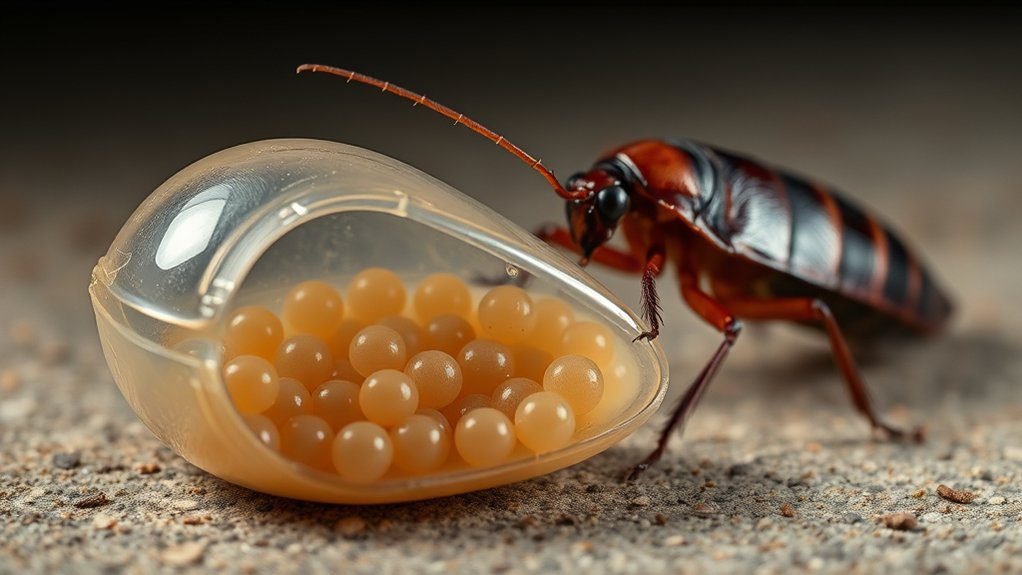
Although species differ, cockroaches follow a clear three-stage path from egg to adult: egg, nymph, and adult.
You’ll first encounter the ootheca, a protective case holding roughly 10–60 eggs. Females may carry it briefly or stash it in hidden, suitable spots on or under substrates. Incubation ranges from a few weeks to several months, depending on species. Some species, like the German cockroach, reproduce quickly and thrive in warm, humid environments.
When nymphs hatch, they look like smaller, wingless adults. They’re paler, lack wings and reproductive organs, and start feeding immediately. Growth happens through molts—typically 6 to 18. After each shed, nymphs appear white until the new exoskeleton hardens.
Following the final molt, adults emerge with wings and reproductive capacity. Lifespan varies: around six months to over a year, and up to two years in ideal settings. Flight ability depends on species.
How Often Do They Lay? Egg Case Frequency by Conditions
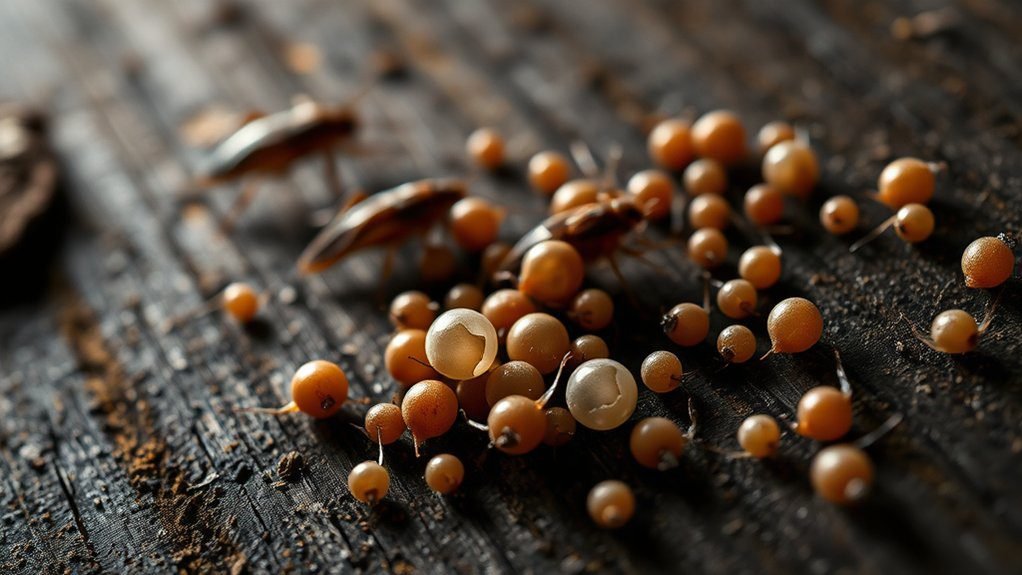
You’ll see cockroaches lay fastest on an ideal timeline when it’s warm, humid, and stable—think German and brown-banded roaches producing oothecae in just a few weeks.
If temperature or humidity swings, that schedule slows, egg cases come less often, and viability drops.
As conditions worsen, expect longer gaps between oothecae and fewer successful hatchings.
Across species, a single ootheca can carry 10–50 eggs, depending on the roach.
Optimal Conditions Timeline
When warmth, humidity, and food line up, cockroaches speed up their egg-case schedule—and each species has a distinct tempo. In steady 28–30°C heat with about 70% RH and ready food, you’ll see German cockroaches produce an ootheca every 4–6 weeks (30–40 eggs each). American cockroaches average one per month, typically ~16 eggs per case, while brown-banded females can drop one every 16–22 days. Oriental cockroaches trail slightly, about every 22 days after maturity. Under poor sanitation and available moisture, infestations can escalate rapidly because cockroaches reproduce quickly.
| Species | Peak interval | Eggs per ootheca |
|---|---|---|
| German | 4–6 weeks | 30–40 |
| American | ~1 month | ~16 (range varies) |
| Brown-banded | 16–22 days | ~16 |
Expect later oothecae—especially in Americans—to carry fewer eggs than early cases.
Stress-Slowed Schedules
Even under the same roof, stress can stretch a cockroach’s egg-case calendar from weeks to months. You’ll see longer gaps between oothecae when temperatures swing or sit at extremes. Below 60°F (15°C), females may pause laying altogether; above 90°F (32°C), heat stress slashes output. Fluctuations alone disrupt regular schedules.
If food or water runs short, reproduction slows. Limited calories shrink ootheca size, infrequent feeding extends intervals, and starvation can stop production. Dehydration forces delays or skipped lays.
Humidity matters, too. Low moisture dries oothecae, kills embryos, and drags out hatching; arid conditions mean fewer egg cases. High, stable humidity speeds development; very low humidity derails it.
Species respond differently, but all slow under stacked stressors: Germans skip cycles, Americans widen intervals, brown-banded and Oriental species falter in dry or cold air.
Even small early signs should prompt action because early detection prevents the exponential growth that can occur within weeks.
Species Breakdown: German vs. American vs. Oriental vs. Brown-Banded
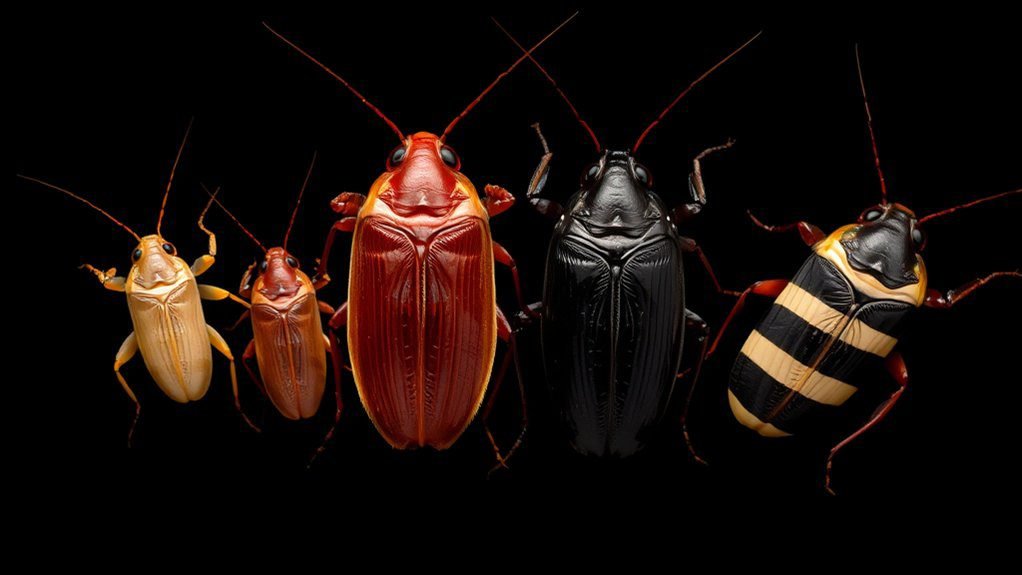
Now you’ll compare how each species stacks up on egg case counts and how fast eggs incubate and nymphs mature.
You’ll see German cockroaches top the charts with frequent oothecae and quick maturation, while American and Oriental species pace slower and brown-banded sits in between. Warmer temperatures accelerate reproduction, so heated indoor environments can shorten incubation and maturity times across species.
Use these differences to anticipate population growth and prioritize control.
Egg Case Counts
Although all cockroaches reproduce with oothecae, their egg case counts and strategies vary sharply by species. You’ll see the biggest numbers from German cockroaches: about 30–40 eggs per case (sometimes up to 50) and 4–8 cases in a lifetime, pushing totals toward 300–400 under ideal conditions.
American cockroaches pack fewer eggs—typically 14–16 per ootheca—but a female can create roughly 15 cases, yielding about 160 eggs yearly.
Oriental cockroaches sit in the middle with 12–16 eggs per case and around eight cases per female. They deposit oothecae in damp, sheltered spots.
Brown-banded cockroaches produce 10–18 eggs per case and up to 20 oothecae, for roughly 250 eggs total.
Species behavior matters: Germans retain oothecae until near hatch, while others deposit cases sooner.
Incubation and Maturation
Four common household cockroaches follow similar reproductive steps—egg incubation, nymphal molts, and adulthood—but their timelines diverge sharply.
You’ll see German cockroaches sprint: eggs incubate about 28–30 days (the female carries the ootheca ~20 days), nymphs molt 5–6 times over 40–125 days, and total time runs roughly 50–120 days, averaging ~66 days per generation.
Brown-banded roaches track moderately fast: eggs incubate ~40–50 days; nymphs mature in 2–6 months; females glue oothecae to walls or furniture, thriving in warm, dry spots.
American cockroaches slow things down: eggs incubate 6–8 weeks; nymphs need 6–12 months and up to 14 molts; females deposit oothecae in hidden warm areas.
Oriental cockroaches match that pace: 40–60 days incubation, 6–12 months nymphs, favoring cooler, damp habitats.
Temperature drives all rates.
Incubation Timelines: How Long Until Eggs Hatch
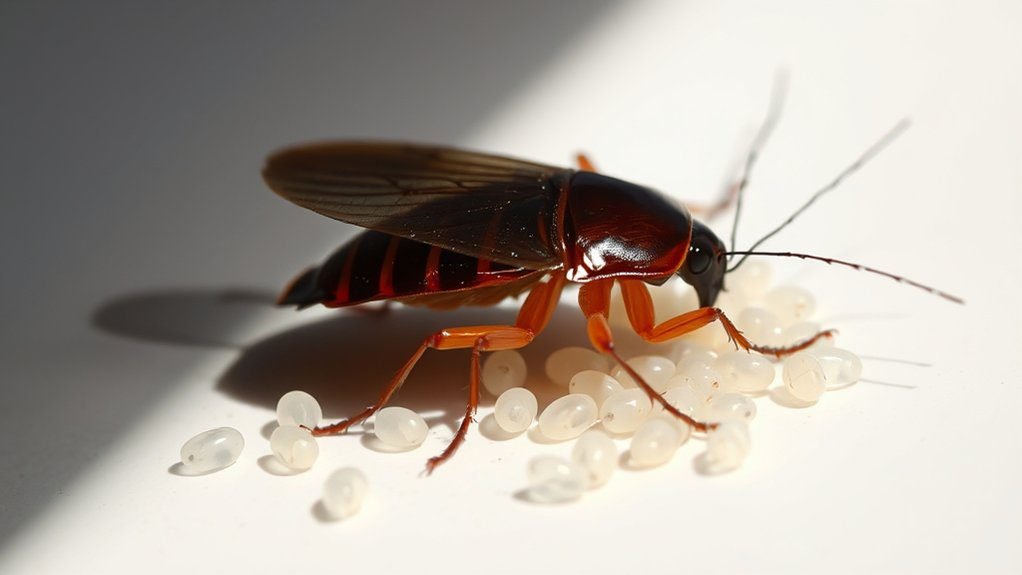
From a few weeks to two months, cockroach egg incubation varies by species and conditions.
At typical room temperatures, German cockroach eggs hatch in about 28 days. Each ootheca holds 30–40 embryos, and the female carries it until just before hatching; a blue‑green line can appear when they’re ready. If you remove that capsule from the female, it rarely hatches.
American cockroach eggs take about 50 days after the reddish‑brown ootheca (8–10 mm) is deposited. Females produce roughly one case per month, often tucking it into hidden spots.
Oriental cockroach eggs hatch in about 60 days; their dark brown cases (10–12 mm) are dropped in warm, sheltered areas.
Brown‑banded cockroach eggs hatch in about 50 days; females glue light 5 mm cases to higher, drier surfaces.
Nymph Growth: Molts, Maturation, and Time to Reproduce
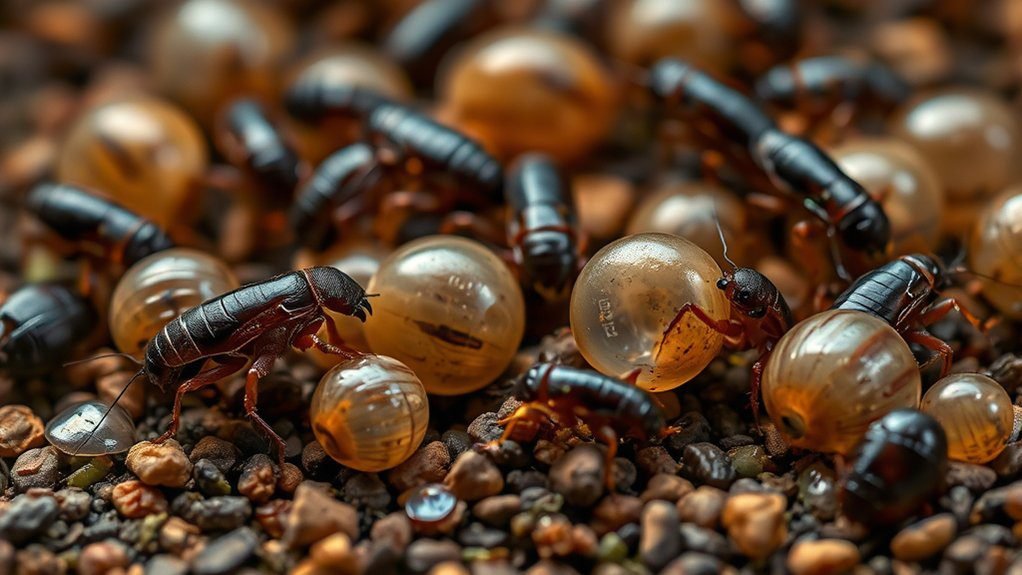
Once an egg hatches, the tiny nymph takes over the growth story you started with incubation. You’ll see incomplete metamorphosis: a wingless nymph passes through several molts, growing larger at each instar.
Right after molting, it looks pale or white, then darkens as the new exoskeleton hardens. Nymphs resemble adults in shape but lack wings and reproductive organs, so they can’t breed until the final molt.
Freshly molted nymphs turn from pale white to darker as their exoskeleton hardens, remaining wingless and infertile until adulthood.
Species mature at very different speeds. German cockroach nymphs typically finish in about 100–103 days. Brown-banded nymphs need up to 276 days. American cockroach nymphs take roughly 600 days, while Oriental nymphs can require 300–800 days.
Molt counts vary too: German 6–7, American 6–14, Brown-banded up to 8, Oriental 7–10. Nymphs forage actively at night and hide by day.
What Speeds or Slows Breeding: Temperature, Food, Humidity, and Density
Although genetics set the baseline, the pace of cockroach breeding rises or stalls with four levers you can control: temperature, food, humidity, and crowding. Keep rooms near 28–30°C and you’ll shorten cycles; cooler or hotter conditions slow egg development and can cut adult lifespan and mating success. Provide steady, protein-rich food and water, and you’ll see faster maturation and more oothecae; starvation trims clutch size and delays laying. Maintain 60–70% RH to boost hatching; dry air desiccates eggs. Manage density because crowding shifts laying into clusters, aids mating proximity, yet can stress and slow growth.
| Lever | Speeds breeding | Slows breeding |
|---|---|---|
| Temperature | 28–30°C; faster gonad development | Outside optimum; thermal stress |
| Food/Water | Protein, minerals, constant access | Starvation, poor diet |
| Humidity | ~60–70% RH; active mating | Dry air; egg desiccation |
| Density | Easy mate access | Stress, reduced intake |
Frequently Asked Questions
How Far Can Cockroaches Spread Within a Home During One Breeding Cycle?
They can spread room to room and across floors, traveling meters via wall voids, plumbing, and ducts within weeks. You’ll see clusters near kitchens and bathrooms; nymphs disperse quickly, and adults—or transported oothecae—extend infestations throughout your home.
Do Cockroaches Reproduce Without Males or After a Single Mating?
Yes—some species can reproduce without males via parthenogenesis, and many can keep producing after a single mating by storing sperm. You’ll see faster, larger clutches from fertilized females, while parthenogenesis yields fewer, less viable offspring.
Where Are Oothecae Most Commonly Hidden Inside Modern Households?
You’ll find oothecae behind warm, moist kitchen appliances, inside and beneath cabinets near sinks, around garbage bins, pantry corners, bathroom vanities and drains, wall cracks and baseboards, cluttered storage boxes, electronics, and damp basements, garages, or laundry rooms.
Can DIY Cleaning Routines Significantly Reduce Egg Survival Rates?
Yes—DIY cleaning can reduce egg survival, but it’s limited. You’ll lower eggs by vacuuming with HEPA, steaming above 50°C, decluttering, sealing cracks, and removing trash nightly. Still, you’ll need integrated pest management to prevent reinfestation.
How Do Insecticides Impact Nymph Development and Future Fertility?
They disrupt molting, stretch development, and reduce future fertility. With IGRs, nymphs become sterile or deformed adults; embryos fail. Neurotoxins like Indoxacarb kill and slow nymphs; resistance imposes fitness costs. Combine IGRs, baits, and DE in IPM to suppress reproduction.
Conclusion
You now know how fast cockroaches can take over: eggs to nymphs to adults on a tight clock, with German roaches leading the race. You’ve seen how ootheca frequency, warm temps, steady food, and humidity turbocharge breeding, while cool, dry, lean conditions slow it. You also understand incubation ranges, molt counts, and when nymphs start reproducing. Use this knowledge to break the cycle: reduce resources, seal entry points, set traps, and act early before populations explode.
