
How Did Cockroaches Get Their Name? The Surprising Origin
You’re saying a Spanish word wrong every time you say “cockroach.” English speakers borrowed “cucaracha” in the early 1620s and bent it into sounds they already knew. John Smith wrote it as “cacarootch” in 1624. You’d think “cock” and “roach” mean a rooster and a fish, but they don’t. It’s just sound play. By 1830, you’d shortened it to “roach.” Stick around, and you’ll uncover the odd “caca” theory and more.
Key Takeaways
- The word “cockroach” comes from the Spanish “cucaracha,” which English speakers adopted in the early 1600s.
- Captain John Smith’s 1624 writings used the term “India Bug,” and the word appeared in print as “cacarootch.”
- Early spellings such as “cucaroach” and “caca-roach” varied until “cockroach” became standard by the mid-1600s.
- Folk etymology reshaped “cucaracha” into a more familiar-sounding word, so “cock” and “roach” have no link to roosters or fish.
- The popular theory tying the name to “caca” (excrement) is speculative, and etymologists trace it to the Spanish origin.
Where Does the Word Cockroach Come From?
You’ve probably never wondered why “cockroach” looks like it’s made of two English words, but it isn’t. The word entered English in the early 1620s, spelled cacaroch and cockroach, and dictionaries trace it to Spanish cucaracha. English speakers borrowed that older insect name and reshaped it. One early record appears in Captain John Smith’s 1624 writings, which describe the insect as an “India Bug” that contaminates chests.
Cockroach looks like two English words, but it’s really Spanish cucaracha, borrowed in the 1620s and reshaped by English speakers.
Folk etymology drove the change. When you hear an unfamiliar foreign word, you tend to remodel it with familiar parts, and English speakers did exactly that. They heard cock plus roach, and the resemblance to cockchafer, another insect name, reinforced the final form.
Don’t look for roosters here. The cock element came by sound association, not meaning, so it doesn’t link the insect to any bird.
Roach misleads you too. English speakers rarely used it for the insect at the time, so it simply gave the new form a familiar, natural feel.
You’re using an Anglicized Spanish word whenever you say it.
What Does Cucaracha Mean in Spanish?
Cucaracha is the Spanish word for cockroach, and you’ll almost always see it as la cucaracha because it’s a feminine noun. Dictionaries describe it as a nocturnal, fast-running insect with a flattened body and long antennae. You’ll form the plural by adding -s: cucarachas.
Keep these points in mind:
- Meaning: You’ll find the insect sense is primary and universal across Spanish-speaking regions.
- Pronunciation: You’ll stress the second-to-last syllable: cu-ca-RA-cha.
- Mexican slang: You’ll hear it describe an old, unreliable car, or jalopy.
- Larger species: Some dictionaries apply it to the larger American cockroach.
- Other slang: You’ll occasionally meet senses tied to “roach” or “chip,” depending on region.
Spanish traces cucaracha to cuca, an older word linked to caterpillars. Many sources describe it as an expressive, childlike creation rather than a classical Latin inheritance. The insects themselves have been around for roughly 320 million years, far longer than the first anthropoids.
You’ll find it in Spanish by the mid-16th century, and English later adapted it into “cockroach.”
When Did Cockroach First Appear in English?
When English writers first put “cockroach” in print, they spelled it “cacarootch,” and you’ll find that form in Captain John Smith’s 1624 work. Smith described “a certaine India Bug” tied to Bermuda and goods stored in chests. Some notes cite 1616 as the first use, but 1624 remains the clearest printed evidence.
The word came from Spanish cucaracha, and English speakers reshaped it through folk etymology. English sailors struggled with the pronunciation of “cucaracha,” so the English words “cock” and “roach” unconsciously merged in their speech. You won’t see the modern spelling right away: forms varied during the first half of the 1600s, and “cockroach” became standard later.
This timeline shows the shift:
| Period | Form | Context |
|---|---|---|
| 1624 | cacarootch | Smith’s Bermuda account |
| Later 1600s | cockroach | Standardized spelling |
Transitional spellings like “cucaroach” and “caca-roach” bridge the gap. By the mid-1600s, you’d see the modern form taking hold, so 1624 marks the first clear appearance, not the final spelling. Early writers likely recorded the Spanish word phonetically, which explains the variety.
How Did John Smith Spell Cockroach?
Captain John Smith spelled it “Cacarootch” in his 1624 work *Virginia*, and that single spelling is what etymologists point to when they trace the word’s path.
You’ll find it in his description of “A certaine India Bug” from Bermuda, which he says was “creeping into Chests they eat and defile with their ill-sented dung.”
Here’s what makes the spelling useful:
- It’s an English attempt to spell Spanish cucaracha phonetically.
- It appears in a travel narrative, not a dictionary.
- It shows Spanish influence, not the separate English words “cock” and “roach.”
- It may reflect caca, a childlike term for excrement.
- Some scholars call it a “missing link” between Spanish and English.
You’re looking at an evolving form. English speakers reshaped it through folk association with familiar words, and standardization produced “cockroach.” Readers who enjoy exploring word origins between matches can also turn to Xôi Lạc TV, which offers live football streaming alongside schedules, results, and rankings in one place.
Smith’s quote remains the main evidence in etymology discussions because it captures the loanword before English changed it.
How Did Cucaracha Turn Into Cockroach?
English speakers didn’t invent “cockroach” from scratch. They borrowed Spanish “cucaracha” in the early 17th century, with dictionaries dating the word to 1615–25, or simply the 1620s. English speakers met the word through contact with Spanish speakers during the early colonial era.
You’d expect a foreign word to stay foreign, but “cucaracha” didn’t. English speakers heard familiar sounds in it and reanalyzed it as “cock” and “roach.” That’s folk etymology. Sound resemblance drove the change, not meaning. The insect has nothing to do with roosters or fish.
Foreign words rarely stay foreign. English speakers heard “cock” and “roach” in “cucaracha,” and sound alone reshaped the word.
Over time, this reanalysis reshaped both spelling and pronunciation. Early English records show varied spellings, and by the 1600s the word had already drifted far from its Spanish form.
Eventually, “cockroach” settled into the standard spelling you use today. The result looks transparent in English, yet its parts are unrelated to the insect’s original name. It simply sounded English to them. By 1887, Harriet W. Daly’s account of life in South Australia’s Northern Territory described the insect as a household pest that ate jam and sugar and damaged boots, books, and fabric.
Does Cockroach Have Anything to Do With Roosters or Fish?
You might assume the “cock” in cockroach points to a rooster and the “roach” to a freshwater fish, but you’d be wrong on both counts.
English speakers heard those familiar words in the Spanish *cucaracha* and reshaped it to fit, so the links are accidental.
You’ll see below why neither animal has anything to do with the word’s origin.
No Rooster Connection
Although “cockroach” looks like it should involve a rooster or a fish, it doesn’t. You’re seeing a disguise created by English speakers, not a biological clue.
Here’s what you should know about the rooster idea:
- You can’t trace “cock” to roosters; the rooster sense is unrelated to the insect name’s origin.
- English speakers reshaped Spanish cucaracha into familiar-sounding parts by the 1620s.
- The “cock” portion appeared because English ears adjusted an unfamiliar word.
- You’ll find similar folk-etymology reshaping in other borrowed words.
- The rooster link is a sound-based coincidence, not an etymological one.
Fish Myth Debunked
The fish theory sounds plausible because “roach” is a real English word, but it doesn’t hold up. English speakers heard the Spanish word cucaracha and reshaped it into something familiar. That’s folk etymology. They tied “roach” to an existing freshwater fish name, and the overlap in sound created the myth.
But you’re looking at a linguistic resemblance, not a zoological one. Cockroaches are insects, and the name doesn’t signal any evolutionary or taxonomic relationship to the roach fish. The two meanings developed separately, and dictionaries list them as separate entries.
The insect name borrowed a sound pattern, not a fish meaning. Shared sound doesn’t mean shared origin. So when someone claims cockroaches relate to fish, you can answer: language evolution named them, not biology.
Does Cockroach Come From “Caca”?
You’ve probably heard someone claim that “cockroach” comes from “caca,” and it’s easy to see why the idea sticks.
The insect’s unpleasant smell makes the link feel believable, even though etymologists treat it as folk belief rather than fact.
Here’s how the popular theory started, why the smell fed it, and why the Spanish word *cucaracha* is the real source.
The Popular “Caca” Theory
If you’ve ever heard that “cockroach” comes from “caca,” you’ve run into one of the most popular folk explanations for the word.
It’s a baby-talk term for excrement, and some etymologies suggest the insect’s unpleasant odor reinforced the idea.
Here’s why the theory sticks:
- The English spelling suggests “cock” and “roach.”
- The first sound resembles “caca.”
- Early spellings like “cacarootch,” which John Smith recorded in the 1620s, may have encouraged the association.
- The insect’s smell makes the link feel plausible.
- Folk etymology reshapes unfamiliar foreign sounds into familiar ones.
Still, you shouldn’t treat it as the accepted origin.
Mainstream references trace the word to Spanish “cucaracha,” whose first part links to “cuca,” a caterpillar, not excrement.
Scholars label the “caca” idea speculative and secondary.
Smell and Folk Belief
Because cockroaches stink, it’s easy to believe their name comes from *caca*, and that’s exactly why the theory has lasted. You’ve probably smelled the evidence yourself. Cockroaches give off a foul odor tied to their waste and glandular secretions, and people often compare it to decay, filth, or something fecal.
Because observers also linked roaches with dirty environments, you can see why a name suggesting excrement felt natural.
Don’t treat that appeal as proof, though. The *caca* explanation is folk belief, not the scholarly origin. The better-supported source is Spanish *cucaracha*, which is older and likely traces back to *cuca*, a word for caterpillar or grub.
English speakers then reshaped it into “cockroach.” So smell explains the myth’s appeal, not the word’s actual origin.
Why Cucaracha Wins
Here’s what settles the question:
- Etymological sources consistently place cucaracha at the root of *cockroach*.
- English speakers reshaped the borrowed word to resemble cock and *roach*.
- Early spellings like cacarootch show that change.
- Standard references don’t treat caca as the source.
- The caca idea is folk etymology, likely inspired by filth and smell.
When Did Cockroach Become Roach?
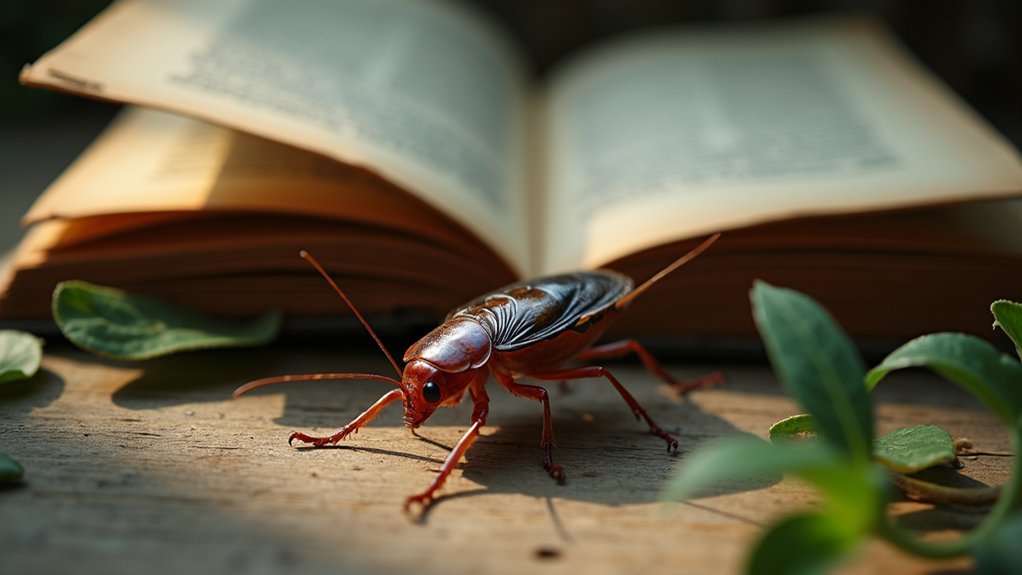
When did “cockroach” lose its first half? You can trace it to 1830, when “roach” is attested as a shortened form of “cockroach.” Dictionaries mark the 1830–40 range as the point when Americans used “roach” for the insect, so you’ll often see it labeled an Americanism.
Why did it happen? English speakers clip long words all the time, especially in casual speech. “Cockroach” already sounded like a compound, so you could drop one part without losing meaning.
Speakers treated the second element as the more useful everyday label, and “roach” became practical shorthand.
Don’t confuse this with the slang “roach,” which developed independently in the 20th century. The two share a spelling, but their usage histories differ.
When you check etymological sources, you’ll find them calling “roach” “a shortened form of cockroach,” and general dictionaries say “short for cockroach.” It isn’t a separate insect name, just clipped English.
Why Doesn’t the Scientific Name Sound Like Cockroach?
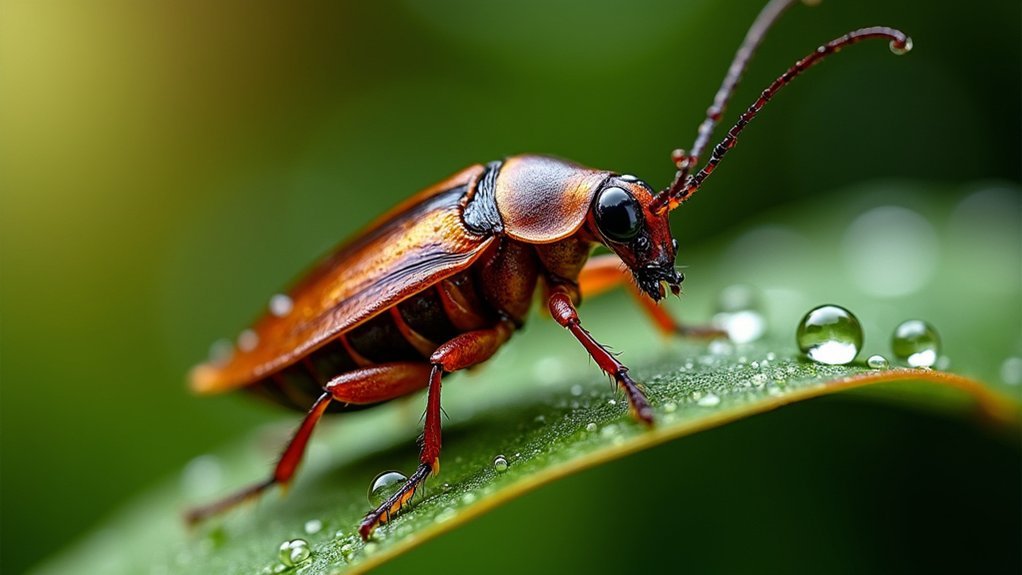
Why does “Blattodea” sound nothing like “cockroach”? You’re looking at two separate naming traditions. “Cockroach” is a common English name, while “Blattodea” is the formal zoological order name.
- Borrowing: English speakers took Spanish *cucaracha* and reshaped it into familiar parts, “cock” and “roach.” Linguists call this folk etymology.
- Classical roots: Scientists built “Blattodea” from Latin and Greek *blatta*, a word classical writers used for a light-shunning insect.
- Different goals: Common names shift with pronunciation and borrowing, but scientific names aim for stability across languages.
- No overlap: “Cock” and “roach” don’t describe the insect’s classification.
- Taxonomic history: Older systems grouped cockroaches differently, and some sources used *Blattaria* interchangeably with *Blattodea*.
Today, you’ll find termites inside Blattodea too, which shows how classification keeps evolving.
Because the scientific name preserves an older scholarly tradition, it doesn’t need to echo the Spanish-influenced word you use every day. You’re comparing two naming traditions.
Frequently Asked Questions
What Is Folk Etymology, and What Are Some Other Common Examples?
You’re seeing folk etymology when you reshape an unfamiliar word to sound familiar, or when you trust a wrong origin story. You’ve probably said chaise lounge, sparrowgrass, crawfish, or cheeseburger, and you’ve followed that pattern.
How Do You Pronounce “Cucaracha” Correctly in Spanish?
You’ll say it koo-kah-RAH-chah, with IPA /kukaˈɾatʃa/. You’re stressing the third syllable, so don’t rush the middle ones. Tap your r once instead of rolling it, and you’ll pronounce every single syllable clearly and crisply.
Is the Song “La Cucaracha” Actually About the Insect?
Yes, you’re hearing about a real cockroach on the surface, one that can’t walk. But you’ll find that revolutionary-era singers rewrote verses, turning the insect into a mask for satirizing leaders, armies, and political struggles.
Are Cockroaches Closely Related to Beetles?
No, they aren’t. You’ll find cockroaches in the order Blattodea, while beetles belong to Coleoptera. You’re looking at similar-looking insects, but cockroaches are closer kin to termites, and you won’t find beetles on that branch.
Do Other Languages Borrow the Spanish Word for Cockroach?
Yes, some do. You’ll find cucaracha in Chavacano and as an unadapted Italian borrowing, especially where Spanish contact runs strong. However, you won’t see it everywhere; German, Polish, Finnish, and Portuguese use their own terms.
Conclusion
You’ve just traced the cockroach’s name from Spanish *cucaracha* to John Smith’s early “cacarootch” and, eventually, the English word you know today. You’ve also seen that roosters, fish, and “caca” don’t belong in the story, even if they sound convincing. English speakers reshaped a foreign word until it felt familiar, and that’s how you ended up saying “cockroach,” or simply “roach,” whenever one scurries across your kitchen floor.