
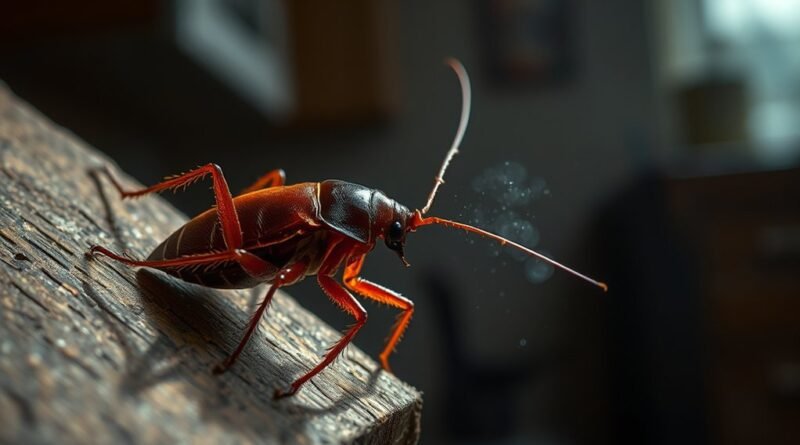
How Long Do Cockroaches Live? Understanding Their Life Expectancy Indoors
Indoors, you’ll see most cockroaches live several months to about a year, though American roaches can reach two years. German roaches mature fast and reproduce rapidly, fueling infestations. Eggs hatch in weeks, nymphs molt repeatedly, and warmth (70–90°F), humidity, food, and water extend lifespan. Roaches hide by day, forage at night, and can go weeks without food but need water sooner. Activity spikes in warm months and persists in heated homes. Learn how this affects control and prevention next.
Key Takeaways
- Indoor lifespans vary by species: American 1–2 years, German up to 12 months, Brown-banded 6–8 months, Oriental 6–12 months, Australian 8–12 months.
- Eggs hatch in weeks; German in 14–35 days, American in 24–38 days, with nymphs maturing in ~103 days (German) to ~600 days (American).
- Nymphs molt multiple times (6–18 molts), growing faster in warm, humid, food-rich environments; cooler, drier conditions slow development and reduce survival.
- Cockroaches tolerate a month without food but need water within a week; optimal indoor survival is 70–90°F with humidity above 50%.
- Rapid German cockroach reproduction means small indoor populations can explode quickly, making early detection and control critical.
Species Variations in Indoor Lifespan
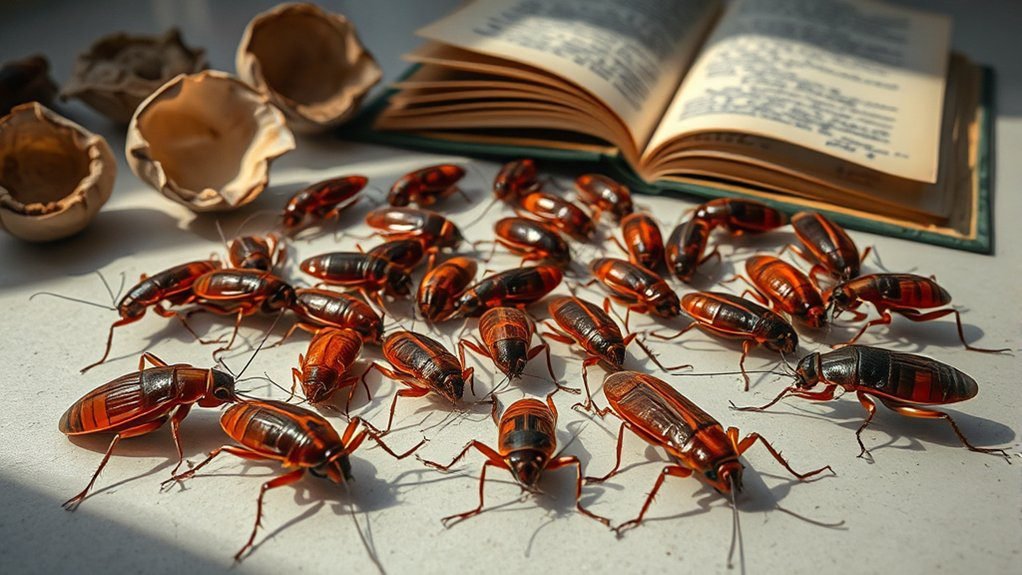
Although cockroaches share many survival traits, their indoor lifespans vary considerably by species.
You’ll see American cockroaches last the longest indoors—typically 1 to 2 years, with some surviving up to 400 days in stable, warm, humid spots like kitchens and pantries.
German cockroaches usually live up to 12 months; their small size and resilience, plus rapid reproduction, make infestations surge. Their life cycle includes egg, nymph, and adult stages, and each stage plays a role in how quickly populations can expand indoors.
Brown-banded cockroaches live 6 to 8 months, favoring warm, dry cabinets and furniture and adapting well to climate-controlled homes.
Oriental cockroaches persist 6 months to 1 year in dark, damp areas such as basements, but they’re less tolerant of dry conditions.
Australian cockroaches endure 8 months to a year, thriving in warm, humid spaces yet tolerating drier indoor zones when food and moisture remain.
From Egg to Adult: How Long the Life Cycle Takes
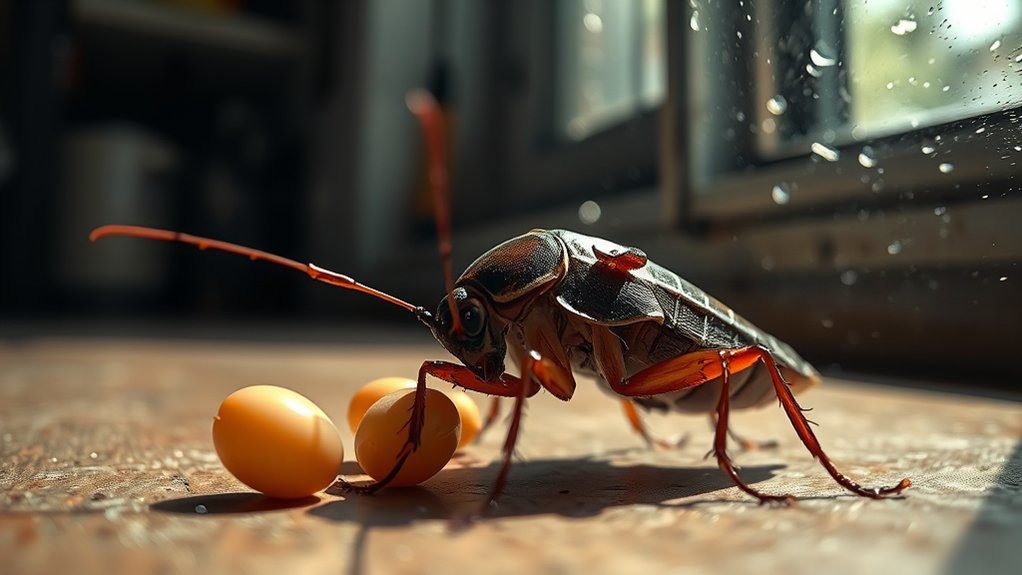
You’ll start by looking at how long it takes an egg to hatch into a nymph and why temperature and shelter matter. Adult American cockroaches have a lifespan of approximately one year, which means favorable indoor conditions can accelerate development and sustain larger populations.
Next, you’ll track the nymph’s molting stages—typically 10 to 13 molts—until wings and reproductive organs appear.
Finally, you’ll compare time to maturity across species, from about 103 days in German cockroaches to roughly 600 days in American cockroaches.
Egg to Nymph Timeline
While conditions vary by species and environment, a cockroach’s journey from egg to adult follows a clear timeline: eggs incubate for a few weeks to several months, hatch into nymphs, and then progress through multiple molts to maturity.
You’ll first see egg cases (oothecae) formed and carried briefly by American cockroach females, then glued in hidden spots with saliva. German females keep oothecae until near hatching, boosting survival. Early detection is crucial because one sighting often signals a larger infestation, allowing populations to expand rapidly if left unchecked.
Incubation depends on species and conditions: about 24–38 days for American cockroaches, roughly 14–35 days for German cockroaches (often ~28 days at room temperature), and up to 100 days in slower species. Warmer, humid environments with food shorten timelines.
When eggs hatch, nymphs emerge immediately active, pale, and wingless, seeking dark, moist shelter and food.
Nymph Molting Stages
Even before wings appear, a cockroach’s nymph stage unfolds through a series of molts that step the insect toward adulthood. You’ll see small, wingless nymphs shed their exoskeletons repeatedly—anywhere from 6 to 18 times, depending on species and conditions.
Oriental nymphs usually molt 7–10 times; American nymphs 13–18; German nymphs 6–7. Right after each molt, they look pale or white, then darken within hours as the new cuticle hardens. Adult cockroaches are primarily nocturnal scavengers, a behavior that begins in the nymph stage and continues through adulthood.
Nymphs behave like adults—nocturnal, scavenging, hiding in crevices—but remain vulnerable immediately after molting. Development spans weeks to many months: roughly 6–31 weeks for German cockroaches, and 160–971 days for American cockroaches, with Oriental and brown-banded species in between.
Warmth and humidity speed molting and survival; dry, cool, crowded, or resource-poor settings slow growth and increase mortality. Wings form only after the final molt.
Time to Maturity
From egg to adult, cockroaches mature on timelines that swing from weeks to well over a year, depending on species and conditions. You’ll see eggs (within oothecae) hatch anywhere from 14 to 100 days. German cockroach oothecae open in about 3–8 weeks, faster in warmth. American cockroach eggs hatch in 24–38 days, with moisture from the female aiding survival. Prevention is key, as sealing cracks, removing food and water sources, and timely pest control help keep populations from exploding.
After hatching, nymphs drive the schedule. German cockroach nymphs finish in roughly 50–60 days under ideal indoor heat and food, reaching adulthood in about three months from egg.
American cockroach nymphs molt 10–13 times and can take six months to over a year to mature. Brown-banded roaches typically need longer than Germans.
Warmer, food-rich, moist environments accelerate every stage; cold, dry, resource-poor settings slow development.
Environmental Factors That Extend or Shorten Lifespan
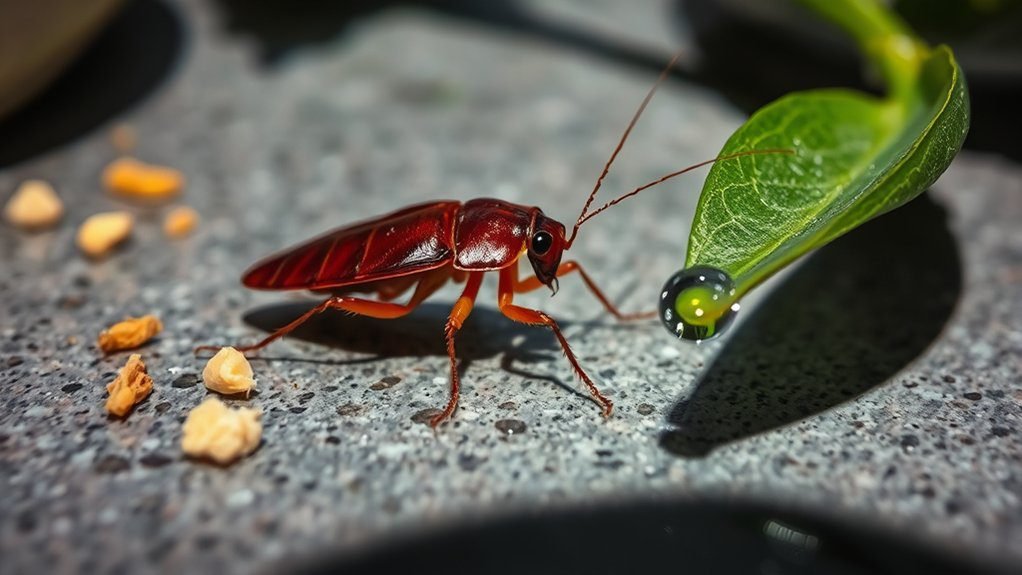
Although cockroaches are resilient, their lifespan hinges on everyday environmental conditions—heat, humidity, food, water, shelter, and stressors. They live longest around 70–90°F with humidity above 50%. Cooler rooms slow development but don’t guarantee survival; extremes at any stage shorten life.
Warm microclimates from appliances and leaky pipes create refuges that keep them going.
Food and water availability matter just as much. Diverse, nutritious scraps extend life; scarcity and poor quality weaken nymphs and shorten adult longevity. Reliable moisture is critical—dehydration kills quickly, especially in dry homes.
Shelter shapes outcomes. Tight, dark crevices lower stress, protect molting, and buffer temperature swings. Overcrowding and disturbance shorten life.
Predators, pathogens, and injury add mortality. Finally, sanitation, drying leaks, sealing harborage, and consistent treatments reduce lifespan through stress and direct control.
Reproduction Rates and Population Growth Indoors
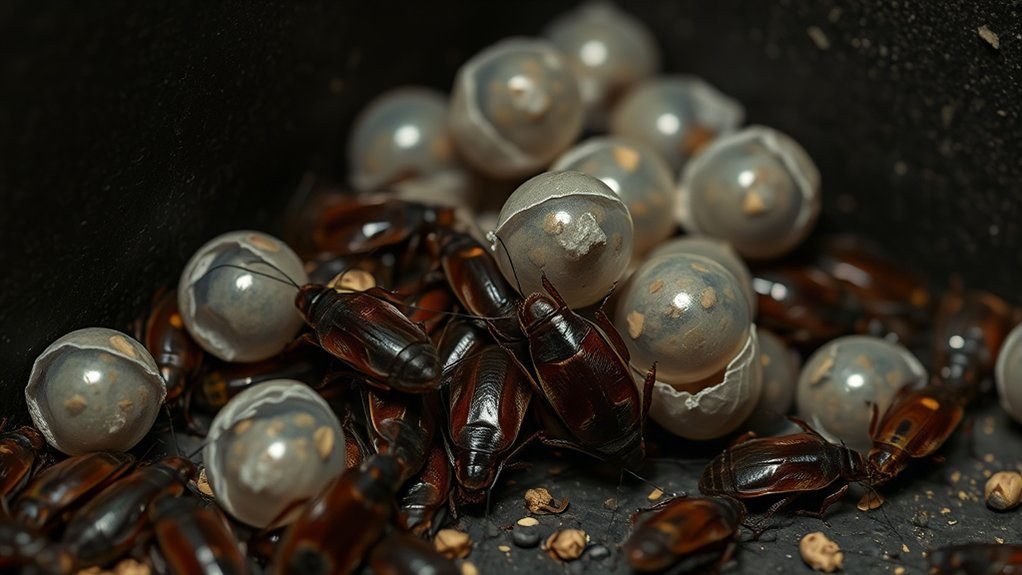
You’ll see how rapid ootheca production—often every 3–4 weeks—sets the stage for quick population surges indoors.
With warm, humid conditions, generations turn over in as little as a few months, pushing numbers up fast.
Without controls, overlapping generations escalate from a few roaches to a persistent, expanding infestation.
Rapid Ootheca Production
One female cockroach can seed an entire indoor infestation thanks to rapid ootheca production and short incubation times.
You’ll see oothecae about 8 x 3 mm, with two visible rows that can hold 14–48 eggs; German cockroaches average 30–40. Females often carry the casing until just before hatching, then drop it where warmth and humidity speed development. At 77°F (25°C) or higher, German cockroach eggs hatch in about 20–30 days; some species hatch in 14 days near 95°F.
Under ideal indoor conditions, German females produce an ootheca every 2–3 weeks, sustaining output after one mating.
- Warmer, humid kitchens and bathrooms accelerate ootheca cycles.
- Food and water availability boosts hatch success.
- Ootheca output declines slightly after several batches.
- Most nymphs emerge within 24 hours of dropping.
Generational Turnover Speed
Rapid ootheca production quickly feeds into faster generational turnover indoors, where warm, humid, food-rich spaces cut development time and keep numbers climbing. You’ll see German cockroaches race from egg to reproductive adult in about 50–60 days at 25–30 °C, enabling several generations per year. Their nymphs molt 5–7 times in 6–8 weeks, while American cockroach nymphs take 6–12 months and 10–13 molts, yielding slower replacement but longer-lived adults.
- Overlapping generations mean continuous breeding.
- Protective oothecae raise egg survival, sustaining momentum.
| Factor | Effect on Turnover |
|---|---|
| Temperature 25–30 °C | Faster molts, shorter nymph stage |
| High humidity, food | Higher survival, earlier maturity |
| German vs. American | Short vs. long generation time |
| Adult lifespan | Multi-generational coexistence |
One female German cockroach can exceed 200 offspring, magnifying growth swiftly.
Escalation Without Controls
When warmth, humidity, and food stay constant indoors, German cockroach numbers climb fast as overlapping generations breed without pause. You’re not dealing with a slow trickle; you’re facing exponential growth.
A single female forms new oothecae every 20–25 days, each carrying 30–48 eggs that hatch in about a month. Nymphs mature in as little as 40–50 days above 77°F, then reproduce immediately, sustaining four generations per year.
Even a small, hidden cluster can surge into thousands within months, especially in damp, protected spots under sinks and behind appliances.
- Small inputs—crumbs, drips, warmth—produce outsized population outputs.
- Overcrowding slows growth but rarely stops it.
- Hidden activity means you notice infestations late.
- Interrupt reproduction—remove food, water, shelter, and use targeted controls.
Behaviors That Help Cockroaches Survive Inside Homes
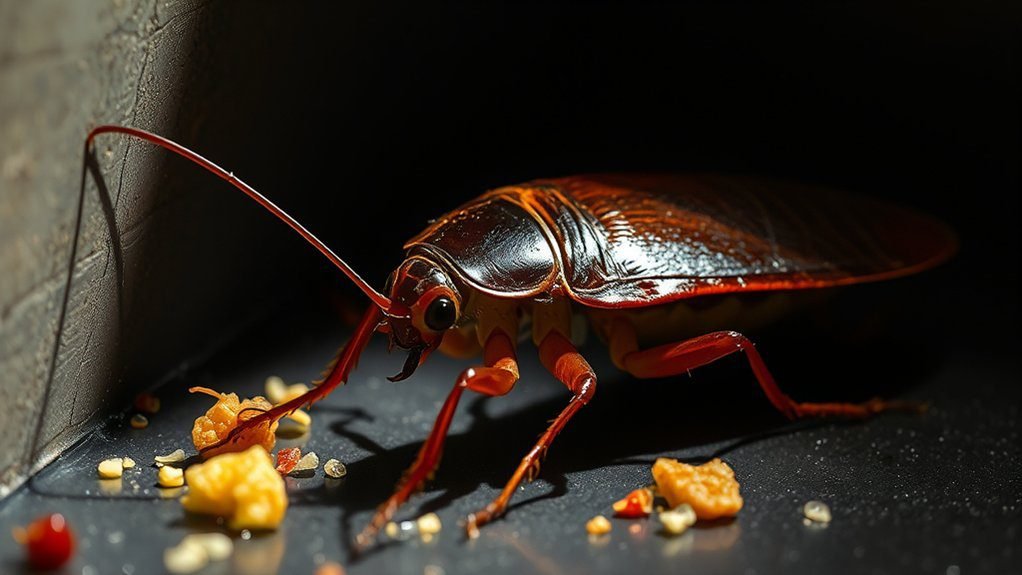
Although they seem elusive, cockroaches survive indoors by exploiting behaviors finely tuned to human homes: they stay hidden by day and roam at night, slip into tight cracks and cabinets, and conserve energy by resting most of the time.
You’ll find them behind refrigerators, under sinks, and inside crevices that make detection and control harder.
At night, they scavenge broadly—grease, crumbs, soap residue, paper, glue, even pet food—adapting to whatever’s available. They can go a month without food but need water within about a week, so they prioritize moisture.
Night foragers, roaches eat anything—grease to glue—surviving weeks without food but chasing moisture.
They also coordinate. Pheromone trails recruit others to food and shelter, and group living boosts protection and efficient foraging.
Females stash oothecae in secluded spots and reproduce quickly, sustaining colonies. When crowded, they disperse through walls to new harborage.
Seasonal Patterns and Year-Round Indoor Activity
Even as seasons shift outside, cockroaches adjust their routines to stay active wherever warmth and moisture persist. You’ll see spikes in late spring and summer when temperatures sit between 70–90°F with 50–70% humidity—metabolism and reproduction surge, and populations swell.
As fall cools, outdoor roaches migrate inside; winter activity dips but doesn’t vanish in heated, humid spaces. German cockroaches remain active year-round, completing their lifecycle indoors where food and water are steady.
- Warm months accelerate breeding, causing rapid indoor increases, especially after storms or heat waves.
- Cold snaps and low humidity push roaches into warm, humid microhabitats—bathrooms, basements, near appliances.
- Subtropical cities stay active all year; northern areas see sharper summer peaks.
- Human habits—crumbs, leaks, clutter—sustain activity regardless of season.
What Lifespan Means for Infestation Risk and Control
Seasonal surges matter, but a cockroach’s lifespan determines how fast an infestation entrenches itself and how hard it’s to clear.
Longer-lived species, like American cockroaches that can survive up to two years, get more reproductive cycles and more chances to find food and hideouts. German cockroaches live 100–200 days, but their rapid maturation (70–100 days) and multiple oothecae—each with up to 40 eggs—let one female spawn hundreds. American oothecae hold 14–16 eggs.
Longevity complicates control. Adults can survive initial treatments, shelter in cracks, and repopulate. Eggs and nymphs often escape sprays, so you’ll need repeated treatments and vigilance.
Their ability to starve for weeks, cannibalize, and tolerate harsh conditions sustains populations. Persistent infestations raise allergens, worsen asthma, spread bacteria, and require deep cleaning even after elimination.
Frequently Asked Questions
How Long Do Cockroaches Live Without a Head Indoors?
They typically survive several days to one or two weeks indoors, sometimes longer under ideal humidity and temperature. You’ll see movement and reflexes, but they can’t eat or drink, so dehydration and starvation ultimately kill them.
Do Insecticides Shorten Cockroach Lifespan or Just Reduce Activity?
They mostly kill rather than merely quiet roaches. You’ll see rapid mortality with contact sprays and baits; sub-lethal doses can cause lethargy, disorientation, or avoidance. Resistance and species differences matter, sometimes preserving lifespan while only suppressing activity and reproduction.
Can Household Cleaning Routines Measurably Reduce Cockroach Lifespan?
Yes—cleaning measurably shortens cockroach survival. You cut off water, starve nymphs, disrupt aggregation, and expose hiding adults. German roaches suffer most; Americans migrate. Pair sanitation with baits or residuals for eradication, since cleaning alone won’t eliminate entrenched infestations.
How Do Predators Inside Homes Affect Cockroach Longevity?
Predators indoors slightly shorten cockroach longevity by eating nymphs, weakened adults, and egg cases, and by spreading pathogenic fungi. You’ll see reduced numbers, not eradication, because predators are scarce, roaches hide well, reproduce quickly, and often still reach long lifespans.
Does Access to Specific Foods Change Cockroach Life Expectancy?
Yes. You boost cockroach longevity with protein- and fat-rich, balanced diets and reliable water. Poor-quality, carbohydrate-heavy, or contaminated foods shorten lives. Continuous access extends life up to 25–50%; ideal diets reach ~1.5 years, while suboptimal ones drop to 6–8 months.
Conclusion
You’ve seen how long roaches can live indoors, what speeds up their life cycle, and why homes let them thrive year-round. Small cracks, steady warmth, moisture, and food scraps all boost survival and reproduction, letting populations explode fast. Knowing their habits helps you act early: seal entry points, fix leaks, reduce clutter, and clean consistently. Pair prevention with targeted baits or professional help when needed. Do that, and you’ll cut lifespans short—and keep infestations from taking hold.
