
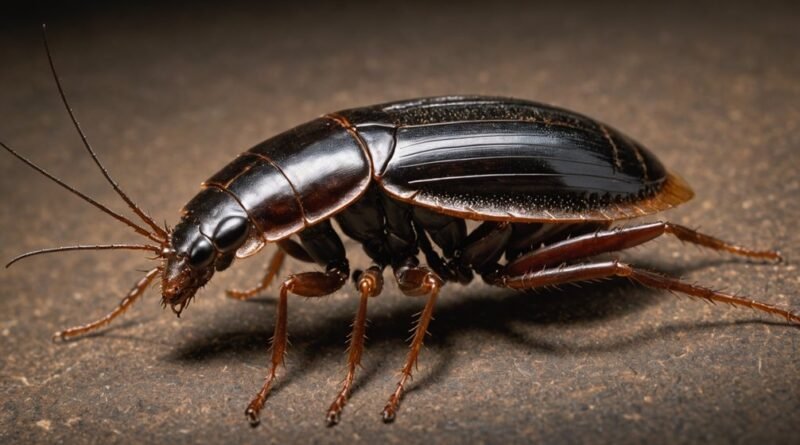
What Does a Cockroach Look Like Up Close? Photos and Identification Guide
Up close, you’ll spot a cockroach by its flat, oval body, long whip-like antennae, and six spiny legs built for speed. Its head is triangular with big compound eyes, chewing mouthparts, and a segmented abdomen at the rear. Color and size help you ID species: tiny tan Germans with dark stripes, large reddish-brown Americans, or uniform dark smokybrowns. When you look closer, each body part reveals more about how these pests live and move.
Key Takeaways
- Cockroaches have flat, oval bodies with six spiny legs, a segmented abdomen, and soft wings that often lie folded over the back.
- Their heads are small and triangular with large compound eyes, long whip-like antennae, and strong chewing mouthparts visible up close.
- Common household species range from tiny tan German cockroaches (about 1/2 inch) to large reddish-brown American cockroaches (up to 2 inches).
- Males are slimmer with longer wings extending past the abdomen, while females are broader with shorter wings and a visible egg-laying structure.
- Nymphs look like smaller, wingless versions of adults, gradually developing wing pads and more defined body shape with each molt.
Cockroach Body Shape, Size, and Quick ID
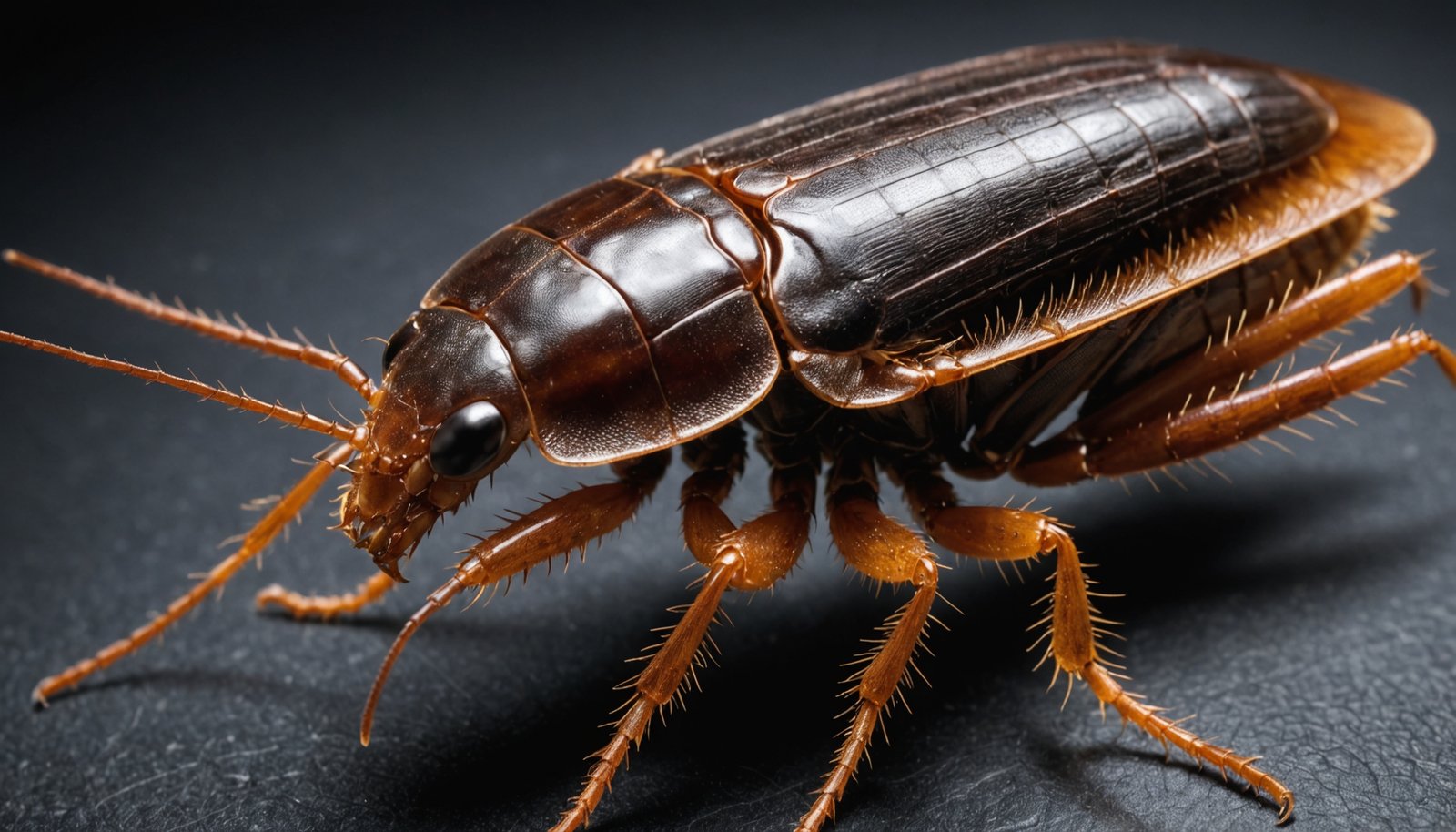
Cockroaches share a few signature traits that make them easy to recognize once you know what to look for: a flat, oval body with six spiny legs attached to the thorax, a segmented abdomen at the rear, and soft wings that lie exposed over the back instead of being covered by a hard shell. That flattened profile lets them slide into thin cracks, vanish under baseboards, and use cockroach camouflage techniques to blend with dark, tight spaces. Their springy legs power rapid escape responses when you disturb them. Identifying the species correctly is important because different cockroaches have distinct habits that call for specific control strategies.
To size them up quickly, note length and color. American cockroaches are reddish‑brown and large—often 1.5–2 inches—with a yellowish figure‑8 marking behind the head. German cockroaches are smaller (about 1/2 inch), tan, with two dark stripes down the back. Oriental cockroaches look shiny black or very dark brown, about 1–1.25 inches long, with a heavier, slower build than the others.
Cockroach Head, Eyes, and Antennae: How They Sense
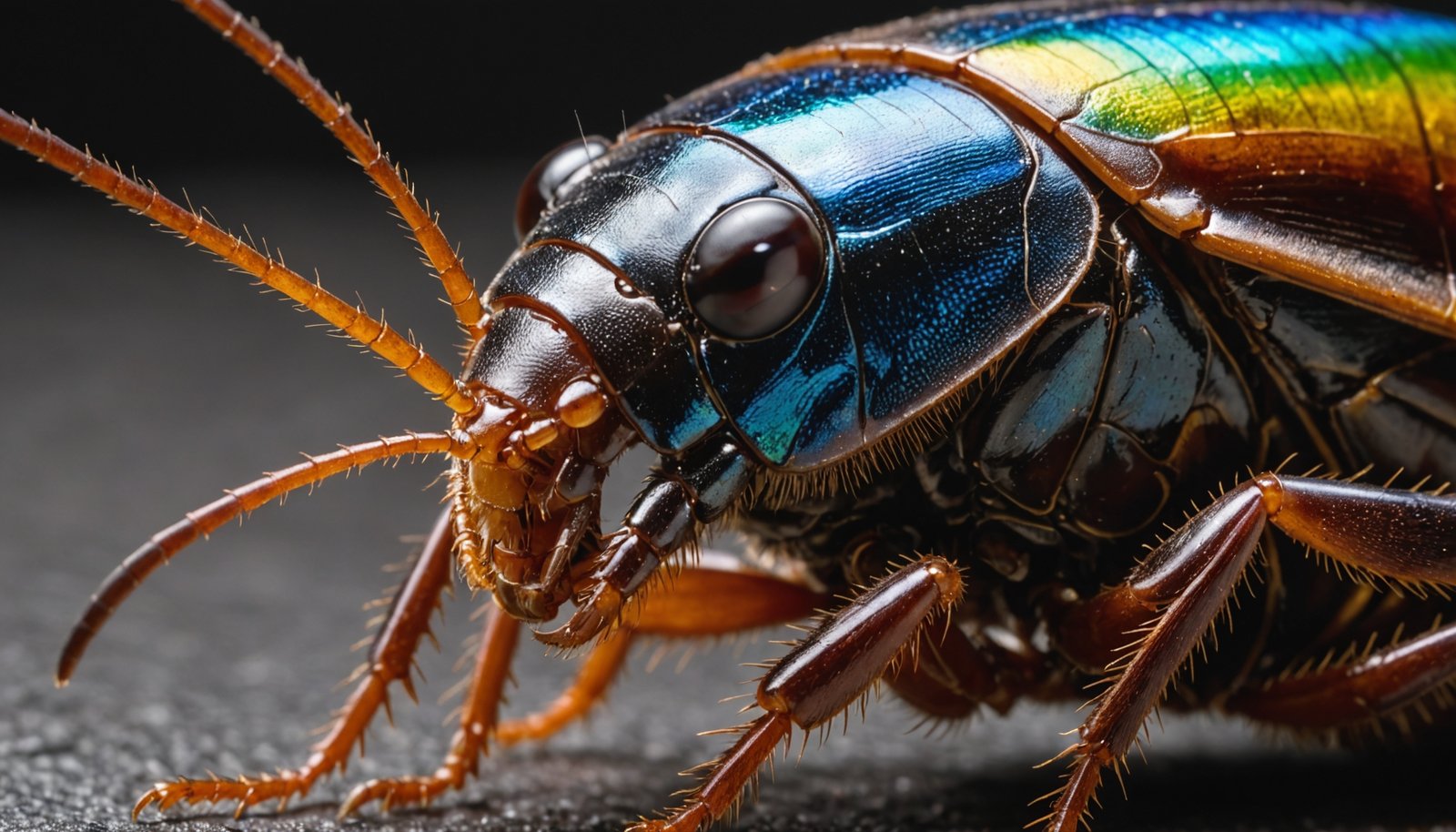
Once you recognize a roach by its flat, oval body and racing legs, the next step is to understand the sensory gear that helps it stay one step ahead of you. Its small, triangular head sits at a right angle to the body, made of six fused plates that form a tough capsule for the brain, muscles, and front of the gut. A flexible neck lets the head pivot freely, sharpening its cockroach sensory adaptations. The mouthparts on this head are adapted for biting and chewing, with strong mandibles and accessory structures that work together as a chewing apparatus.
From above, you’ll see two huge compound eyes. This compound eye structure packs in over a thousand lenses per eye, letting the roach track several moving objects at once and quickly spot threats.
Behind the eye bases sit two simple eyes, or ocelli, that help gauge light levels. Between them rise the long, whip-like antennae: three-part “feelers” packed with smell and touch receptors, constantly sampling air currents and chemical cues as the roach explores.
Mouthparts: How Cockroaches Bite and Eat
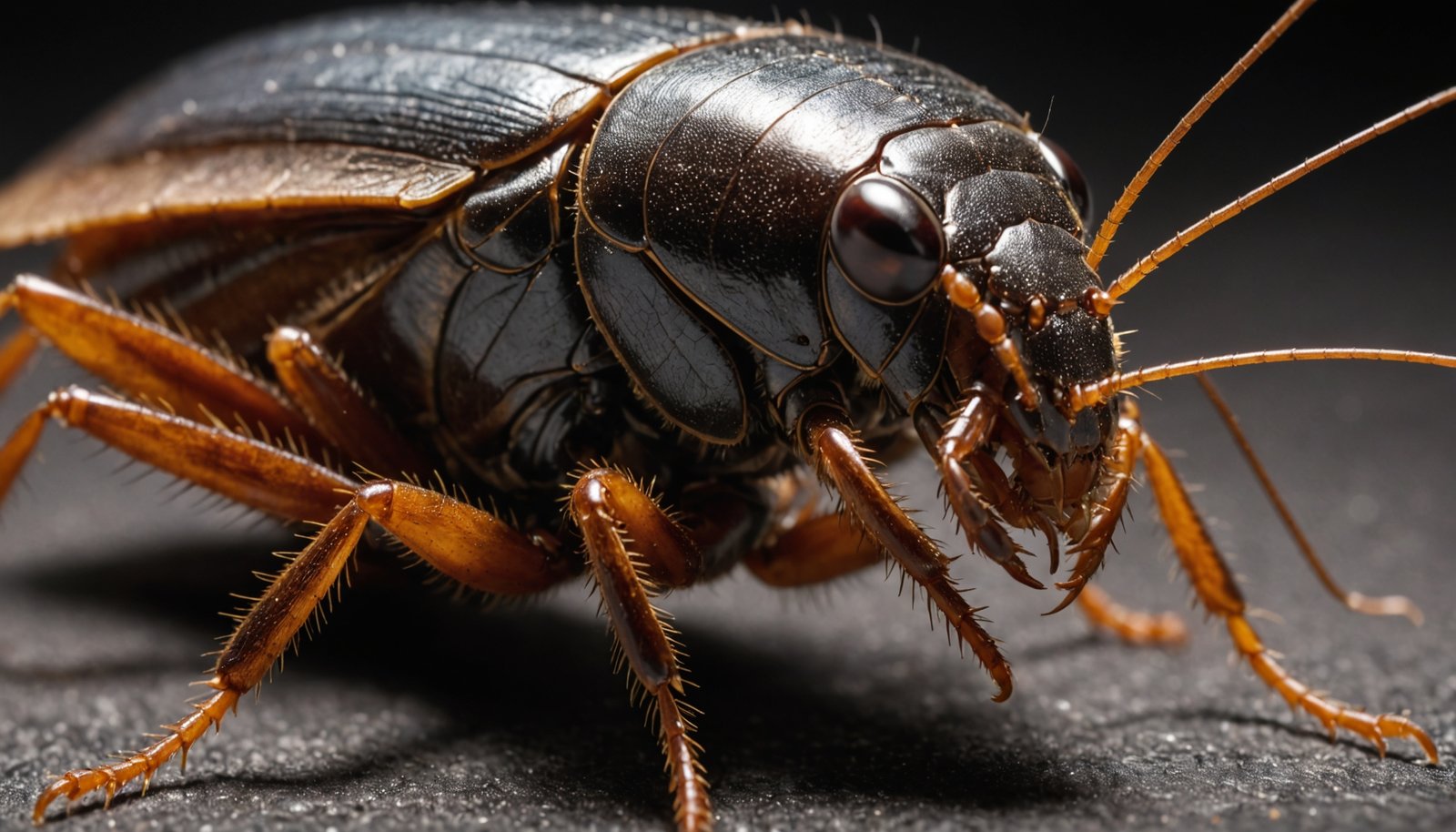
When you look at a cockroach’s head up close, you’ll see a set of powerful, specialized mouthparts that work together like tiny tools. You can learn how the labrum, mandibles, maxillae, labium, and hypopharynx coordinate each bite, from gripping and cutting to grinding. Understanding this system helps you see how roaches process an incredible range of foods in your home. Insects like cockroaches also use mandibles and maxillae to cut and grind food as it enters the foregut, starting digestion before it moves through the rest of the gut.
Key Cockroach Mouthparts
Although they look simple from the outside, a cockroach’s mouth hides a compact set of powerful tools that bite, tear, and process food with surprising efficiency. When you examine the labrum function, you’ll see this “upper lip” forms the front wall of the mouth, holds food in place, and uses tiny taste sensors to sample it. The mandible structure consists of hard, triangular jaws with toothed cutting edges that slice and grind. Like many chewing insects, cockroaches retain these basic mouthpart structures throughout both their larval and adult stages.
The maxillae roles are more delicate: hood‑like and pincer‑like parts manipulate food, while palps help clean antennae and legs. Labium anatomy forms the broad “lower lip” and carries sensory palps that help position food. Finally, the hypopharynx purpose is tongue‑like—delivering saliva and starting digestion.
How Roaches Bite
Those compact mouthparts don’t just sit there—they work together like a tiny set of power tools every time a cockroach takes a bite. When you look closely, you’ll see the mandible mechanics: two hard, triangular jaws on each side that swing in and out like sideways pliers. Their inner edges carry incisor-like teeth at the tip for cutting and a small molar zone nearer the base for grinding. These biting and chewing mouthparts are a classic mandibulate design, specialized for processing solid food.
As the labrum and labium hold the food, maxillae steady it and the mandibles deliver the real bite force. Paired adductor and abductor muscles drive those chitinized jaws so the interlocking teeth slice fibers and reduce tough materials into smaller pieces, from gentle nibbling to maximum-force chewing.
Eating And Food Processing
While the mandibles supply the bite force, cockroaches actually process food inside a compact preoral cavity where several mouthparts work in sync. The labrum forms the front “upper lip,” covering the mouth, tasting food, and helping hold each fragment. On the sides, the first maxillae grip, steady, and pass food inward, while their five‑segmented palps sense texture and even clean the antennae and front legs.
Behind this, the broad labium acts as the lower lip, bracing food as it’s chewed and adding more sensory feedback. Centered on the floor, the tongue‑like hypopharynx delivers saliva from a duct at its base, starting mechanical and chemical digestion. This compact system lets roaches exploit wide dietary habits and flexible food preferences.
Cockroach Thorax, Legs, and Spines for Fast Movement
Beneath a cockroach’s tough outer shell, the thorax acts as a compact power center that drives its remarkable speed and agility. When you look closely, you’ll see clear thorax segmentation: the prothorax, mesothorax, and metathorax, each carrying a pair of legs. Inside, dense leg musculature anchors to the exoskeleton, powering fast sprints and sudden turns.
Each leg has five main parts—coxa, trochanter, femur, tibia, and tarsus—arranged for leverage and grip. The coxa sits broad and flat against the thorax, giving a flexible pivot. Femur and tibia form the long “thigh” and “shin,” often lined with sharp spines for traction and defense. The tarsus ends in claws that hook onto rough surfaces.
You can spot speed adaptations in:
- Increasing leg size from front to back
- Stiff thorax acting as a stable base
- Jointed legs for rapid climbing and dodging
- Sensory hairs detecting touch and vibrations
Cockroach Wings vs Beetles: What the Back Really Shows
Look closely at a cockroach’s back and you’ll notice it never has the hard, split “shell” you see on beetles. A cockroach’s wings lie flat and flexible, with a papery, leathery wing texture that bends when you press it gently with a tool. There’s no deep midline seam because both pairs of wings layer together like soft covers across the abdomen.
Beetles, by contrast, carry rigid forewings called elytra. These form a true shield over the hidden flight wings, creating a clean center split and often striking elytra patterns, grooves, or bumps. Even dark ground beetles that mimic roaches feel hard on top and show that distinct line.
From above, a cockroach looks elongated and flattened, its pronotum flowing smoothly into the wings. Beetles look more domed or compact, with a clearly segmented body and armor-like back that doesn’t flex the way cockroach wings do.
Male vs Female Cockroaches and How Nymphs Differ
At first glance, a cockroach’s sex isn’t obvious, but key body details quickly separate males, females, and nymphs once you know where to look. When you study cockroach anatomy from above, males usually show slimmer, more elongated bodies, with wings that extend past the abdomen tip and more pointed rear cerci. Flip one over and you’ll see a pair of short styli on the last abdominal segment—classic male characteristics.
Females display broader, rounder abdomens built for egg carrying. Their wings stop at or just meet the abdomen tip, and they lack styli. Instead, you may notice a small ovipositor, part of their egg-laying structure—key female characteristics and clear sexual dimorphism.
Females have broader, rounded abdomens, shorter wings, no styli, and a visible ovipositor for egg-laying
Nymph development hides these differences at first. Young nymphs are smaller, wingless, and show no styli or ovipositor. Over molts, you’ll notice:
- Growing wing pads
- Gradually tapering (future male) abdomens
- Broadening (future female) abdomens
- Increasing activity linked to emerging mating behaviors
How to ID American, German, and Smokybrown Cockroaches
Once you can tell males, females, and nymphs apart, the next step is recognizing which cockroach species you’re dealing with. Start with size. German cockroaches are the smallest—about 13–17 mm, or up to 2/3 inch. American and smokybrown roaches are much larger, around 1.5–2 inches long.
Next, check color and markings. German cockroaches are light brown with two dark “racing stripes” on the pronotum. American cockroaches are reddish‑brown with lighter or yellowish margins on the pronotum. Smokybrowns are uniformly dark brown to nearly black, with an unmarked, dark pronotum.
Wings help too. All three have full wings, but Germans rarely fly. American and smokybrown adults can glide, with wings reaching or slightly exceeding the abdomen.
Finally, look at cockroach habitats and cockroach behavior. Germans cluster in kitchens and bathrooms. Americans favor warm, damp basements and crawl spaces. Smokybrowns often invade from outdoor, humid areas.
Frequently Asked Questions
Do Cockroaches Change Color or Appearance as They Age or After Molting?
Yes, they do. You’ll see dramatic color changes right after each molting process, when nymphs emerge pale, then quickly darken. As adults age, their colors can fade or shift slightly with wear, humidity, diet, and sex.
Can You Identify Cockroach Species by Their Droppings or Smear Marks?
You can’t reliably identify cockroach species by droppings or smear marks alone. Use dropping analysis and smear identification only as clues, then confirm with live or dead specimens, behavior, and, if needed, a professional inspection.
How Close Do Cockroaches Need to Be to Detect Humans or Food?
You’re detectable from several feet to several rooms away because cockroaches use ultra-sensitive antennae for scent detection. Their sensory receptors pick up faint food odors, skin flakes, sweat, and crumbs long before you ever see them.
Do All Cockroach Species Have the Same Number of Body Segments?
No, they don’t. You’ll see broadly similar body segmentation across cockroaches, but embryonic stages, adults, and sexes differ, and species variations tweak segment fusion, visibility, cerci shape, and terminal abdominal structures used for reproduction and sensing.
Are There Harmless Insects That Closely Mimic Cockroaches up Close?
Yes, you’ll see several mimic insects that look roach‑like yet pose no threat. You’ll commonly mistake ground beetles, crickets, wood roaches, booklice, and some termites for cockroaches, but these harmless species rarely infest homes.
Conclusion
Now that you know what a cockroach looks like up close, you can spot key features fast—flat oval body, long antennae, spiny legs, and that shield-like pronotum over the head. You can tell males from females, nymphs from adults, and even separate American, German, and smokybrown roaches by size, color, and markings. Use these visual clues to identify what you’re seeing quickly and decide on the right control steps for your home.
