
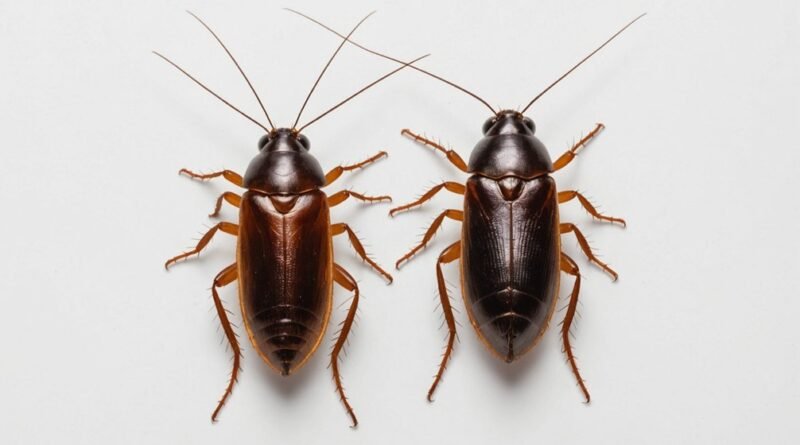
How to Identify Cockroach Species by Size, Color & Photos
Identify cockroaches fast by color and gloss: German are tan with two dark stripes; American are reddish-brown with a yellowish figure-eight; brown-banded are dark with two pale bands; Oriental are shiny blackish without stripes. These visual characteristics are the foundation of accurate cockroach species identification. Check size: German ~0.5″, American 1.5–2″, Oriental ~1–1.25″. Note habitat: Germans in kitchens/bathrooms, Americans in warm damp areas, Orientals in cool soggy places, brown-banded in dry upper cabinets. Wings vary; only Americans glide. Nymph patterns confirm it. Accurate identification is the first step in choosing the right pest control strategy. The wrong approach wastes money and lets the infestation grow. This guide covers every key feature: appearance, behavior, habitats, and the common mix-ups that cost homeowners time and money.
Key Takeaways
- Color patterns and characteristics: German have two dark head stripes; American show a yellowish figure-eight; brown-banded have two pale bands; and Oriental are uniformly glossy dark. Each set of characteristics is species-specific and consistent.
- Size cues: German and brown-banded ~0.5 inch; Oriental ~1–1.25 inches; Smokybrown ~1.25 inches; American 1.5–2 inches.
- Habitat: Germans cluster in kitchen/bathroom cracks; Americans favor warm, damp sewers/kitchens; Orientals prefer cool, soggy basements; brown-banded like drier, higher cabinets.
- Wings/flight: Americans and Smokybrowns glide short distances; Germans rarely fly; Oriental females wingless, males with short useless wings; most crawl unless disturbed and warm.
- Nymph ID: German nymphs tiny with two stripes; Oriental nymphs shiny dark and stocky; American nymphs redden with age; brown-banded nymphs show light transverse bands.
- In homes, buildings, apartments, restaurants, and commercial spaces across the United States, accurate cockroach species identification determines which insecticides, pesticides, and pest management methods will actually work. It also helps prevent thousands of dollars from being wasted on ineffective pest control approaches.
Cockroach Identification Chart: All Species at a Glance
Use this cockroach identification chart to narrow down the species in seconds, then confirm it with the detailed sections below.
| Species | Adult Size | Color & Gloss | Key Marking | Where You Find It |
|---|---|---|---|---|
| German | 0.5–0.625 in | Light brown to tan, matte | Two dark parallel stripes behind the head | Kitchen and bathroom cracks, near food and water |
| Brown-banded | ~0.5 in | Tan to dark brown | Two pale bands across the wings and body; liberty-bell head mark | Warm, dry upper areas: cabinets, closets, behind furniture |
| Oriental | 1.0–1.25 in | Glossy dark brown to black | No stripes or bands, uniform shine; females wingless | Cool, damp spots: drains, basements, crawl spaces |
| Smokybrown | ~1.25 in | Uniform glossy mahogany brown | No markings; a strong flier drawn to lights | Warm, humid areas: gardens, attics, gutters |
| American | 1.5–2.0 in | Reddish-brown | Yellowish figure-eight on the shield behind the head | Warm, damp areas: sewers, basements, commercial kitchens |
| Pennsylvania wood | ~1.0 in | Brown with pale edges on thorax and wing margins | Pale translucent stripe along the wing edges | Outdoors: woodpiles and leaf litter; occasional indoor visitor |
Visual Cues: Color Patterns, Markings, and Key Characteristics
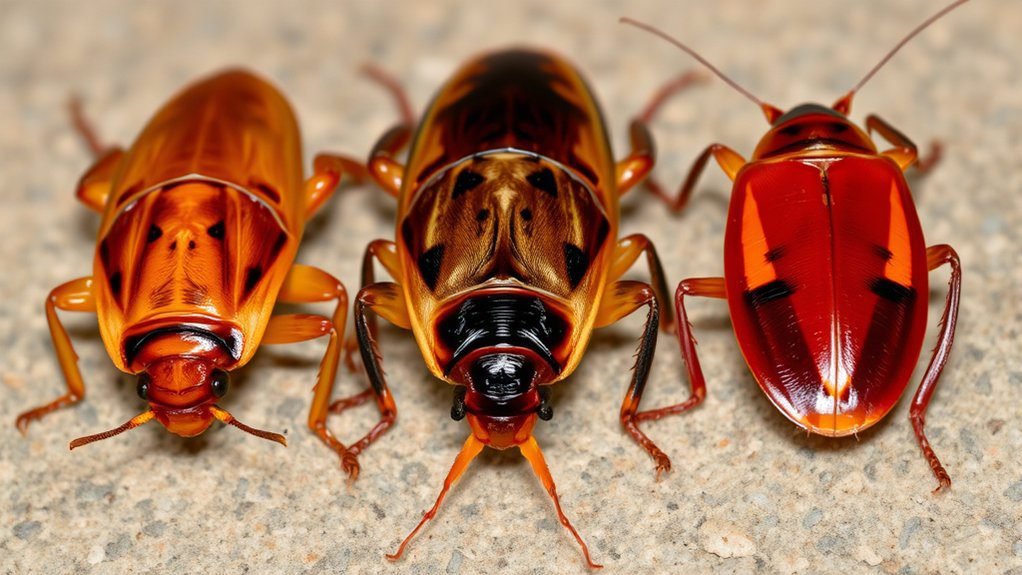
German cockroaches look light brown to tan with two dark, parallel stripes just behind the head. These characteristics do not vary by sex and make them one of the most reliably identifiable cockroach species found in homes. Their bodies are flat and oval, built to squeeze into the tightest crevices behind appliances and inside cabinet walls. Their nymphs run darker with a single pale stripe. German roaches reproduce extremely fast, with a female producing dozens of eggs per case and completing their lifecycle in under two months, which makes accurate ID critical for treatment and early pest control.
Light brown to tan with two dark parallel stripes behind the head. These are the defining characteristics of the German cockroach, the most common household pest species.
American cockroaches (Periplaneta americana) show a reddish-brown body with a bright yellowish figure-eight on the shield behind the head, plus lighter wing and body edges that heighten contrast; nymphs start grayish-brown before reddening. Their large, robust bodies and distinctive markings make them one of the easier cockroach species to identify On sight, though people often confuse them with Australian cockroaches at first glance because of their similar colors and shapes.
Brown-banded cockroaches are dark brown with two lighter transverse bands across the body and wings the bands being their most distinctive characteristics. Males fly, females usually don’t. You’ll also see a liberty-bell head mark on adults and banding on nymphs.
Oriental cockroaches (Blatta orientalis) appear glossy dark brown to black and are uniformly colored, with short or no wings and no stripes or bands. Their appearance often leads people to mistake them for beetles or other insects. The characteristics of Oriental cockroaches, including their shiny exoskeletons, slow movement, and preference for damp habitats, are quite unlike those of other common household pests. Note the glossiness: Oriental cockroaches are shiny, while German cockroaches are matte to lightly glossy. This subtle difference is a reliable way to distinguish between these two species.
Size Comparison Chart by Species
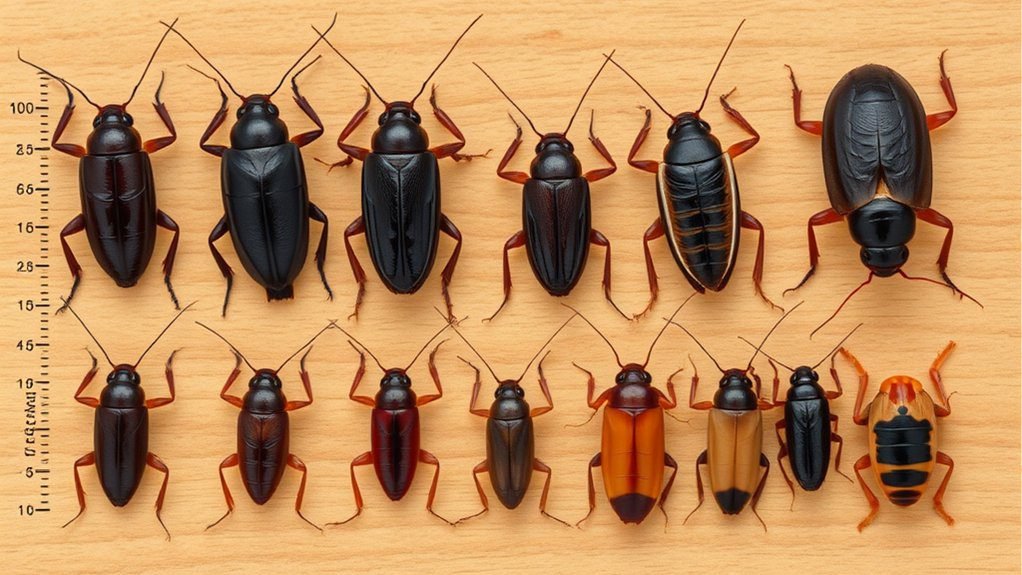
Color and characteristics can narrow your options fast, but size quickly confirms what you’re seeing. Grab a ruler and match what you find to these benchmarks: tiny roaches around 0.5 inches point to German or brown-banded; medium roaches near 1–1.25 inches suggest Oriental; medium-large at ~1.25 inches leans Smokybrown; true giants at 1.5–2 inches are American. Measure body length without antennae. Because cockroaches can reproduce quickly, identifying the species by size helps you act before numbers grow and an infestation expands through your home.
Here’s a quick size snapshot you can scan:
| Species | Adult Size |
|---|---|
| German | 0.5–0.625 in |
| Brown-banded | ~0.5 in |
| Oriental | 1.0–1.25 in |
| Smokybrown | ~1.25 in |
| American | 1.5–2.0 in |
Nymphs run smaller: German nymphs are under 0.25 inches and dark; Oriental nymphs show wing pads and grow slowly; brown-banded and Smokybrown nymphs are wingless until later molts; American nymphs start small and quickly scale toward 2 inches. When you’re unsure, compare both size and proportion: the smallest species look compact and flat-oval, medium kinds appear sturdier, and the largest look long and robust. Size combined with appearance, characteristics, and habitat gives you a three-point confirmation that virtually eliminates misidentification.
Habitat and Behavior Clues for Identification
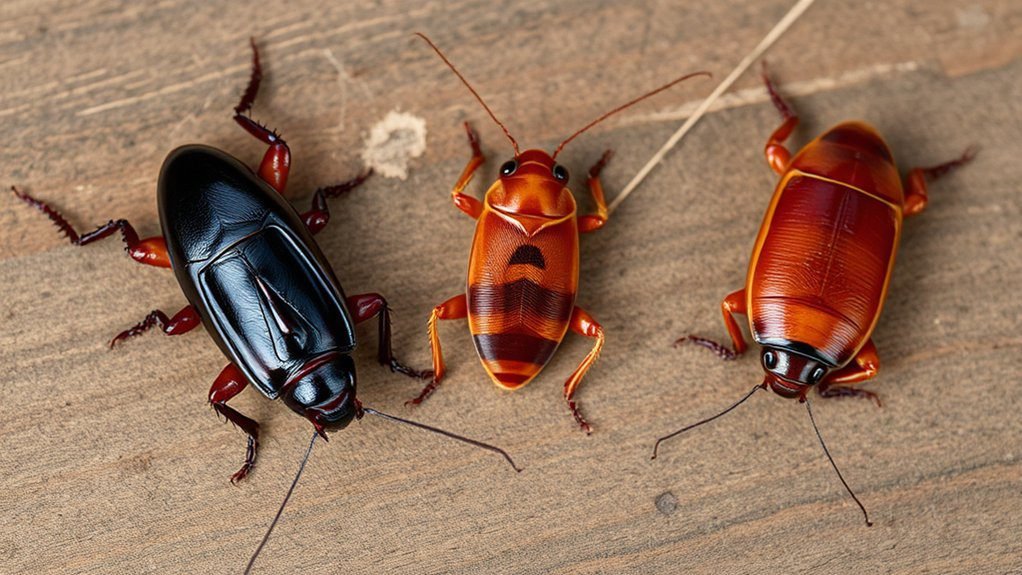
Habit tells on a roach faster than markings. Start with moisture: heavy, damp odors and floor-level activity point to American or Oriental cockroaches. American cockroaches favor warm, damp areas such as sewers, laundry rooms, pipe chases, commercial kitchens, and crawl spaces beneath homes. Their preferred habitats are places where plumbing, heat, and food sources intersect. This characteristic pattern makes them especially common in restaurants, apartments, and other multi-unit buildings. Cockroaches can trigger allergies and asthma, making accurate identification important for protecting people’s health and reducing the nuisance, contamination, and sanitation risks they create in homes and businesses.
Oriental cockroaches, commonly called “water bugs,” prefer cooler, damp environments such as drains, shaded yards, wet basements, areas beneath debris and leaf litter, and spaces along pipes and plumbing runs. Their nocturnal habits and slow movement make them easy to spot during late-night kitchen or bathroom inspections. Their characteristics are distinct enough that misidentification is uncommon once you’ve seen one up close.
Find clusters? German cockroaches often pack into tight cracks near food and water sources, including kitchen cabinets, refrigerator gaskets, sink bases, bathroom vanities, and the spaces behind refrigerators. Their tendency to aggregate is one of their most reliable identification traits. Finding large numbers clustered in a single location is often a strong indicator of a German cockroach infestation.
German cockroaches cram into tight cracks near food and water: cabinets, gaskets, sinks, vanities characteristics that make kitchens and bathrooms ground zero for these pests.
Season matters. Americans surge indoors as temperatures dip below the 70s, moving through plumbing and cracks around pipes and doors. Orientals wander in more during warm months but remain tied to cool moisture and damp locations like garages, crawl spaces, and outdoor vegetation. Germans ignore seasons inside stable buildings, breeding year-round a characteristic that makes cockroach problems in homes and apartments persistent regardless of the time of year.
Mostly outdoors around woodpiles, leaf litter, and tree bark? That’s Pennsylvania wood cockroaches occasional indoor visitors without persistent colonies. Their outdoor habitats and behaviors set them clearly apart from the four main indoor pest species.
What Cockroach Droppings and Egg Cases Reveal
Beyond the cockroach itself, the evidence it leaves behind is often the first thing people notice, and it can be just as useful for species identification as the insect’s physical characteristics. Each species leaves a distinctive trail of droppings, shed exoskeletons, and oothecae (egg cases) that experienced pest professionals and attentive homeowners can interpret like a fingerprint. These signs are often the earliest indicators of a cockroach infestation in a home, so they should not be ignored.
- German cockroach droppings: tiny black specks resembling ground pepper, found in high-traffic places near food inside cupboards, along walls, near refrigerators and appliances
- American cockroach droppings: larger, blunt-ended cylindrical pellets with ridged sides characteristics that distinguish them from German droppings found near drains, plumbing access points, and in garages
- Oriental cockroach droppings: similar to American but found near floor-level moisture sources, pipes, and damp basements
- Ootheca (egg cases): German ootheca are pale, ribbed, carried by the female until hatching; American ootheca are dark brown and deposited near garbage, food debris, and moist locations; brown-banded cases are glued to furniture, walls, and closets
- Exoskeleton skins: shed during life cycle stages, found in harborage zones in crevices, behind appliances, under cardboard boxes, and in crawl spaces
The presence of ootheca and shed exoskeleton skins confirms active breeding not just the presence of a few stray roaches. Contamination from droppings and shed skins can spread bacteria and allergens that pose genuine health risks, including allergic reactions, asthma flare-ups, and foodborne illness. These risks are among the primary reasons a cockroach infestation in any household should be treated as an urgent pest control priority.
Nymph Stages and Juvenile Look-Alikes
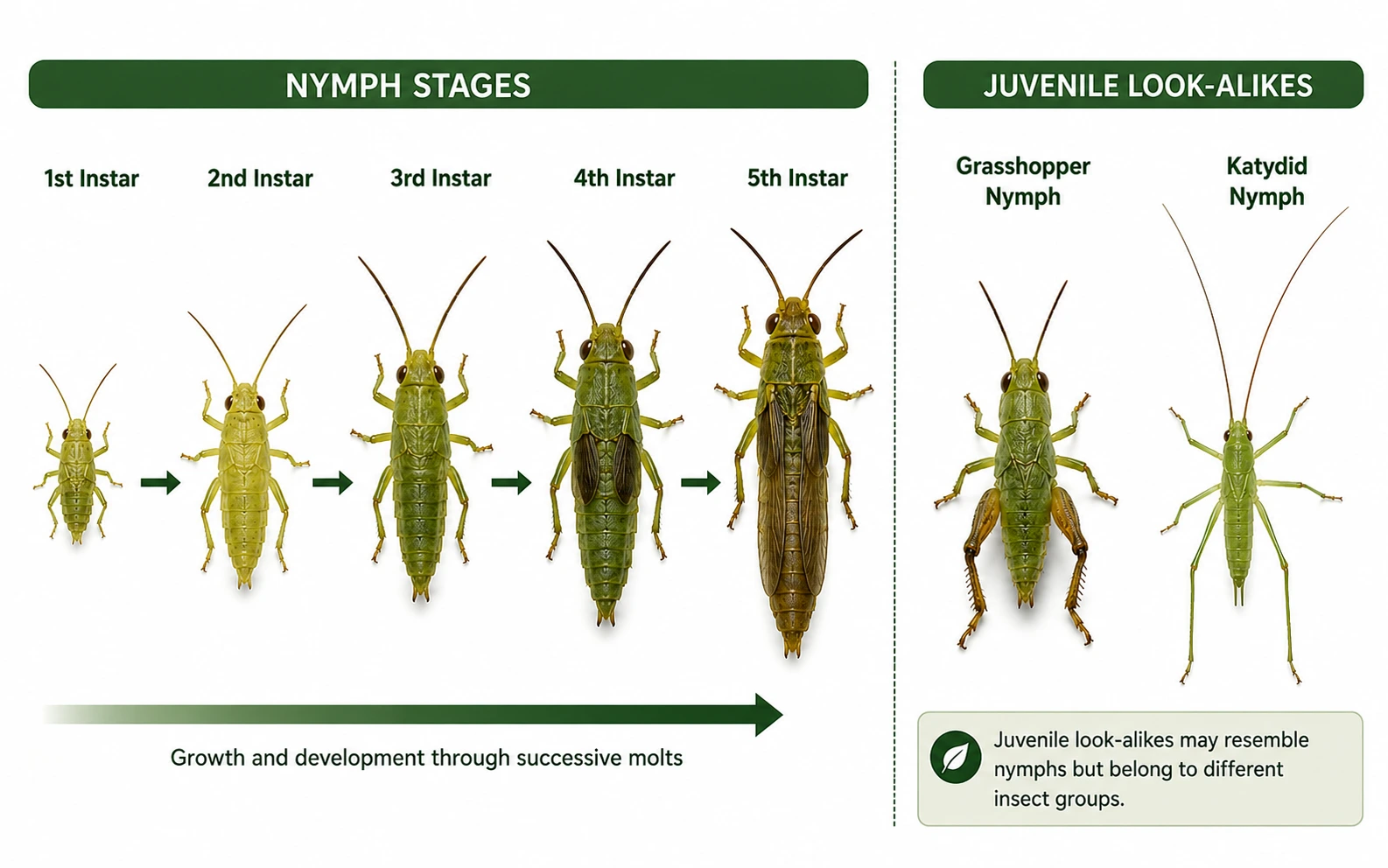
Even before wings enter the picture, nymphs tell you which roach you’re dealing with. You’ll spot incomplete metamorphosis in action: egg to nymph to adult, with multiple molts across several stages. Right after hatching or molting, nymphs look white and soft, then darken within hours as their new exoskeleton hardens. As they progress through instars, they grow, and wing pads appear on species that will develop wings. Baby cockroaches indicate ongoing infestation, seeing nymphs usually means that adults and egg cases are nearby, making it a clear sign of an active cockroach infestation in the home.
Read the characteristics, markings, and size:
- German nymphs: 3-10 mm, tan to dark brown with two dark pronotal stripes.
- American nymphs: hatch white (~1/8 inch), turn reddish-brown, rounded, wingless early on.
- Brown-banded nymphs: small (~0.5 inch), slender, light transverse bands.
- Oriental nymphs: shiny dark brown to black, stocky, up to ~1 inch, minimal markings.
Three features separate a cockroach nymph from almost every look-alike: long thread-like antennae, a flat oval body, and two short cerci at the rear. Use the table below to rule out the insects people most often mistake for baby roaches.
| Insect | Size | Color | Body & Antennae | How to Tell It From a Roach Nymph |
|---|---|---|---|---|
| Cockroach nymph (the baseline) | 3 mm to ~1 in, by species and stage | White right after molting, darkening to tan, reddish, or dark brown within hours | Flat, oval, segmented body; long thread-like antennae nearly as long as the body; six spiny legs; two short cerci at the rear | This is the reference. Look for the long antennae, flat oval body, and two tail-like cerci |
| Booklice | 1–2 mm (pinhead) | Translucent white to pale brown | Soft, rounded body with a large head; short, thin antennae | Far smaller, with no spiny legs and no cerci. Clusters around damp paper, books, mold, and stored food |
| Bed bug | 1.5–5 mm | Translucent when young, reddish-brown after feeding | Flat, broad apple-seed shape; short stubby antennae; never winged | Short antennae instead of long ones, rounder body, no cerci. Found near mattress seams and bed frames, not kitchens |
| Beetle larva | 2–12 mm | Cream, tan, or brown, often with fine hairs | Elongated, grub or worm-like, segmented, sometimes bristly; tiny antennae | Grub-shaped rather than flat-oval, frequently hairy, with no long antennae or cerci. Found in stored food, carpets, and fabrics |
| Termite worker | 3–5 mm | Creamy white to pale, almost translucent | Straight-sided body with no waist; short, straight, bead-like antennae | Bead-like antennae instead of long thread-like ones, plus no spiny legs or cerci. Lives in wood, mud tubes, and soil |
| Ground beetle | 6–20 mm | Glossy black to dark brown | Hard, domed wing covers meeting in a line down the back; moderate antennae | A hard shell that splits down the middle, versus a roach’s leathery segmented back. No cerci and no whip-like antennae |
Watch behavior and pace: nymphs hide in warm, humid cracks, feed immediately, molt 6–14 times across multiple stages. Germans reach maturity fast (~40–60 days); American/Oriental can take months to ~600–800 days. This wide range in lifecycle timing and life cycle stages directly affects which pest control products, insecticides, and pesticides are most effective.
Avoid look-alike traps: check long antennae, leg spines, wing pads, cerci. Booklice and beetle larvae lack these cockroach characteristics. Their bodies, legs, and antennae are structurally different in ways that become obvious once you know what to look for. Insects like beetles also lack the flat, low-profile exoskeleton that helps cockroaches squeeze into crevices and under appliances.
Wings and Flight Ability Differences
Moisture and hiding spots set the stage, but wings tell you how a roach moves once it’s exposed. Most adults have wings, yet how they use them varies significantly across cockroach species. Immature nymphs are wingless and cannot fly. This is a key biological characteristic of the incomplete metamorphosis life cycle followed by all cockroach species.
American cockroaches carry full-length wings and can glide or make short flights across short distances, especially in hot, humid air. Smoky browns behave similarly. Asian cockroaches and some wood cockroaches are capable fliers and are often attracted to porch lights and open windows at night. They can cover longer distances than most other common household pest insects. German cockroaches have fully developed wings but rarely fly. Instead, they rely on speed and typically run when disturbed. Their flight muscles are not well suited for sustained flight, which helps distinguish them from species such as the American cockroach that are more likely to glide or fly under certain conditions.
Oriental cockroaches, often called water bugs, show a clear difference between the sexes. Females are wingless, while males have short wings that provide little or no flight capability. Female Oriental cockroaches also tend to be wider and heavier-bodied than males. This sexual dimorphism is one of the most useful identifying characteristics of the species. For most cockroach species, flight is a last-resort behavior used to escape danger, locate mates, or reach new harborage sites rather than to travel long distances. Warm temperatures, high humidity, bright lights, overcrowding, and disturbance can all increase the likelihood of flight activity.
Common Mix-Ups and How to Tell Similar Species Apart
Although many roaches look alike at a glance, a few quick checks keep you from misidentifying them. Misidentification is one of the most common reasons DIY pest control fails, since the wrong insecticides, pesticides, baits, or sprays for the species present deliver poor results and let cockroach problems grow into infestations of thousands in just months.
Start with the “shield” behind the head. German roaches show two dark stripes on the pronotum; brown-banded don’t. They carry two pale bands across the wings and abdomen and look lighter overall. American roaches are big and reddish-brown with a yellowish figure-8 on the head; Australian roaches show brighter yellow thorax markings but are slightly smaller. Smokybrown roaches match American size but have a uniformly dark, unmarked pronotum and wings, which are the key distinguishing characteristics.
Use size and wings next. Germans run 13–16 mm and rarely fly; brown-banded are smaller, with males that fly short distances. American roaches reach 1.25–2.1 inches; Oriental top out around 1 inch, glossy, and don’t fly. Female Orientials are larger than males, so compare gloss, wing length, and the width of their backs. Females are noticeably wider at the rear of the body than the slimmer, slightly narrower males.
Confirm the identification with habitat. Germans like warm, humid kitchens; brown-banded cockroaches favor drier, elevated spots such as upper furniture and closets. Orientals move slowly in damp basements and drains. If you find cockroaches in garages, around woodpiles, or near outdoor vegetation without a consistent indoor presence, they may be a wood cockroach species rather than a true pest infestation. Their habitats and behaviors, including a preference for outdoor areas such as leaf litter, rotting wood, and vegetation, set them apart from the four main species commonly found in homes, apartments, and commercial buildings.
Frequently Asked Questions
Are Cockroaches Dangerous to Humans or Pets?
Yes, cockroaches are a genuine pest danger for people and pets. They spread Salmonella and other bacteria, contaminate food and surfaces, and trigger allergies and asthma. Their contamination of foods, containers, and food-preparation surfaces in kitchens, along with the food-poisoning risk they create, makes them a serious public health nuisance in any household. They rarely bite, but their allergens can linger, worsen respiratory issues, and increase health risks in homes, restaurants, and other buildings.
How Can I Prevent Cockroach Infestations Long-Term?
Prevent cockroach infestations long-term by cleaning spills fast, sealing food in airtight containers, emptying covered trash, fixing leaks, sealing cracks around pipes and plumbing, reducing clutter and cardboard boxes (which provide shelter and breeding grounds), drying damp areas, and setting traps and rotating baits. Inspect routinely, track hotspots, and use integrated pest management for sustained control. Eliminating garbage and crumbs removes key food sources that sustain cockroach colonies in homes and buildings.
Do Cockroaches Indicate Unsanitary Living Conditions?
No. Cockroaches do not automatically mean you live unsanitarily. They exploit moisture, warmth, cracks, and nearby infestations, so even the cleanest homes can develop cockroach problems through shared walls, plumbing connections, or by unknowingly bringing in infested furniture or cardboard boxes. You can reduce the risk through cleaning, sealing entry points, and making repairs, but building defects, leaks, and species behavior can still lead to infestations despite good hygiene. This is true across apartments, households, and commercial buildings alike.
What DIY Traps or Baits Work Best?
Use sticky traps in kitchens and bathrooms, baited with sugar, beer, or peanut butter. For killing, mix boric acid with sugar or peanut butter; keep from kids and pets. Gel baits placed in crevices and along walls are highly effective for German cockroaches. Commercial insecticides and pesticides can address exposed adult roaches but rarely reach eggs hidden deep in crevices, crawl spaces, or behind appliances. The kinds of pesticides that work differ by species. This is another reason accurate identification is so important.
When Should I Call a Professional Exterminator?
Call a pro when daytime sightings surge, you find many nymphs, ootheca, droppings, or a persistent odor, DIY efforts fail, species seem mixed or German, or you’re in multi-unit, healthcare, or food-service settings needing integrated pest management and regulation compliance. A professional brings the experience and specialized products needed to reach harborage zones inside walls, under floors, behind plumbing, and in crawl spaces that DIY sprays and insecticides simply cannot access. For cockroach problems involving thousands of insects across multiple life stages, professional intervention is often the most reliable path to complete eradication.
Conclusion
You’ve now got the key cues to tell cockroach species apart quickly. Check color patterns and characteristics, including colors, shapes, markings, and stripes, first, then confirm with size and wing shape. Use habitat and behavior to narrow the identification, and don’t forget nymph traits, droppings, oothecae, and shed exoskeletons. These signs are often what distinguish a genuine cockroach pest problem from an isolated encounter.
If it flies, note how far it travels and under what conditions. Snap a clear photo, compare it to a size chart, and confirm two or three characteristics across appearance, habitat, and behavior. With practice, people can confidently identify cockroach species in their homes and choose the right pest control steps, or recognize when it’s time to call a professional for an infestation that has moved beyond a simple DIY fix.
