
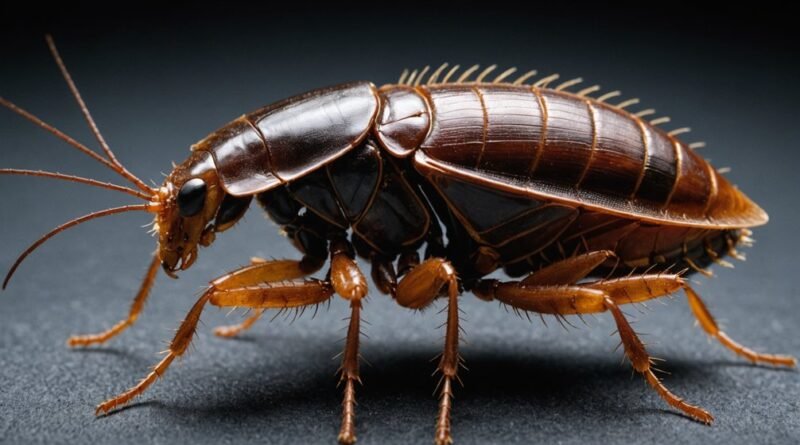
How Many Legs Does a Cockroach Have? Anatomy and Body Parts Explained
A cockroach has six legs — exactly 6, arranged as three pairs attached to its three-part thorax, a configuration shared by over 95% of cockroach species worldwide. Using all six legs, cockroaches can run at speeds up to 5.4 kilometers per hour — roughly 50 body lengths per second — making them among the fastest insects relative to body size on the planet. Approximately 82% of a cockroach’s leg muscles are located in the hind legs, which explains why the hind pair provides the explosive propulsion driving their escape speed while the front and middle pairs handle steering and stability. Cockroaches can even survive up to 40 seconds without any legs by relying on their body structure for balance. Understanding cockroach leg anatomy explains not just how they move, but why they are so frustratingly difficult to catch and eliminate.
Key Takeaways
- Cockroaches have exactly six legs, arranged as three pairs on the thorax — a feature consistent across all adult and nymph stages of over 95% of cockroach species.
- All six legs attach to the thorax, with one pair on each segment: prothorax, mesothorax, and metathorax.
- Each leg has five main segments: coxa, trochanter, femur, tibia, and tarsus ending in claws, pads, and spines — approximately 82% of all leg muscle mass is concentrated in the hind legs.
- Cockroaches run at speeds up to 5.4 kilometers per hour using all six legs in a coordinated double tripod gait, with hind legs providing primary propulsion.
- Front, middle, and hind legs differ in size, length, color, and function — handling steering, stability, and powerful running propulsion respectively.
Cockroach Leg Count: The Quick Answer
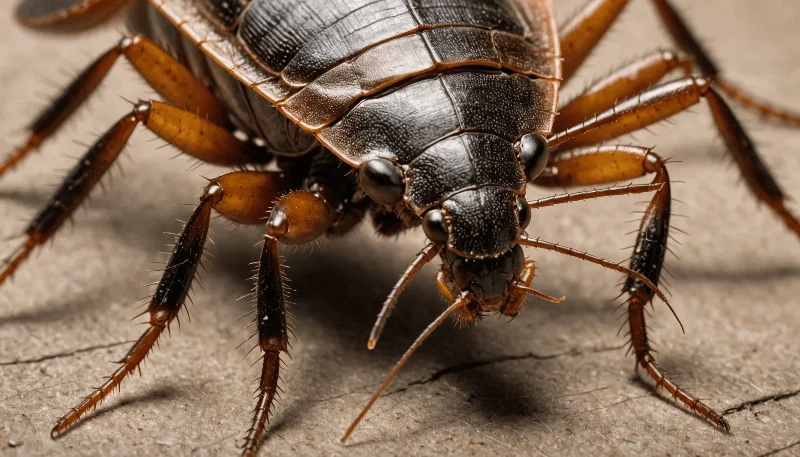
Cockroaches have six legs — a standard feature of all insects in the order Blattodea. Over 95% of cockroach species use all six legs to run efficiently, and when you look at any adult cockroach — German, American, brown-banded, or oriental — you will always find exactly three pairs. This leg count does not change as the insect grows: it stays fixed at six from nymph to adult, even though wings develop only at adulthood. Even cockroach nymphs, which lack functional wings, always have the same six legs as adults.
Each pair’s design reflects specific adaptations that enable the speed and agility cockroaches are known for. The shorter front legs handle fine control and quick directional adjustments. The middle pair balances speed and stability during normal locomotion. The long, powerful hind legs — which house approximately 82% of all cockroach leg muscle mass — provide the main thrust for rapid escape running up to 5.4 kilometers per hour. All six legs contribute sensory functions: spines, hairs, and adhesive pads on leg surfaces detect texture, obstacles, and vibrations, allowing cockroaches to navigate rough terrain, cling to smooth surfaces, and react almost instantly to threats. See our complete guide to cockroach appearance for full body anatomy beyond the legs.
Cockroach Body Regions and Leg Attachment
Three Main Body Regions
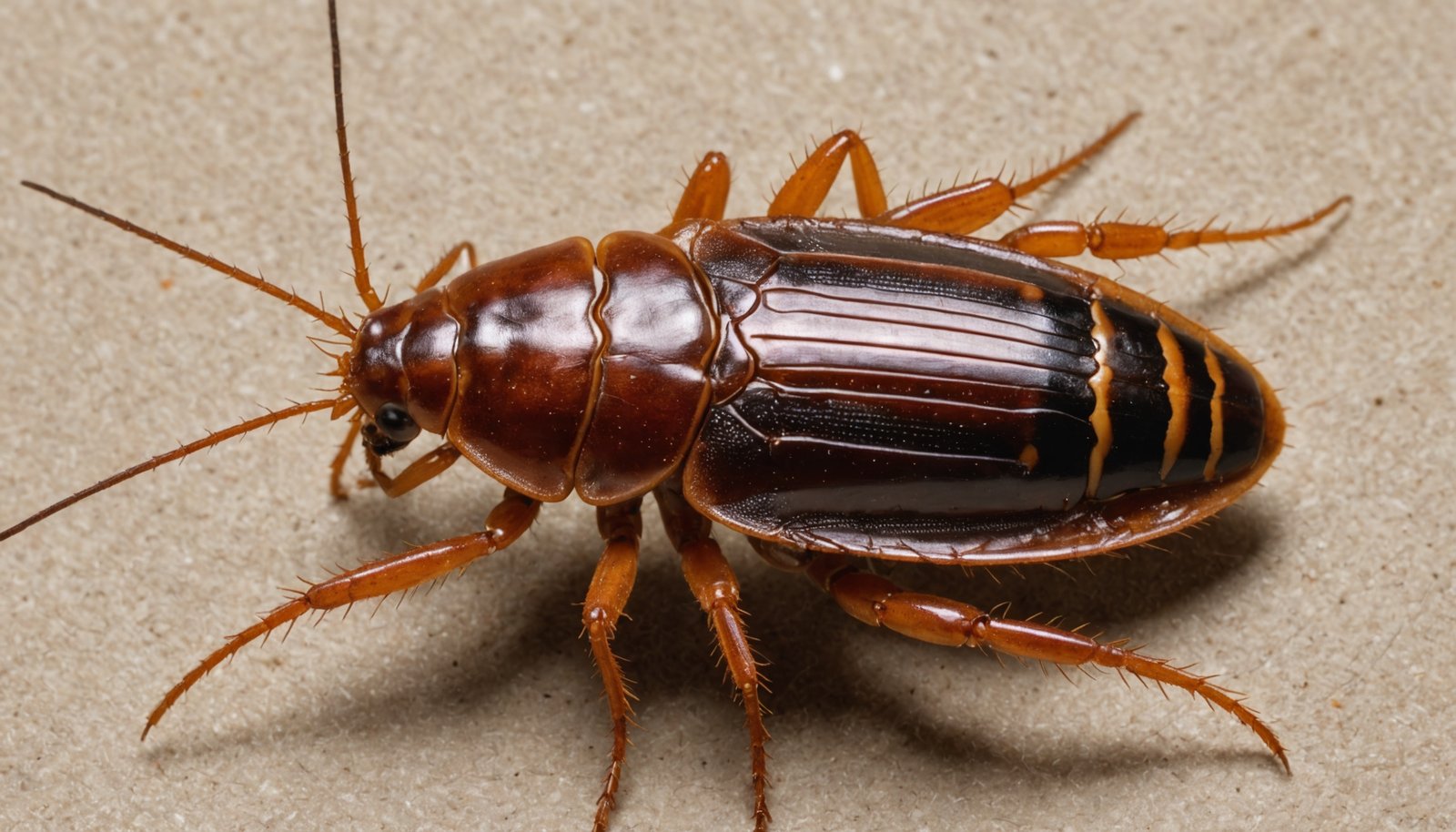
Although a cockroach may look like a simple flattened brown insect at first glance, its body is clearly divided into three main regions — head, thorax, and abdomen — and all six legs attach exclusively to the thorax. The head is a triangular capsule packed with sensory organs: large compound eyes, long antennae roughly equal in length to the body, and strong mouthparts. Behind the head, precise thorax segmentation (prothorax, mesothorax, metathorax) supports leg attachment and provides a sturdy base for each pair while also anchoring the wings in adult stages. The typical brown to reddish-brown body coloration with waxy exoskeleton surface helps cockroaches stay protected and concealed across diverse environments and surfaces.
The abdomen forms the largest body region, with obvious segments and protective exoskeleton plates. Internal and reproductive organs are housed here, along with cerci that provide critical sensory capability for predator detection. Cockroaches are abundant worldwide, thriving in many environments but reaching highest density in warm tropical and subtropical climates where both food sources and shelter are plentiful. Understanding the body’s three-region structure is the foundation for understanding why cockroach leg placement on the thorax creates such an efficient locomotion platform.
Thorax as Leg Hub
The thorax functions as the cockroach’s locomotion center — a compact hub where all six legs attach and operate. The three-part thorax system (prothorax, mesothorax, metathorax) each bears one pair of legs, with each successive pair increasing in length and muscle mass. Inside, robust muscles drive both legs and wings simultaneously. At each segment, leg articulation begins with the coxa — the flattened base that locks into the pleurites and sternites — from which the trochanter, femur, tibia, and long tarsus extend outward. Dicondylic joints keep leg movement primarily in one controlled plane, while coxal and sternal muscles provide the lift, depression, and retraction that produce coordinated walking and running cycles. Flexible sclerites and membranes at segment junctions allow cockroaches to maneuver through tight crevices narrower than their apparent body depth.
Cockroach Thorax Segments and Leg Pairs
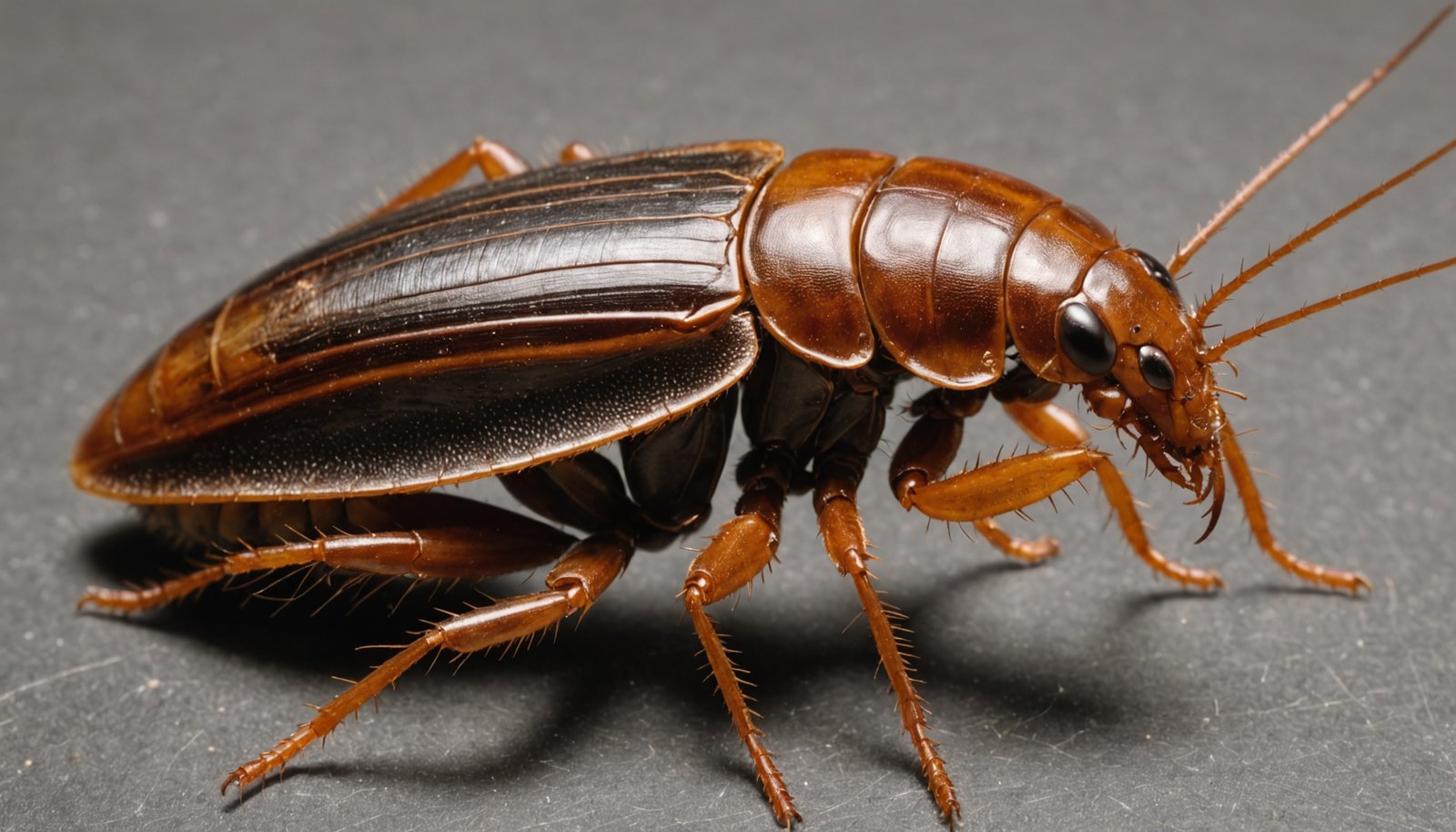
Three distinct thoracic segments — prothorax, mesothorax, and metathorax — each bear a single pair of walking legs, giving the cockroach its characteristic three pairs of cursorial legs. Every segment has a dorsal tergite, lateral pleurites, and a ventral sternite, all braced around one leg pair. The thoracic segments lie just anterior to the abdomen, whose ten segments contain spiracles that open to the tracheal system for gas exchange supporting sustained running activity.
In the prothorax, the tergite forms the shield-like pronotum while the small prothoracic legs attach ventrally, handling careful steering and ground-surface sensing. The mesothorax follows with a larger leg pair and the second spiracles; its mesonotum sits hidden under the forewings in adult cockroaches. The metathorax bears the largest, most powerful legs for rapid running — housing approximately 82% of all cockroach leg muscle mass in their femur segments. From below, you would see the coxae crowding the sternites so thoroughly that they visually dominate each segment, reflecting how thoroughly the thorax is architecturally optimized for walking and running efficiency.
Parts of a Cockroach Leg: Coxa to Tarsus
Moving from the thorax down each leg reveals a series of five specialized segments: coxa, trochanter, femur, tibia, and tarsus. Each segment performs a distinct mechanical and sensory role that makes cockroach locomotion so fast, stable, and adaptable across different surface types and environments.
Major Leg Segments
The coxa is the short, broad base that anchors the leg to the thorax — packed with sensory hairs and restricting motion to a controlled plane to prevent destabilizing lateral movement during fast running. The tiny trochanter acts like a pivot point, allowing the femur to tuck and rotate across a wider range than dicondylic joints alone would permit.
| Segment | Relative Size | Primary Function | Human Analogy |
|---|---|---|---|
| Coxa | Short, broad | Anchor to thorax, sensory | Hip socket |
| Trochanter | Tiny pivot | Multi-directional rotation | Hip joint |
| Femur | Thick, longest | Power, muscle housing | Thigh |
| Tibia | Long, narrow | Lever, traction via spines | Shin |
| Tarsus | Multi-part foot | Grip, surface sensing | Toes and claws |
Structure and Functions of Each Segment
The femur houses powerful muscles and protective spines — in the hind legs, where 82% of total leg muscle mass concentrates, the femur provides the explosive contraction that drives rapid running and short jumping behavior during predator escape. The tibia works like a rigid lever, bristling with spines along its length that add mechanical traction across varied surface textures. The multi-part tarsus — composed of 5 tarsomeres — ends in adhesive pads (pulvilli) and two curved claws that grip rough surfaces and smooth vertical surfaces alike, with dense sensory bristles across the tarsomere surfaces providing real-time chemical and textural data about the substrate beneath each foot.
Front Leg Specialization
The prothoracic (front) legs are the shortest pair in length and are primarily specialized for sensory function, steering adjustment, and fine-motor ground contact during slow movement. Their coxa sensory hair density is highest of the three pairs, reflecting their role as the primary ground-level tactile sensor that informs the cockroach’s navigation decisions before committing middle and hind leg thrust.
Hind Leg Specialization
The metathoracic (hind) legs are significantly longer and more muscular than the front or middle pairs, housing approximately 82% of total cockroach leg muscle mass in their femur segments. During maximum speed running at up to 5.4 kilometers per hour, the hind legs provide essentially all propulsive force — the front and middle legs transition to stabilization and steering roles as running speed increases, while hind leg extension drives the forward momentum that enables the brief aerial phases recorded in high-speed cockroach locomotion studies.
Claws, Spines, and Sensory Hairs on Cockroach Legs
Each cockroach leg bristles with claws, spines, and sensory hairs that transform it into a specialized tool for both movement and environmental perception. At the end of the tarsus, two sharp curved claws sit between soft adhesive pulvilli, giving precise grip on rough surfaces and climbing adhesion on smooth vertical surfaces — a combination that allows cockroaches to navigate both natural outdoor terrain and smooth indoor surfaces including walls and ceilings equally effectively.
The femur and tibia carry stout spines that stiffen the leg against stress forces during fast running, distribute mechanical loads along the limb, and resist the bending that would otherwise occur under the high contractile forces generated by hind leg muscle groups. Sensory adaptation appears most clearly in the hair arrays: dense sensory hairs on the coxa monitor nearby objects and surfaces, bristles on the tarsomeres detect texture and chemical residues, and specialized campaniform sensilla (dome-shaped mechanoreceptors) distributed across leg surfaces monitor the strain forces generated during locomotion — providing real-time biomechanical feedback that adjusts muscle output for surface irregularities at speeds where conscious control is impossible.
How Cockroaches Use Their Legs to Move and Climb
Cockroaches coordinate their six legs in a double tripod gait — one tripod (left front, right middle, left hind) swings forward while the other (right front, left middle, right hind) supports the body. This alternating tripod pattern keeps at least three legs in contact with the surface at all times during normal locomotion, providing the stability that allows cockroaches to run at full speed across uneven terrain without losing balance. Over 95% of cockroach species use all six legs in this coordinated tripod pattern for efficient locomotion.
During rapid escape running at speeds approaching 5.4 kilometers per hour, the hind legs take over propulsion almost entirely. At maximum speed, a cockroach can briefly shift to four-legged or even two-legged running, with hind legs supplying the explosive extension that creates short aerial phases between stride cycles. For climbing, the middle legs rotate at the thorax-coxa joint to lift the front of the body over an obstacle while the hind legs extend to drive upward and forward momentum. Cockroaches can scale smooth vertical surfaces and move across inverted ceilings using the adhesive pulvilli on their tarsal pads combined with micro-scale surface contact mechanics.
Comparison with Other Insects
All insects share the six-leg body plan — it is a defining characteristic of the class Insecta, making the answer to “how many legs does a cockroach have” the same answer you get for ants, beetles, flies, and bed bugs. However, the specific structure and specialization of cockroach legs differs from those of other common household insects in ways that reflect each species’ evolutionary adaptations.
Ants have six legs with similar coxa-to-tarsus segment structure, but their legs are proportionally more slender and the front legs in some ant species carry specialized cleaning structures (strigils) absent in cockroaches. Houseflies have six legs with adhesive pads (pulvilli) similar to cockroaches but their leg musculature is optimized for takeoff rather than sustained ground running. Bed bugs have six legs significantly shorter relative to body size than cockroach legs, reflecting their slow-movement lifestyle as a feeding specialist rather than a fast-running generalist. Termites — which share evolutionary ancestry with cockroaches in the order Blattodea — also have six legs with similar general structure, though their leg adaptations reflect colony-living and substrate-tunneling behavior rather than open-surface sprinting. Compared to arachnids (spiders, mites, ticks) with eight legs, or myriapods (centipedes, millipedes) with far more, cockroaches represent the basic insect six-leg arrangement optimized specifically for speed, surface adhesion, and sensory integration across diverse environments.
Variations Among Different Cockroach Species
While all cockroach species have exactly six legs in the same three-pair arrangement, leg length, relative proportion, color, and the degree of hind-leg specialization vary across species in ways that reflect their different ecological niches and behavioral adaptations. See our close-up cockroach anatomy guide for detailed visual comparisons across species.
American cockroaches (Periplaneta americana) have long, powerful legs relative to their 35 to 53mm body length — their hind legs are proportionally long, supporting their ability to run at the highest speeds recorded among common household cockroach species. Their leg color is reddish-brown, matching their overall body coloration. German cockroaches (Blattella germanica) have shorter legs relative to their smaller 13 to 16mm body length, but their leg muscle density allows running speeds impressive for their size. Their legs are tan to light brown in color. Oriental cockroaches (Blatta orientalis) have legs adapted for slower, more deliberate movement through drainage and sewer environments — their leg spines are denser and their tarsal pads more robust, reflecting adaptation to wet surface climbing. Smokybrown cockroaches have legs with particularly well-developed adhesive pads supporting their regular tree and surface-climbing behavior. Pennsylvania wood cockroaches (Parcoblatta pennsylvanica) show clear flight-related leg adaptation in males, with hind legs that assist in the leg-push phase preceding flight takeoff during mating season. Across all species, the fundamental six-leg, five-segment structure remains constant — the variations lie in proportional length, color, surface feature density, and muscle mass distribution.
Abdomen, Spiracles, and Cerci That Support Movement
Beyond the six legs themselves, three abdominal systems quietly power and protect cockroach movement. Ten clear abdominal segments, each built from tough tergal, sternal, and pleural plates, flex while shielding soft tissues — this segmented flexibility allows the body to bend as the cockroach runs, slips into crevices, or lifts to climb without the rigid exoskeleton limiting range of motion. Ten pairs of spiracles drive gas exchange, their valves and bristle filters maintaining respiratory efficiency that keeps oxygen flowing to leg muscles without excessive water loss — critical for sustained high-speed running in dry indoor environments with insecticides and other environmental stressors.
| Abdominal Feature | Role in Movement | Key Detail |
|---|---|---|
| Abdominal plates | Flex and protect during running | Broader in females, narrower in males |
| Spiracles | Supply oxygen to leg muscles | Eight pairs on abdomen |
| Tracheae | Carry gases directly to tissues | Support sustained 5.4 km/h running |
| Cerci | Sense air disturbances behind cockroach | Trigger escape response before visual detection |
| Anal styles | Aid balance during climbing | Present in males only |
The cerci — paired sensory appendages at the abdomen tip — are particularly important for survival. They detect minute air pressure changes from an approaching object before visual detection is possible, triggering pre-programmed escape running responses that get the cockroach moving in the opposite direction within milliseconds of threat detection.
How Cockroach Eyes, Antennae, and Legs Work Together
Three major sense systems — eyes, antennae, and legs — operate as a single integrated guidance network that keeps cockroaches fast, stable, and highly responsive to environmental threats. The compound eye provides continuous movement detection through thousands of individual ommatidia, creating a wide-field mosaic view that drives visual coordination of leg placement during rapid running even in low-light environments. This vision system, refined by ocelli (simple light-detecting organs) that register overall light levels, allows legs to place quickly and accurately across irregular surfaces in the dim conditions cockroaches prefer.
Antennae function as long flexible probes for environmental navigation — they sample air currents, surface textures, and chemical signals before the legs commit to a direction, providing the cockroach with advance information about what lies immediately ahead at running speed. Antennal mechanoreceptors detect wind direction and surface vibration in real time, fine-tuning leg adjustments mid-stride to maintain stability during sudden turns or unexpected substrate changes. Dense neural pathways link retinula cells in the eyes, ocellar interneurons, and antennal mechanoreceptors directly to leg motor centers, creating rapid feedback loops that synchronize vision, touch, and motion within response times that make cockroaches effectively impossible to catch by hand once they have detected an approaching threat.
Why Cockroach Legs Make Them Hard to Kill
Cockroach legs are not just for walking — they are the primary reason cockroaches are so frustratingly difficult to eliminate once an infestation is established. Each leg segment, loaded with muscles and traction spines, provides the mechanical basis for escape speeds reaching 5.4 kilometers per hour with direction changes that no human hand or swatter can track. Cerci detecting air movement behind the cockroach trigger escape responses before the threat is visually registered, meaning the leg-driven escape begins before conscious human action completes.
Adhesive pads and claws work together as built-in climbing gear, letting cockroaches scale walls, cross ceilings, and disappear into cracks narrower than their apparent body width within seconds of detection. Leg regeneration capability adds further resilience — cockroaches can regrow damaged or lost legs during molts, with nymphs showing the most effective regeneration. Cockroaches can survive up to 40 seconds without any legs by using body structure for balance, recovering full mobility through subsequent molts if legs were lost rather than permanently damaged. This combination of speed, sensory integration, surface adhesion, and biological resilience makes eliminating cockroach infestations through physical means alone effectively impossible — understanding their leg-based escape capability is what makes the case for systematic bait program and exclusion-based pest control approaches over reactive swatting and spraying.
Frequently Asked Questions
How Many Legs Does a Cockroach Have?
A cockroach has exactly six legs — three pairs arranged on the three segments of the thorax (prothorax, mesothorax, metathorax). This six-leg count is consistent across all cockroach species and does not change from nymph to adult stage. Over 95% of cockroach species use all six legs to run efficiently, with the hind pair — housing approximately 82% of total leg muscle mass — providing the primary propulsion for escape speeds up to 5.4 kilometers per hour.
Do Cockroach Legs Grow Back if Damaged or Lost?
Yes — cockroach legs can regenerate, primarily in nymph stages. After leg loss, cockroaches regrow the missing leg during subsequent molts, with the regenerated limb initially smaller than the original but approaching full size after additional molts. Adults have limited regeneration capability but can survive and function with fewer than six legs by compensating with remaining limbs. Cockroaches can survive up to 40 seconds without any legs at all, relying on body structure for balance.
Can a Cockroach Survive With Fewer Than Six Legs?
Yes — cockroaches survive long-term with fewer than six legs by compensating with remaining limbs and adjusting their gait pattern. They rely on survival strategies including modified tripod patterns using available legs and increased reliance on antennal sensory input when leg sensory coverage is reduced. Nymphs that lose legs regrow them during molts, often reaching normal lifespan despite early leg loss. The six-leg double tripod gait is optimal for speed and stability, but cockroaches are effective even on four legs in most escape and foraging scenarios.
Are Cockroach Leg Structures Similar to Other Household Insects?
All insects share the six-leg, three-pair arrangement — it is the defining feature of the class Insecta. Cockroach legs share the same coxa-to-tarsus segment structure as ants, houseflies, bed bugs, and beetles, with similar adhesive pad and claw arrangements. The primary differences lie in proportional length, muscle mass distribution, and sensory hair density reflecting each species’ locomotion strategy — cockroaches are optimized for fast running across all surfaces, while flies are optimized for takeoff, ants for load carrying, and bed bugs for slow stalking movement.
How Do Cockroach Legs Influence the Spread of Germs?
Cockroach legs are primary vectors for pathogen spread throughout homes and buildings. The spines, sensory hairs, and adhesive pads on cockroach legs readily pick up bacteria, fecal particles, and other pathogens from droppings, garbage, sewers, and contaminated surfaces, then deposit them on food contact surfaces, dishes, countertops, and food packages as the cockroach moves through kitchen and food storage areas. A single cockroach traveling from a drain to a food preparation surface transfers pathogens across the entire distance. This leg-mediated surface contamination is why cockroach infestations create genuine food safety hazards beyond the direct health risks from allergen exposure.
