
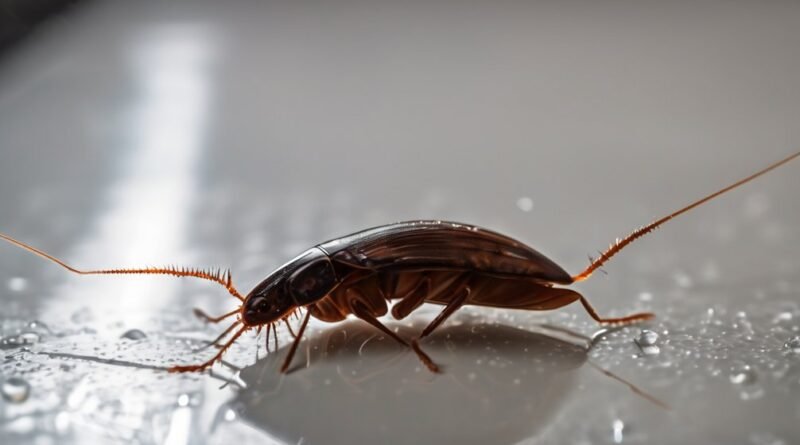
Why Are Cockroaches So Hard to Kill? The Science Behind Their Survival
You’ve probably encountered a cockroach that just wouldn’t die, no matter what you tried. These resilient insects have survived for over 300 million years, outlasting dinosaurs and adapting to modern threats with remarkable efficiency. Their sophisticated survival mechanisms go far beyond their tough exterior, combining advanced biological systems with evolutionary advantages that make them nearly indestructible. Let’s explore the fascinating science behind their seemingly supernatural survival abilities.
Built-in Biological Armor: Their Extraordinary Physiological Defenses

Nature’s armor plating gives cockroaches an extraordinary defense system against physical threats. Their multi-layered chitinous exoskeleton acts as a sophisticated shield, combining both rigidity and flexibility through its specialized layers: the epicuticle and procuticle.
You’ll find sclerotized proteins hardening their exterior, making these insects incredibly resistant to crushing forces. This biological armor isn’t just tough – it’s smart too. Sensory axons embedded within their cuticle can distinguish between harmless touch and dangerous pressure, helping them avoid damage before it occurs. Their highly developed nociceptive pathway system allows them to quickly detect and respond to potentially harmful stimuli.
What makes their armor even more remarkable is how it works with their other defense systems. Their exoskeleton doesn’t just protect against physical harm; it’s part of an integrated system that includes biochemical defenses and immune responses, making them exceptionally difficult to eliminate through mechanical means.
Masters of Radiation Resistance: How They Withstand Nuclear Events
While cockroaches aren’t completely immune to radiation as popular myths suggest, they’ve evolved remarkable cellular defenses that let them withstand doses up to 100 Gray – roughly 15 times what would kill a human.
You’ll find their survival secret lies in their efficient cellular repair mechanisms. When radiation damages their DNA, specialized molecular machinery quickly fixes the breaks, much like mechanics repairing structural damage.
Their slower cell division rates also help protect them during radiation exposure, as cells are most vulnerable while reproducing.
However, don’t believe the hype about cockroaches inheriting Earth after a nuclear war. They can’t survive the intense heat and extreme radiation levels at ground zero, which exceed 1000 Gray. These resilient creatures face significant challenges from toxic radioactive particles in post-nuclear environments.
While they’re impressively resilient, even these hardy insects have their limits.
Breathing and Energy: The Ultimate Survival System
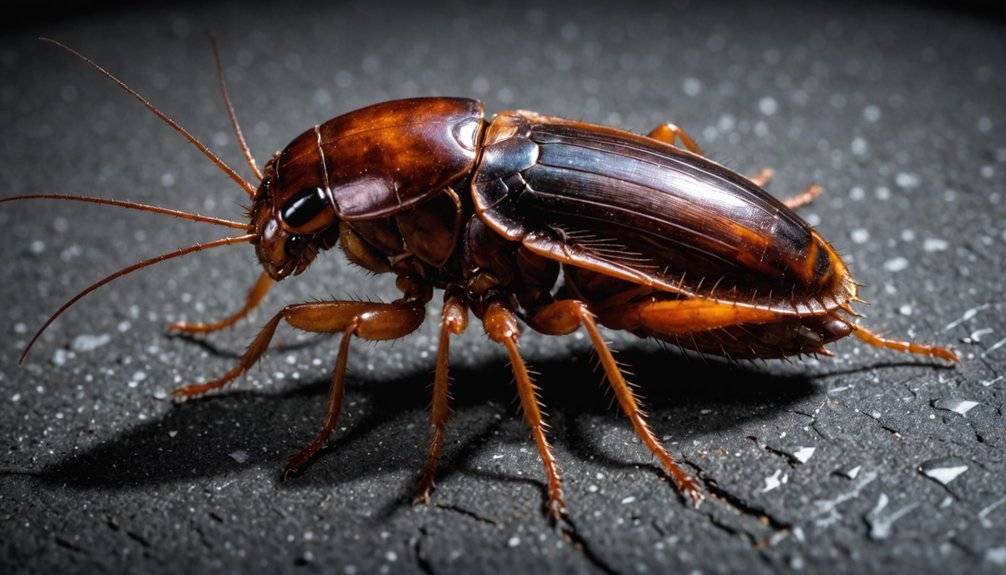
Unlike mammals that rely on lungs, cockroaches breathe through an intricate network of tubes called tracheae that deliver oxygen directly to their cells. This efficient system features ten pairs of spiracles along their body that act like tiny doors, controlling airflow and preventing water loss.
You’ll find that their respiratory system is remarkably adaptable. When a cockroach needs more oxygen during intense activity, it contracts its abdominal muscles to pump air through the network. These remarkable insects can hold their breath underwater for up to seven minutes.
The system’s direct delivery method means they don’t need oxygen-carrying blood proteins, making them highly efficient at energy production and consumption. Even if some spiracles become blocked, they can still breathe through others, and their ability to thrive in low-oxygen environments helps them survive in spaces where other creatures can’t.
Smart Escape Artists: Their Advanced Defense Mechanisms
Inside every cockroach lies an arsenal of sophisticated defense mechanisms that make them nearly impossible to catch or kill.
Nature has equipped cockroaches with an extraordinary defense arsenal, transforming these insects into masters of survival and evasion.
Their spiny legs deliver precise, lightning-fast kicks that successfully repel 63% of predator attacks, while their sensory hairs detect the slightest air movements in under 50 milliseconds.
You’ll find their defenses go beyond physical combat. Like many insects, cockroaches can engage in thanatosis when threatened, appearing dead to avoid detection.
Their neural system transmits danger signals at speeds up to 3 meters per second through giant neurons, triggering instant escape responses.
They’ll also release unpleasant odors to deter threats, while their robust immune system, powered by lectin proteins and antimicrobial peptides, protects them from pathogens in unsanitary environments.
It’s this combination of rapid reflexes, physical prowess, chemical deterrents, and immune defenses that makes cockroaches such remarkable survivors.
Tough to Poison: Chemical and Physical Resilience
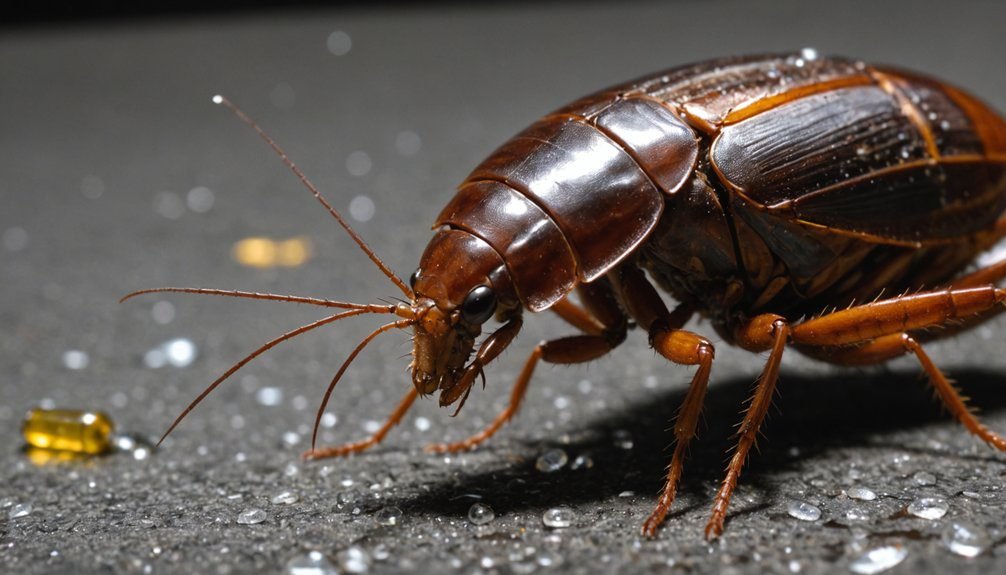
Beyond their impressive defense mechanisms, cockroaches possess remarkable chemical and physical resilience that makes them notoriously difficult to eliminate.
These pests rapidly evolve resistance to insecticides through their short life cycles, with some populations withstanding doses ten times higher than standard application rates. Recent studies in Indiana and Illinois colonies showed widespread resistance to multiple common insecticides including abamectin, boric acid, and thiamethoxam.
Their resilience comes from multiple adaptations:
- A sophisticated enzymatic system that can neutralize toxins before they become lethal
- A thick, waxy exoskeleton that prevents chemicals from penetrating their bodies
- The ability to develop cross-resistance, where surviving one type of insecticide makes them resistant to others
This remarkable adaptability is especially evident in environments with frequent pesticide exposure, like hospitals and public housing, where cockroach populations can develop resistance to multiple chemical classes simultaneously.
This makes conventional control methods increasingly ineffective.
Microscopic Allies: The Hidden Power of Their Microbiome
While cockroaches’ external defenses are impressive, their true survival power lies in an intricate network of microscopic allies living within their bodies. Their gut microbiome, a complex community of bacteria, archaea, and fungi, adapts through different life stages to enhance survival.
The endosymbiont Blattabacterium, dominant in early development, helps recycle nitrogen waste into usable nutrients, letting cockroaches thrive even in protein-poor environments.
Blattabacterium’s nitrogen recycling abilities allow cockroaches to survive and flourish even when quality protein sources are scarce.
You’ll find these microscopic partners change with the cockroach’s needs – from supporting nymphal growth to boosting adult reproduction and social activities.
Even more remarkable, their gut microbiome remains stable despite antibiotics and environmental stresses. This diverse microbial team helps cockroaches digest various foods, resist toxins, and adapt to new environments, making them incredibly hard to eliminate.
Frequently Asked Questions
Can Cockroaches Survive Being Flushed Down a Toilet?
Yes, cockroaches can survive being flushed down a toilet.
You’ll find they’re excellent survivors thanks to their spiracle respiratory system, which lets them hold their breath for up to 40 minutes underwater.
They’re also skilled climbers who can grip pipe surfaces and escape back up through plumbing.
Once flushed, they quickly reach air pockets in pipes or sewers, making survival highly likely.
Do Cockroaches Feel Pain When Injured or Killed?
Yes, cockroaches have a nociceptive system that allows them to detect and respond to harmful stimuli, similar to how you’d sense pain.
They’ll exhibit avoidance behaviors when injured and possess specialized neurons that process noxious signals.
However, you can’t know if they experience emotional suffering like humans do.
While they definitely detect damage through their nervous system, their subjective experience of “pain” remains debated among scientists.
Why Do Cockroaches Always Seem to Appear at Night?
You’ll see cockroaches at night because they’re naturally nocturnal creatures, governed by their circadian rhythms.
Their internal biological clock, regulated by a neuropeptide called PDF, drives them to be most active in darkness. Night offers them protection from predators and better foraging opportunities.
If you spot them during daylight, it’s usually a sign of overcrowding or severe infestation that’s forcing them out of hiding.
Can Cockroaches Transmit Diseases Directly to Humans Through Bites?
No, there’s no strong scientific evidence that cockroaches transmit diseases directly through bites.
While cockroaches carry various pathogens like Salmonella, MRSA, and Enterococcus, they don’t typically transfer these through biting.
You’re more likely to get sick from indirect contamination when cockroaches spread bacteria through their droppings, saliva, or by crawling across your food and surfaces.
Their bites can become infected if not cleaned properly.
How Long Can a Pregnant Female Cockroach Continue Reproducing After Mating?
You’ll find that a mated female cockroach can keep reproducing for several months after a single mating.
German cockroaches continue laying eggs for about 140-280 days, producing 5-8 oothecae containing 30-40 eggs each.
American cockroaches lay one ootheca monthly for around ten months.
Unlike many insects, they don’t die after laying eggs, allowing them to produce multiple egg cases throughout their adult life.
Conclusion
You’ll find that cockroaches aren’t just pests – they’re natural survival machines. Their layered defenses, from their tough exoskeletons to their radiation resistance, make them incredibly resilient. Whether you’re dealing with chemicals, physical force, or environmental threats, these insects have evolved multiple backup systems to stay alive. Understanding their remarkable adaptations helps explain why they’ve outlasted so many other species.
