
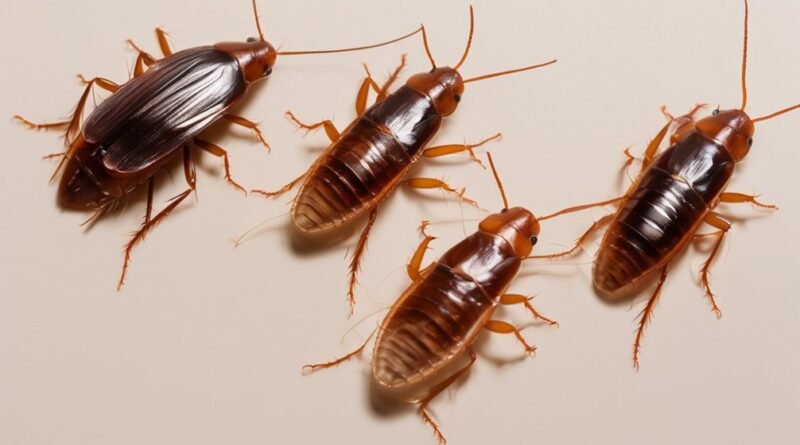
Cockroach Life Cycle Stages (Egg → Nymph → Adult)
If you’ve ever wondered how cockroaches maintain their seemingly endless presence in our world, you’ll find the answer in their remarkably efficient life cycle. These resilient insects follow a three-stage development process rooted in fascinating biology — and understanding it is essential for anyone dealing with a cockroach infestation in their home or business. From hidden egg cases to scurrying baby cockroaches and prolific adults, each phase reveals why cockroaches have become one of nature’s most successful survivors. Let’s explore the intricate journey from egg to adult.
Key Takeaways
- Cockroaches begin as eggs within oothecae, with German cockroaches containing 35-40 eggs and other species having 14-18 eggs per case.
- Female cockroaches carry oothecae attached to their abdomen for 20-30 days until eggs hatch into tiny baby cockroaches known as nymphs.
- Cockroach nymphs develop through 5-6 instars, molting their exoskeletons and growing from 3mm to 12.5mm before reaching adulthood.
- The complete metamorphosis from egg to adult takes approximately 40 days on average under ideal conditions of warmth and humidity.
- Adult cockroaches live about one year on average, with females capable of producing up to 90 oothecae throughout their lifetime.
- Recognizing the signs of each nymph stage gives homeowners critical information for deciding when to call pest control services.
The Egg Stage: Understanding Oothecae Development

Three key characteristics define a cockroach ootheca: its protective shell, impressive egg capacity, and crucial role in species survival.
You’ll find these egg cases measuring 7-8 mm long and 2-3 mm in both width and height, providing a fortress-like environment for developing embryos. For people dealing with an infestation, these cases are often the first physical evidence found — tucked behind furniture, inside walls, or in dark corners of kitchens and bathrooms across homes and buildings.
The numbers vary by species: German cockroaches pack 35-40 eggs per case, while American, Oriental, and Brown-banded cockroaches contain 14-18 eggs. To put that into context, a single overlooked ootheca can account for dozens of new baby cockroaches entering your home within weeks.
A female German cockroach’s reproductive activity begins just 4-6 days after reaching adulthood — which is why pest control professionals emphasize early inspection and treatment before breeding accelerates.
Female cockroaches carry their oothecae attached to their abdomen, carefully selecting ideal conditions for the 20-30 day incubation period. They’ll move the case to protected locations as hatching approaches — inside walls, behind furniture, or anywhere warm and sheltered inside a property.
This maternal behavior, combined with the ootheca’s durability and high egg count, makes cockroaches remarkably successful at maintaining their populations — and a growing cockroach infestation a serious problem for both residential and commercial businesses.
Nymph Growth and Molting Patterns
While cockroach eggs hatch into tiny nymphs, these juveniles — sometimes called baby cockroaches — must undergo multiple molting stages before reaching adulthood. Understanding the nymph stage is one of the most valuable pieces of information for identifying an active infestation, since cockroach nymphs are often spotted before adults are ever seen.
You’ll find that these cockroach nymphs grow through 5-6 instars, starting at just 3mm and reaching about 12.5mm by their final stage. During each molt, they shed their exoskeletons in dark, secluded areas — inside walls, under appliances, or behind furniture — where they’re less vulnerable. These nymphs resemble miniature wingless adults as they develop, which is why people sometimes mistake them for a different type of insect entirely.
The entire process from hatch to adult takes around 40 days on average under ideal conditions. After molting, you’ll notice cockroach nymphs appear pale or white before darkening to their normal color within hours. Shed skins are a key sign of an active cockroach infestation and should trigger a professional inspection of the property.
Their development is regulated by juvenile hormone levels, a key aspect of cockroach biology that coordinates their progression through each nymph stage. Throughout their development, you’ll observe these nymphs behaving similarly to adults — they’re quick, prefer dark spaces, and maintain consistent feeding habits, contaminating food, surfaces, and even saliva trails as they forage through kitchens, pantries, and homes.
Adult Stage Characteristics and Reproduction
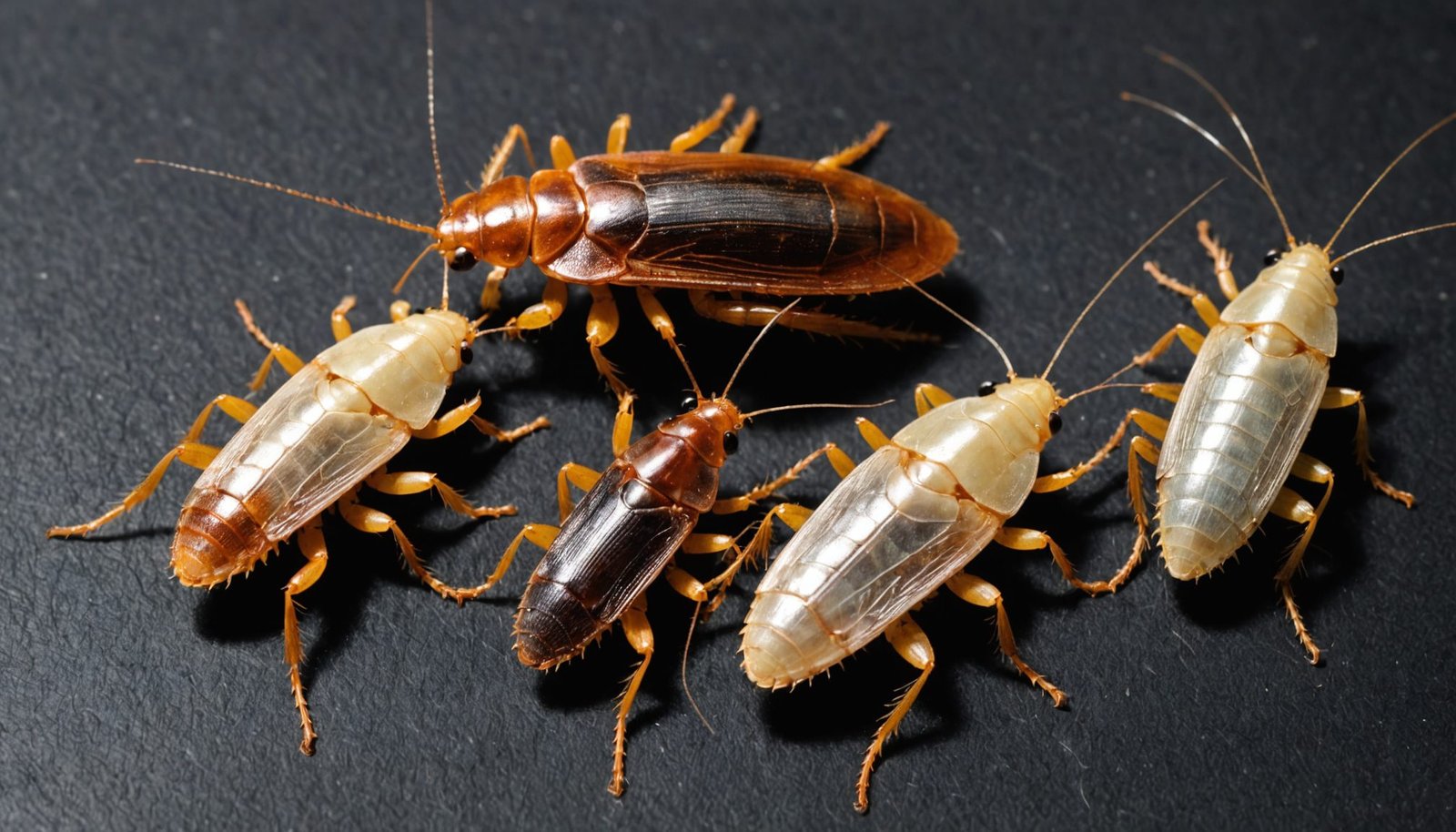
Once cockroaches reach adulthood, you’ll notice distinct physical changes that set them apart from their nymph stage. For homeowners and businesses managing an infestation, understanding adult behavior is essential information for effective pest control.
Adult American cockroaches develop two pairs of wings and grow to about 4 cm in length, displaying a reddish-brown color with pale markings. Unlike cockroach nymphs, adults will no longer molt, as their growth is complete.
Adult cockroaches reach their full size of 4 cm and develop wings, showcasing their distinctive reddish-brown coloring with light markings.
You’ll find that adult females are prolific breeders, producing protective egg cases called oothecae throughout their lifetime. A single American cockroach female can create up to 90 oothecae, potentially yielding 150 offspring within a year — staggering numbers that explain why a small problem can rapidly become a full-scale cockroach infestation across entire buildings.
They’re primarily active at night, seeking warm, humid spots for mating and egg-laying. As they move through a home or commercial property, they leave behind saliva, droppings, and shed skins that contaminate food preparation areas and trigger health concerns — particularly for family members with asthma or allergies. While adults typically live for about a year on average, their survival and reproduction rates heavily depend on environmental conditions. German cockroach populations can multiply especially quickly, as females can produce thousands of offspring annually — making them one of the most challenging pests for both residential and commercial pest control services to manage.
Environmental Factors Affecting Life Cycle Duration
Several environmental factors greatly shape the duration of a cockroach’s life cycle, with temperature playing a primary role. This information is highly useful for professionals designing targeted treatments, as well as for homeowners looking to make their homes less hospitable to these pests.
You’ll find that warmer temperatures around 28-30°C accelerate development, while cooler conditions slow it down significantly. As an example, a cockroach infestation in a heated commercial kitchen will expand far faster than one in a cool storage room. High humidity levels of about 70% are essential for ideal growth and survival — which is why kitchens, bathrooms, and basements across homes and buildings are the most common infestation hotspots.
Access to food, water, and safe shelter directly impacts development speed. When these resources are abundant, you’ll see faster growth, more frequent molting, and larger colony numbers. Most species can survive for one to two years under optimal conditions — take this into account when assessing how long an untreated infestation can persist inside a property.
However, if cockroaches face resource scarcity or overcrowding, their development slows considerably. Environmental stress from predators, pesticides, or habitat disruption can delay or interrupt development stages — which is why consistent, professional treatments that target multiple stages of the life cycle are more effective than one-off solutions.
Pest control professionals use this understanding of environmental biology to identify the conditions driving an infestation and recommend methods that address root causes — not just visible adult pests.
Species-Specific Development Timelines

Each cockroach species follows a distinct developmental timeline, from egg incubation through adult maturity. Knowing which type you’re dealing with is critical information for choosing the right pest control approach — the same treatments don’t work equally across all species, and professionals always factor species biology into their inspection and solution.
- German cockroaches develop fastest, completing their lifecycle in 3-4 months with 5-7 molts, producing 30-40 eggs per ootheca. Their rapid breeding makes them the most common type found in homes, restaurants, and businesses across urban buildings.
- American cockroaches take about 6 months on average to mature, undergo 13-18 molts, and carry 14-16 eggs in each case. These larger pests are frequently found in basements, sewers, and commercial properties.
- Brown-banded cockroaches need roughly 4 months to complete development, with each ootheca containing about 18 eggs. Unlike other species, they glue their oothecae to furniture, walls, and ceilings — making inspection more challenging.
- Oriental cockroaches develop slowest, requiring up to a year to reach maturity, with fewer eggs (about 12) per ootheca. They’re common in damp homes, basements, and commercial buildings with moisture problems.
The Smoky-brown cockroach exhibits highly variable adaptation, taking anywhere from 160 to 716 days to reach maturity depending on environmental temperatures — a wide range that underscores how critical environmental biology is to understanding these pests.
Signs of Infestation: What to Look For
Identifying the signs of an active cockroach infestation early — across each stage of the life cycle — gives homeowners and businesses the best chance of controlling the problem before numbers escalate.
Common signs at each stage include:
- Egg stage: Oothecae found behind furniture, inside walls, or in dark kitchen and bathroom corners
- Nymph stage: Shed exoskeletons near nests, pale baby cockroaches spotted near food sources or drains
- Adult stage: Live cockroaches visible during daylight hours (a sign of severe infestation), musty odor from saliva and droppings, and damage to food packaging
If you spot any of these signs in your home, commercial kitchen, or business premises, contact pest control services immediately. A thorough inspection by professionals will identify the species type, nesting locations, and the most effective treatments and methods to break the life cycle at every stage.
Conclusion
You’ll find that the cockroach’s three-stage life cycle is remarkably efficient and adaptive. When you study their metamorphosis from egg to adult — the emergence of baby cockroaches, the vulnerable nymph stage, and the rapid breeding of adults — you’re witnessing a biology that’s evolved over millions of years. Whether you’re a homeowner dealing with infestations in homes, a facility manager protecting commercial buildings, or a business owner safeguarding your property, this information is your foundation. Understanding the life cycle helps you recognize the signs early, take the problem seriously, and work with pest control services to implement treatments that target every stage — not just the adults you can see.
