
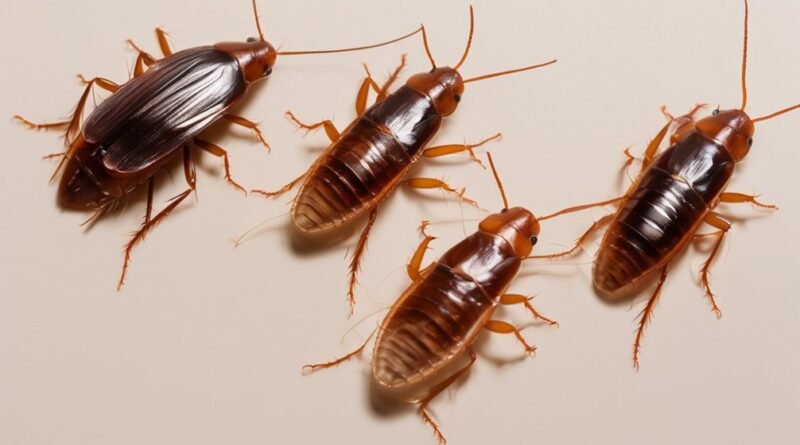
Cockroach Life Cycle Stages (Egg → Nymph → Adult)
Cockroaches develop through three distinct life cycle stages — egg, nymph, and adult — in a process of incomplete metamorphosis that takes an average of approximately 195 days from egg to reproductive adult. About 85% of a cockroach’s life is spent in the nymph stage, cockroach eggs hatch in roughly 28 days under optimal conditions, and around 90% of cockroach species undergo 6 to 7 nymphal molts before reaching adulthood. Female cockroaches lay an average of 16 eggs per ootheca (egg case), with German cockroaches packing 35 to 40 per case. Each stage plays a critical role in how fast an infestation grows and how difficult it becomes to eliminate — treating only the adult cockroaches you can see while leaving active egg cases and nymphs in harborage zones is the most common reason cockroach treatments fail.
Key Takeaways
- Cockroaches undergo three life cycle stages: egg (ootheca), nymph, and adult — with no pupal stage between nymph and adult as in butterflies or beetles.
- The average cockroach life cycle lasts approximately 195 days, with about 85% of that time spent in the nymph stage progressing through 6 to 7 molts.
- Female cockroaches carry the egg case attached to their abdomen for 20 to 30 days. German cockroaches pack 35 to 40 eggs per ootheca; American, Oriental, and Brown-banded species carry 14 to 18.
- Cockroach eggs hatch in roughly 28 days under optimal conditions — temperature around 28 to 30°C and humidity around 70%.
- Adult cockroaches live about one year on average, with females producing up to 90 oothecae during their lifetime — potentially yielding hundreds of offspring from a single individual.
Overview of Cockroach Species and Life Cycle Variation

Over 4,500 cockroach species exist worldwide, but only about 30 species are associated with human habitats, and fewer than 5 account for the vast majority of residential and commercial infestations in the United States. All cockroach species share the same three-stage life cycle of egg, nymph, and adult, but the duration of each stage, the number of nymphal molts, the eggs per ootheca, and the total lifespan vary significantly across species — which is why species identification is the first step in any effective pest control program.
German cockroaches are the most common indoor pest species, found in kitchens, bathrooms, and commercial food service environments globally. American cockroaches are larger peridomestic species associated with basements, sewers, and moisture-rich commercial infrastructure. Oriental cockroaches prefer cool, damp environments and develop the slowest of the common indoor species. Brown-banded cockroaches are distinctive for gluing egg cases to furniture, walls, and ceilings rather than floor-level locations. See our species-specific life cycle timeline comparison for full stage-by-stage breakdowns of each common species.
The Egg Stage and Oothecae Development

The egg stage is where every cockroach infestation begins, and it is often the stage that goes undetected the longest. A cockroach egg case — known as an ootheca — is a small, remarkably efficient protective structure that shields developing embryos from environmental threats, physical damage, and most topical insecticides. Cockroach eggs hatch in roughly 28 days under optimal temperature and humidity conditions, introducing anywhere from 12 to 40 new cockroaches per case depending on species.
What a Cockroach Egg Case Looks Like
Each ootheca measures roughly 7 to 8mm in length and 2 to 3mm wide, with a leathery, ridged exterior that blends into dark corners easily. The color ranges from tan to dark reddish-brown depending on species. Female cockroaches lay an average of 16 eggs per ootheca across all species, but this varies significantly by species:
- German cockroaches pack 35 to 40 eggs per case — the highest of any common household species, making them the most prolific producers and the hardest to control once established.
- American cockroaches carry 14 to 16 eggs per ootheca, deposited in sheltered locations soon after production.
- Oriental and Brown-banded cockroaches carry approximately 12 to 18 eggs per case, with Brown-banded females uniquely gluing egg cases to elevated surfaces including furniture undersides, walls, and ceilings rather than floor-level crevices.
A single overlooked egg case can introduce dozens of nymphs into your home within weeks — this is why physical removal and destruction of oothecae must be part of any effective treatment program, not just chemical application to adult cockroaches.
How Females Carry and Deposit the Egg Case
Female cockroaches carry the ootheca attached to the tip of their abdomen throughout most of the 20 to 30 day incubation period, only detaching it shortly before hatching. During this carrying period, the ootheca receives moisture and oxygen through the female’s body while being protected from environmental exposure. Females actively seek warm, protected spots to deposit the case — heated kitchens, basements, inside wall cavities, under appliances, and behind furniture are the most common deposition locations. Reproductive activity in German cockroaches begins just 4 to 6 days after a female reaches adulthood, which is why early inspection and treatment before breeding accelerates is essential.
Ootheca Protection Mechanisms
The ootheca’s leathery exterior is not just structural — it contains proteins that provide chemical resistance to many surface-applied insecticides, which is why topical sprays applied near egg cases rarely penetrate to the developing embryos inside. Desiccant dusts, physical removal, and vacuuming are the most effective egg-stage control methods because they work through physical rather than chemical mechanisms. Temperature extremes — sustained temperatures above 40°C or below 0°C — will kill eggs inside the ootheca, which is the physical basis for professional heat treatment effectiveness.
Nymph Growth and Molting Patterns
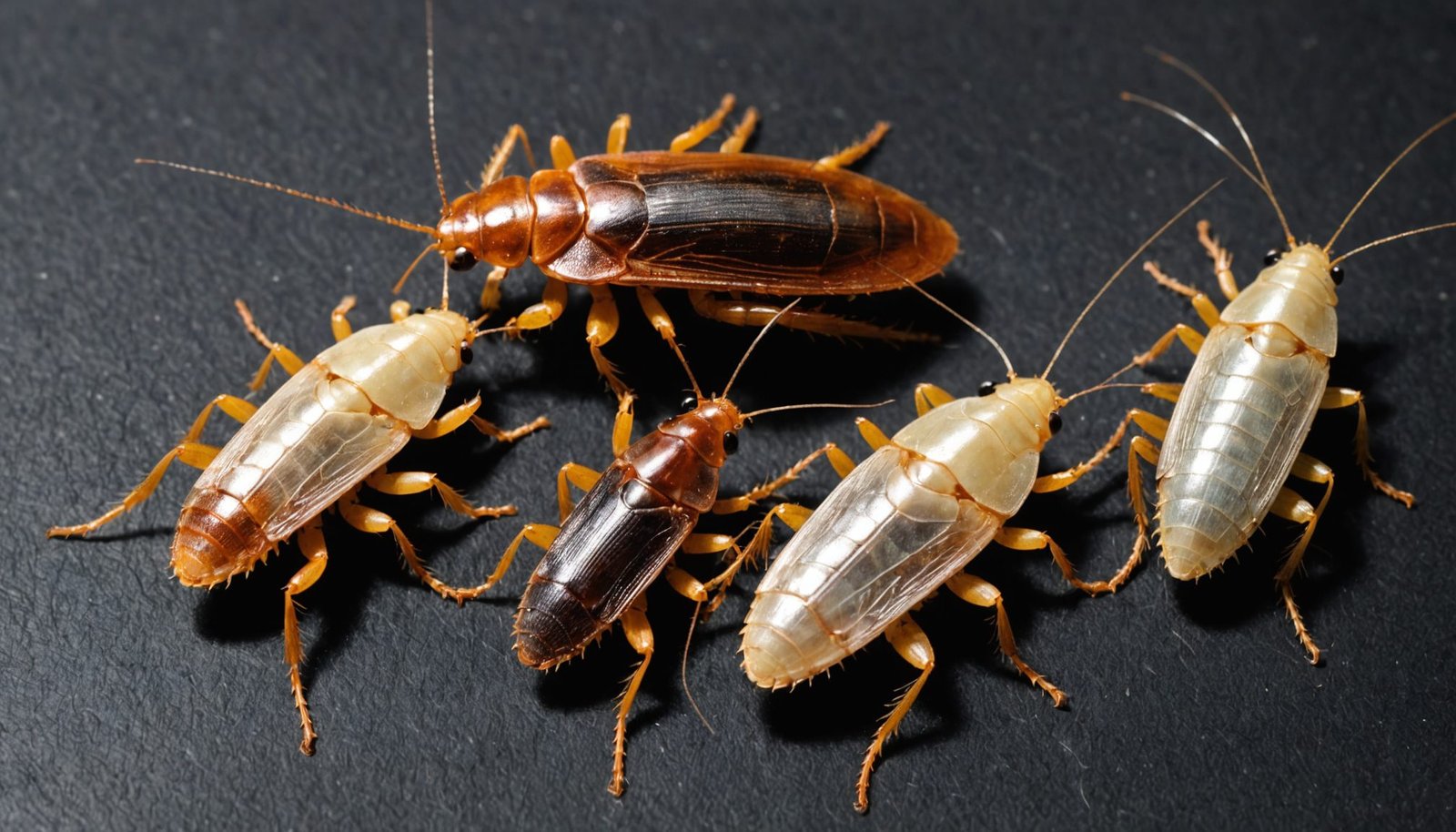
Once eggs hatch, the cockroach enters its nymph stage — and this is where approximately 85% of a cockroach’s total life is spent. The nymph stage is also where the infestation often becomes visible for the first time. Cockroach nymphs are smaller, wingless versions of adults that grow through a series of molts called instars before reaching full maturity. Around 90% of cockroach species undergo 6 to 7 nymphal molts before adulthood, though this varies by species from 5 to 18 instars depending on the cockroach type.
The Instars and How Nymphs Develop
Cockroach nymphs pass through 5 to 7 instars on average, starting at just 3mm and reaching approximately 12.5mm by their final stage. At each instar, the nymph finds a secluded location — inside walls, under appliances, beneath furniture — where it sheds its exoskeleton (molts) in a protected spot while the new exoskeleton hardens. The molting process takes several hours, during which the nymph is at its most vulnerable.
White Cockroach Phenomenon During Molting
Immediately after molting, nymphs appear pale or white before darkening to their normal species coloration within hours as the new exoskeleton hardens and pigments develop. These pale, recently-molted nymphs are sometimes called “white cockroaches” and spotting them is a clear sign of active breeding underway in the home. Shed exoskeletons (cast skins) scattered near food sources, drains, or in dark corners are one of the most reliable early signs of a growing cockroach infestation — each shed skin confirms a nymph successfully completed an instar and the population is actively progressing toward adulthood.
Nymph Behavior and Feeding Habits
Throughout their development, cockroach nymphs behave similarly to adults but stay closer to harborage sites, venturing out only when necessary to feed. They are faster relative to their body size than adults, prefer dark spaces, and maintain consistent feeding habits — contaminating food, surfaces, water sources, and saliva traces as they forage through kitchens and pantries. Nymph development is regulated by juvenile hormone levels, which coordinate the transition through each instar by suppressing the adult development program until the final molt. The entire egg-to-adult process takes approximately 195 days on average across all species, though German cockroaches can complete the full cycle in as little as 3 to 4 months under ideal conditions.
Why Insect Growth Regulators Target Nymphs
Since approximately 85% of a cockroach’s life is spent in the nymph stage, insect growth regulators (IGRs) are specifically designed to disrupt this phase by mimicking juvenile hormones and preventing nymphs from successfully completing their final instar molt to adulthood. A nymph that cannot successfully molt to adulthood cannot reproduce — which is why IGR programs that prevent the next generation from reaching reproductive maturity are among the most effective long-term cockroach control tools available. IGRs applied during the nymph stage work through the 85% of the life cycle where they have the most impact.
Adult Stage Characteristics and Reproduction
Reaching the adult stage marks the end of molting and the beginning of active reproduction. Unlike the nymph stage where cockroaches are sexually immature and focused on growth, the adult stage is dedicated to reproduction, territory, and food acquisition across a wider area than nymphs typically cover.
Physical Changes at Adulthood
Adult American cockroaches develop two pairs of wings and reach approximately 4cm in length, displaying a reddish-brown color with pale yellowish markings near the head. Unlike nymphs, adults no longer molt once their exoskeleton is fully formed. Wing development, adult coloration, and the disappearance of white banding (in brown-banded nymphs) are the clearest visual markers distinguishing adults from nymphs found in the same infestation. German cockroach adults are 13 to 16mm long with fully developed wings they rarely use, light tan coloration, and two dark parallel stripes on the pronotum. See the German cockroach life cycle guide for stage-by-stage identification details specific to the most common indoor species.
Reproduction Rates and Breeding Behavior
Adult females are highly productive breeders. Female cockroaches lay an average of 16 eggs per ootheca, producing multiple cases throughout their adult lifespan. A single American cockroach can produce up to 90 oothecae during her lifetime, potentially yielding 150 offspring within a year. German cockroaches reproduce even more aggressively, with females generating thousands of offspring annually when conditions are favorable. This reproductive output — even from a single gravid female — is why a small overlooked problem in a kitchen or bathroom can escalate into a full-scale infestation across entire buildings within weeks. Adults are primarily active at night, seeking warm, humid locations for mating and egg-laying. As they move through a property, they leave behind droppings, saliva traces, and shed skins that contaminate food preparation surfaces and trigger health concerns. Adults typically live about one year under ideal conditions. See the American cockroach life cycle guide for specific reproductive timelines of the largest common indoor species.
Survival Adaptations at Each Life Cycle Stage
Each cockroach life cycle stage has evolved specific survival adaptations that explain why cockroaches have persisted largely unchanged for over 300 million years and why they remain so difficult to eliminate with modern pest control methods.
Egg stage survival adaptations: The ootheca’s leathery protein exterior provides chemical resistance to most surface-applied insecticides, physical protection from crushing forces, moisture regulation through controlled gas exchange, and camouflage coloration that makes egg cases blend into dark substrate surfaces. German cockroach females carry the ootheca attached to the body for almost the entire incubation period, protecting it from environmental threats until the last day before hatching. The 28-day incubation period under optimal conditions means a single successful laying event introduces a new cohort of cockroaches into the environment regardless of what chemical treatments have been applied to adult populations during that window.
Nymph stage survival adaptations: Nymphs’ small body size allows them to access harborage gaps — as small as 1.6mm for German cockroach early instars — that adults cannot enter, providing protection in the stage when they are most physiologically vulnerable during molting. The exoskeleton shed at each molt is consumed by other colony members in crowded infestations, recycling protein and removing evidence that might attract predators. Nymph aggregation pheromones from frass and shed skins actively recruit additional nymphs to established harborage zones, concentrating the population in the most protective microhabitat available. Regenerative capacity — nymphs can regrow lost legs during subsequent molts — allows survival of physical injury that would be fatal to adult insects.
Adult stage survival adaptations: Cockroaches can run at speeds up to 5.4 kilometers per hour and change direction in fractions of a second, triggered by cerci sensory detection of air movement that initiates escape before visual detection of the threat is complete. Thigmotactic behavior — the preference for body contact with surrounding surfaces on multiple sides simultaneously — guides adults to harborage cracks and crevices where they are physically protected from predation. Cockroaches can survive up to 40 days without food, one week without water, and continue functioning after exposure to radiation levels that would kill humans. Insecticide resistance, which develops rapidly in German cockroach populations through genetic selection in high-density infestations, is an adult-stage adaptation that compounds with every treatment cycle that does not achieve complete population elimination.
Environmental Factors Affecting Life Cycle Duration
The cockroach life cycle does not follow a fixed schedule. Environmental conditions directly determine how fast development progresses through each stage, which is why infestations in heated commercial kitchens spread far more rapidly than those in cool storage rooms or basements. Temperature is the most powerful variable — the optimal range of 28 to 30°C accelerates development through every stage, while temperatures below 15°C can effectively halt nymph development entirely. Cockroach eggs hatch in roughly 28 days at optimal temperature, but the same eggs may take 60 to 90 days to hatch at 20°C — a factor that makes seasonal temperature changes directly relevant to infestation dynamics.
High humidity levels of approximately 70% are equally important, supporting healthy molting and egg incubation throughout the nymph stage. This biological dependence on moisture is exactly why kitchens, bathrooms, and basements are the most common infestation hotspots — they provide the combined warmth, moisture, food availability, and structural harborage that accelerate every stage of the 195-day average life cycle. Access to food, water, and secure shelter also determines how quickly a colony expands: when these resources are abundant, nymphs grow faster, molting cycles shorten, and adult populations multiply. When cockroaches face resource scarcity or overcrowding, the development slows and some individuals may delay final instars until conditions improve — a biological flexibility that makes starvation-based control approaches slow and unreliable compared to targeted bait programs.
Species-Specific Development Timelines
The average cockroach life cycle lasts approximately 195 days across all species, but this average masks enormous variation. Knowing which species you are dealing with is critical because the treatment approach, timing, and bait rotation schedule depend on that specific biology.
- German cockroaches develop fastest, completing the full lifecycle in 3 to 4 months with 5 to 7 molts and producing 35 to 40 eggs per ootheca. Their rapid breeding cycle makes them the most common species found in homes, restaurants, and commercial buildings across urban environments. Reproductive activity begins just 4 to 6 days after a female reaches adulthood.
- American cockroaches take approximately 6 months on average to mature, undergo 13 to 18 molts, and carry 14 to 16 eggs per egg case. These larger pests are frequently found in basements, sewers, and commercial properties where moisture is consistently available.
- Brown-banded cockroaches need roughly 4 months to complete development, with each ootheca containing about 18 eggs. Their distinctive behavior of gluing egg cases to furniture undersides, walls, and ceilings rather than floor-level crevices makes inspection and treatment significantly more challenging than for floor-harborage species.
- Oriental cockroaches develop the slowest of the common indoor species, requiring up to a full year to reach maturity, with approximately 12 eggs per ootheca. Their slow development timeline means oriental cockroach infestations build slowly but can persist for years without complete elimination of the population.
The Smoky-brown cockroach is the most variable of all, taking anywhere from 160 to 716 days to reach maturity depending on environmental temperature. This wide range underlines how profoundly habitat conditions shape cockroach biology and why professionals assess environmental factors before designing treatment programs.
Behavior Changes Through the Life Stages
Understanding how cockroach behavior shifts across the three stages directly informs where to look for evidence and where to place treatments for maximum effectiveness. Nymphs tend to stay within 1 to 2 feet of established harborage sites, venturing out only when necessary to feed — they are more dependent on physical shelter because their developing exoskeleton offers less protection than the hardened adult version. Finding nymphs concentrated in a specific location — behind a refrigerator, inside a cabinet base, or along a particular baseboard — pinpoints the primary harborage zone where gel bait placement will achieve maximum contact.
As cockroaches enter adulthood, behavior becomes more exploratory. Adults cover greater distances in search of food and mating opportunities — which is why adult cockroaches are more frequently spotted across different rooms of a property rather than concentrated near a single harborage point. Seeing cockroaches during daylight hours is a strong behavioral signal that the population has grown large enough that competition for nighttime harborage space has increased significantly, indicating a serious infestation requiring immediate professional assessment rather than continued DIY management.
Signs of Infestation at Each Life Cycle Stage
Egg Stage Signs
At the egg stage, the primary physical evidence is the ootheca itself — small, oval, leathery capsules 7 to 8mm long in tan to dark brown coloration, commonly found behind furniture, inside wall cavities, under appliances, and in dark kitchen and bathroom corners. German cockroach egg cases are lighter colored and often found attached to harborage surfaces near the female’s primary activity zone. Brown-banded egg cases are glued to elevated surfaces at height rather than floor-level locations. Finding even one egg case warrants a thorough property-wide inspection — each case contains enough eggs to introduce a meaningful new population cohort within 28 days under optimal conditions.
Nymph Stage Signs
During the nymph stage, shed exoskeletons (cast skins) near drains, behind appliances, and along wall edges are the most telling indicator of active development. These cast skins are translucent to light tan hollow shells that closely resemble the nymph but lack the living body. Pale or white cockroaches spotted in or near food storage areas signal a nymph that has just completed a molt and is waiting for its new exoskeleton to harden — confirming active breeding in that exact location. Nymphs are smaller and faster than adults and are often initially mistaken for a different insect species before closer examination confirms their cockroach identity. Around 90% of cockroach species undergo 6 to 7 nymphal molts before adulthood, meaning a significant population of cast skins can accumulate near active harborage before adults are visible.
Adult Stage Signs
At the adult stage, live cockroaches visible during daylight indicate the colony has grown large enough to force individuals out during non-preferred activity hours. A persistent musty odor from pheromone trails and dropping accumulations, damage to food packaging in pantries, and fecal smear marks along wall-floor junctions at adult cockroach travel routes are additional adult-stage indicators. At this point, a professional cockroach inspection and a multi-stage treatment plan targeting all three life cycle phases simultaneously are both essential to prevent treated adults from being replaced by the nymphs and egg cases that survive single-stage chemical applications.
Effective Control Methods for Each Stage
Treating only the adult cockroaches you can see is one of the most common and expensive mistakes homeowners make — surviving eggs and nymphs repopulate the property within weeks of any treatment that does not target all three stages simultaneously.
Egg stage control: Physical removal and destruction of oothecae is necessary because most insecticides do not penetrate the egg case’s protective protein exterior. Vacuuming, mechanical removal during professional inspection, and application of desiccant dusts (diatomaceous earth, silica gel) in wall voids reduce egg case survival. Vacuuming also removes the aggregation pheromones left by frass and shed skins that recruit additional cockroaches to established harborage zones. The ootheca’s chemical resistance to most topical insecticides means heat treatment (sustained temperatures above 40°C for professional applications) is the most reliable egg-stage kill method when cockroach eggs hatch in roughly 28 days and must be prevented from contributing to the next generation.
Nymph stage control: Gel baits and insect growth regulators work effectively against nymphs because they feed actively throughout the 85% of their life spent in this stage and are more vulnerable to growth-disrupting compounds than adults with fully formed exoskeletons. IGRs specifically interfere with the juvenile hormone regulation that controls molting, preventing nymphs from completing their development to adulthood and reproduction. Gel bait applications in confirmed harborage zones identified by monitoring trap data maximize contact with nymphs during their frequent foraging cycles.
Adult stage control: A combination of gel baits, bait stations, and residual sprays applied to harborage zones alongside structural exclusion delivers the most complete adult-stage coverage. Rotate bait active ingredients (fipronil, indoxacarb, abamectin) every 90 days to prevent resistance development in established German cockroach populations. Whether DIY or professional service is appropriate depends on species and infestation scale — the average cockroach life cycle lasting approximately 195 days means a consistent 6-month treatment program is the minimum timeframe for reliable population elimination rather than temporary suppression.
Frequently Asked Questions
What Are the Three Cockroach Life Cycle Stages?
The three stages of the cockroach life cycle are the egg stage, the nymph stage, and the adult stage. Cockroaches undergo incomplete metamorphosis — there is no pupal stage between nymph and adult as there would be in butterflies or beetles. The average cockroach life cycle lasts approximately 195 days, with about 85% of that time spent in the nymph stage progressing through 6 to 7 instars before reaching adulthood.
How Long Does Each Cockroach Life Cycle Stage Last?
The egg stage lasts approximately 28 days under optimal conditions (28 to 30°C and 70% humidity), extending to 60 to 90 days at lower temperatures. The nymph stage spans the majority of the 195-day average total cycle — approximately 85% — covering 5 to 7 instars for most species. The adult stage can last up to one year. For faster species like the German cockroach, the full egg-to-adult development completes in as little as 3 to 4 months; Oriental cockroaches may take up to a full year.
How Many Nymph Stages Do Cockroaches Have?
Around 90% of cockroach species undergo 6 to 7 nymphal molts before adulthood, though this varies by species. German cockroaches go through 5 to 7 molts, while American cockroaches undergo 13 to 18 molts during their longer nymph stage. Each instar ends with the nymph shedding its exoskeleton — the shed skins (cast skins) left near harborage zones are a key sign of active nymph development underway.
What Does a Cockroach Egg Case Look Like?
A cockroach egg case (ootheca) is a small, oval, leathery capsule measuring 7 to 8mm long with a ridged surface, ranging in color from tan to dark reddish-brown depending on species. Female cockroaches lay an average of 16 eggs per ootheca across all species, though German cockroaches produce 35 to 40 per case. German cockroach oothecae are lighter colored and often carried attached to the female until just before hatching. American cockroach egg cases are darker and deposited in sheltered locations soon after production.
Can Cockroach Life Cycle Speed Vary by Species?
Yes — significantly. German cockroaches complete development in as little as 3 to 4 months, making them the fastest-developing common household species. Oriental cockroaches can take up to a full year. The Smoky-brown cockroach shows the most dramatic variation, with development ranging from 160 to over 700 days depending on environmental temperature. The average across all species is approximately 195 days. This variation is why species identification is the critical first step in any pest control program.
What Factors Affect Cockroach Development Time?
Temperature, humidity, and access to food and water are the three primary factors. The optimal range of 28 to 30°C and humidity around 70% accelerates development through every stage — cockroach eggs hatch in roughly 28 days under these conditions but can take 60 to 90 days at 20°C. Scarcity of food or water, pesticide exposure, and overcrowding can significantly slow or interrupt development, though cockroaches’ biological flexibility means they tolerate a wide range of conditions far better than most other insect pests.
{
“@context”: “https://schema.org”,
“@type”: “FAQPage”,
“mainEntity”: [
{
“@type”: “Question”,
“name”: “What Are the Three Cockroach Life Cycle Stages?”,
“acceptedAnswer”: {
“@type”: “Answer”,
“text”: “The three stages are egg, nymph, and adult. Cockroaches undergo incomplete metamorphosis with no pupal stage. The average cockroach life cycle lasts approximately 195 days, with about 85% spent in the nymph stage progressing through 6 to 7 instars before reaching adulthood.”
}
},
{
“@type”: “Question”,
“name”: “How Long Does Each Cockroach Life Cycle Stage Last?”,
“acceptedAnswer”: {
“@type”: “Answer”,
“text”: “Cockroach eggs hatch in roughly 28 days under optimal conditions (28 to 30°C and 70% humidity), extending to 60 to 90 days at lower temperatures. The nymph stage spans approximately 85% of the 195-day average total life cycle. The adult stage lasts up to one year. German cockroaches complete the full cycle in 3 to 4 months; Oriental cockroaches may take a full year.”
}
},
{
“@type”: “Question”,
“name”: “How Many Nymph Stages Do Cockroaches Have?”,
“acceptedAnswer”: {
“@type”: “Answer”,
“text”: “Around 90% of cockroach species undergo 6 to 7 nymphal molts before adulthood. German cockroaches go through 5 to 7 molts; American cockroaches undergo 13 to 18. Each instar ends with the nymph shedding its exoskeleton — shed skins near harborage zones confirm active nymph development.”
}
},
{
“@type”: “Question”,
“name”: “What Does a Cockroach Egg Case Look Like?”,
“acceptedAnswer”: {
“@type”: “Answer”,
“text”: “A cockroach egg case (ootheca) is a small oval leathery capsule 7 to 8mm long with a ridged surface, tan to dark reddish-brown in color. Female cockroaches lay an average of 16 eggs per ootheca across all species, with German cockroaches producing 35 to 40 per case. German cockroach oothecae are lighter colored and often carried attached to the female until hatching.”
}
},
{
“@type”: “Question”,
“name”: “Can Cockroach Life Cycle Speed Vary by Species?”,
“acceptedAnswer”: {
“@type”: “Answer”,
“text”: “Yes — significantly. German cockroaches complete development in 3 to 4 months; Oriental cockroaches take up to a full year. The Smoky-brown cockroach ranges from 160 to over 700 days depending on temperature. The average across all species is approximately 195 days. Species identification is the critical first step in any pest control program.”
}
},
{
“@type”: “Question”,
“name”: “What Factors Affect Cockroach Development Time?”,
“acceptedAnswer”: {
“@type”: “Answer”,
“text”: “Temperature, humidity, and access to food and water are the three primary factors. Optimal conditions (28 to 30°C and 70% humidity) allow cockroach eggs to hatch in roughly 28 days, while 20°C can extend this to 60 to 90 days. Scarcity of food or water, pesticide exposure, and overcrowding can slow or interrupt development.”
}
}
]
}
