
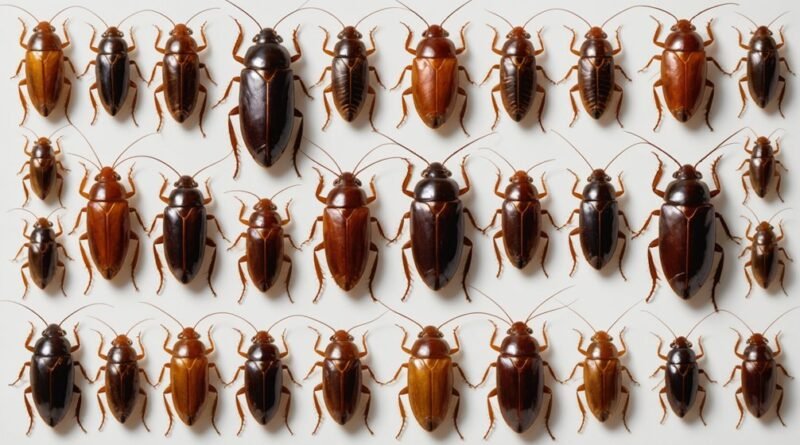
Cockroach Size Comparison Chart: All Species by Length and Weight
You’ll see that most home roaches range from tiny 1/3–1/2 inch brownbanded and 0.5–0.6 inch German roaches up to hefty 1.25–2 inch American roaches. Oriental and smokybrown cockroaches sit in the middle at about 1–1.5 inches. Colors and markings, like German stripes or brownbanded bands, help you ID them fast. Knowing the size tells you where they hide and which control methods work best, and that’s exactly what comes next.
Key Takeaways
- Small indoor species like German and brownbanded cockroaches measure about 4–16 mm long and typically weigh under 0.2 grams.
- Larger peridomestic species like American, Oriental, and smokybrown cockroaches range from about 20–54 mm and can weigh up to roughly 1–2 grams.
- German cockroaches are about 13–16 mm, American 32–54 mm, Oriental 20–32 mm, smokybrown 32–35 mm, and brownbanded up to 13 mm.
- Nymph and egg case sizes (4–12 mm nymphs; 5/16–½ inch oothecae) help estimate species, developmental stage, and potential population growth.
- Size strongly correlates with habitat and control: small species infest indoor cracks and appliances; larger species dominate moist outdoor or structural void areas.
Cockroach Size Chart at a Glance
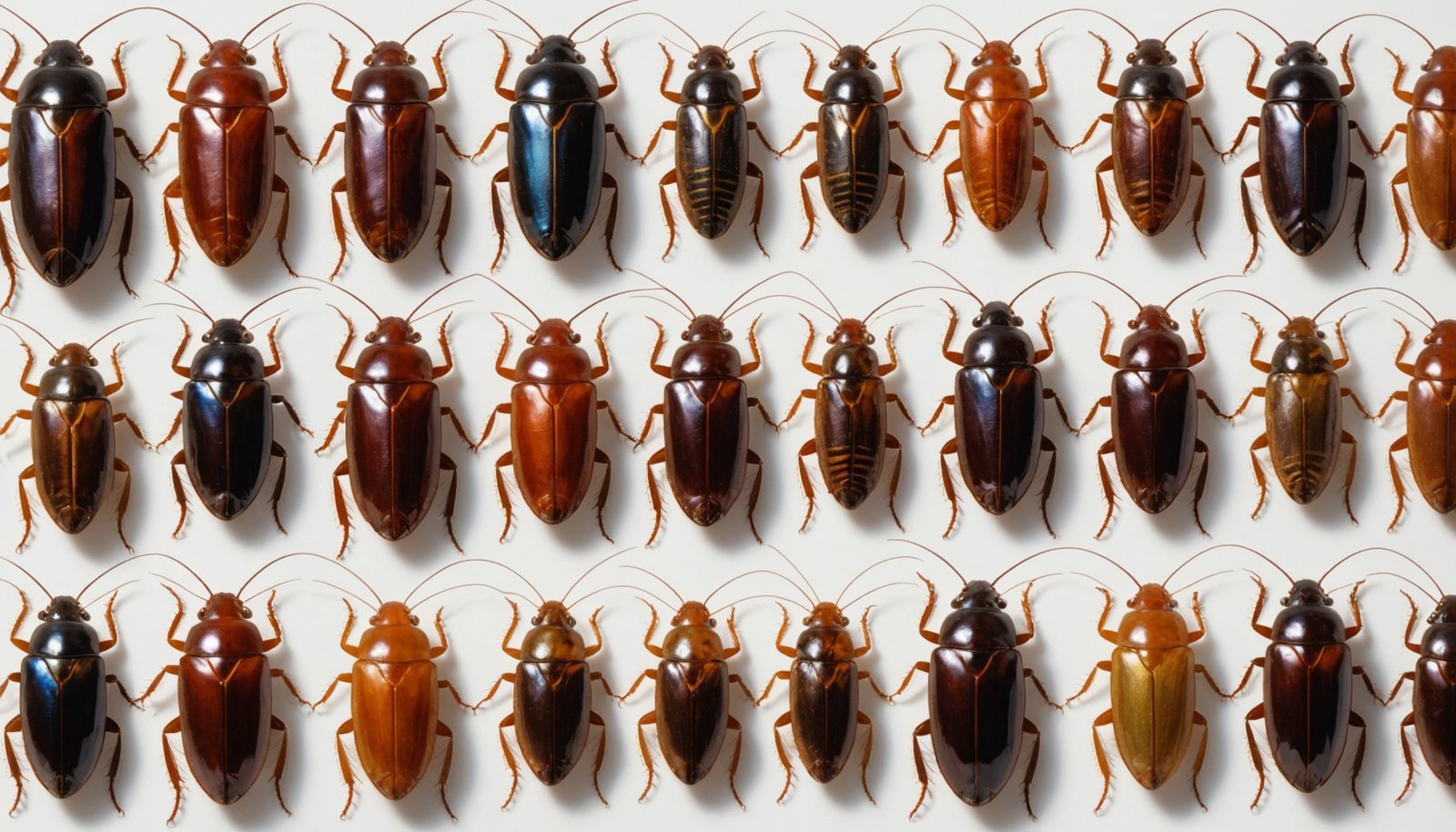
A cockroach size chart gives you a quick way to compare the most common home-invading species at a glance. You instantly see that German, American, Oriental, and smokybrown roaches don’t just differ in length; their colors, markings, and lifespans also vary in ways that affect control strategies. Correct species identification helps you decide whether you’re dealing with a minor, temporary issue or a fast-growing indoor infestation that needs urgent treatment.
By lining up these profiles, you connect size with cockroach habitat preferences and cockroach behavior patterns. Smaller German cockroaches squeeze into tight kitchen and bathroom crevices, while larger American and smokybrown roaches favor warmer, more spacious areas like basements, utility rooms, and garages. Oriental cockroaches, with their dark, glossy bodies, often stay closer to damp, cooler spots.
Using a chart, you quickly match a roach’s approximate length and coloration to a likely species, then infer where it’s hiding and how long it might live. That lets you prioritize inspection zones and choose more targeted treatment and monitoring methods.
How Big Are Common Cockroach Species?
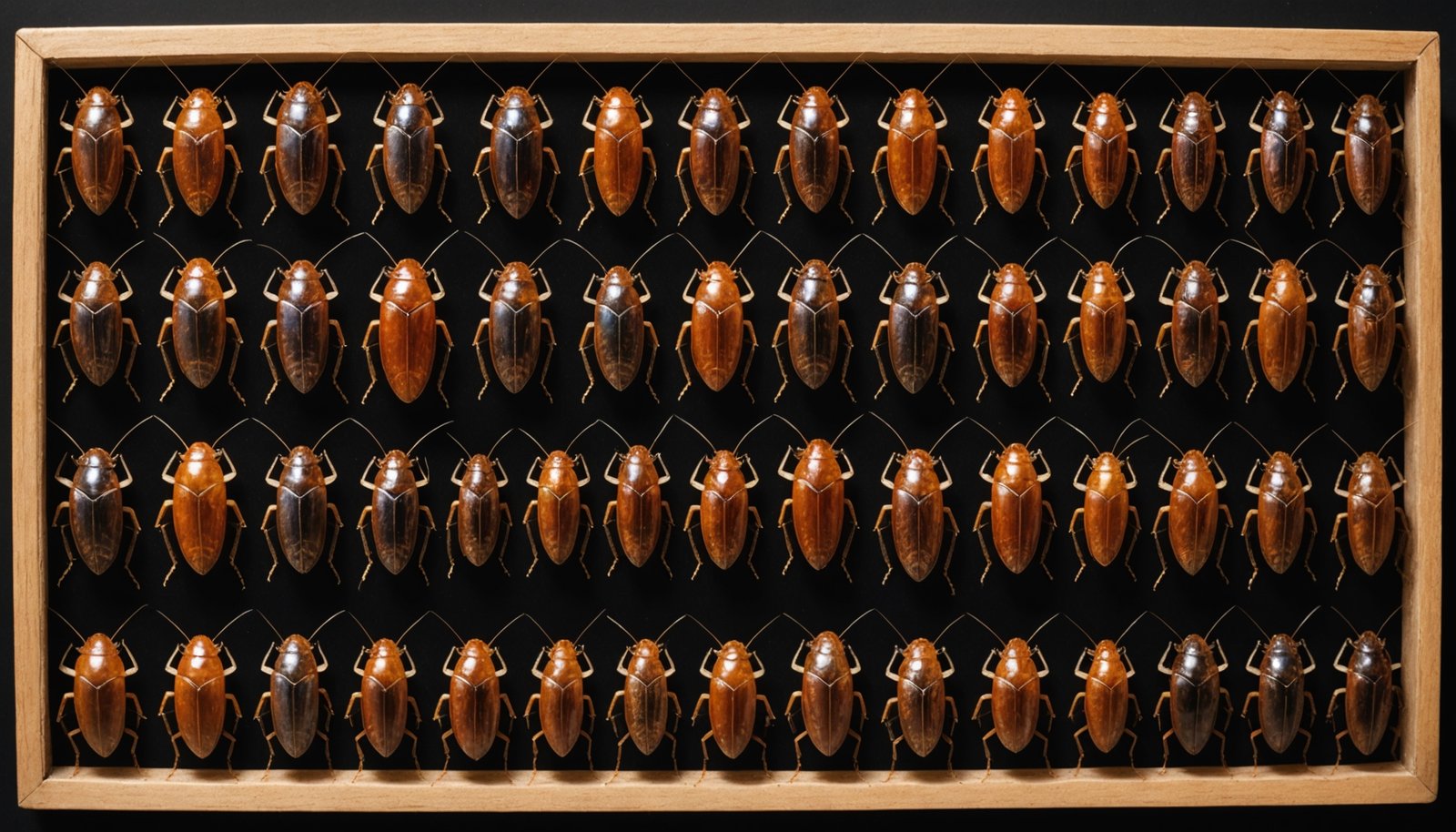
As you compare cockroach sizes, you’ll notice a big contrast between tiny German roaches and much larger American roaches. You’ll also want to recognize the small indoor species that hide in kitchens, bathrooms, and furniture. Then you can look at the large outdoor roaches that usually live outside but still find their way into your home. Professional pest control services can identify cockroach species accurately so they can tailor treatments to each type’s behavior and habitat.
German vs. American Size
Two of the most common home-invading cockroaches, German and American, differ dramatically in size, and that makes them easier to tell apart at a glance. In a quick size comparison, a fully grown German cockroach reaches about ½ inch, small enough to sit on your thumbnail. An American cockroach typically measures 1.25 to 2 inches, closer to the length of your thumb. Both species can carry harmful bacteria that contaminate surfaces and food, raising potential health risks indoors.
These size and behavior differences help you identify what you’re dealing with. Germans are light brown to tan with two dark stripes behind the head, dart quickly, and rarely fly. Americans are larger, reddish-brown with a yellowish figure-eight pattern, move more steadily, and can fly short distances. You’ll usually find Germans in warm kitchens, Americans in basements or near drains.
Small Indoor Species
Beyond the size gap between German and American cockroaches, you’ll also encounter smaller indoor species that stay under ⅝ inch long. You’ll typically deal with German and brown-banded roaches, both light brown and slim enough to hide in tiny cracks. Their small size lets them move easily through walls, cabinets, and appliances. Professional help may still be necessary for effective management when these small indoor species reproduce quickly and spread throughout a home.
- German cockroaches measure about 0.5–0.6 inches (13–16 mm), with two dark stripes behind the head.
- Brown-banded cockroaches reach up to 13 mm and show pale yellow bands across their wings and body.
- German Cockroach Behavior centers on warm, humid kitchens and bathrooms close to food and water.
- Brown Banded Habitat includes drier, warmer rooms like bedrooms and living areas, where they tuck into furniture, electronics, and high wall spaces.
Large Outdoor Roaches
Large outdoor cockroaches quickly make that half‑inch German roach look tiny by comparison. In your yard, sewers, or woodpiles, you’ll meet species that routinely exceed an inch and sometimes stretch past three. The American cockroach, the largest in US homes, reaches 1.25–3 inches and thrives in a moist outdoor habitat like storm drains and crawlspaces. In warmer regions, you might even encounter the giant black cockroach, Megaloblatta longipennis, which can grow up to 3.8 inches long with an 8‑inch wingspan.
| Species / Size Range | Notable Details |
|---|---|
| American: 1.25–3 in | Reddish‑brown, runs fast, common in US cities |
| Oriental: up to 32 mm | Glossy dark brown to black, flightless, sewer‑associated |
| Megaloblatta: 1.6–3.8 in | Giant Neotropical flier with 8‑inch wingspan |
As species distribution shifts with warming climates, you may see traditionally tropical giants encroaching on new outdoor areas.
German vs American Cockroach Size
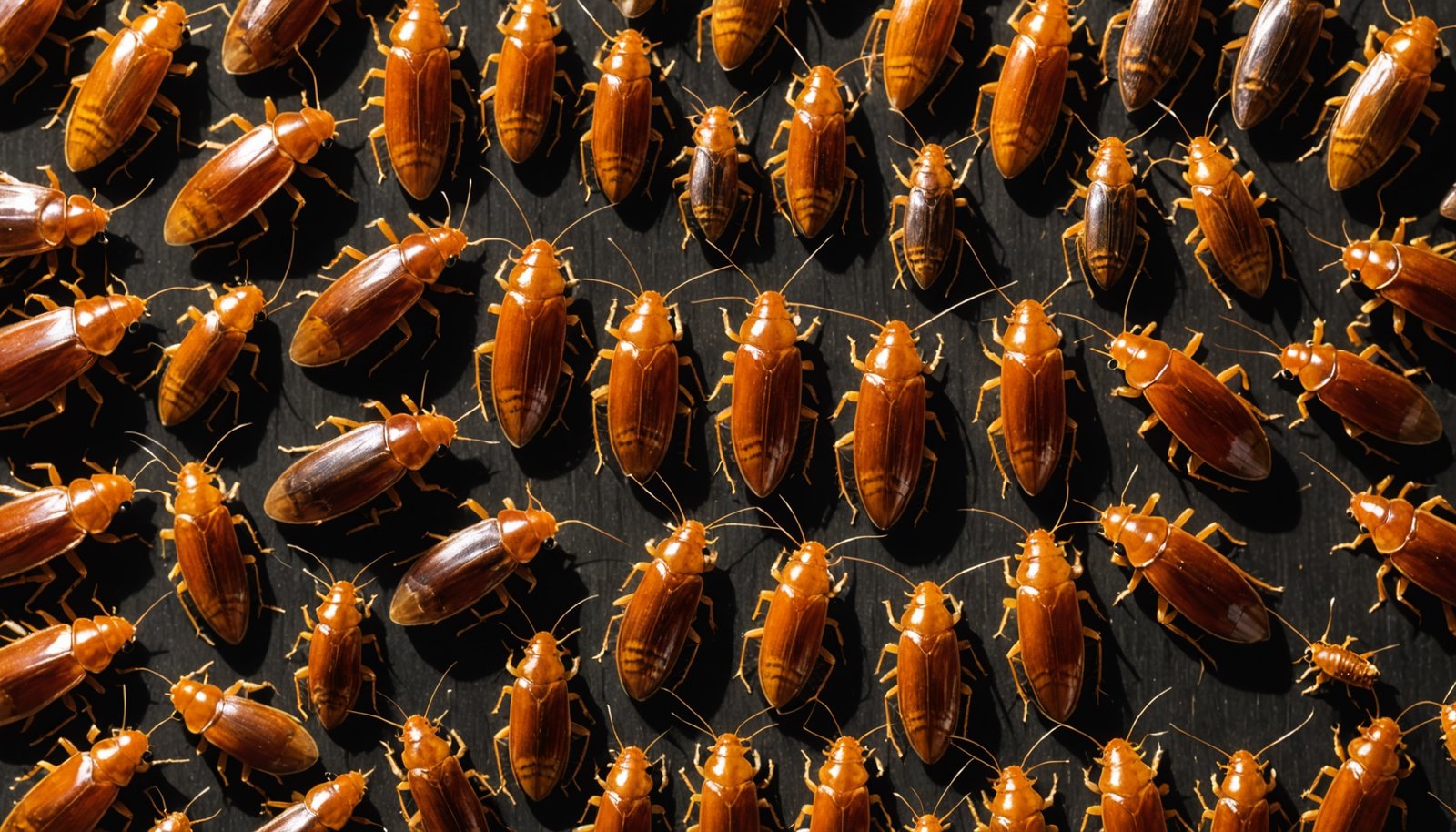
Although both species are easy to confuse at a glance, German and American cockroaches differ dramatically in size, making measurement one of the quickest ways to tell them apart. When you’re doing german cockroach identification, think “penny-sized household pest.” When you’re dealing with american cockroach behavior, you’re usually seeing a much larger, more mobile “thumb-sized” roach that often wanders in from sewers or basements.
German roaches stay small, rarely reaching even ⅝ inch, while American roaches routinely exceed 1½ inches and can approach 2 inches.
Use this quick comparison when you spot a roach:
- German cockroach length: about 0.5 inch, usually ½–⅝ inches (13–17 mm)
- American cockroach length: 1.25–2 inches (32–54 mm)
- German coloring: light to medium brown with two dark parallel stripes behind the head
- American coloring: reddish‑brown with a pale yellow band or figure‑eight marking behind the head
Oriental, Smokybrown, and Brownbanded Sizes
When you switch from German and American roaches to Oriental, smokybrown, and brownbanded species, their body sizes tell you a lot about what to expect indoors and outdoors. You’ll see that Oriental cockroaches sit in the mid-size range, smokybrowns push into larger territory, and brownbanded roaches stay noticeably smaller. By understanding these measurements, you can better identify what you’re seeing and gauge how serious an infestation might be.
Oriental Cockroach Body Size
Oriental cockroaches sit in the middle of the household roach size spectrum, and understanding their dimensions helps you tell them apart from similar species like smokybrown and brownbanded roaches. When you know Oriental anatomy and typical measurements, you can link size to habitat preferences, behavior patterns, and diet variations inside or around your home.
- Adults usually measure 20–27 mm, with a typical length near 22–27 mm (about 1 inch).
- Males reach about 18–29 mm, narrower, with wings covering roughly 75% of the abdomen.
- Females grow 20–27 mm, sometimes up to 1.25 inches, with broader, heavier bodies around 0.95 g.
- Both sexes look glossy dark brown to black, with males about 0.45 g and clearly exposing the last abdominal segments.
Smokybrown And Brownbanded Measurements
Two cockroach species often confused with Orientals—smokybrown and brownbanded roaches—sit at opposite ends of the size chart, and their measurements make them easy to tell apart. Smokybrown adults reach 1.25–1.5 inches (about 32–35 mm), with solid dark bodies and wings that extend beyond the abdomen in both sexes. Their long antennae and strong flight help them exploit humid smokybrown habitats like tree canopies, rooflines, and damp attics.
Brownbanded adults stay much smaller, only 1/3–1/2 inch (8–13 mm), with pale bands across wings and abdomen. Males have longer wings than females, which carry short, rounded wings. Their light build and agile brownbanded behavior keep them active around ceilings, electronics, and drier indoor zones.
| Species | Adult Length |
|---|---|
| Smokybrown | 1.25–1.5 in (32–35 mm) |
| Brownbanded | 0.33–0.5 in (8–13 mm) |
Identifying Tiny Cockroaches by Length and Color
Although tiny roaches can look alike at a glance, you can quickly narrow down what you’re seeing by focusing on length and color patterns. For fast color identification, pay close attention to nymph characteristics rather than expecting full adult markings or wings.
- German cockroach nymphs reach about 12 mm and appear light brown with two dark longitudinal stripes on the pronotum; their oval bodies and long antennae make them easy to spot in kitchens and bathrooms.
- Brown-banded nymphs stay smaller, around 4–5 mm, and show dark brown bodies with two pale transverse bands, often higher on the back.
- Oriental nymphs look stocky, shiny dark brown to nearly black, with few markings and a heavier build than similar-sized species.
- American cockroach nymphs start tiny (about 1/8 inch), initially whitish, then turn reddish-brown with a rounded body, remaining lighter than the eventual mahogany adults.
Nymph and Egg Case Sizes by Species
Across the most common household cockroach species, both nymphs and their egg cases (oothecae) fall into predictable size ranges that make identification much easier. German oothecae are purse‑like, light brown, about 5/16 inch long and quite narrow, holding 30–40 small eggs; their 3 mm dark nymphs show a pale pronotum stripe and molt 5–7 times. American cockroach oothecae are similar in length (5/16 inch) but thicker, dark red to black, with 14–16 eggs; nymphs are larger, grayish to reddish‑brown and wingless at first.
Oriental egg case variations stand out: they’re the largest, about ½ inch, turning from light yellow to black, with 16 eggs. Their stout, nearly black nymph characteristics are distinctive. Brown‑banded oothecae are ¼–½ inch, ridged, with two dark bands and 10–18 eggs; nymphs hatch at 2–3 mm with cream bands. Smokybrown oothecae are black, 3/8 inch, contain 24 eggs, and produce tiny mahogany nymphs.
How Cockroach Size Affects Pest Control
Because each cockroach species grows to a different size and hides in different‑sized spaces, effective pest control depends on matching your tactics to the insect you’re dealing with. Size specific management sits at the core of modern Pest control techniques, especially when you follow an integrated pest management (IPM) approach.
You’ll treat small, indoor breeders like German or brown‑banded roaches very differently from large American or Oriental roaches that wander in from outdoors.
- Use pea‑size gel bait spots and IGRs in cracks under 3/8 inch to knock down small species hiding in cabinets and appliances.
- Place sticky or baited traps in tight gaps to monitor small populations and confirm control progress.
- For large species, deploy bigger bait placements, glue boards, and thorough inspections of wall voids and outdoor harborage.
- Pair sanitation and exclusion with IPM to cut insecticide use dramatically, sealing tiny gaps for small roaches and exterior entry points for larger ones.
Frequently Asked Questions
Can a Cockroach’s Size Predict How Long It Will Live?
Yes, size can partly predict a cockroach’s lifespan, but not perfectly. You’d see larger individuals often living longer due to size genetics, metabolism, behavior, and environment—key lifespan factors that interact rather than act alone.
Do Larger Cockroach Species Spread More Diseases Than Smaller Ones?
No, larger cockroach species don’t spread more diseases than smaller ones. You should focus on hygiene and infestation levels, because disease transmission depends on contamination and population density, not any size advantage a particular species has.
How Does Cockroach Size Influence What They Can Chew Through?
Cockroach size directly shapes what they can chew through: larger roaches have stronger chewing capabilities, biting into thick cardboard, plastic, and wood, while smaller ones face size disadvantages, limited mostly to thin paper, soft glues, and surface nibbling.
Are There Regions Where Only Small Cockroach Species Are Found?
No, you won’t find regions with only small cockroach species. Because habitat preferences overlap, species distribution always mixes small and larger roaches, indoors and outdoors, including attics, heated apartments, leafcutter ant nests, and detritus-rich landscapes.
Can Diet or Environment Change an Individual Cockroach’s Adult Size?
Yes, diet and environment can change an individual cockroach’s adult size. You see size variation because growth factors respond to environmental influences like temperature, humidity, and crowding, while dietary impacts arise from protein–carbohydrate balance and overall food availability.
Conclusion
Now that you’ve seen how cockroach sizes compare by species, life stage, and color, you can quickly tell what you’re dealing with—and how serious the infestation might be. Use length, body shape, and markings to narrow down the species, then match your control approach to its size and habits. When roaches get larger or more numerous than you can safely handle, don’t hesitate to call a professional for targeted treatment.
