
Do Cockroaches Have Wings, Brains, or Blood? Anatomy Facts Explained
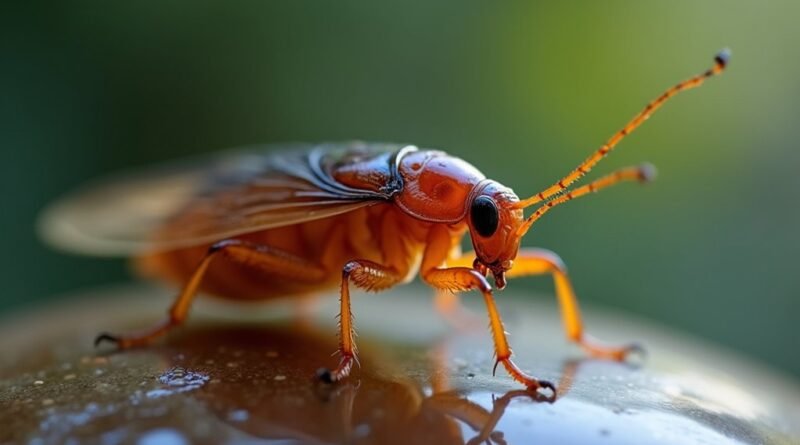
You’re looking at an insect that has wings, a brain, and hemolymph instead of blood. Cockroaches carry two wing pairs: tough forewings that protect the body and thin hindwings that help them glide or fly short distances. Their brain sits above the esophagus in the head, while ganglia along the belly handle local reflexes. Hemolymph is pale and bathes the organs, but it doesn’t carry oxygen. Tracheae do that, and there’s more to uncover below.
Key Takeaways
- Cockroaches have two pairs of wings: leathery forewings that protect the body and thin membranous hindwings used for flight or gliding.
- Flight ability varies by species; American cockroaches fly short distances, while indoor species often glide and rarely fly, usually unsteadily.
- Cockroaches have a brain in the head, but their ventral nerve cord ganglia can control movements like leg activity independently.
- Cockroaches lack vertebrate-style blood; they have colorless hemolymph that bathes organs directly in an open circulatory system.
- A tubular dorsal vessel heart pumps hemolymph, but oxygen travels through the tracheal system rather than through the circulatory system.
Do Cockroaches Have Wings, a Brain, and Blood?
How can an insect that survives almost anything still have a brain, wings, and blood? It does, but each works differently than you’d expect.
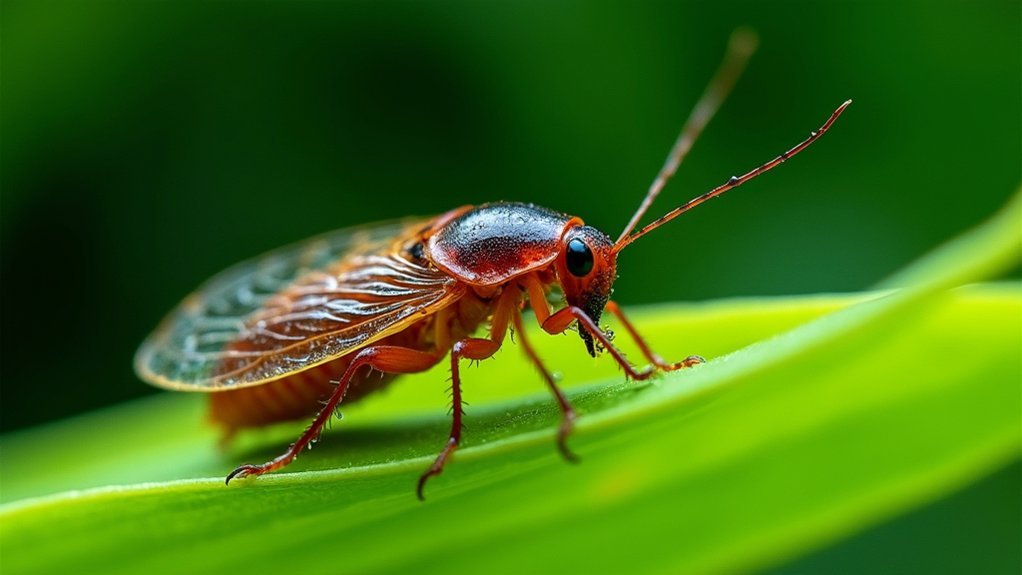
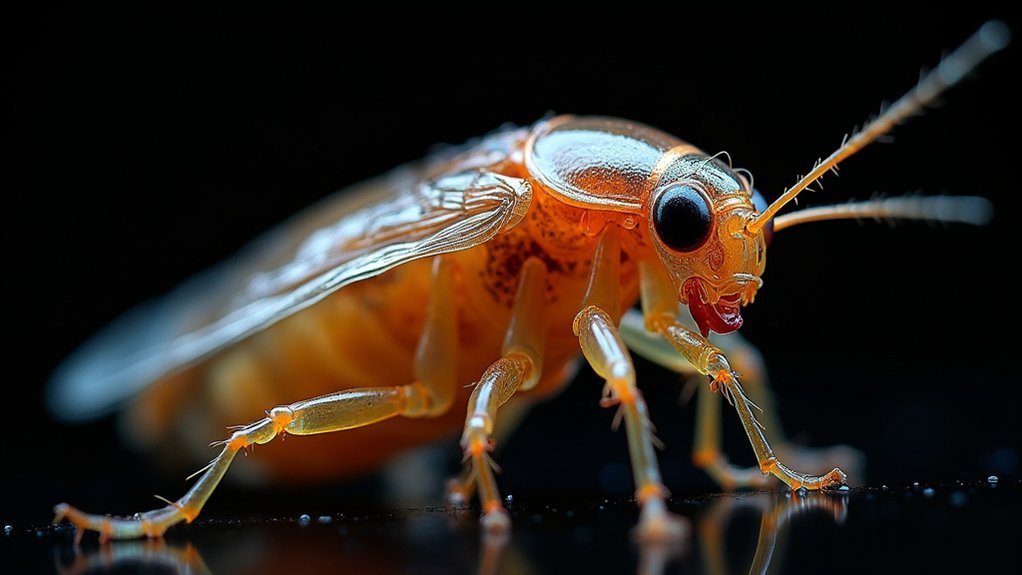
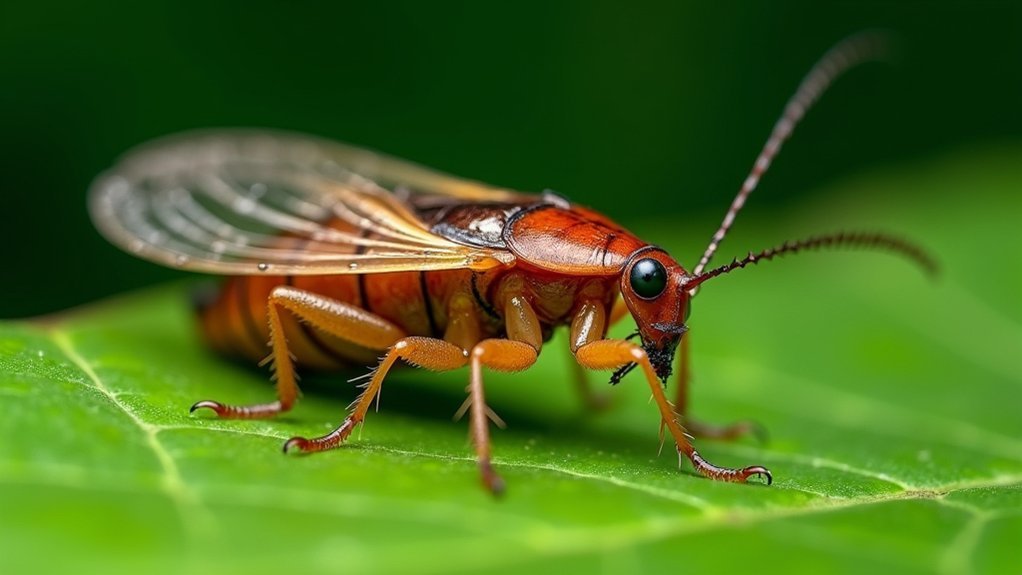
Adult cockroaches usually have two pairs of wings. The leathery forewings, which arise from the mesothorax, protect the body. The thin, membranous hindwings, which arise from the metathorax, handle flight or gliding.
Don’t expect strong flyers, though. Many species only glide or make short flights, and some have reduced wings.
Cockroaches do have a brain. It sits in the head as the supra-oesophageal ganglion and serves mainly as a sensory and endocrine center.
A ventral nerve cord with segmental ganglia coordinates movement and body functions, so the brain doesn’t control everything alone.
Cockroaches don’t have vertebrate-style blood. They’ve colorless hemolymph in an open circulatory system, so it flows freely around organs.
It transports nutrients, hormones, and wastes, but not oxygen. Tracheae deliver oxygen. The respiratory system relies on tracheal tubes that bring oxygen directly to body tissues.
What Are a Cockroach’s Three Body Regions?
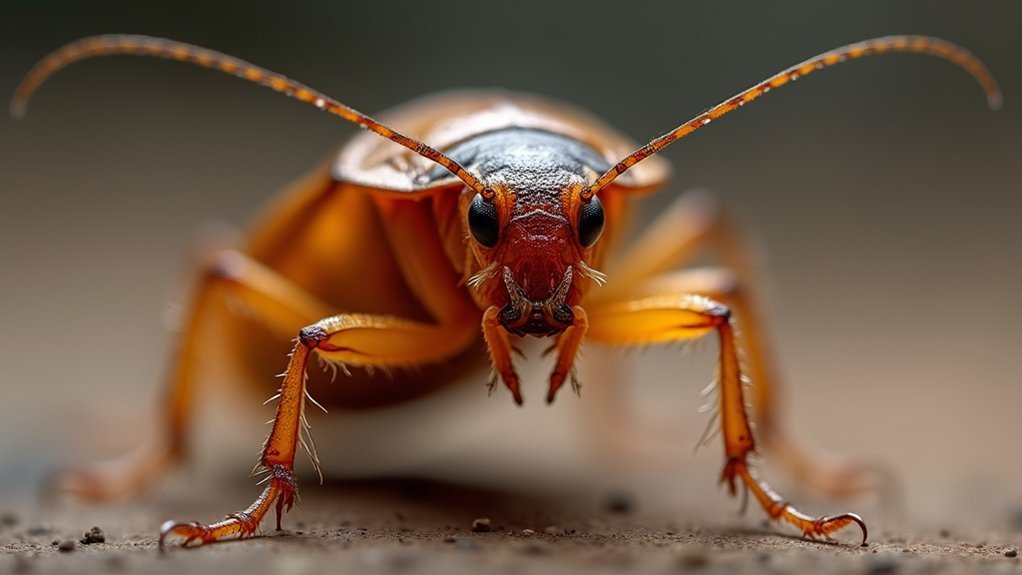
If you look closely at a cockroach, you’ll see that its body splits into three regions: the head, the thorax, and the abdomen.
The head handles sensing and feeding, while the abdomen houses most of the internal organs.
You’ll find the thorax in the middle, and it’s the part that carries the three pairs of legs and the wings, if present.
The body is covered by a brown chitinous exoskeleton made of sclerites joined by arthrodial membranes, which allows the insect to move flexibly.
Head, Thorax, and Abdomen
When you look closely at a cockroach, you’ll see its body divides into three regions: the head, the thorax, and the abdomen. Each region handles distinct jobs, and you can spot the differences quickly.
| Region | Location | Key Features |
|---|---|---|
| Head | Front | Antennae, compound eyes, mouthparts |
| Thorax | Middle | Three segments; bears the legs |
| Abdomen | Rear | Ten visible segments; cerci |
| Body shape | Overall | Dorsoventrally flattened |
Your cockroach’s head senses and feeds. Its six fused segments form a highly mobile unit on a flexible neck. The thorax anchors movement, with the prothorax, mesothorax, and metathorax each carrying one pair of legs. The mesothorax also carries leathery forewings called tegmina, while the metathorax bears membranous hindwings used for flight. The abdomen is the largest region, and you’ll find digestive, excretory, and reproductive organs inside it. These regions create a flattened body that slips through narrow spaces.
Thorax: Legs and Wings
The thorax is your cockroach’s engine room, and it’s where both its legs and its wings attach. You’ll find three segments here: the prothorax, mesothorax, and metathorax. Each one carries a pair of legs, so you’re looking at six legs total. The legs are sturdy and covered in spines that aid locomotion across rough surfaces.
Here’s how the thorax works:
- Front legs: They brake and stabilize your cockroach during rapid runs.
- Middle legs: They adjust speed and control balance.
- Hind legs: They deliver the main thrust for forward motion.
- Wings: Tough forewings (tegmina) attach to the mesothorax and cover the thinner hind wings, which attach to the metathorax and power flight.
Because of this setup, your cockroach runs efficiently, changes direction quickly, and manages short flight bursts. That’s why you’ll often see it sprint across your kitchen floor.
How Do Forewings and Hindwings Differ?
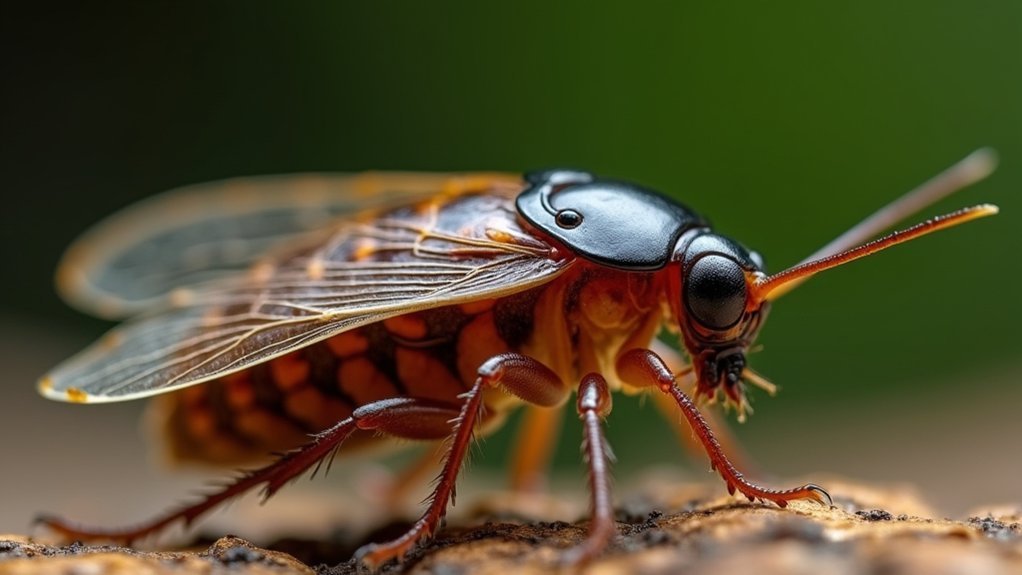
You’ve probably noticed that a cockroach’s back looks like it has just one set of wings, but there are actually two pairs, and they don’t match.
The forewings (tegmina) are thick, dark, and leathery, while the hindwings are thin, clear, and membranous.
Both pairs are outgrowths of the exoskeleton that sit on the mesothorax and metathorax, the second and third thoracic segments.
You’ll see how their textures, their roles in protection and flight, and their origins on the thorax set them apart.
Structure and Texture Differences
If you look closely at a cockroach’s back, you’ll see two wing pairs that look and feel completely different. The forewings, called tegmina, cover the hindwings, and you can tell the pairs apart by checking these four features:
- Material: You’ll find forewings thick, leathery, and stiff, while hindwings feel thin, membranous, and delicate.
- Color: Forewings look opaque and dark. Hindwings look transparent.
- Shape: Forewings are narrower and more rigid. Hindwings are broader and more expanded.
- Position: Forewings lie on top, forming a shield-like layer. Hindwings stay folded beneath.
Structure clearly matches function here. The rigid forewings protect the hindwings, and you’ll notice they aren’t the primary flight wings.
The flexible, sheet-like hindwings do the flying, so they unfold rapidly when the cockroach takes off.
Roles in Protection and Flight
Each wing pair has its own job: the forewings protect, and the hindwings fly. When you look at a resting cockroach, you’re seeing the tegmina, which shield the abdomen and the delicate wings beneath them.
| Feature | Forewings | Hindwings |
|---|---|---|
| Role | Protection | Flight |
| Texture | Thick, leathery | Thin, membranous |
| At rest | Cover the body | Tuck underneath |
| During flight | Lift out of the way | Beat to generate lift |
| Shape | Hard, thick | Broad, flexible |
When a cockroach takes off, you’ll see the hindwings deploy rapidly while the forewings move aside. Flights stay short, and many species just glide to escape danger. Both pairs coordinate to keep the insect balanced and stable in the air. Because the forewings don’t generate lift, you won’t see them doing any of the flying.
Origins on the Thorax
Although you’ll see both wing pairs on a cockroach’s back, they don’t start in the same place. Both pairs arise from the thorax, not the abdomen or head, but they attach to different segments. Here’s how to tell them apart:
- Prothorax: You’ll find no wings here. This first segment stays wingless.
- Mesothorax: You’ll see the forewings, called tegmina, attach here. They’re thick, dark, opaque, and leathery.
- Metathorax: You’ll find the hindwings here. They’re thin, broad, membranous, and transparent.
- Resting position: You’ll notice the forewings lie flat on top, while the hindwings stay folded underneath.
Each segment has a distinct function, so wing attachment reflects the insect’s segmented body plan.
The mesothorax gives you protective wing covers; the metathorax gives you the actual flight surface.
Can Cockroaches Actually Fly?
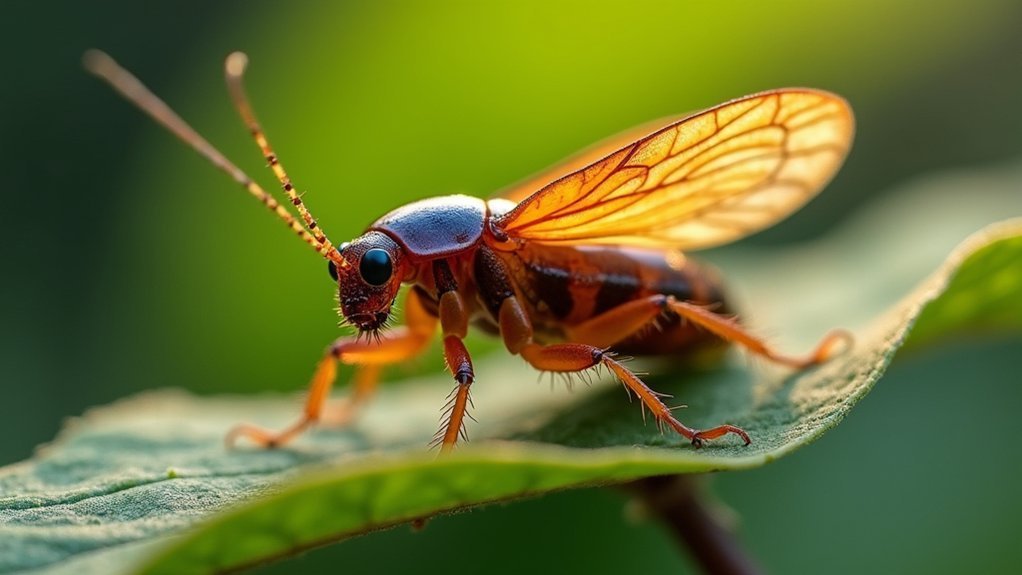
Yes, some cockroaches can fly, but you can’t assume every one you see will. Adults typically have two pairs of wings, yet wings don’t guarantee flight. Many species only glide or flutter briefly, especially when startled or dropping from higher surfaces. Nymphs can’t fly at all.
| Flight ability | Species | Behavior |
|---|---|---|
| Strong | Smokybrown, Australian, Asian | Fly readily, especially in warm conditions |
| Weak or none | German, Oriental | Germans run instead; Orientals can’t fly |
Species identification matters because wing size and flight ability differ considerably. American cockroaches fly short distances, and male brown-banded cockroaches can fly too. When they do fly, expect short, noisy, unstable flight rather than smooth travel. The household cockroaches you’re most likely to find indoors usually have wings but seldom use them for true flight. Gliding is far more common than sustained flight, so “flying cockroach” is a loose description. Warmth boosts flight activity in some species.
Where Is a Cockroach’s Brain Located?
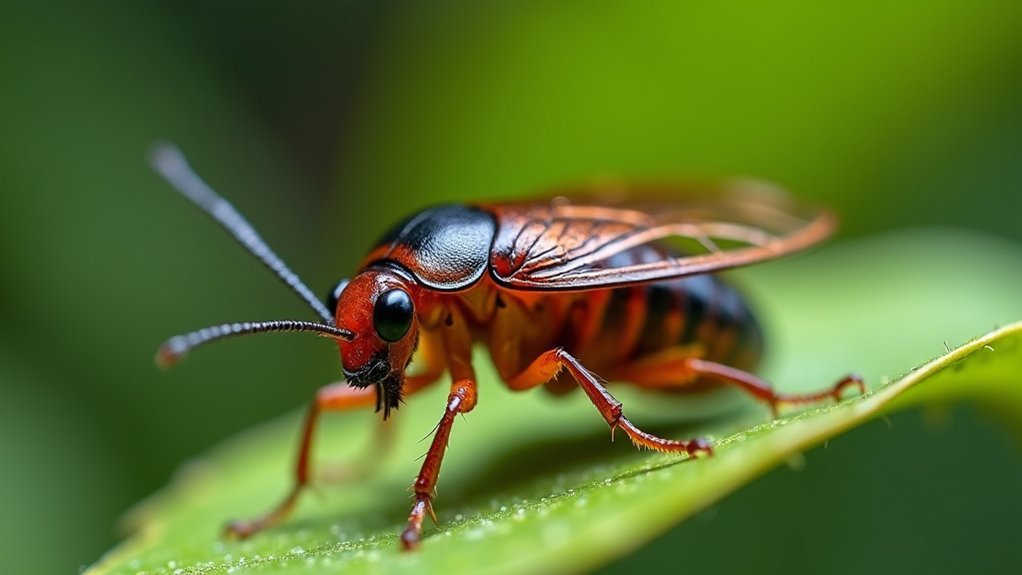
Where’s a cockroach’s brain? You’ll find it in the head, above the esophagus, as the supraesophageal ganglion. It isn’t a single compact organ like yours. It’s a paired structure of fused ganglia, protected inside the head capsule.
Picture the layout this way:
- Protocerebrum: You’ll find the central complex and mushroom bodies here, which handle navigation, motor control, and learning.
- Deutocerebrum: It receives major sensory input from the antennae.
- Tritocerebrum: It connects the brain to other nerve centers.
- Subesophageal ganglion: It sits below the esophagus, linked to the brain by short circumoesophageal connectives.
Together, the brain and subesophageal ganglion form the main head nerve centers. The nerve ring surrounds the esophagus, and neural pathways continue into the ventral nerve cord.
Your cockroach’s brain processes antenna and eye input, then coordinates responses to cues. It’s small relative to body size, but it’s highly organized, and it isn’t a vertebrate-style brain.
How Does the Nerve Cord Work?
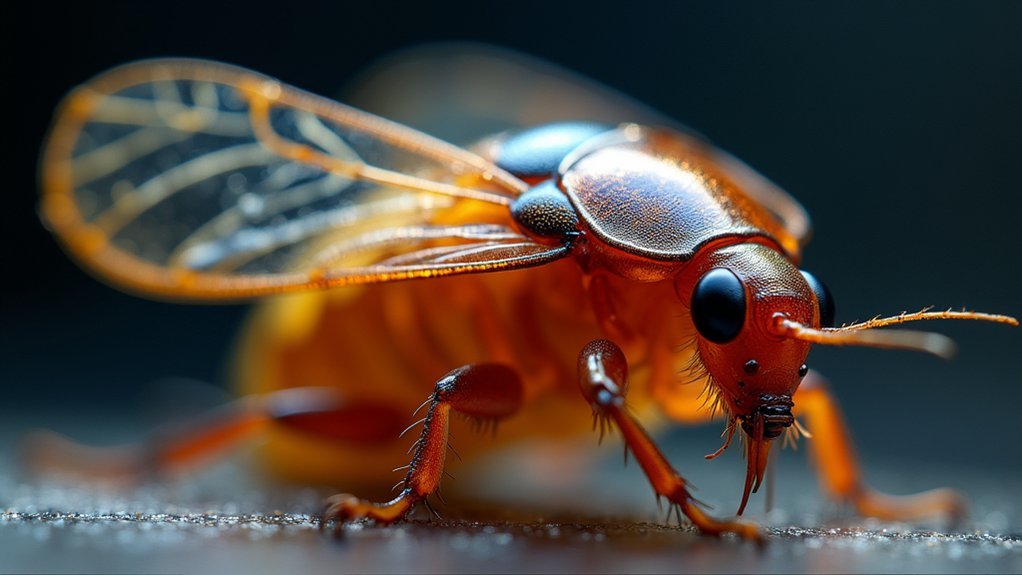
Your cockroach’s nerve cord runs along its belly as a chain of ganglia joined by paired connectives, and it works as both a relay line and a set of local processing centers. Sensory input enters through segmental nerves, and each ganglion processes it locally. That’s why thoracic ganglia can activate your cockroach’s leg motor neurons without waiting for the brain.
The escape reflex shows the whole system at work. Cercal hairs at the rear of the abdomen detect air movement from a predator and send signals into the terminal abdominal ganglion.
There, the ganglion helps determine the stimulus’s direction and velocity. Giant axons then carry fast signals forward to your cockroach’s thoracic ganglia and head, driving turning and running. Some responses travel up to the head ganglia, so the cord links the body. Noxious stimuli move through it at about 2–3 m/s. Segmental organization lets regions respond independently.
Do Cockroaches Have Blood or Hemolymph?
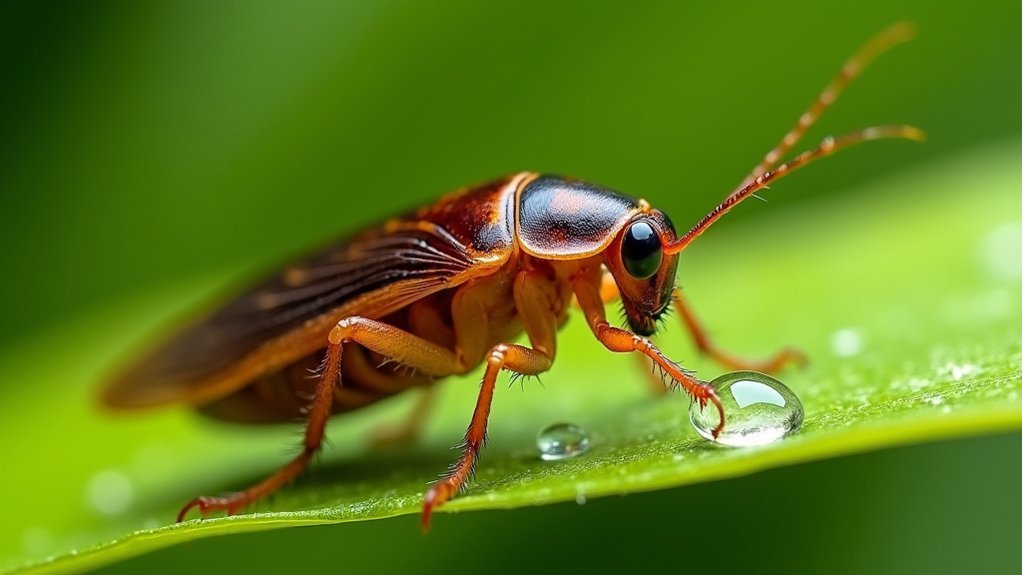
What’s flowing through your cockroach isn’t blood in the vertebrate sense. It’s hemolymph, the insect equivalent, and it’s usually clear, pale, yellowish, or whitish rather than red. Cockroaches lack hemoglobin, so you won’t see red when you crush one.
Here’s what you should know about hemolymph:
- Open circulation: Hemolymph fills the hemocoel and bathes your cockroach’s organs directly, instead of staying inside closed vessels.
- Composition: It’s about 70% water, plus hemocytes, proteins, sugars, fats, and salts.
- Functions: It distributes nutrients and hormones, delivers wastes to the Malpighian tubules, stores water, and maintains internal pressure.
- Immunity: Hemocytes defend your cockroach and help maintain its internal environment.
Hemolymph doesn’t transport oxygen like your blood does. Your cockroach’s tracheal system handles gas exchange instead, delivering air directly to tissues.
People loosely call it “blood,” but hemolymph is the more precise term. Its main jobs are transport, internal pressure maintenance, and immunity.
How Does a Cockroach’s Heart Pump Hemolymph?
Although a cockroach’s heart doesn’t look like yours, it still works as a pump. It’s part of the dorsal vessel, a muscular tube running along the middle of your cockroach’s back through the thorax and abdomen. The abdominal heart has 12 to 13 chambers, which sits in the pericardial sinus.
When the heart relaxes, hemolymph flows in through the ostia, the valve-like openings on the sides of each chamber. Alary muscles expand the sinus and help fill the heart.
Then the heart contracts in a wave, moving from back to front. The ostia close, so hemolymph can’t flow backward.
The heart pushes hemolymph into the anterior aorta, which carries it toward the head sinus. From there, hemolymph drifts back through the body’s sinuses, because you’re looking at an open circulatory system.
One study measured forward flow about every 1.5 seconds. This pump moves nutrients and wastes, not oxygen.
How Do Cockroaches Get Oxygen Without Blood?
Since hemolymph doesn’t carry oxygen, a cockroach needs another way to breathe, and it uses a tracheal system. Think of it as a network of air-filled tubes that delivers oxygen straight to tissues. Here’s how it works:
- Air enters through spiracles, valve-like openings you’d find in ten pairs: two on the thorax, eight on the abdomen.
- Oxygen travels through branching tracheae, which split into tiny tracheoles.
- Oxygen diffuses across thin tracheole walls and reaches muscles and organs directly.
- Carbon dioxide diffuses back out through the same spiracles.
Because this system bypasses the circulatory system, you won’t find blood ferrying oxygen. Cockroaches also pump their abdomens rhythmically to push air along, especially during activity.
No blood ferries oxygen here. Instead, cockroaches rhythmically pump their abdomens to push air through their tracheal tubes, especially when they’re active.
Closing spiracles helps them limit water loss in dry conditions. Fluid at the tracheole tips may help gas exchange, and muscles near the spiracles open and close the valves to regulate airflow.
Diffusion works fast.
Frequently Asked Questions
Can a Cockroach Live Without Its Head?
Yes, a cockroach can live without its head for days, sometimes a week or more. You’ll see it move because body ganglia handle reflexes, and spiracles let it breathe. Without water, dehydration eventually kills it.
Why Is Cockroach Hemolymph Often Clear, Yellowish, or White?
You won’t see red because roaches don’t have hemoglobin, so their hemolymph looks clear. You’ll also notice yellowish tints from dissolved pigments, and suspended hemocytes or proteins like vitellogenin make it look creamy or whitish.
How Long Can Cockroaches Survive Without Food or Water?
You’ll find cockroaches last about one week without water, roughly a month without food, and one to two weeks without both. Species, heat, and humidity change that, so you’re best off cutting off water first.
Do Baby Cockroaches Have Wings?
No, baby cockroaches don’t have functional wings. When you spot a tiny, wingless roach, you’re likely seeing a nymph. Some species show small wing pads, but you won’t see full wings until the final molt.
Which Cockroach Species Are Most Likely to Fly?
Smokybrown, Asian, and American cockroaches are the likeliest fliers you’ll meet. Smokybrown and Asian roaches often fly strongly toward lights, while you’ll usually see large American roaches glide when heat, humidity, or disturbance triggers them.
Conclusion
You’ve now seen how cockroaches defy expectations. They’ve got wings, though many species barely use them. They’ve got a brain in the head, plus a nerve cord that handles much of the body’s control. They don’t have blood, but they’ve got hemolymph, which a tubular heart pumps around. You’ll find that they breathe through spiracles, not blood. Next time you spot one, you’ll know exactly what’s happening inside.