
Heat Vs Chemical Treatments: Which Works Best?
If you’re battling bed bugs, you’ve likely encountered two main treatment options: heat and chemicals. While both methods can eliminate these persistent pests, they differ greatly in their approach, effectiveness, and potential drawbacks. You’ll need to weigh factors like safety, cost, and environmental impact before making your choice. Understanding how these treatments work – and where they fall short – will help you make an informed decision that saves both time and money.
Key Takeaways
- Heat treatment eliminates bed bugs in 6-8 hours with one application, while chemical treatments require multiple visits over weeks or months.
- Heat is more cost-effective at $1-$3 per square foot, compared to chemical treatments at $4-$7.50 per square foot.
- Heat treatments penetrate deep into cracks and crevices, killing both adult bed bugs and eggs without leaving harmful residues.
- Chemical treatments require evacuation and extensive preparation, while heat treatments allow occupants to stay with minimal prep work.
- Heat treatment is more environmentally friendly, producing no toxic residues, while chemical treatments pose risks to soil and air quality.
The Science Behind Bed Bug Elimination Methods
When it comes to eliminating bed bugs, understanding the science behind different treatment methods is essential for success.
These pests die when exposed to temperatures around 120°F (49°C), with adults succumbing at 48.3°C and eggs requiring higher temperatures of 54.8°C. Heat works by causing irreversible cellular damage through protein denaturation, disrupting crucial enzymatic processes across all life stages.
Chemical treatments rely on pesticides that may face resistance issues, while heat treatment penetrates deeply into cracks and crevices where bed bugs hide. Due to their nocturnal feeding habits, bed bugs often remain hidden during daylight hours, making thorough treatment crucial.
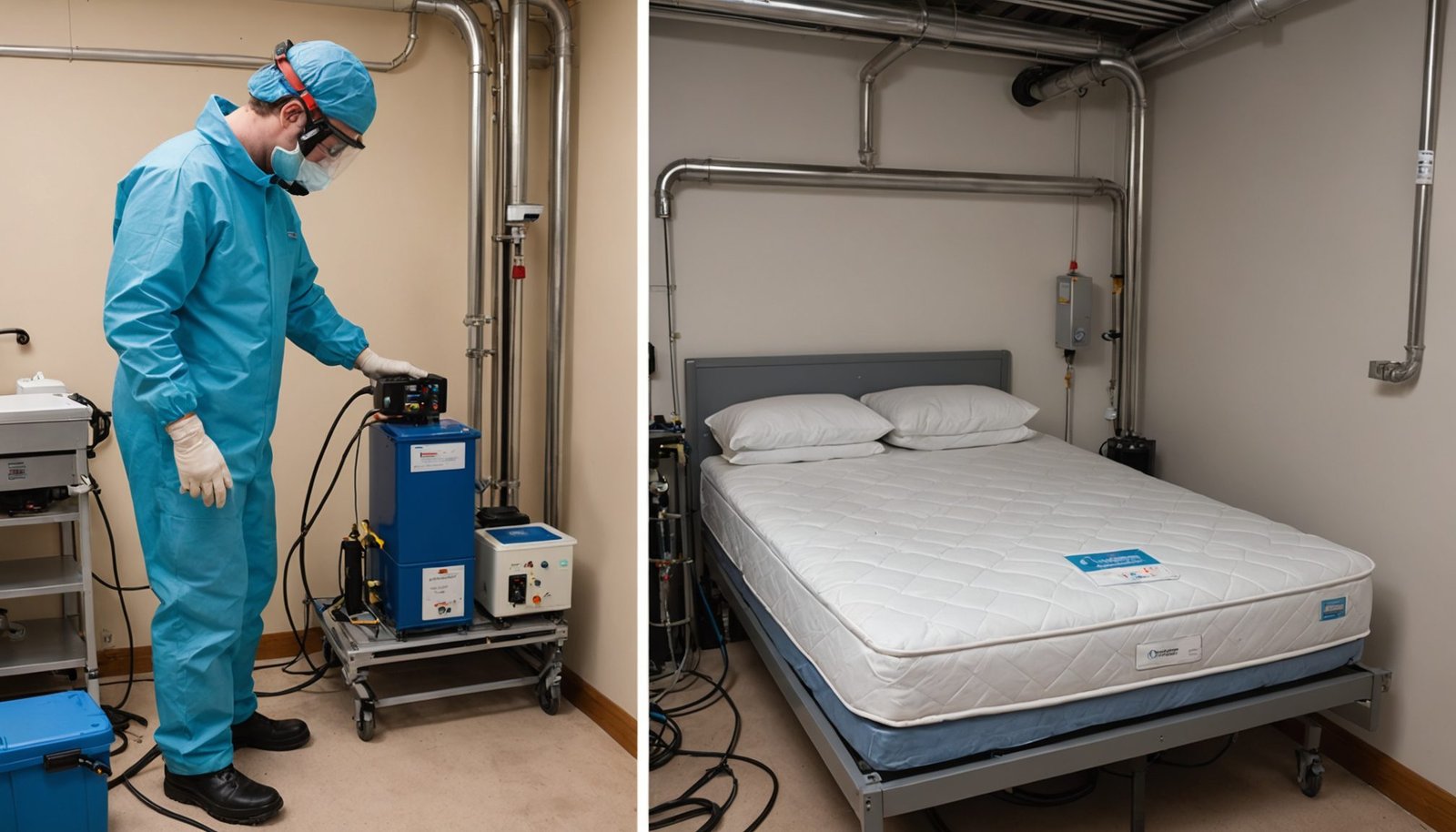
You’ll need proper heat distribution through professional equipment and fans to maintain lethal temperatures uniformly. The effectiveness of heat treatment depends on achieving and sustaining these temperatures for adequate exposure time, typically 60-120 minutes, especially in areas protected by insulating materials like mattresses.
Health and Safety Implications of Treatment Options
Although both heat and chemical treatments effectively eliminate bed bugs, each method carries distinct health and safety implications that you should carefully consider.
While professional heat treatments won’t damage your home’s structure when properly controlled, they don’t eliminate histamines from bed bug feces, which can trigger allergies and respiratory problems. The circulating hot air may actually spread histamine-containing dust throughout your home. Recent studies identify bed bug feces as a source of persistent indoor histamines.
Chemical treatments pose more direct health risks. You’ll need to be aware that pesticides can cause headaches, dizziness, respiratory issues, and nausea – even when properly applied.
These risks extend beyond applicators to hotel workers and residents who enter treated areas. If you’re choosing between methods, consider that heat treatment offers fewer toxic exposure risks but may require additional steps to address residual allergens.
Cost Analysis and Economic Considerations
Understanding the financial aspects of bed bug treatments reveals significant cost variations between heat and chemical methods. You’ll typically spend $1-$3 per square foot for heat treatment, while chemical applications range from $4-$7.50 per square foot. Though heat treatment has higher upfront costs, it often proves more economical long-term due to its single-treatment effectiveness. Professional inspections ranging from $65 to $200 can help determine the best treatment approach.
| Cost Factor | Heat Treatment | Chemical Treatment |
|---|---|---|
| Price/sq ft | $1-$3 | $4-$7.50 |
| Typical home cost | $2,000-$6,000 | $2,000-$4,500 |
| Repeat treatments | Rarely needed | Often required |
| Prep costs | Minimal | Extensive |
| Additional expenses | None | Laundering/cleaning |
While chemical treatments might seem cheaper initially, you’ll need to factor in potential repeat applications, preparation expenses, and additional cleaning costs. Heat treatment’s one-time application and minimal prep requirements can make it the more cost-effective choice overall.
Time Requirements and Convenience Factors
Since time management plays an essential role in pest control decisions, you’ll find significant differences between heat and chemical treatments. Heat treatments typically require just one day for complete elimination, while chemical approaches often extend over weeks or months with multiple applications.
- Heat treatments take 6-8 hours from setup to completion, requiring moderate preparation like removing heat-sensitive items and decluttering.
- Chemical treatments demand extensive prep work, including bagging clothes, moving furniture, and temporary evacuation for several days.
- You can usually stay in your space during heat treatment, but chemical applications require you to vacate the premises.
While heat treatment offers quicker resolution, it’s less convenient for targeted spots. The effectiveness of heat treatment significantly increases when materials contain adequate moisture content, making it particularly efficient for certain applications.
Chemical treatments allow for more focused applications but extend overall disruption due to multiple visits and longer waiting periods.
Environmental Impact and Long-term Effects

When comparing environmental impacts, heat treatments emerge as the more eco-friendly choice over chemical alternatives.
While they do generate carbon emissions from fuel use, heat treatments don’t leave harmful chemical residues in the environment. Heat treatment involves raising wood temperature to 56°C for 30 minutes. You’ll find they’re safer for soil, water, and indoor air quality.
Heat treatments produce fewer environmental hazards than chemical options, protecting soil and water while maintaining safer indoor air conditions.
Chemical treatments pose significant environmental risks through persistent residues that can bioaccumulate and contaminate ecosystems. They also release VOCs and toxic gases, requiring strict regulatory oversight to prevent accidents.
Regarding long-term effects, you’ll benefit from heat-treated materials’ extended lifespan and improved rot resistance. They’re also more sustainable since they won’t interfere with future recycling efforts.
Unlike chemical treatments that may degrade materials over time, heat treatments enhance durability without leaving lasting chemical footprints.
Conclusion
You’ll find heat treatments are the smarter choice for eliminating bed bugs. Not only will you avoid harmful chemical exposure, but you’ll save money in the long run with a single, effective treatment. While the initial prep time might seem intimidating, your investment pays off with faster results and better peace of mind. Plus, you’re making an eco-friendly choice that won’t harm your indoor environment.
