
Heat Vs Chemical Treatments: Which Works Best?
Heat treatment eliminates cockroaches and bed bugs in a single application by raising interior temperatures to lethal levels across all life stages, while chemical treatments use insecticides applied to surfaces, cracks, and voids over multiple visits. Heat works faster and leaves no residue, but chemical treatments cost less upfront, allow targeted application, and remain the standard approach for most cockroach infestations.
Key Takeaways
Both methods work when applied correctly. The right choice depends on pest species, infestation severity, budget, and how quickly you need results.
- Heat treatment kills cockroaches, bed bugs, and eggs in one application without leaving chemical residues on surfaces or in the air.
- Chemical treatments cost less upfront but often require multiple visits over weeks or months to achieve full control.
- Heat penetrates deep into walls, furniture, and cracks where insects hide and chemicals cannot always reach.
- Chemical treatments allow targeted spot applications and are more practical for most cockroach infestations than whole-structure heat.
- Heat is more eco-friendly with no toxic runoff or persistent residues, but generates carbon emissions from fuel use during the process.
How Each Method Works
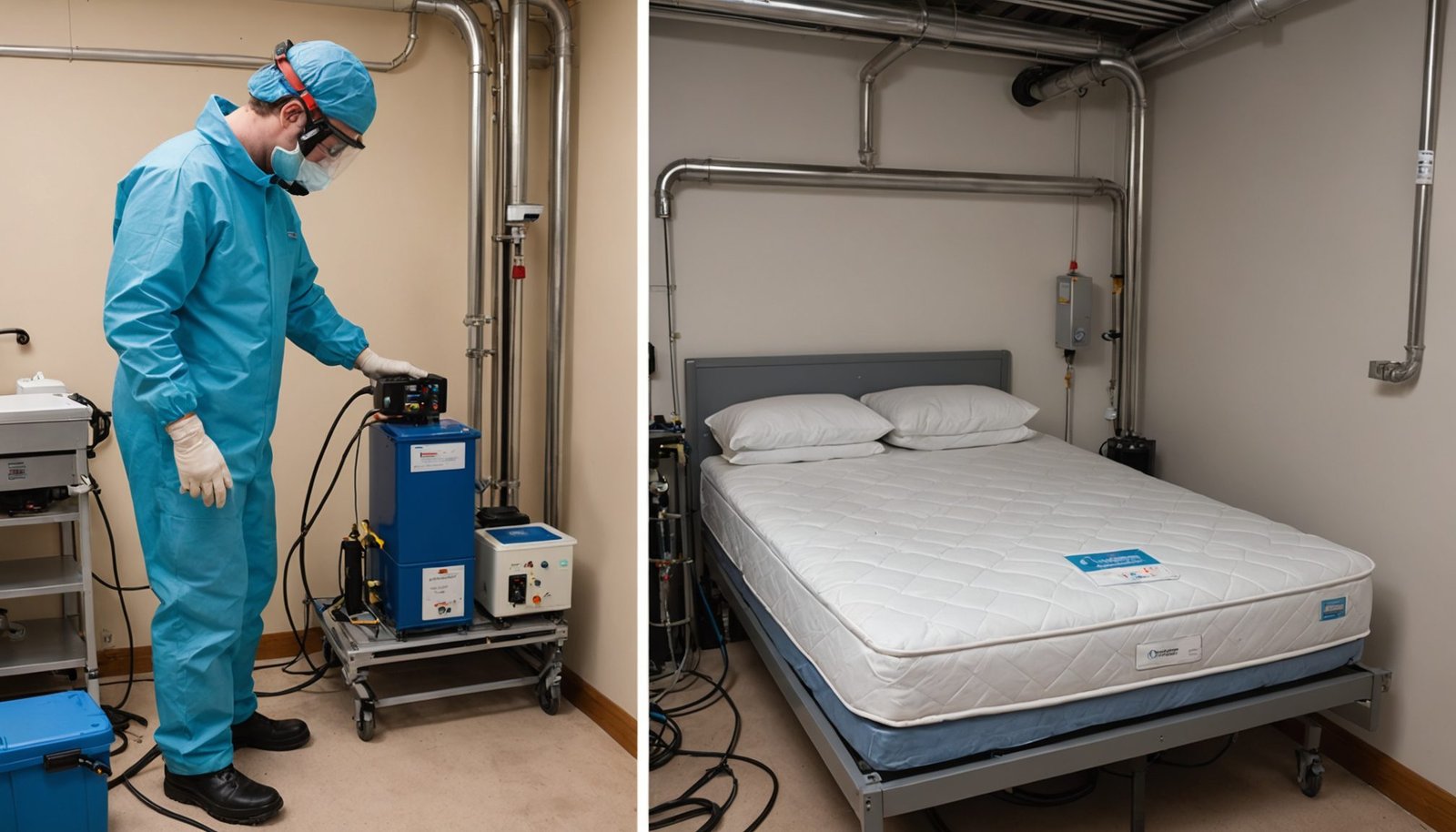
Understanding the mechanism behind each treatment type helps explain why they perform differently across pest species, infestation sizes, and structural environments.
Heat treatment raises the temperature of the entire structure or a sealed room to levels lethal to insects and their eggs. Professional equipment including industrial heaters and high-powered fans circulates hot air uniformly throughout the space, including inside wall voids, beneath floors, inside furniture, and deep into cracks and crevices that spray applications cannot penetrate. The target temperature for cockroach and bed bug elimination is around 120 to 140 degrees Fahrenheit sustained for 60 to 90 minutes to ensure exposure reaches insects sheltering in insulating materials like mattresses, baseboards, and wall cavities.
How Heat Kills Insects
Heat works through protein denaturation, a process that causes irreversible cellular damage across all life stages simultaneously. Adult cockroaches, nymphs, and eggs all die when exposed to sustained lethal temperatures. This is the primary advantage of thermal treatment: it does not leave any life stage unaffected the way that contact-only chemical applications sometimes do.
- Adults die at temperatures above 118 degrees Fahrenheit with sustained exposure
- Eggs require slightly higher temperatures, around 130 to 140 degrees, to reach the embryonic tissue inside the shell
- The process takes 6 to 8 hours from setup to completion including heat-up and cool-down time
- Uniform heat distribution requires professional equipment and careful monitoring of temperature across all zones
How Chemical Treatments Work
Chemical pest control uses insecticides applied as sprays, dusts, gels, or bait stations to surfaces, cracks, and void areas where cockroaches travel and harbor. The active ingredients work through contact kill, ingestion, or both, depending on the product. Residual sprays maintain effectiveness on treated surfaces for weeks. Gel baits work through delayed ingestion and transfer kill as poisoned insects return to the colony and share the toxin through feces and body contact.
Professional cockroach extermination methods typically combine multiple chemical tools in a layered approach: gel baits in harborages, crack-and-crevice residual sprays along travel routes, desiccant dusts in wall voids, and insect growth regulators to disrupt reproduction across multiple generations. This multi-tool strategy is what makes chemical treatment effective against cockroach infestations that heat treatment would eliminate in a single application.
Heat vs Chemical Effectiveness by Pest Type
The most important factor in choosing between heat and chemical treatment is the pest you are targeting. These two methods are not equally suited to every infestation type.
For bed bugs, heat treatment is widely considered the most reliable single-application solution available. Bed bugs are notorious for hiding in electronics, furniture seams, wall gaps, and clothing in ways that make complete chemical coverage extremely difficult. A single properly executed heat treatment reaches all of these areas simultaneously. Chemical treatments for bed bugs require multiple visits over weeks or months and are more likely to leave survivor populations in areas the chemical did not penetrate.
Heat and Chemical Treatment for Cockroaches
For cockroach infestations, the comparison is more nuanced. Whole-structure heat treatment works for cockroaches but is rarely the most practical or cost-effective approach because cockroach infestations are typically concentrated in specific harborage zones like kitchen cabinets, under sinks, behind appliances, and in wall voids near moisture sources rather than spread uniformly throughout an entire structure.
Chemical treatment using gel baits, IGRs, and targeted residual applications is the standard professional approach for cockroach control because it can be precisely directed at the specific areas where cockroaches actually live and breed. The best baits, gels, and traps for cockroach control deliver targeted colony-level knockdown that heat cannot replicate in terms of cost and operational simplicity for most residential infestations.
Heat treatment becomes more relevant for cockroach control in situations where chemical resistance has developed in the local population, where the infestation has spread through an entire structure including wall voids and subfloor spaces, or where chemical exposure is a serious concern due to occupant health conditions.
Health and Safety Comparison
Safety profiles differ significantly between heat and chemical treatment, and the right choice depends on who lives in the house and what health sensitivities are present.
Heat treatment does not leave chemical residues on surfaces, in the air, or on furniture and clothing after the process completes. Occupants can return once temperatures normalize, typically within a few hours after treatment ends. The main health consideration with heat treatment is that it does not eliminate histamines from cockroach or bed bug feces that have settled into surfaces and fabrics. The circulating hot air can actually spread histamine-containing dust throughout the home during treatment, which matters for people with cockroach-related asthma or severe allergies.
Chemical Treatment Safety Considerations
Chemical treatments carry more direct exposure risks during and immediately after application. Synthetic insecticides can cause headaches, dizziness, respiratory irritation, and nausea even when applied correctly by a licensed technician. These risks affect not only the applicator but homeowners, children, and pets who reenter treated areas before residues dry and off-gassing subsides.
- Most chemical treatments require occupants to vacate for 2 to 4 hours after spray applications
- Gel baits pose significantly lower exposure risk than spray applications and can be applied without evacuation in most cases
- Pets should be removed before chemical applications and reintroduced only after surfaces are fully dry
- People with asthma, respiratory conditions, or chemical sensitivities should request gel-only or low-toxicity treatment programs
- Food surfaces, dishes, and pet bowls should be covered or removed before any spray treatment
For households with young children, pets, or occupants with respiratory problems, a gel bait and IGR approach carries the lowest risk profile of all chemical options while still delivering effective cockroach control. Natural extermination methods like diatomaceous earth and boric acid are also worth considering as complements to either approach in sensitive environments.
Cost Analysis: Heat vs Chemical Treatment
Cost is one of the most common decision factors homeowners use when comparing these two treatment types, and the numbers look different depending on whether you are calculating upfront cost or total cost across the full treatment cycle.
| Cost Factor | Heat Treatment | Chemical Treatment |
|---|---|---|
| Price per sq ft | $1 to $3 | $4 to $7.50 |
| Typical home cost | $2,000 to $6,000 | $2,000 to $4,500 |
| Repeat treatments | Rarely needed | Often required |
| Preparation costs | Minimal | Extensive |
| Additional expenses | None | Laundering and cleaning |
Heat treatment has a higher single-session cost but rarely requires repeat visits. Chemical treatment has a lower entry cost per visit but typically requires multiple applications over weeks or months, and each visit adds preparation time, disruption, and expense. For bed bug infestations specifically, heat often proves more economical over the full treatment duration. For cockroach infestations, chemical programs with professional follow-ups are almost always the more cost-effective path.
When Heat Treatment Justifies the Cost
Heat treatment is worth the higher upfront investment in specific situations.
- Bed bug infestations that have spread to furniture, electronics, and clothing throughout multiple rooms
- Cockroach infestations where chemical resistance has made spray and gel programs ineffective after multiple rounds
- Properties where chemical exposure is not acceptable due to occupant health conditions
- Commercial properties like hotels, restaurants, and multi-unit buildings where rapid one-day resolution is essential to minimize operational disruption
- Situations where the infestation has penetrated wall voids and subfloor areas beyond the reach of targeted chemical application
Professional cockroach extermination costs vary significantly by method, infestation size, and region. Getting a professional inspection before deciding between heat and chemical is the most reliable way to match the treatment type to the actual problem rather than defaulting to the cheaper option upfront.
Time Requirements and Preparation
The time investment required from homeowners differs substantially between heat and chemical treatment, and this practical factor influences many final decisions independently of cost.
Heat treatment takes 6 to 8 hours from setup to completion in a single day. Preparation is relatively minimal: remove heat-sensitive items including candles, certain medications, aerosol cans, plants, and pets before the technician arrives. Electronics and most furniture can stay in place. Occupants typically return the same day once temperatures have normalized.
Chemical treatment preparation is significantly more involved and disruptive. Depending on the products used, preparation may include bagging clothes, moving furniture away from walls and baseboards, clearing kitchen cabinets, removing food from counters, covering or removing pet food and water bowls, and vacating the premises for several hours to days.
How Preparation Affects Treatment Results
The thoroughness of preparation directly affects treatment effectiveness for both methods. For heat treatment, items left in treated areas must reach lethal temperature throughout, which means overcrowding or blocking airflow can create cold spots where insects survive. For chemical treatment, areas left cluttered or inaccessible prevent the technician from reaching harborages where cockroaches actually live.
- Pull appliances away from walls before chemical treatment to expose harborage zones behind them
- Clear cabinet interiors so technicians can access cracks along shelves and back walls
- Remove pets and their food bowls for any spray-based chemical application
- For heat treatment, ensure all rooms are accessible and airflow is unobstructed
- Do not clean treated surfaces for several days after chemical application to preserve residual effectiveness
Environmental Impact and Long-Term Effects

Heat treatment produces no toxic residues in soil, water, or indoor air after the process completes. The environmental footprint is limited to the carbon emissions from fuel used to power heating equipment during the treatment itself. Treated materials are not contaminated and require no special handling or disposal.
Chemical treatments carry more significant environmental risks. Persistent residues from synthetic insecticides can accumulate on surfaces, enter drain systems during cleaning, and affect soil and water quality over time with repeated applications. Volatile organic compounds released during spray application affect indoor air quality for days after treatment. These risks are reduced significantly when chemical programs use gel baits and desiccant dusts rather than broad-spectrum sprays, which is why modern professional cockroach control has shifted toward bait-primary approaches.
Resistance and Long-Term Pest Control Sustainability
Chemical treatments carry an inherent long-term risk that heat does not: resistance development. Cockroach populations exposed repeatedly to the same insecticide active ingredients develop genetic resistance within a few generations, eventually producing colonies that survive standard application rates. Cockroaches are so hard to kill in part because of how rapidly this adaptation occurs in German cockroach populations specifically.
Heat treatment does not create resistance because it kills through a physical thermal process rather than chemistry. No genetic adaptation makes an insect immune to protein denaturation at sustained high temperatures. This makes heat a reliable option even in situations where chemical programs have failed due to resistance, and it explains why pest control professionals sometimes recommend heat as a reset treatment before resuming a chemical maintenance program.
Which Treatment Is Right for Your Situation
The choice between heat and chemical treatment is not universal. It depends on the pest, the severity of the infestation, the structure of the property, the health needs of the occupants, and the budget available.
Chemical treatment is the right starting point for the vast majority of cockroach infestations. A professional program using gel baits, IGRs, and targeted residual applications costs less, causes less disruption, and delivers effective results in the hands of a qualified technician. Cockroach treatment timelines for chemical programs show measurable results within the first week and full colony collapse in 2 to 8 weeks for most infestations.
Heat treatment is the better choice for bed bug infestations involving widespread penetration into furniture and electronics, for cockroach infestations where chemical resistance has been confirmed, and for any situation where chemical exposure is not acceptable. It is also worth considering for commercial properties where a single-day resolution is operationally essential.
- Cockroach infestation, light to moderate: chemical treatment with gel bait and IGR
- Cockroach infestation, severe or chemical-resistant: heat treatment or fumigation followed by chemical maintenance
- Bed bug infestation, localized: chemical treatment with mattress encasements and crack-and-crevice spray
- Bed bug infestation, widespread: heat treatment as the primary and often only necessary application
- Mixed infestation or uncertain severity: professional inspection before committing to either method
DIY versus professional extermination is a separate decision that applies within each treatment category. Both heat and chemical programs can theoretically be attempted as DIY, but heat treatment in particular requires professional equipment and monitoring to achieve and sustain lethal temperatures uniformly throughout a structure. DIY heat attempts using consumer-grade heaters consistently underperform because they cannot maintain uniform temperature distribution across insulated zones, furniture interiors, and wall voids where insects survive.
Frequently Asked Questions
Can Heat Treatment Damage My Home or Belongings?
Professionally executed heat treatment should not damage your home’s structure when temperatures are properly controlled and ramped up gradually. Items that can be damaged by heat include candles, certain medications, aerosol cans, vinyl records, some plastics, musical instruments, and fine art. Plants and pets must be removed. Electronics, furniture, clothing, and most household items are safe at the temperatures used for pest control. Your technician should provide a full preparation list before the treatment date.
Does Heat Treatment Kill Cockroach Eggs?
Yes. Heat treatment is one of the few methods that reliably kills cockroach eggs inside their protective cases. Chemical sprays and most surface-applied treatments cannot penetrate the egg case to reach the embryo. Heat achieves lethal temperatures throughout the egg structure when sustained at 130 degrees Fahrenheit or above for the required exposure duration. This is a meaningful advantage in heavy infestations where egg cases are hidden inside wall voids, beneath floors, and deep inside cabinet structures.
How Many Chemical Treatment Visits Does a Cockroach Infestation Require?
Most moderate cockroach infestations require an initial treatment plus 1 to 3 follow-up visits spaced 2 to 4 weeks apart. Light infestations sometimes resolve after a single visit with good sanitation support from the homeowner. Heavy infestations with established colonies in wall voids may require monthly visits for 3 to 4 months before consistent control is achieved. Each follow-up visit includes inspection, trap monitoring, bait reapplication, and product rotation to prevent resistance development.
Is Heat or Chemical Treatment Better for Multi-Unit Buildings?
Multi-unit buildings present unique challenges for both methods. Heat treatment requires whole-unit access and is difficult to coordinate across multiple tenants simultaneously. Chemical treatment with a coordinated building-wide program is more practical for ongoing control in apartments and condos, but individual unit treatments are consistently undermined by reinfestation from untreated neighboring units. Cockroach control in multi-unit buildings works best with a property-wide chemical IPM program that treats all units on a synchronized schedule rather than responding unit-by-unit to reported activity.
What Should I Do to Prevent Reinfestation After Treatment?
Seal cracks along baseboards, around pipe penetrations, and inside cabinet backs to block entry points. Fix moisture sources under sinks and in bathrooms. Store all food in sealed containers and remove food debris from surfaces nightly. Keep sticky monitoring traps in active zones after treatment to catch any surviving or newly arriving cockroaches early. Stopping cockroaches from coming back after either heat or chemical treatment depends on maintaining these sanitation and exclusion practices as a permanent habit rather than a one-time response to the infestation.
{
“@context”: “https://schema.org”,
“@type”: “FAQPage”,
“mainEntity”: [
{
“@type”: “Question”,
“name”: “Can Heat Treatment Damage My Home or Belongings?”,
“acceptedAnswer”: {
“@type”: “Answer”,
“text”: “Professionally executed heat treatment should not damage your home’s structure when temperatures are properly controlled and ramped up gradually. Items that can be damaged by heat include candles, certain medications, aerosol cans, vinyl records, some plastics, musical instruments, and fine art. Plants and pets must be removed. Electronics, furniture, clothing, and most household items are safe at the temperatures used for pest control. Your technician should provide a full preparation list before the treatment date.”
}
},
{
“@type”: “Question”,
“name”: “Does Heat Treatment Kill Cockroach Eggs?”,
“acceptedAnswer”: {
“@type”: “Answer”,
“text”: “Yes. Heat treatment is one of the few methods that reliably kills cockroach eggs inside their protective cases. Chemical sprays and most surface-applied treatments cannot penetrate the egg case to reach the embryo. Heat achieves lethal temperatures throughout the egg structure when sustained at 130 degrees Fahrenheit or above for the required exposure duration. This is a meaningful advantage in heavy infestations where egg cases are hidden inside wall voids, beneath floors, and deep inside cabinet structures.”
}
},
{
“@type”: “Question”,
“name”: “How Many Chemical Treatment Visits Does a Cockroach Infestation Require?”,
“acceptedAnswer”: {
“@type”: “Answer”,
“text”: “Most moderate cockroach infestations require an initial treatment plus 1 to 3 follow-up visits spaced 2 to 4 weeks apart. Light infestations sometimes resolve after a single visit with good sanitation support from the homeowner. Heavy infestations with established colonies in wall voids may require monthly visits for 3 to 4 months before consistent control is achieved. Each follow-up visit includes inspection, trap monitoring, bait reapplication, and product rotation to prevent resistance development.”
}
},
{
“@type”: “Question”,
“name”: “Is Heat or Chemical Treatment Better for Multi-Unit Buildings?”,
“acceptedAnswer”: {
“@type”: “Answer”,
“text”: “Multi-unit buildings present unique challenges for both methods. Heat treatment requires whole-unit access and is difficult to coordinate across multiple tenants simultaneously. Chemical treatment with a coordinated building-wide program is more practical for ongoing control in apartments and condos, but individual unit treatments are consistently undermined by reinfestation from untreated neighboring units. Cockroach control in multi-unit buildings works best with a property-wide chemical IPM program that treats all units on a synchronized schedule rather than responding unit-by-unit to reported activity.”
}
},
{
“@type”: “Question”,
“name”: “What Should I Do to Prevent Reinfestation After Treatment?”,
“acceptedAnswer”: {
“@type”: “Answer”,
“text”: “Seal cracks along baseboards, around pipe penetrations, and inside cabinet backs to block entry points. Fix moisture sources under sinks and in bathrooms. Store all food in sealed containers and remove food debris from surfaces nightly. Keep sticky monitoring traps in active zones after treatment to catch any surviving or newly arriving cockroaches early. Stopping cockroaches from coming back after either heat or chemical treatment depends on maintaining these sanitation and exclusion practices as a permanent habit rather than a one-time response to the infestation.”
}
}
]
}
