
How to Prevent Cockroaches Naturally: Methods That Actually Work
Natural cockroach prevention is not about finding one magic ingredient. It is about removing every reason a cockroach would want to enter your home in the first place, and then making it harder for the few that try anyway to survive.
The internet is full of natural remedies that promise to repel or kill cockroaches. Some of them genuinely work. Many do not, despite being shared widely. This guide separates the two, covers the methods that are backed by real evidence, and explains exactly how to use each one effectively.
Before focusing on prevention, it helps to understand which species you are most likely to be dealing with. Different cockroach species are attracted by different conditions, and the right prevention strategy depends on the type. See our guide to types of cockroaches in homes to confirm what you are up against.
Already seeing cockroaches inside?Prevention alone will not solve an active infestation. Our removal guide covers what to do when they are already in.
Why Natural Prevention Is Worth Doing
Cockroaches need three things to survive inside a home: food, water, and shelter. Remove reliable access to any one of these and cockroaches become far less likely to establish themselves. Remove all three consistently and most species will not stay.
Natural prevention methods work with this biology rather than relying on chemical barriers that degrade over time and require repeated reapplication. They are also safer for households with children, pets, or people with respiratory conditions, where chemical sprays may cause their own problems.
That said, natural methods work best as prevention or for managing very early-stage activity. Once cockroaches have established harborage areas inside walls or large appliances, natural approaches alone are rarely sufficient to eliminate them. The EPA’s Integrated Pest Management approach recommends using sanitation and exclusion as the foundation of any control strategy, with targeted treatments added only when needed.
Natural Methods That Work: What to Use and How
1. Eliminate Food and Water Access
This is the single most powerful natural cockroach prevention step available. Cockroaches can survive weeks without food but only a few days without water. Cut off both and your home becomes far less hospitable regardless of what else is present.
- Store all food, including pet food and dry goods, in sealed airtight containers
- Wipe down counters, stovetops, and the inside of the microwave after every use
- Wash dishes immediately after meals; never leave them in the sink overnight
- Fix all dripping taps, slow-draining sinks, and leaky pipes as soon as they appear
- Dry sinks and pet water bowls before bed each night
- Empty indoor bins daily and use bins with tight-fitting lids at all times
- Remove grease buildup from the sides and back of the stovetop regularly
2. Seal Entry Points and Remove Harborage
Cockroaches can enter through gaps as narrow as 1.6mm. German cockroaches are frequently introduced inside cardboard grocery bags, secondhand appliances, and furniture rather than crawling through cracks, but American and Oriental cockroaches typically enter through structural gaps around plumbing and foundations.
- Caulk gaps around baseboards, where pipes enter walls, and behind kitchen units
- Install door sweeps on all exterior-facing doors, including garage doors
- Cover floor drains and utility vents with fine mesh screens
- Remove cardboard boxes from kitchen and storage areas; use plastic bins instead
- Clear clutter from under sinks, in corners, and inside cabinets where cockroaches hide
- Inspect secondhand furniture, appliances, and grocery bags before bringing them inside
3. Diatomaceous Earth
Food-grade diatomaceous earth (DE) is a fine powder made from fossilised algae. It works mechanically rather than chemically, damaging the waxy outer coating of a cockroach’s exoskeleton and causing it to dehydrate. It is one of the most genuinely effective natural options available.
Apply a very thin, barely visible layer along baseboards, behind appliances, inside cabinet bases, and in any other dry, hidden areas where cockroaches travel. A thick layer is counterproductive because cockroaches will avoid walking through it. The powder must stay dry to remain effective; reapply after any cleaning or exposure to moisture.
Use food-grade DE only, wear a dust mask during application, and keep it away from areas where children or pets might inhale it directly. It is non-toxic once settled but the fine particles can irritate airways if inhaled during application.
4. Boric Acid Bait
Boric acid is a naturally occurring compound that disrupts a cockroach’s digestive system and damages its nervous system on contact. It is one of the oldest and most studied natural cockroach control methods and remains highly effective when applied correctly.
For a simple natural bait, mix equal parts boric acid, plain flour, and sugar. The sugar attracts the cockroach, the flour provides a binder, and the boric acid does the work. Apply small amounts inside cabinet hinges, behind appliances, and along the edges of wall voids where cockroaches travel.
5. Baking Soda and Sugar Trap
A mixture of equal parts baking soda and sugar attracts cockroaches with the sugar and kills those that ingest the baking soda, which causes fatal gas buildup in their digestive systems. This is a simple, genuinely functional method for managing early-stage activity or monitoring problem areas.
Sprinkle lightly in corners, along the backs of cabinet shelves, and under sinks. Replace weekly and after any moisture exposure. This method works on cockroaches that eat it but does not affect egg casings or cockroaches that do not encounter the mixture, so it is most useful as a supplementary trap rather than a standalone solution.
6. Essential Oils as Repellents
Peppermint oil, eucalyptus oil, and tea tree oil all contain compounds that cockroaches find unpleasant. When applied to entry points and areas of activity, they can deter cockroaches from crossing treated areas for a short period.
Mix 15 to 20 drops of peppermint or eucalyptus oil with water in a spray bottle and apply along baseboards, around drain openings, and inside cabinet bases. Reapply every two to three days to maintain effectiveness.
Be clear about what essential oils can and cannot do. They may push cockroaches away from one area, but the cockroaches will simply move to another part of the home. Essential oils do not eliminate an infestation and should be used alongside structural prevention, not instead of it.
Natural Remedies That Do Not Work
Many popular natural cockroach remedies get passed around as fact but have little to no supporting evidence. Using them gives a false sense of security while the infestation continues to grow. These are the most common ones to avoid relying on.

Does not repel or kill cockroaches. It can help remove food odors and grease during cleaning, which is indirectly helpful, but cockroaches are not deterred by its smell.
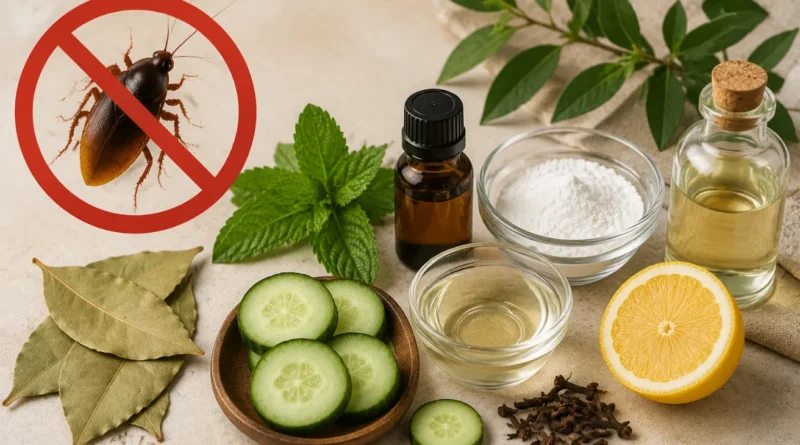
A widely repeated myth. There is no scientific evidence that bay leaves repel cockroaches. Cockroaches that feed on animal waste and decaying matter are unlikely to be bothered by the scent of a kitchen herb.
The idea that cockroaches are repelled by cucumber has no basis in evidence. Leaving cucumber peels out is more likely to attract cockroaches as a food source than to push them away.
Some lab studies showed cockroaches avoiding nepetalactone, the active compound in catnip. In real-world home conditions it has no reliable effect and is not a practical prevention method.
The theory is that cockroaches dislike limonene in citrus. In practice, citrus peels left out in corners will decompose and become a food source long before deterring anything.
Can suffocate individual cockroaches on contact by blocking their breathing pores. Requires direct application to a live cockroach and has no residual effect whatsoever.
Natural Prevention Methods at a Glance
| Method | Effect | Best Use | Verdict |
|---|---|---|---|
| Sanitation and moisture control | Removes attractants | Ongoing daily habit | Works |
| Sealing and exclusion | Blocks entry and harborage | One-time + annual recheck | Works |
| Diatomaceous earth | Kills on contact | Hidden, dry locations | Works |
| Boric acid bait | Kills on ingestion | Concealed harborage areas | Works |
| Baking soda and sugar | Kills on ingestion | Early activity monitoring | Partial |
| Essential oils | Short-term deterrent | Entry points, temporary | Partial |
| Bay leaves / vinegar / citrus | No meaningful effect | Not recommended | Myth |
Why Prevention Matters Beyond the Nuisance
Cockroaches are not just unpleasant. They carry bacteria on their bodies and legs, contaminate food preparation surfaces, and shed skin and produce droppings that are among the most documented indoor asthma triggers in the United States.
According to the CDC, cockroach allergens are a major contributor to asthma attacks in children, particularly in urban environments. Preventing an infestation from taking hold in the first place is far better for household health than dealing with one after the fact.
Read more about the specific risks each species poses in our article on health risks from cockroach species. Not all cockroaches present equal danger, and knowing which species is present helps prioritise the right prevention approach.
When Natural Prevention Is Not Enough
Natural methods are most effective as prevention or for dealing with early-stage, isolated activity. Once cockroaches have established harborage areas inside walls, behind large appliances, or across multiple rooms, the infestation has usually grown beyond what natural methods alone can resolve.
Signs that you need to move beyond natural prevention include daytime sightings in multiple rooms, visible egg casings in more than one location, or a musty odor that has become noticeable in enclosed spaces. In these cases, targeted treatment is needed before natural prevention can become effective again.
Our cockroach identification guide can help confirm what species is present, and our overview of professional treatment options covers what is available when the situation has moved past DIY territory.
What is the most effective natural way to prevent cockroaches?
Eliminating food and water access is the single most powerful step. Store food in airtight containers, fix leaking taps, dry sinks before bed, and empty bins daily. Cockroaches can survive weeks without food but only a few days without water, so cutting off moisture is especially effective.
Does diatomaceous earth really work against cockroaches?
Yes. Food-grade diatomaceous earth is one of the most genuinely effective natural options. It works mechanically by damaging the waxy coating on a cockroach’s exoskeleton, causing dehydration. Apply a very thin, barely visible layer in dry, hidden areas. A thick layer is counterproductive as cockroaches will simply avoid walking through it.
Do bay leaves, vinegar, or citrus peels repel cockroaches?
No, these are widely repeated myths. There is no scientific evidence that bay leaves or citrus peels repel cockroaches. White vinegar does not repel or kill them either, though it can help remove food odors during cleaning. Relying on these remedies gives a false sense of security while an infestation continues to grow.
When should I stop relying on natural methods alone?
Natural methods work best for prevention or very early-stage activity. If you are seeing cockroaches during the day in multiple rooms, spotting egg casings in more than one location, or noticing a musty odor in enclosed spaces, the infestation has likely grown beyond what natural methods alone can resolve.
Are essential oils effective for keeping cockroaches away?
Only as a short-term deterrent. Peppermint and eucalyptus oil contain compounds cockroaches find unpleasant and can deter them from crossing treated areas briefly. However, they do not eliminate an infestation as cockroaches will simply move to another part of the home. Reapplication every 2 to 3 days is needed, and essential oils should always be used alongside structural prevention methods, not as a replacement for them.
{
“@context”: “https://schema.org”,
“@type”: “FAQPage”,
“mainEntity”: [
{
“@type”: “Question”,
“name”: “What is the most effective natural way to prevent cockroaches?”,
“acceptedAnswer”: {
“@type”: “Answer”,
“text”: “Eliminating food and water access is the single most powerful step. Store food in airtight containers, fix leaking taps, dry sinks before bed, and empty bins daily. Cockroaches can survive weeks without food but only a few days without water, so cutting off moisture is especially effective.”
}
},
{
“@type”: “Question”,
“name”: “Does diatomaceous earth really work against cockroaches?”,
“acceptedAnswer”: {
“@type”: “Answer”,
“text”: “Yes. Food-grade diatomaceous earth is one of the most genuinely effective natural options. It works mechanically by damaging the waxy coating on a cockroach’s exoskeleton, causing dehydration. Apply a very thin, barely visible layer in dry, hidden areas. A thick layer is counterproductive as cockroaches will simply avoid walking through it.”
}
},
{
“@type”: “Question”,
“name”: “Do bay leaves, vinegar, or citrus peels repel cockroaches?”,
“acceptedAnswer”: {
“@type”: “Answer”,
“text”: “No, these are widely repeated myths. There is no scientific evidence that bay leaves or citrus peels repel cockroaches. White vinegar does not repel or kill them either, though it can help remove food odors during cleaning. Relying on these remedies gives a false sense of security while an infestation continues to grow.”
}
},
{
“@type”: “Question”,
“name”: “When should I stop relying on natural methods alone?”,
“acceptedAnswer”: {
“@type”: “Answer”,
“text”: “Natural methods work best for prevention or very early-stage activity. If you are seeing cockroaches during the day in multiple rooms, spotting egg casings in more than one location, or noticing a musty odor in enclosed spaces, the infestation has likely grown beyond what natural methods alone can resolve.”
}
},
{
“@type”: “Question”,
“name”: “Are essential oils effective for keeping cockroaches away?”,
“acceptedAnswer”: {
“@type”: “Answer”,
“text”: “Only as a short-term deterrent. Peppermint and eucalyptus oil contain compounds cockroaches find unpleasant and can deter them from crossing treated areas briefly. However, they do not eliminate an infestation as cockroaches will simply move to another part of the home. Reapplication every 2 to 3 days is needed, and essential oils should always be used alongside structural prevention methods, not as a replacement for them.”
}
}
]
}
