
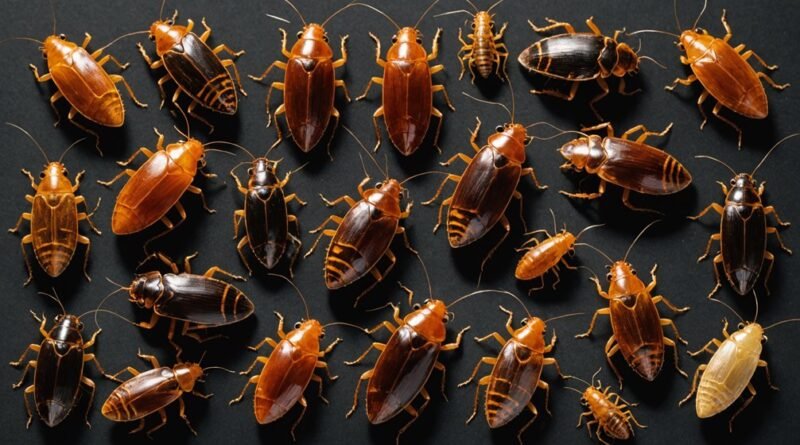
Cockroach Life Cycle by Species: Stages, Duration & Facts
All cockroaches develop through the same three stages, egg, nymph, and adult, but timelines, egg counts, instar numbers, and adult lifespans differ sharply by species. Knowing the cockroach life cycle by species is the foundation of effective pest control: the wrong timing or the wrong treatment stage means the infestation continues to grow.
Key Takeaways
- All cockroaches undergo incomplete metamorphosis, egg, nymph, adult, with no pupal stage. Temperature and humidity are the biggest drivers of development speed.
- German cockroach: 30-40 eggs per ootheca; incubation ~28 days; nymphs mature in 40-65 days; adults live 5-7 months. The fastest life cycle of any common species.
- American cockroach: 14-16 eggs per ootheca; incubation 24-56 days; nymphs take 6-12+ months; adults live 6-15 months, sometimes up to 2 years.
- Oriental cockroach: ~16 eggs per ootheca; incubation 50-80 days; nymphs need ~10-12 months; adults live 5-26 weeks.
- Brown-banded cockroach: 14-18 eggs per ootheca; incubation ~50 days; total life cycle averages ~132 days; adults live 3-11 months.
- Australian cockroach: ~24 eggs per ootheca; incubation 40-80 days; nymphs take 6-12 months; adults live 4-12 months.
- Identifying which species is present, and which life cycle stage dominates, is the most important step before selecting a treatment approach.
Overview of the Cockroach Life Cycle
Cockroaches develop through incomplete metamorphosis, meaning they skip the pupal stage entirely. Every species passes through three distinct phases: the egg stage, the nymph stage, and the adult stage. This biology separates them from beetles or butterflies, which transform through a fourth pupal phase.
Eggs are enclosed in a hardened protein case called an ootheca. The number of eggs per case, incubation duration, and where females deposit the case all differ by species. Incubation ranges from roughly 14 to 100 days and accelerates with warmth and humidity.
When nymphs hatch, they are pale white and wingless, resembling miniature adults. They darken within hours as the exoskeleton hardens. Nymphs forage immediately, molting through multiple instars, anywhere from 5 to 14 depending on species, until they reach adulthood. Each molt involves shedding the old exoskeleton; the insect briefly appears white before the new cuticle hardens. Shed exoskeleton skins left in crevices and behind appliances are a reliable sign of an active cockroach infestation.
Adults develop wings (though not all species fly), reproduce by producing multiple oothecae over their lifetime, and typically live 6 to 24 months. Their saliva, droppings, and shed skins are the primary sources of allergens linked to health risks in homes and buildings.
A single female German cockroach can be responsible for more than 300 offspring per year under optimal conditions, one reason early identification and targeted pest control matter so much.
German Cockroach Life Cycle
The German cockroach (Blattella germanica) has the fastest and most prolific life cycle of any common household pest. Females carry an ootheca containing 30-40 eggs for about 20-30 days, then tuck it away in a warm, sheltered location, behind appliances, inside cabinets, under sinks, a day or two before hatching.
At around 80 degrees F (27 degrees C), eggs incubate in roughly 28 days. Nymphs emerge pale and wingless, passing through 5-7 instars over 40-65 days. Under ideal warmth and humidity, the entire life cycle can compress to just 50-60 days. In cooler or drier environments, it typically spans 70-100 days.
A single female produces 4-8 oothecae in her lifetime, generating up to 200-400 offspring. At any given time, roughly 75-80% of a German cockroach population are nymphs, a sign of constant, rapid reproduction. Adults begin reproducing just 4-6 days after the final molt and live 5-7 months. Their preferred habitats are warm, humid areas near food and water: kitchens, bathrooms, and areas around pipes and sinks.
Because populations skew so heavily toward nymphs, effective German cockroach control requires disrupting both the egg and nymph stages. Insect Growth Regulators (IGRs) combined with gel baits placed in crevices and near entry points deliver the strongest results.
| Life Stage | Duration | Key Facts |
|---|---|---|
| Egg (Ootheca) | ~28 days | 30-40 eggs per case; female carries it until just before hatching |
| Nymph | 40-65 days | 5-7 instars; pale white at first, darkens quickly |
| Adult | 5-7 months | Reproduces 4-6 days after final molt; produces 4-8 oothecae |
American Cockroach Life Cycle
The American cockroach (Periplaneta americana) is the largest common house roach in North America. It develops far more slowly than the German cockroach but compensates with a long adult lifespan, sometimes exceeding two years. Females produce dark brown, purse-shaped oothecae about 0.9 cm in length, each holding 14-16 eggs. They carry the case briefly, then cement it in a warm, protected crevice near food and moisture.
Incubation takes 24-56 days depending on temperature; development accelerates around 29 degrees C (84 degrees F) and halts below about 15 degrees C. Nymphs hatch white, then harden to a reddish-brown color. They progress through 10-14 instars, most commonly 13, over a nymph stage lasting roughly 160 to 971 days (about 6 months to over a year). This extended nymph stage means American cockroach infestations can become deeply entrenched in basements, walls, and sewers before homeowners notice them.
A single female typically produces 9-10 oothecae over her lifetime, sometimes up to 14, generating hundreds of offspring. Adults are reddish-brown with a distinctive yellowish figure-eight marking behind the head, a reliable identification feature. They mate soon after the final molt and can live 6-15 months, longer when water is consistently available. Drought significantly shortens survival and reduces reproduction.
American cockroach populations in homes and commercial buildings typically harbor in walls, pipes, sewers, and under floors. Effective pest control focuses on moisture elimination, sealing crevices and entry points, and treating sewer access points and crawl spaces. Bacteria spread through their droppings and contact with surfaces represent a genuine health risk in kitchens and food-preparation areas.
| Life Stage | Duration | Key Facts |
|---|---|---|
| Egg (Ootheca) | 24-56 days | 14-16 eggs per case; dark brown, purse-shaped, 0.9 cm long |
| Nymph | 6-12+ months | 10-14 instars; starts white, hardens to reddish-brown |
| Adult | 6-15 months | Reddish-brown; figure-eight marking; produces 9-14 oothecae |
Oriental Cockroach Life Cycle
The Oriental cockroach (Blatta orientalis) favors cool, damp environments, basements, crawl spaces, sewers, and areas near pipes and water sources. Its biology is tightly tied to seasonal moisture and temperature swings, making it one of the most environment-sensitive species in pest control.
Females produce dark reddish-brown, slightly inflated oothecae (8-12 mm) and deposit them in moist, sheltered areas near food. Each case holds about 16 eggs; a female produces 8-16 oothecae in her lifetime. Incubation ranges from 42-81 days, fastest at around 29.5 degrees C; freezing temperatures destroy egg viability entirely.
Nymphs hatch ready to forage in dark, wet zones, mulch, leaf litter, and debris around building foundations. They pass through 7-10 instars over a development period spanning 150 to 500+ days depending on temperature and moisture. Adults reach about one inch in length, glossy dark brown to black in color. Males carry short wings; females have only tiny wing pads, a clear anatomical distinction for identification. Adults live 5-26 weeks.
Populations peak in late spring and early summer; late-summer heat drives retreat and mortality. Overwintering nymphs mature in spring, signaling that cockroach infestation activity is entering its breeding peak. Targeting Oriental cockroach control before spring emergence is the most effective intervention timing.
| Life Stage | Duration | Key Facts |
|---|---|---|
| Egg (Ootheca) | 42-81 days | ~16 eggs per case; dark reddish-brown, slightly inflated |
| Nymph | ~10-12 months | 7-10 instars; peaks in spring and summer |
| Adult | 5-26 weeks | Glossy dark brown to black; males have short wings, females none |
Brown-Banded Cockroach Life Cycle
The brown-banded cockroach (Supella longipalpa) is one of the smaller household roach species, averaging about half an inch in length. It is distinguished by two light-colored bands across its dark brown abdomen, a pattern that gives the species its name and aids identification in homes and businesses.
Females glue oothecae to furniture, inside cabinets, along ceilings, behind wall hangings, and in the upper areas of rooms, a habitat behavior that separates brown-banded cockroaches from German roaches, which cluster near ground-level moisture. Each case holds 14-18 eggs and is deposited roughly every 1-2 weeks. Incubation lasts approximately 50 days at room temperature.
Nymphs hatch with characteristic banding and pass through 6-8 instars over about 90 days, with the complete life cycle averaging 132 days. Males have full wings and can fly when disturbed; females have shorter wings and do not fly. Adult lifespan ranges from 3 to 11 months, with females producing up to 14 oothecae over their lifetime.
Brown-banded cockroaches prefer warm, dry areas above 80 degrees F (27 degrees C) and are frequently found near electronics, inside appliances, and in upper kitchen cabinets, locations often overlooked during inspections. Effective cockroach control requires whole-room treatment, including bait placement near furniture, ceilings, and electrical appliances.
| Life Stage | Duration | Key Facts |
|---|---|---|
| Egg (Ootheca) | ~50 days | 14-18 eggs per case; glued to walls, ceilings, furniture |
| Nymph | ~90 days | 6-8 instars; distinctive banding visible throughout |
| Adult | 3-11 months | Males fly; females do not; produces up to 14 oothecae |
Australian Cockroach Life Cycle
The Australian cockroach (Periplaneta australasiae) is found widely across tropical and subtropical regions, including the southern United States. It closely resembles the American cockroach but is slightly smaller and has a distinctive yellow stripe along the outer edge of each forewing, a key color feature for accurate species identification.
Females carry oothecae for a short period before depositing them in moist, protected spots, commonly in soil, mulch, leaf debris, wood piles, and around building entry points. Each ootheca contains approximately 24 eggs; incubation takes 40-80 days depending on temperature.
Nymphs hatch with distinctive yellow spots and markings, which fade as the exoskeleton darkens through successive molts. They progress through 6-12 instars over 6-12 months. Adults are strong fliers, particularly when temperatures rise, and are attracted to light, a behavior difference from the German cockroach that influences pest control strategy. They favor outdoor habitats: greenhouses, gardens, wood piles, and spaces around doors, windows, and gaps in building foundations.
Controlling Australian cockroach populations requires sealing cracks, gaps, and entry points around doors and windows, removing outdoor debris near foundations, and treating the perimeter of buildings.
| Life Stage | Duration | Key Facts |
|---|---|---|
| Egg (Ootheca) | 40-80 days | ~24 eggs per case; deposited in soil, mulch, and debris |
| Nymph | 6-12 months | 6-12 instars; yellow markings fade through molts |
| Adult | 4-12 months | Strong flier; yellow forewing stripe; attracted to light |
Duration of Each Life Stage by Species
The table below compares all five species across every life cycle stage. Use this as a quick reference when identifying which cockroach species is present and planning your pest control approach.
| Species | Eggs / Ootheca | Incubation | Instars | Nymph Stage | Adult Lifespan | Avg. Total Life Cycle |
|---|---|---|---|---|---|---|
| German | 30-40 | ~28 days | 5-7 | 40-65 days | 5-7 months | ~100 days |
| American | 14-16 | 24-56 days | 10-14 | 6-12+ months | 6-15 months | ~609 days |
| Oriental | ~16 | 50-80 days | 7-10 | ~10-12 months | 5-26 weeks | ~300-800 days |
| Brown-Banded | 14-18 | ~50 days | 6-8 | ~90 days | 3-11 months | ~132 days |
| Australian | ~24 | 40-80 days | 6-12 | 6-12 months | 4-12 months | ~300-400 days |
Reproduction and Egg-Laying Habits
All female cockroaches produce oothecae, hardened protein egg cases that protect developing embryos from environmental hazards, including most household cleaning chemicals. The size, color, shape, and placement of oothecae vary enough between species to serve as reliable identification markers during a pest inspection.
German cockroach females carry their ootheca externally until just before hatching, a behavior that protects eggs during the critical incubation period. American and Oriental cockroach females deposit their cases early in incubation, cementing them in crevices, along walls, or near water sources and food.
Brown-banded cockroaches exhibit the most dispersed egg-placement behavior, gluing cases to surfaces throughout a room rather than concentrating near moisture. Australian cockroaches frequently deposit oothecae in outdoor debris, soil, and wood, meaning egg cases may enter homes passively through gaps and entry points in building materials.
The number of oothecae a female produces over her lifetime ranges from about 4 (German) to 16 (Oriental), but total offspring counts also depend on incubation survival rates. Research estimates that about 72% of cockroach nymphs survive to adulthood under optimal conditions, a reproduction rate that drives rapid population growth when infestations go unaddressed. Understanding cockroach biology and reproduction at this level is essential for choosing the right treatment timing.
Factors Affecting Cockroach Development
Temperature is the single most powerful driver of cockroach development speed. German cockroaches develop fastest between 77-86 degrees F (25-30 degrees C); American cockroaches thrive near 84 degrees F (29 degrees C); Oriental cockroaches peak around 85 degrees F (29.5 degrees C) but tolerate cooler conditions better than the others. Below roughly 60 degrees F (15 degrees C), most species slow dramatically; freezing is lethal to eggs and early nymphs.
Humidity and moisture shape both development speed and survival. Oriental and American cockroaches have the highest moisture dependence, environments with leaks, condensation around pipes, or standing water in basements and crawl spaces support the fastest population growth for these species. Drought shortens adult lifespan and reduces reproduction in American cockroaches measurably.
Diet quality affects adult development and nymph maturation speed. Cockroaches that access a balanced protein-to-carbohydrate ratio, common in kitchens and areas with food debris, mature faster and produce more offspring than those in food-scarce environments. Consistent sanitation, cleaning up crumbs, sealing food in containers, and managing droppings are core components of any cockroach control program.
Aggregation pheromones, particularly fecal compounds such as periplanolide-E, accelerate nymph development by promoting clustering. Nymphs are more sensitive to these signals than adults, which explains why cockroach populations cluster so densely in crevices and behind appliances. Bait placement near these aggregation zones consistently outperforms treatments placed where adults are most visible.
Pest Control by Life Cycle Stage
The most effective cockroach control programs target multiple life cycle stages simultaneously. At any given time, a cockroach infestation contains eggs, nymphs, and adults, not just the adults you can see. Treatments that address only adults leave eggs and nymphs to continue the population cycle.
Egg stage: Oothecae resist most household cleaning chemicals. IGRs, targeted steam, and crevice vacuuming are the most effective approaches. Repeated treatments are necessary as nymphs continue hatching.
Nymph stage: IGRs specifically disrupt nymph development, preventing molting and blocking the transition to reproductive adults. Gel baits placed in crevices near aggregation zones reach nymphs effectively.
Adult stage: Gel baits, residual insecticides, and dust formulations in voids and behind appliances target adults. Moisture control, sealing entry points, and eliminating food sources reduce survival and reproduction.
Signs of an active breeding phase include shed exoskeleton skins in crevices and behind appliances, oothecae in cabinets or along walls, small pale nymphs near food sources, and increasing numbers of adults in bathrooms or kitchens. Professional pest control services that inspect for all three life cycle stages deliver the most reliable, long-term results.
Frequently Asked Questions
What are the stages of a cockroach life cycle?
All cockroaches develop through three stages: egg (enclosed in an ootheca), nymph, and adult. This is incomplete metamorphosis, there is no pupal stage. Nymphs molt through multiple instars, ranging from 5 (German) to 14 (American), before reaching adulthood with wings and reproductive maturity.
Which species has the shortest life cycle?
The German cockroach completes its full life cycle in approximately 98-100 days under ideal conditions, the fastest of any common household species. The brown-banded cockroach averages about 132 days, making it the second fastest. The American cockroach is the slowest, with a total lifespan sometimes exceeding 609 days from egg to death.
How does the Oriental cockroach’s life cycle differ from others?
Oriental cockroaches are the most season-dependent species. Their development slows dramatically in cool or dry conditions and accelerates with spring warmth and moisture. They prefer habitats below 85 degrees F, the opposite of German cockroaches, which thrive in warm kitchens. Their nymph stage can last 150 to 500+ days, and adults live only 5-26 weeks, far shorter than American cockroaches. Population peaks in late spring to early summer, making pre-spring treatment the most effective control strategy.
How does temperature affect cockroach development?
Temperature is the dominant environmental factor. Warmer conditions (77-86 degrees F for most species) shorten incubation and nymph development dramatically. The German cockroach life cycle can compress from 100 days to around 50-60 days at peak warmth. Freezing is lethal to eggs and early nymphs of all species except the Oriental cockroach, which tolerates cooler conditions better than others.
Do cockroach oothecae survive household cleaning chemicals?
Yes. The hardened protein exoskeleton of the ootheca resists soaps, sprays, and typical household cleaners. Sanitation removes exposed food and harborage but will not kill eggs. Insect Growth Regulators, targeted steam, and crevice vacuuming are the most effective tools for egg-stage control. Repeated treatments timed to coincide with hatching cycles are necessary for lasting results.
How many eggs do cockroaches lay per species?
German cockroaches carry 30-40 eggs per ootheca and produce 4-8 cases over a lifetime (200-400 total eggs). American cockroaches lay 14-16 eggs per case with 6-14 cases per lifetime. Oriental cockroaches produce ~16 eggs per case across 8-16 cases. Brown-banded cockroaches carry 14-18 eggs per case and up to 14 cases. Australian cockroaches average ~24 eggs per ootheca.
Where do American cockroaches lay their eggs?
American cockroach females cement their oothecae in warm, protected crevices near food and moisture sources, typically inside walls, along basement floors, near pipes, in sewers, and under appliances. The dark reddish-brown purse-shaped case (about 0.9 cm long) is a reliable identification marker during a pest inspection.
How does the brown-banded cockroach life cycle compare to the German cockroach?
German cockroaches cluster near moisture in kitchens and bathrooms; brown-banded cockroaches scatter throughout rooms and favor warm, dry areas above 80 degrees F, often near electronics, inside cabinets, and along ceilings. German roaches have a slightly faster life cycle (~100 days vs. ~132 days) and far more eggs per ootheca (30-40 vs. 14-18). Control strategies must account for the brown-banded cockroach’s dispersed distribution, which requires whole-room treatment rather than targeted kitchen and bathroom applications only.
Conclusion
The cockroach life cycle by species reveals how dramatically timelines, habitat preferences, and reproductive rates differ between common household pests. German cockroaches reproduce at explosive speed, demanding immediate action before nymph populations compound. American cockroaches develop slowly but embed deeply in the structure of older buildings. Oriental cockroaches track the seasons, peaking in spring. Brown-banded cockroaches scatter throughout living spaces rather than concentrating near moisture. Australian cockroaches enter from outdoors through entry points and crevices in the building envelope.
Effective pest control depends on knowing which species is present, which life cycle stage dominates, and which environmental factors, temperature, moisture, food access, and habitat, are sustaining the population. Homeowners who act at the first signs of a cockroach infestation consistently spend less on treatment and achieve better long-term results. Monitor regularly, target all three stages, and you will break the life cycle before populations compound.
