
Why Roaches Love Cardboard Boxes & What to Do
You might not think twice about stacking cardboard boxes in your garage or basement. But those innocent-looking boxes could already be harboring one of the most resilient pests on the planet. Cockroaches and cardboard have a relationship that works entirely in the roach’s favor — and against yours. Understanding exactly why will change how you handle every box that enters your space.
Key Takeaways
- Cockroaches are attracted to cardboard boxes because the material provides food, moisture, darkness, and ideal hiding spots within corrugated layers.
- Common infestation signs include small dark droppings, brownish egg casings, shed skins, chew marks, and a musty odor near boxes.
- German cockroaches are the most common species found in cardboard, with one female potentially producing up to 30,000 offspring annually.
- Inspect all incoming boxes outdoors before bringing them inside, and dispose of cardboard immediately after unpacking to prevent infestations.
- Contact a pest control professional if you spot two or more roaches, droppings, or shed skins inside your home.
Why Cockroaches Are Drawn to Cardboard Boxes
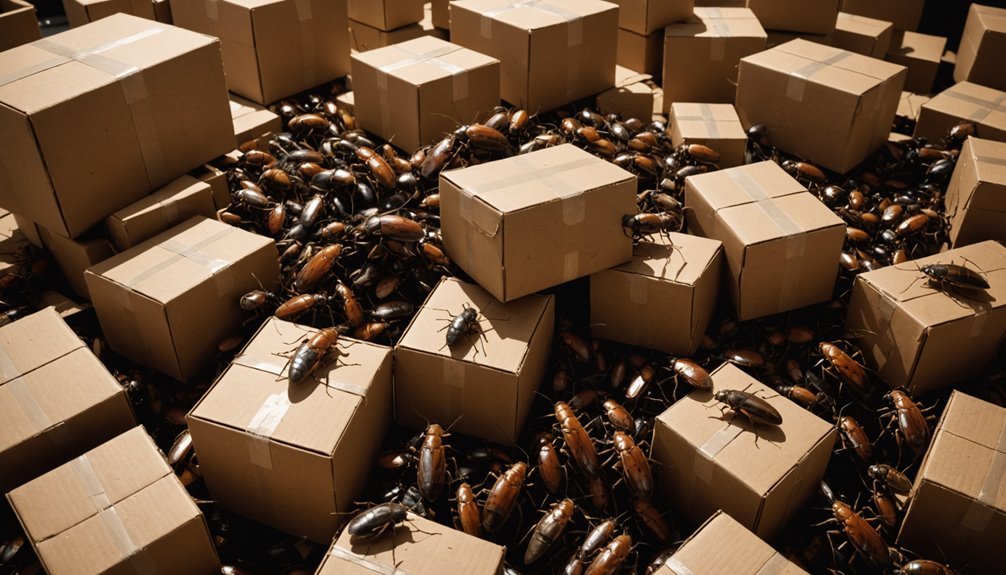
Cardboard boxes seem like harmless storage containers, but they’re practically a five-star hotel for cockroaches. These pests are drawn to cardboard for several overlapping reasons that work together to support their survival.
Cardboard boxes look innocent, but to cockroaches, they’re the ultimate luxury retreat.
Cockroaches can actually eat cardboard itself. The organic cellulose fibers, adhesives, and any food residue trapped in the material all serve as food sources.
Beyond nutrition, corrugated cardboard’s ridged, fluted layers create tight, dark pockets that match exactly what cockroaches seek in a hiding spot.
If you store boxes in a basement or near moisture, damp cardboard absorbs water and may grow mold, giving roaches even more resources.
Cardboard also retains pheromones, so once one roach settles in, the scent signals others to follow, accelerating how quickly an infestation takes hold. Cardboard boxes can also harbor roach eggs, allowing populations to grow rapidly before you even notice a problem.
Where Do Cockroaches Hide Inside a Box?
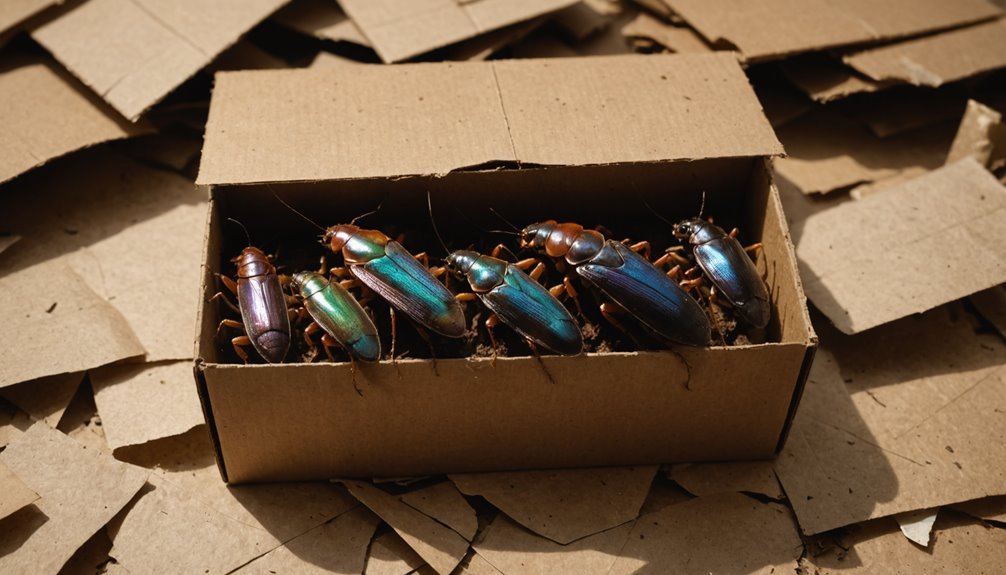
When cockroaches move into cardboard boxes, they don’t settle just anywhere — they target specific structural features that give them cover.
You’ll find them tucked into the folds, seams, and corrugated layers, where narrow gaps create the tight, dark spaces they prefer.
Box bases, flap joints, and stacked interiors are especially common hiding zones, since these areas stay undisturbed and are harder for you to inspect. Cluttered, undisturbed areas are particularly inviting to cockroaches, making stacked or forgotten boxes in storage rooms a prime nesting opportunity.
Preferred Hiding Spots
Once inside a box, cockroaches don’t settle randomly — they gravitate toward specific spots that offer the most protection.
They’re drawn to dark, concealed areas where disturbance is unlikely and conditions support long-term hiding.
Watch for activity in these key locations:
- Bottom surfaces — the underside stays hidden from routine checks and often holds egg cases.
- Flaps, folds, and seams — narrow gaps concentrate both roaches and egg sacs in tight, sheltered pockets.
- Moist or residue-rich sections — damp cardboard and food traces create overlapping shelter and food sources.
If you’re inspecting a box, don’t just look inside — flip it over, check the seams, and examine any folded edges where activity tends to concentrate most. Female roaches specifically deposit egg cases within cardboard folds, making these areas the most critical to examine during any inspection.
Structural Features They Exploit
Corrugated cardboard isn’t just a surface — it’s a system of layered voids, compressed seams, and structural gaps that cockroaches exploit with precision. The fluted middle layer creates narrow channels between liner boards where roaches travel and hide, compressing their bodies to move through spaces smaller than a fraction of their height in under a second.
Corners and folded joints offer additional cover, forming tight, low-light passages that also shelter egg cases and small nymphs. Closure areas are rarely airtight — tape seams lift, flaps don’t meet perfectly, and repeated opening widens gaps further.
Crushed or moisture-damaged sections add irregular cavities through partial delamination. Inside the box, loose packing material and empty headspace create sheltered pockets where roaches move and conceal themselves without exposure.
Cardboard contains 70–90% alpha-cellulose, which serves as a direct food source for cockroaches, making the structural voids within boxes not just shelter but part of an actively consumable resource.
How Cockroaches Enter Your Home Through Boxes
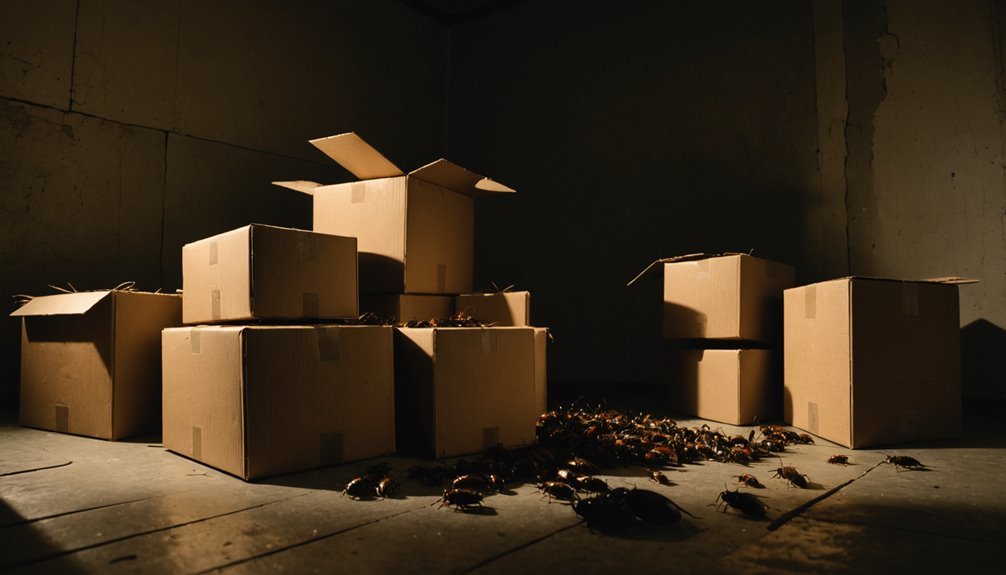
When you order products online or pick up boxes from a warehouse store, those boxes may have already been in contact with roaches hiding in corrugated layers long before they reach your door.
Used moving boxes are another serious risk, since boxes sourced from a previous household or storage unit can carry egg cases and live roaches that you won’t spot without a careful inspection.
Roaches can also enter your home through the gaps, cracks, and openings near wherever you set the box down, so where you place an incoming box matters just as much as what’s inside it. Delivery trucks can also transport boxes that already harbor active infestations before they even arrive at a store or warehouse.
Boxes From Warehouses
Many cockroaches that end up in your home never crawl through a crack or gap in your walls—they ride in through boxes delivered straight from warehouses.
Warehouses create ideal conditions for cockroaches because of stacked inventory, poor sanitation, and moisture—all of which make cardboard boxes attractive hiding spots before they ever reach you.
Warehouse-specific risks include:
- Corrugated layers in cardboard give roaches compact, dark shelter that’s easy to miss during inspection
- Long storage times allow roaches to reproduce inside or around boxes undetected
- Infested distribution points transfer roaches into packaging before shipment
Once you bring these boxes indoors and open them, cockroaches can quickly spread into your kitchen, pantry, or garage—making the delivery box itself the entry point.
Used Moving Boxes
Warehouses aren’t the only place cockroaches hitch a ride into your home—used moving boxes carry the same risk. When you reuse cardboard, you’re potentially inheriting roaches, egg cases, or nymphs from whoever stored them last.
The corrugated layers inside cardboard create narrow, dark channels where roaches hide undetected, surviving the entire move before emerging in your kitchen or closet.
Unpacking slowly makes the problem worse. The longer boxes sit, the more time pests have to spread into nearby fabrics, paper goods, and appliances.
Before you pack anything, inspect every seam, fold, and corrugated edge. Better yet, use new boxes or sealed plastic bins instead.
Once you’ve unpacked, discard the cardboard immediately—don’t give roaches a reason to stay.
Hidden Roach Entry Points
Boxes don’t arrive at your door alone—they bring whatever lived in them last. Cockroaches exploit every hidden opportunity to enter your home, and cardboard boxes are one of their most effective vehicles.
Before you carry anything inside, understand where they’re actually hiding:
- Egg cases glued inside corrugated layers or folded flaps survive transport undetected
- Corrugated gaps between cardboard layers shelter resting roaches during movement
- Food residue on box interiors attracts roaches before the box ever reaches you
Once inside, roaches abandon the box and exploit existing structural weaknesses—gaps around pipes, deteriorated weatherstripping, and foundation cracks.
The box delivers them past your front door, and your walls do the rest. Inspect every box before it crosses your threshold.
Signs of Cockroaches in Cardboard Boxes
Catching a cockroach infestation early means knowing what to look for before the problem gets out of control.
Check hidden areas for small, dark droppings resembling coffee grounds, especially along box seams, folds, and corners. Heavy accumulation suggests repeated activity, not a single roach passing through.
Look for brownish egg casings about 1/4 inch long tucked inside corrugated layers or crevices, along with translucent shed skins. Spotting multiple life-stage signs together points to an established infestation.
You’ll also want to notice chew marks, ragged edges, or damaged box corners where roaches have entered repeatedly.
A musty, oily odor or brownish smears on nearby surfaces can confirm hidden nesting. Live roaches appearing at night are the clearest sign of active trouble.
Why German Cockroaches Are the Biggest Cardboard Threat
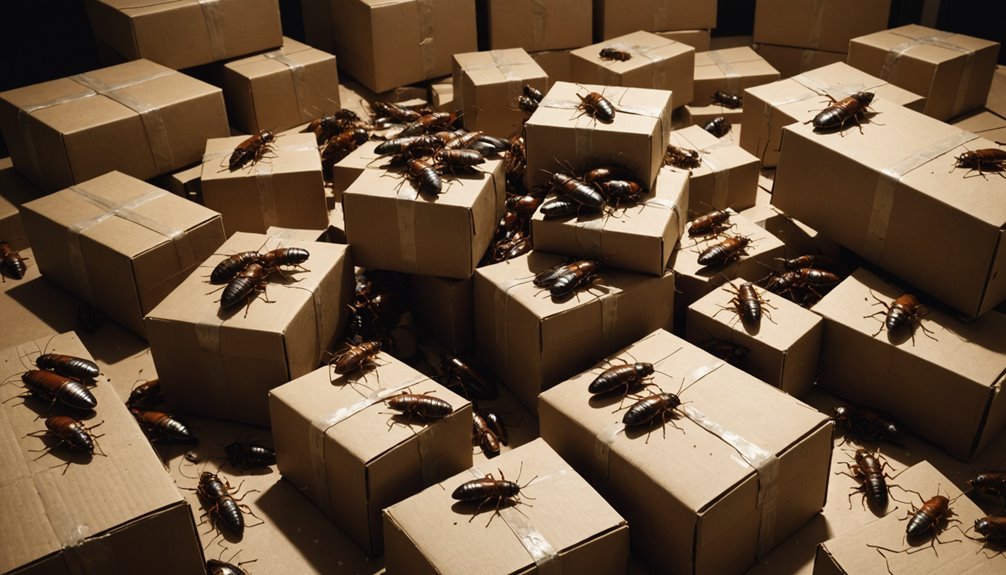
If you’ve spotted cockroaches in your cardboard boxes, there’s a good chance you’re dealing with German cockroaches—the most common and most problematic species tied to cardboard infestations.
Their small size, roughly half an inch long, lets them squeeze into corrugated channels, taped seams, and compressed folds that you’d never think to check.
Worse, a single female can trigger a rapid infestation, since German cockroaches breed fast and hide their egg cases deep inside packaging where you won’t easily find them.
Small Size, Big Problem
Among common indoor roaches, German cockroaches are the smallest—and that’s exactly what makes them such an effective cardboard threat. Their compact bodies let them slip into spaces you’d never think to check, turning ordinary boxes into hidden shelters.
Their small size creates specific risks you should know:
- Nymphs fit into microscopic gaps around box flaps, staples, and labels that larger roaches simply can’t access.
- Flattened or stacked boxes become dense shelter networks where roaches stay completely hidden until you disturb them.
- Passive transport becomes easier, since small roaches ride undetected inside shipping cartons, moving boxes, and stored packaging before you ever unpack them.
The smaller the roach, the harder it’s to catch—and German cockroaches use every millimeter of that advantage.
Rapid Breeding Inside Cardboard
What makes German cockroaches the biggest cardboard threat isn’t just their size—it’s how fast they breed. A single female produces 5–8 egg cases in her lifetime, each containing 30–48 eggs. At warm temperatures, those eggs hatch in about 28 days, and nymphs reach breeding maturity in 70–100 days.
One female can generate 200–300 offspring in her lifetime, with some estimates reaching 30,000 descendants within a year.
Cardboard accelerates this problem. The corrugated layers give egg cases and nymphs a protected, undisturbed space to develop through multiple life stages.
You won’t notice anything is wrong until the population outgrows its hiding spots. By then, you’re likely seeing roaches during the day—a clear sign the infestation is already severe.
German Roaches Spread Fast
That rapid breeding cycle doesn’t stay contained to a single box for long. German cockroaches are built for indoor survival, and cardboard gives them everything they need to establish and expand fast. Their flat bodies slip through packaging seams and cabinet gaps with ease, while shared walls, pipe chases, and plumbing voids carry them into neighboring units before you realize there’s a problem.
What makes them especially dangerous in cardboard situations:
- They’re strictly indoor survivors—they can’t live through temperate winters outside, so they rely entirely on indoor transport like boxes and deliveries.
- They thrive in the same warm, humid, food-rich conditions found near storage and shipping areas.
- Daytime sightings signal heavy infestation pressure, meaning spread is likely already underway.
Which Rooms in Your Home Carry the Highest Risk?
Cockroaches don’t treat every room in your home equally — they gravitate toward the spaces that offer the combination of food, moisture, warmth, and shelter they need to survive.
| Room | Primary Attractants | Key Harborage Points |
|---|---|---|
| Kitchen | Food residue, grease, warmth | Behind refrigerators, cabinet corners |
| Bathroom | Humidity, leaking pipes, darkness | Under-sink cabinets, floor drains |
| Laundry Room | Moisture, lint, warmth | Behind washers, dryers, sink cabinets |
| Kitchen-Adjacent Storage | Dry goods, cardboard, crumbs | Pantry backs, cabinet voids |
| Garage | Clutter, stored food, entry gaps | Cardboard stacks, wall openings |
Cardboard boxes amplify risk in every one of these rooms. They add shelter wherever conditions already favor roaches, turning a manageable problem into an active infestation faster than you’d expect.
Why Long-Term Cardboard Storage Makes Infestations Worse
Knowing which rooms carry the highest risk is only part of the picture — how long cardboard stays in those rooms matters just as much. The longer boxes sit undisturbed, the more time cockroaches have to breed, multiply, and spread into surrounding areas.
Long-term cardboard storage worsens infestations because:
- Boxes become harborage sites, not just storage — folds, seams, and corrugations shelter entire colonies for months undetected.
- Moisture accumulates over time, turning absorbent cardboard into a humid breeding environment cockroaches actively seek out.
- Infested boxes spread the problem — once you stack, move, or repack them, eggs, nymphs, and adults travel with them into new spaces.
Replacing cardboard with sealed plastic containers and keeping storage areas dry greatly reduces these compounding risks.
How to Check a Box Before It Comes Inside
Every box entering your home is a potential entry point for cockroaches, so inspect it before it crosses the threshold.
Start outside by checking all faces, corners, seams, and the bottom for live roaches, egg cases, droppings, or a musty odor. Use a flashlight to shine into folds, flaps, and corrugated layers where nymphs and eggs hide. Treat any single sign of infestation as reason for caution.
One sign of infestation—a droping, an egg case, a musty smell—is one sign too many.
Open the box outdoors or in a garage, then inspect the contents before moving anything inside.
Shake out soft items, wipe down hard surfaces, and use a clean surface for sorting. Once you’ve confirmed everything is clear, transfer items into sealed plastic bins rather than carrying the cardboard box itself indoors.
Pest-Resistant Storage Options That Replace Cardboard Boxes
Replacing cardboard with the right containers removes one of the easiest entry points cockroaches exploit. Airtight plastic containers, glass jars, and metal tins all reduce scent leakage and block physical access far better than any cardboard box can.
Metal resists chewing, glass stays non-porous, and rigid plastic with a complete snap seal limits pest entry effectively. For long-term storage, Mylar bags with oxygen absorbers inside a hard outer container add a reliable second barrier.
Choose storage based on what you’re protecting:
- Dry goods like rice and flour belong in airtight plastic or glass with tight-fitting lids
- Garage and shed items hold up better in metal canisters or locking plastic bins kept off the floor
- Long-term food storage benefits most from Mylar bags sealed inside a hard container
When to Call a Pest Control Professional
Even after switching to pest-resistant storage, you’ll need to recognize when a roach problem has grown beyond what DIY methods can handle. If traps and sprays aren’t reducing sightings, it’s time to call a professional.
| Call Immediately If You See | Call If You Notice |
|---|---|
| Two or more roaches indoors | Droppings or shed skins |
| Roaches active during daytime | Damaged cardboard or packaging |
| Egg cases or juvenile roaches | Repeated sightings after cleanup |
| White roaches after molting | Musty or foul odors |
Delaying treatment lets populations grow fast. If anyone in your home has allergies or asthma, act sooner—roach droppings and shed skins worsen air quality. A technician will treat cracks and hidden harborage areas that surface sprays consistently miss.
Frequently Asked Questions
Can Cockroaches Survive Inside Sealed Cardboard Boxes Without Food?
Yes, cockroaches can survive up to a month without food in sealed cardboard boxes. They’ll eat the cardboard itself, along with any glue or residue, so you shouldn’t assume sealing a box keeps them out.
Do Cockroaches Damage the Items Stored Inside Cardboard Boxes?
Yes, cockroaches can damage items you’ve stored in cardboard boxes. They’ll feed on paper, glue, and food residue while contaminating your belongings with feces, shed skins, and odors that stain and ruin stored materials.
How Quickly Can a Cockroach Infestation Spread From One Box?
You can see a German cockroach infestation double every 3–4 weeks from just one box. Roaches quickly hitchhike into nearby boxes, spreading rapidly before you’ll even notice they’re there.
Are Certain Cardboard Box Brands or Materials Less Attractive to Cockroaches?
No brand’s proven less attractive, but you’ll want boxes with moisture-resistant surfaces, minimal adhesive exposure, and tight construction. Material properties matter far more than brand labels when you’re trying to deter cockroaches.
Can Cockroaches Inside Boxes Contaminate Food Stored Nearby?
Yes, cockroaches can contaminate your nearby food. They’ll transfer pathogens like Salmonella through direct contact, droppings, and saliva. They can also chew through packaging, exposing stored food to harmful bacteria from infested boxes.
Conclusion
Cockroaches and cardboard are a dangerous combination you don’t want in your home. Once they’ve settled in, they’re tough to eliminate. You can protect your space by inspecting boxes carefully, swapping cardboard for sealed plastic containers, and disposing of packaging quickly. If you’re already seeing signs of an infestation, don’t wait—contact a pest control professional before the problem spreads beyond what you can handle on your own.
