
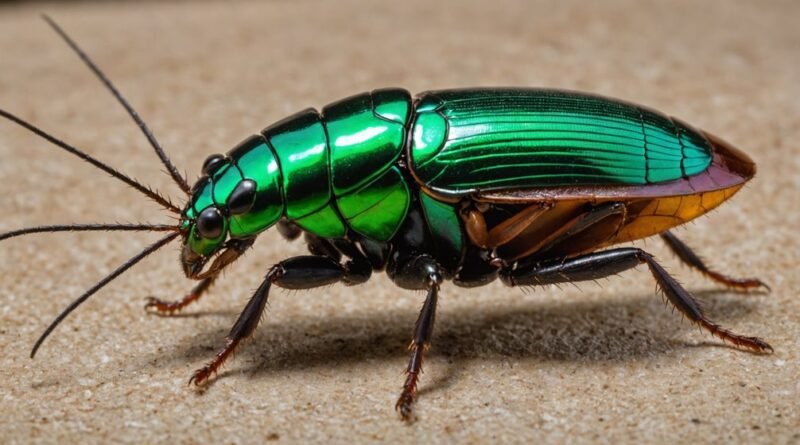
Cuban Cockroach (Green Cockroach)
If you’ve spotted a bright green insect near your porch light, you’re likely looking at a Cuban cockroach. It’s a tropical species native to Cuba and the Caribbean, recognizable by its vivid green color, slender body, and fully developed wings. While it won’t bite you, it can carry harmful bacteria. It prefers warm, humid outdoor environments but can wander inside. Keep exploring to uncover everything you need to know about this unique pest.
Key Takeaways
- The Cuban cockroach is a bright green tropical species, measuring 12–24 mm, native to Cuba, the Caribbean, and parts of Latin America.
- They thrive in warm, humid environments and are commonly found along the U.S. Gulf Coast in Florida, Louisiana, and Texas.
- Cuban cockroaches cannot bite or sting humans but can spread harmful bacteria, including pathogens linked to salmonella and hepatitis A.
- They are nocturnal insects that hide in leaf litter, mulch, and woodpiles during the day and are strongly attracted to bright lights at night.
- Prevent indoor entry by sealing gaps, using door sweeps, installing tight screens, and switching to yellow bug bulbs outdoors.
What Is the Cuban Cockroach?
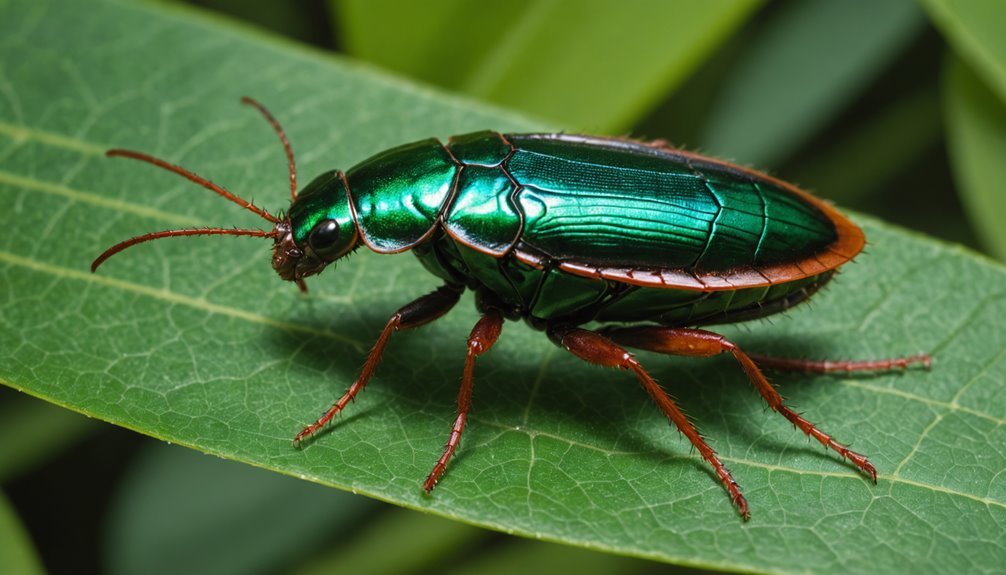
The Cuban cockroach (*Panchlora nivea*) is a tropical species native to Cuba, the Caribbean, and parts of Latin America. You might also hear it called the green cockroach or green banana cockroach — names that reflect its vivid coloring and its history of traveling into new regions through banana shipments.
It belongs to the cockroach subfamily Panchlorinae and thrives in tropical and subtropical climates. In the United States, you’ll find it primarily along the Gulf Coast, with confirmed presence in Florida, Louisiana, Texas, and South Carolina.
Unlike the cockroaches you’d dread finding in your kitchen, the Cuban cockroach is mainly an outdoor species. It’s not considered a major pest, it doesn’t bite or sting, and it’s not known to spread disease.
Some people even keep it as a pet or use it as feeder insects for other animals. Females can grow up to 24 mm in length, making them noticeably larger than their male counterparts.
How to Identify a Cuban Cockroach
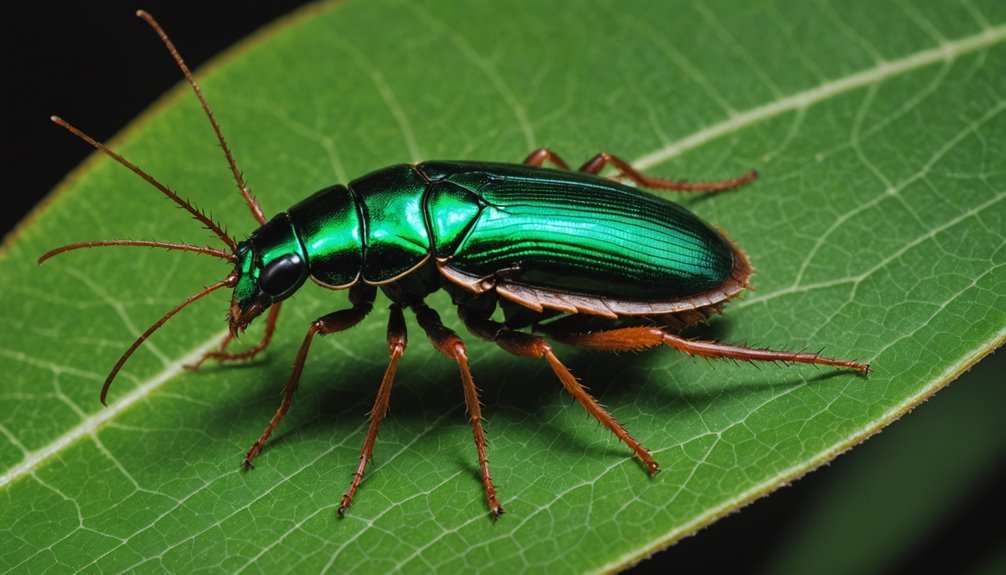
Identifying a Cuban cockroach is straightforward once you know what to look for, because its bright green coloring sets it apart from nearly every other cockroach you’re likely to encounter.
Look for a slender body with a yellowish underbelly, fully developed wings, and strong flight ability. Adults range from roughly 12 mm to just over 24 mm depending on sex, with females being noticeably larger than males.
Cuban cockroaches have slender bodies, yellowish underbellies, fully developed wings, and are strong fliers.
Beyond appearance, context matters. You’ll typically spot Cuban cockroaches outdoors at night, flying toward lights or hiding in shrubs, leaf litter, mulch, or firewood during the day.
They prefer warm, humid environments along the Gulf Coast, from Florida to Texas. Originally from Cuba, they are believed to have arrived in the United States through shipments of ripening green bananas.
If you find a green cockroach indoors, it likely wandered in by accident rather than establishing an infestation.
Combine color, slender shape, outdoor location, and flight behavior together for the most reliable identification.
Are Cuban Cockroaches Dangerous?
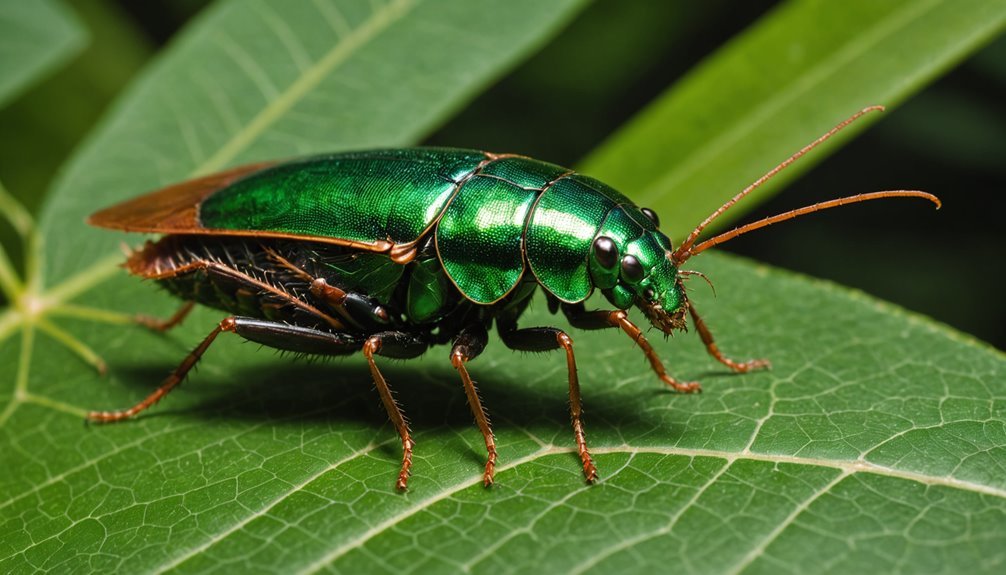
Cuban cockroaches aren’t known to bite humans, and even if they do, their small mouthparts can’t cause meaningful harm.
You don’t need to worry about venom or stings either, since they’ve none. Your bigger concern is bacterial contamination, because these scavengers can pick up pathogens from decaying outdoor matter and transfer them to your food or kitchen surfaces. Specifically, they are capable of spreading serious illnesses, including hepatitis A, salmonella, and gastroenteritis through their scavenging habits.
Biting and Physical Harm
When most people spot a Cuban cockroach, their first concern is whether it can bite or hurt them. The short answer is that it’s unlikely. Their mouthparts are too small and weak to break human skin under normal circumstances.
If a bite did occur, you’d expect nothing worse than minor redness or irritation. Serious injury isn’t associated with this species. Cuban cockroaches are also not known to transmit diseases to humans.
Here’s what you actually need to know about physical harm:
- Biting is rare — Cuban cockroaches prefer plants and decaying matter over human skin.
- No stinging or venom — they can’t sting you and aren’t toxic.
- Startle reactions are the biggest risk — their sudden flight toward lights can catch you off guard.
Bacterial Contamination Risk
While Cuban cockroaches rarely bite or sting, they carry a more serious and less obvious threat: bacterial contamination. As they move through decaying organic matter, waste, and contaminated surfaces, they mechanically transfer harmful bacteria onto food, utensils, and kitchen surfaces through direct body contact, feces, and other deposits.
Studies show bacteria on nearly 97% of cockroaches collected in infested settings, with isolates including *Escherichia coli*, *Salmonella enterica*, *Staphylococcus aureus*, *Pseudomonas aeruginosa*, and *Bacillus cereus*.
These pathogens survive the cockroach’s digestive system and get shed back into your environment, sustaining ongoing risk. Bacteria isolated from cockroaches in hospital environments show higher antibiotic resistance compared to those collected from restaurants and homes.
If you have Cuban cockroaches in your home, you’re facing real exposure to bacteria linked to salmonellosis, gastroenteritis, and *E. coli* illness—particularly in kitchens and food-handling areas.
Where Cuban Cockroaches Hide Around Your Yard and Home
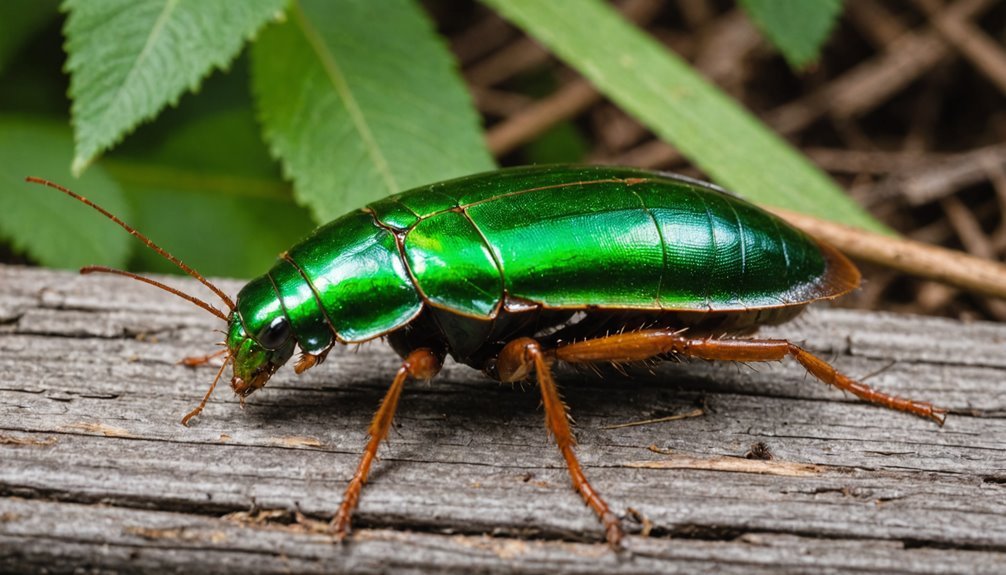
Knowing where Cuban cockroaches hide is the first step toward controlling them. Since they’re nocturnal, they spend daylight hours in tight, dark, undisturbed spaces that offer shade and moisture. Your yard likely has several prime harborage zones worth inspecting.
The three most common hiding hotspots include:
- Leaf litter, mulch beds, and flower beds — damp, shaded organic material creates ideal daytime cover.
- Woodpiles and lawn debris — stacked firewood and accumulated clutter multiply available hiding spots quickly.
- Foundation edges and tree bases — where vegetation collects against your home’s perimeter.
At night, exterior light fixtures draw them toward your home’s walls, doors, windows, and utility openings.
Treating a perimeter zone extending 3 feet up your structure and 3 feet out helps intercept movement before cockroaches find entry points.
How Cuban Cockroaches Get Inside Your Home
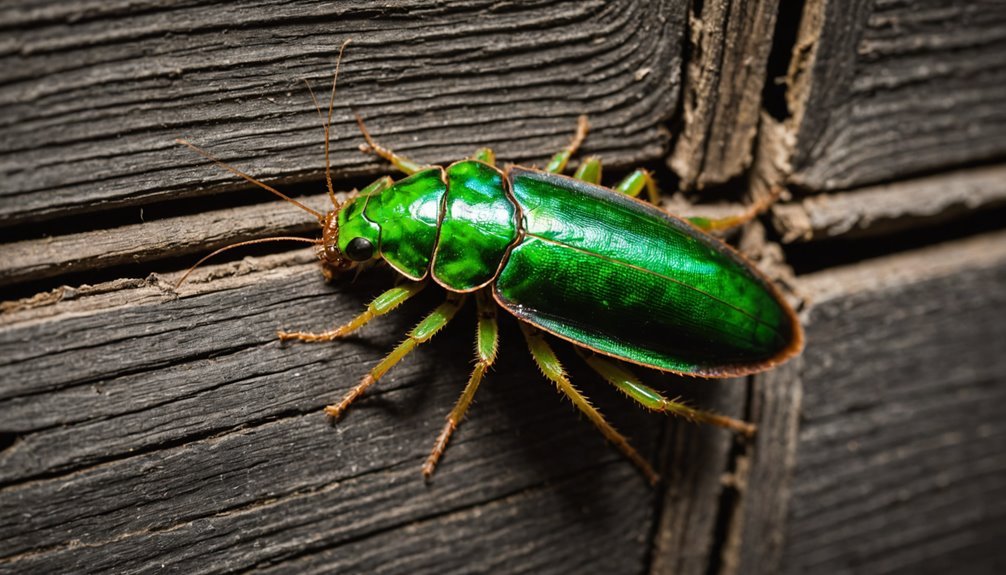
Cuban cockroaches find their way inside primarily because they’re strongly drawn to bright lights, which pull them toward your illuminated doors and windows after dark.
Once they’ve closed that distance, an open door or unscreened window gives them a direct path in.
You’re most at risk on warm nights when you’ve got lights blazing near your entryways and airflow openings unprotected.
Attracted by Light Sources
Unlike most cockroach species that sneak indoors through cracks and crevices, the Cuban cockroach‘s attraction to light is what most often brings it into contact with your home.
During its active nighttime hours, bright exterior fixtures pull it toward your home’s perimeter. From there, entry becomes likely through:
- Open doors and windows near illuminated entryways
- Gaps or poorly sealed screens where interior light leaks outside
- Lighted areas around eaves, soffits, and garage openings
You can reduce this risk by switching to yellow “bug” bulbs, which are less attractive to insects than white light.
Turning off unnecessary exterior lighting and keeping screens tightly sealed further limits how often light-attracted roaches reach your home’s access points.
Flying Through Open Entries
Once light draws a Cuban cockroach to your home’s exterior, open entries become its most direct path inside.
These roaches typically enter through open doors and windows rather than establishing indoor populations, so your openings are the real vulnerability.
Because Cuban cockroaches are nocturnal, nighttime poses the greatest risk. If you leave doors open or have torn, loose-fitting, or damaged screens on windows, you’re giving them a direct route in.
Installing tight-fitting screens and adding door sweeps considerably reduces that risk.
Keep in mind that most indoor sightings reflect temporary intrusion rather than a breeding infestation.
The roach wandered in through an accessible opening. Close those entries, and you remove the primary way it gets inside.
Why Are Cuban Cockroaches So Attracted to Light?
Like many flying insects, Cuban cockroaches are strongly drawn to light through a behavior called phototaxis — the instinctive movement toward a light source.
Since they’re nocturnal and capable fliers, artificial lighting directly intersects with their active period, making your porch lights, windows, and landscape fixtures powerful attractants.
Their eyes are especially sensitive to blue-white light, which most standard bulbs emit.
When a roach flies toward you near a light source, it’s reacting to the illumination — not targeting you.
Three conditions that intensify light attraction:
- High-contrast lighting — Bright fixtures in dark surroundings create strong visual targets roaches can’t easily ignore.
- Warm, humid nights — These conditions increase flight activity, putting more roaches airborne near your property.
- Lights near entry points — Illuminated doors and windows combined with gaps in screens dramatically raise the chance of indoor entry.
What Does the Cuban Cockroach Eat?
The Cuban cockroach is an omnivore, but it feeds far more like a decomposer than a typical household pest. It prefers decaying plant material, rotting fruit, leaf litter, and organic debris over anything you’d find in your kitchen pantry.
You’ll most often spot it foraging through mulch, leaf piles, and piles of lumber where decomposing matter collects.
It’s also drawn to sweet foods. Fresh fruit, fruit odors, and sugary spills can pull it toward trash areas, fruit-bearing plants, and even indoor spaces when those food sources are present. At high population densities, it’s been reported as a pest on banana trees.
Unlike typical household roaches, it rarely targets clean stored foods. Its diet centers on plant matter, fruit, and organic debris, and because it breaks down decaying material, it actually contributes to soil enrichment.
Unlike most roaches, this species breaks down decaying matter rather than raiding your pantry — and actually enriches the soil in the process.
It’s primarily an outdoor forager, not a kitchen invader.
How to Keep Cuban Cockroaches Out for Good
Knowing what the Cuban cockroach eats makes it easier to understand why it ends up near your home in the first place—decaying plant matter, rotting fruit, and organic debris are everywhere in a typical yard.
Cutting off access and reducing attractants gives you the best long-term results.
Start with these three priorities:
- Seal entry points — Caulk gaps around windows, doors, pipes, and baseboards, and add door sweeps to outside doors.
- Manage outdoor lighting — Switch to yellow bug bulbs or motion-sensor lights, since Cuban cockroaches are strongly attracted to light at night.
- Clean up the yard — Remove leaf litter, trim vegetation away from the house, and keep firewood stacked away from the foundation.
Inside, store food in sealed containers, fix water leaks, and reduce clutter.
Place sticky traps along walls to monitor activity, and recheck problem areas after one to two weeks.
Frequently Asked Questions
Can Cuban Cockroaches Survive Cold Winters in Northern States?
You shouldn’t expect Cuban cockroaches to survive cold northern winters outdoors. They can’t tolerate freezing temps, but they’ll thrive indoors if they’ve found their way into your warm, moist, food-rich home.
Do Cuban Cockroach Nymphs Look Different From Adult Cuban Cockroaches?
Yes, they look very different! Nymphs are dark brown or black and wingless, while adults sport a bright green color with fully developed wings, making them nearly unrecognizable as the same species.
Are Cuban Cockroaches Commonly Found on Banana Shipments Entering the US?
They’re not commonly found on modern banana shipments entering the U.S. today. You’ll find that they’re believed to have historically arrived through banana cargo, but current evidence doesn’t confirm they’re a routine shipment contaminant.
How Long Does a Cuban Cockroach Typically Live?
You’re looking at a lifespan of up to about 20 months under favorable conditions. They’ll spend roughly 10 months developing from egg to adult, then another 10 months living as a fully mature adult.
Can Cuban Cockroaches Reproduce Indoors if Conditions Are Favorable?
Cuban cockroaches rarely reproduce in your home, even if conditions seem favorable. They need high humidity and plant-rich environments that most homes can’t provide. Greenhouses are the main exception where you’d see indoor reproduction.
Conclusion
Cuban cockroaches aren’t your typical indoor pest, but that doesn’t mean you should ignore them. If you’re spotting these bright green bugs around your yard or home, it’s time to take action. By sealing entry points, reducing outdoor lighting, and keeping vegetation trimmed, you’ll make your property far less inviting. Don’t wait until a small problem becomes a big one—start protecting your home today.
