
Diatomaceous Earth for Cockroaches
You’ve probably heard that diatomaceous earth kills cockroaches, but you’re not sure if it actually works or how to use it correctly. It’s a legitimate pest control option, but it comes with real limitations that most people don’t know about. Understanding those details is what separates a treatment that works from one that wastes your time.
Key Takeaways
- Diatomaceous Earth kills cockroaches mechanically by abrading their exoskeletons and absorbing protective oils, causing dehydration and death.
- Food-grade DE is safe for home use, but wear a dust mask, gloves, and eye protection during application.
- Apply DE lightly in cracks, crevices, behind appliances, and along baseboards where cockroaches commonly travel.
- DE works slowly, with results visible within 48 hours and complete control taking two to four weeks.
- DE alone cannot eliminate infestations; combine it with gel baits, insect growth regulators, and proper sanitation practices.
What Is Diatomaceous Earth and How Does It Kill Cockroaches?
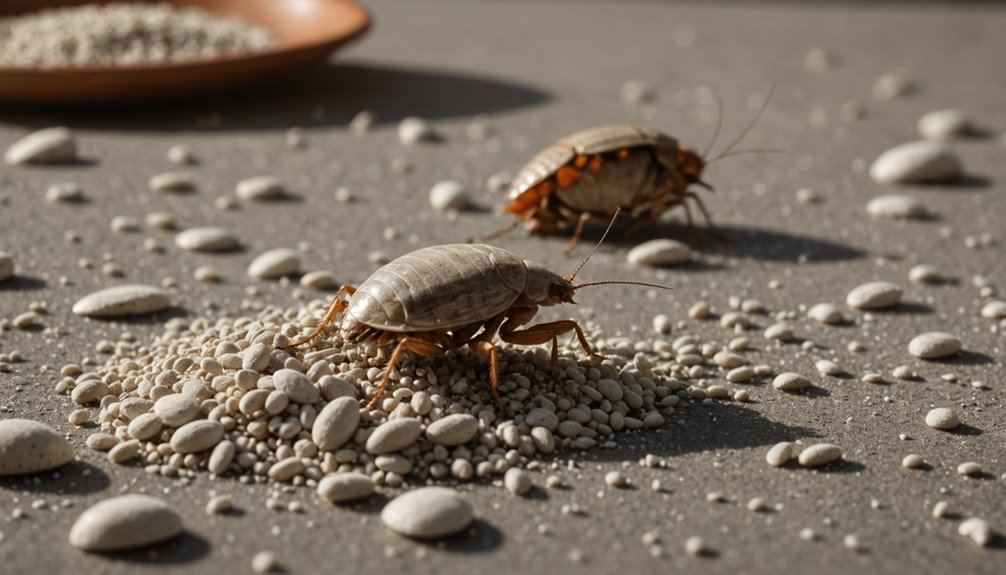
Diatomaceous earth (DE) is a fine, powdery substance made from the fossilized remains of diatoms—tiny aquatic microorganisms whose silica-rich shells have accumulated in sediment over millions of years.
Composed of roughly 80%–90% silica, DE works as a mechanical insecticide rather than a chemical one, meaning it kills through physical action.
When a cockroach walks through DE, the tiny sharp particles abrade its exoskeleton and absorb the oils and fats from its protective outer cuticle. This damages the cuticle’s ability to retain moisture, causing the roach to dehydrate and die.
Because DE kills mechanically, cockroaches can’t develop resistance to it the way they can with chemical pesticides. It’s a straightforward, physical process that depends entirely on direct contact between the roach and the dust. For pest control purposes, the most effective DE is milled or micronized into an especially fine form, with particle sizes ranging from 10μm to 50μm.
Does Diatomaceous Earth Actually Work on Cockroaches?
So does diatomaceous earth actually work against cockroaches? Yes, but with real limitations you need to understand.
DE kills through physical contact—the microscopic particles damage a roach’s outer layer, causing it to dehydrate and die. It’s not a fast-acting spray, and it won’t produce immediate knockdown.
Lab studies on German cockroaches showed that higher DE doses produced 66.7% to 100% mortality in nymphal stages, so the evidence isn’t trivial.
However, roaches that never cross a treated area won’t be affected at all.
You should also know that DE doesn’t kill cockroach eggs, meaning an infestation can persist even when adults are dying.
Think of it as a real but limited tool—useful when applied correctly, but not a complete solution on its own. Beyond cockroaches, it is also effective against other common household pests like fleas, ants, and bed bugs.
Which Type of Diatomaceous Earth Should You Use?
Once you’ve decided to use DE, the product you choose matters more than most people realize. Two grades exist, and only one belongs in your home.
| Feature | Food-Grade DE | Pool-Grade DE |
|---|---|---|
| Crystalline Silica | Under 1% | Over 60% |
| Recommended for homes | Yes | No |
| Safe near food areas | Yes | No |
| Intended use | Household pest control | Industrial only |
| Toxicity concern | Low | High |
Food-grade DE comes from freshwater deposits and contains minimal crystalline silica, making it safe for kitchens, baseboards, and cracks. Pool-grade DE carries over 60% crystalline silica, which makes it toxic to humans and animals. Always check the label before buying, and confirm it says food-grade. DE kills insects like cockroaches, fleas, and bed bugs by breaking down their exoskeletons through dehydration upon contact.
How Long Does Diatomaceous Earth Take to Kill Cockroaches?
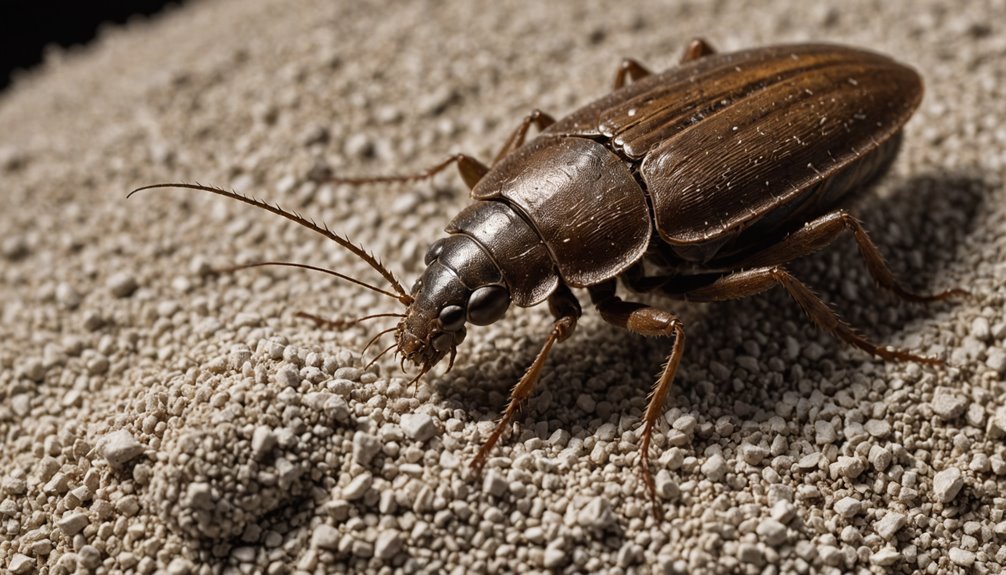
How quickly does diatomaceous earth kill cockroaches? Some die within 4 hours of contact, while others take up to 24 hours or longer. One real-world test showed a roach dying around 8–10 hours after exposure.
Because DE works by drying out the insect rather than poisoning it, death isn’t immediate.
For full infestation control, expect a longer wait. Visible results often begin within 48 hours, but complete control typically takes 2–4 weeks. Since DE doesn’t kill eggs, newly hatched roaches keep emerging, requiring ongoing exposure over time.
Several factors affect the timeline. High humidity reduces effectiveness, and roaches must actually crawl through the dust.
Larger infestations naturally take longer. Plan on consistent treatment for at least a month to break the full population cycle. DE works by destroying the wax layer on insect skin, causing gradual dehydration rather than delivering a fast-acting chemical kill.
Where to Apply Diatomaceous Earth for Cockroaches
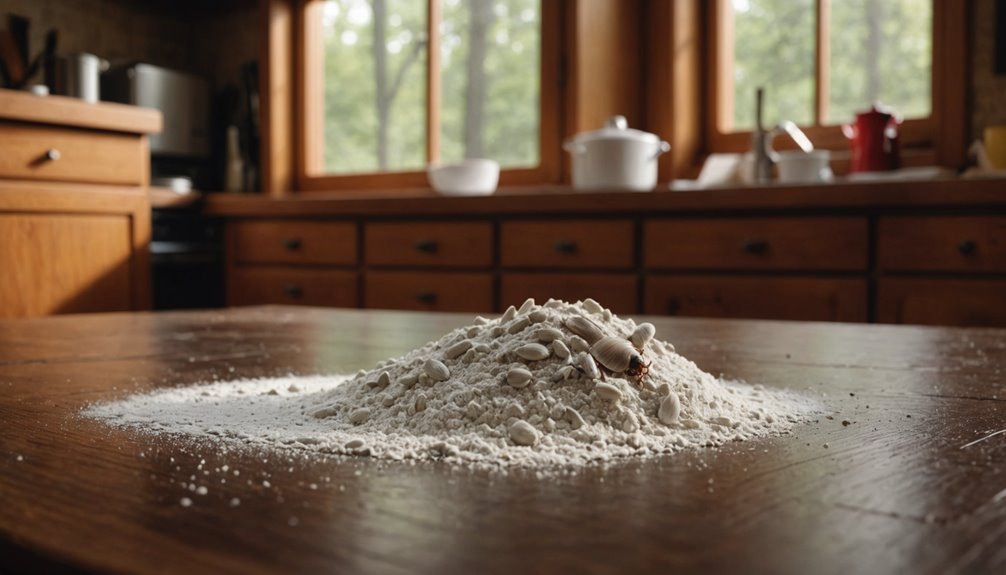
To get the best results from diatomaceous earth, you need to apply it where cockroaches actually spend their time.
Dust lightly into cracks and crevices, behind kitchen appliances like refrigerators and stoves, and along baseboards where roaches travel.
You’ll also want to treat entry points such as window sills and door frames to stop roaches before they move deeper into your home. Keep in mind that DE requires direct contact with cockroaches to work effectively.
Cracks and Crevices
Cracks and crevices are where cockroaches spend most of their time, making them the most important places to apply diatomaceous earth. Use a flashlight to confirm active use before treating, then apply a light dusting directly into narrow cracks, seam lines, and trim joints where roaches travel.
Dust wall void openings, pipe gaps, and wire penetrations where cockroaches shelter out of sight. At baseboards, treat the crack where the wall meets the floor, since roaches commonly follow these edges.
Inside cabinets, target corner joints and interior seams rather than open shelves. Around windows and the foundation, apply DE to small exterior cracks only when surfaces are dry, and reapply after rain.
Keep all layers thin so roaches walk through the powder rather than around it.
Behind Kitchen Appliances
Behind kitchen appliances, there are 4 major harborage zones you’ll want to treat: behind the refrigerator, stove, dishwasher, and microwave. Roaches shelter in the warmth and darkness these spots provide, so precise placement matters.
Before applying, clean away grease, crumbs, and debris, then vacuum any visible activity.
Follow these steps for effective application:
- Pull each appliance forward to expose the rear wall gap and floor space directly behind it.
- Use a duster or puffer to apply a barely visible film along the back wall line.
- Keep DE dry and away from dishwasher leaks or refrigerator condensation, since moisture kills effectiveness.
Reapply only after wetting or cleaning, and wear gloves, eyewear, and a mask throughout the process.
Entry Points and Baseboards
Entry points and baseboards are 2 of the most effective areas to treat because roaches use them as both access routes and travel corridors. Apply a thin, barely visible layer along baseboards, into cracks near wall edges, and at any gaps where roaches can enter. Keep DE dry, and reapply after disturbance.
| Location | Application Tip |
|---|---|
| Window sills and door frames | Dust lightly at suspected access points |
| Baseboard edges and corners | Apply a fine, even layer along travel routes |
| Cracks and crevices near baseboards | Use a duster to push DE into narrow gaps |
Pair these treatments with caulking small gaps and foam-sealing larger ones to reduce reinfestation pressure while DE does its work.
How to Apply DE So Cockroaches Can’t Avoid It
Getting DE to work means placing it where cockroaches already travel rather than where it’s convenient to apply. Focus on the routes they actually use, not open floor space.
Apply it correctly with these three rules:
- Dust lightly — a barely visible film works better than piles; heavy application causes roaches to avoid the area entirely.
- Target tight spaces — push DE into cracks, crevices, and voids so it intercepts movement along hidden travel routes.
- Use a duster or squeeze bottle — precise applicators let you place narrow trails along baseboards and walls instead of spreading dust randomly.
You’re not trying to coat every surface. You’re creating unavoidable contact points directly along the paths cockroaches already take nightly.
Is Diatomaceous Earth Safe to Use Indoors?
Food-grade DE is generally safe for indoor use, but how you apply it determines how safe it actually is. The biggest risk is inhalation. When you apply DE, wear a dust mask, gloves, and eye protection to avoid breathing in particles or irritating your skin and eyes.
Use only EPA-registered, food-grade products and follow label directions exactly. Apply thin, targeted layers in areas with minimal foot traffic.
Keep DE away from vents, fans, and HVAC returns, which can push dust into the air you breathe.
Keep children and pets out of treated areas until the dust fully settles. The less DE you use and the more precisely you place it, the safer your indoor environment stays.
Why DE Alone Won’t Eliminate a Cockroach Infestation
Diatomaceous earth can kill cockroaches, but it won’t eliminate an infestation on its own.
It works too slowly, leaves survivors capable of reproducing, and loses effectiveness anywhere moisture is present or roaches avoid treated areas.
You’ll get far better results by combining DE with sanitation, baiting, and targeted treatment of harborage zones.
DE Works Slowly
While DE can be a useful tool in your pest-control arsenal, it works too slowly to eliminate a cockroach infestation on its own. After roaches crawl through the dust, dehydration takes time, meaning death can occur anywhere from 24 hours to a full week later. That delay keeps active roaches moving through your home long before the treatment takes effect.
Here’s what slow kill time actually means for your infestation:
- Roaches stay mobile long enough to retreat to hidden harborage areas before dying.
- Hidden roaches continue reproducing while exposed ones die gradually.
- Heavy infestations need rapid knockdown, which DE simply can’t deliver.
For faster results, consider pairing DE with quicker-acting methods like chemical treatments or boric acid.
Infestations Need Multiple Approaches
That slow kill time points to a bigger problem: DE can’t handle a cockroach infestation on its own. Cockroaches hide in wall voids, cracks, and harborages that a single dust treatment can’t reach. If you miss those spots, survivors keep reproducing and the infestation holds.
A complete strategy layers several methods together. Gel baits and bait stations target active populations where cockroaches feed. Insect growth regulators suppress breeding over the long term—something DE simply doesn’t do.
Boric acid outperforms DE for cockroach control according to University of Kentucky Entomology. Caulking cracks, sealing pipe penetrations, and adding door sweeps cut off entry points so new roaches can’t replace the ones you’ve eliminated.
DE plays a role, but it can’t carry the whole job.
Sanitation Gaps Undermine Results
Even when DE is applied correctly, sanitation gaps can quietly cancel its effectiveness. Cockroaches need food, water, and shelter to survive—and if those resources stay available, they’ll keep thriving regardless of what you’ve dusted.
Three sanitation failures that undermine DE:
- Food access – Unwashed dishes, exposed pet food, and crumbs in cracks feed roaches overnight, sustaining populations DE can’t eliminate alone.
- Moisture sources – Leaky faucets, slow drains, and humid bathrooms give cockroaches the water they need to survive long-term.
- Hidden harborage – Gaps around pipes, deteriorated caulk, and cabinet voids keep roaches sheltered in areas DE may never reach.
You’re not just fighting insects—you’re fighting the conditions that support them. Fix those conditions first.
How to Build a Complete Cockroach Control Plan Around DE
Diatomaceous earth works best when it’s part of a larger cockroach control strategy rather than a standalone fix. Pair it with sanitation, sealing, and monitoring to get real results.
| What You Do | What It Stops |
|---|---|
| Seal cracks and pipe gaps | Roaches entering your home |
| Remove food waste and clutter | Roaches surviving inside |
| Apply DE along edges and harborage | Roaches traveling undetected |
Start by cleaning, drying, and inspecting your space. Then apply a thin DE layer along wall-floor junctures, under appliances, and inside crevices. Seal entry points with caulk or spray foam. For active infestations, add baits alongside DE since DE alone may not be enough. Remove trash frequently, store food in sealed containers, and reapply DE after cleaning or moisture exposure.
Frequently Asked Questions
Can Diatomaceous Earth Be Used Outdoors During Rainy Seasons?
Yes, you can use diatomaceous earth outdoors during rainy seasons, but it’s less reliable. Apply it in protected, dry spots, reapply after rain, and plan applications around a 24-hour rain-free window.
Does Diatomaceous Earth Have an Expiration Date or Shelf Life?
DE doesn’t have an expiration date. Since it’s a mineral-based material, it won’t spoil like organic products. You can store it indefinitely if you keep it dry, sealed, and free from contamination.
Will Diatomaceous Earth Harm Pets That Walk Through Treated Areas?
Food-grade DE won’t seriously harm pets walking through treated areas, but it can irritate their eyes and respiratory tract. You’ll want to apply thin layers, let dust settle 30–60 minutes before allowing pet re-entry.
Can Cockroaches Carry Diatomaceous Earth Back to Their Nest?
Yes, cockroaches can carry DE back to their nest on their legs, but it’s not the main way it works. You’ll get better results by dusting lightly along travel paths and cracks.
Should Diatomaceous Earth Be Reapplied After Professional Pest Control Treatments?
You’ll likely need to reapply DE after professional treatments if technicians vacuumed, mopped, or wiped treated surfaces. Check your cracks and crevices, and reapply only where the fine, dry dust is no longer visible.
Conclusion
Diatomaceous earth can be a powerful tool in your fight against cockroaches, but it’s not a magic fix. You’ll get the best results when you combine it with good sanitation habits and other control methods. Apply it correctly, stay consistent, and don’t expect overnight results. If your infestation’s severe, you shouldn’t hesitate to bring in a professional. Used strategically, DE can be a key part of keeping your home cockroach-free.
