
Ultrasonic Pest Repellers Cockroaches
You’ve probably seen ultrasonic pest repellers at hardware stores and wondered if they’re worth trying against cockroaches. They seem like a clean, effortless fix. But the reality is more complicated than the packaging suggests. Before you plug one in and call it a day, you need to know what the science actually says.
Key Takeaways
- Ultrasonic pest repellers show inconsistent and unreliable results against cockroaches, with independent reviews reporting largely negative or inconclusive evidence.
- Devices emit high-frequency sound waves between 20–100 kHz, but walls, furniture, and clutter block signals, creating hidden zones for cockroaches.
- Cockroaches habituate to ultrasonic sound over time, diminishing any initial repellent effect and allowing them to return.
- The FTC has warned manufacturers about unsupported efficacy claims, as little competent scientific evidence validates ultrasonic repellers for pest control.
- Proven alternatives include sealing entry points, sanitation, gel baits, boric acid dusts, and sticky traps to monitor and reduce cockroach activity.
Do Ultrasonic Pest Repellers Work on Cockroaches?
When it comes to cockroaches, ultrasonic pest repellers simply don’t deliver reliable results. Multiple pest-control sources confirm these devices produce inconsistent outcomes, and Kansas State University research found they’ve little meaningful effect on cockroach behavior.
A 2023 lab study did report a 30.7% repellent effect and 40.8% lethal effect under controlled conditions, but real-world performance tells a different story.
Ultrasonic sound has a short range, furniture and walls block it easily, and cockroaches hiding in harborage areas receive minimal exposure. Continuous sound also causes habituation, further reducing any temporary reaction.
You shouldn’t rely on these devices as a primary solution. They don’t eliminate food, water, or entry points, meaning the infestation continues regardless of the sound. Unlike ultrasonic devices, roach bait stations have proven far more effective at actually eliminating cockroach populations.
What Ultrasonic Pest Repellers Actually Are
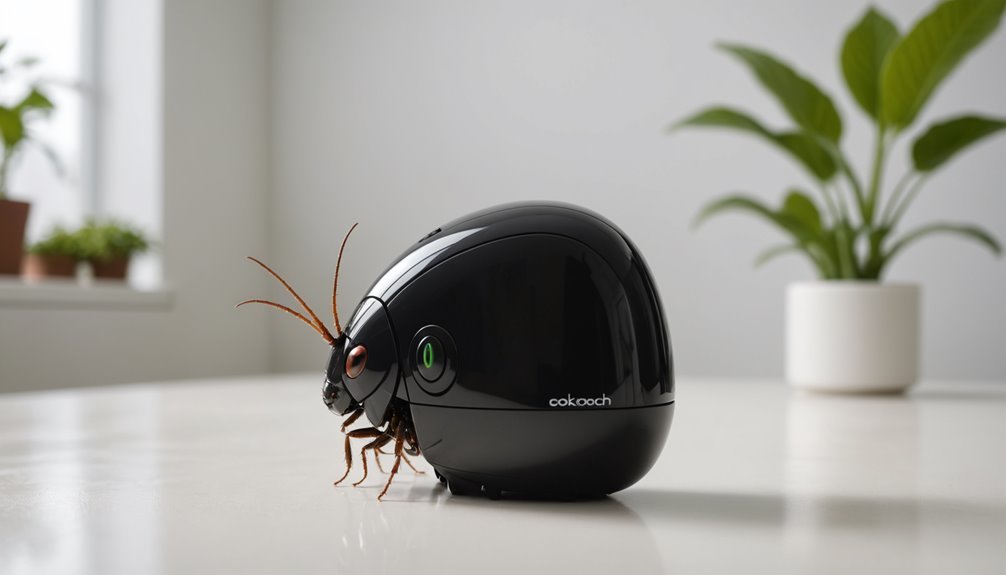
Ultrasonic pest repellers are small electronic devices that emit high-frequency sound waves above the range of human hearing, which manufacturers claim creates an uncomfortable environment that drives pests away.
You’ll typically find them marketed as plug-in units for indoor use, with claims covering everything from cockroaches and mosquitoes to rodents and fleas.
The core selling point is straightforward: no chemicals, no traps, just sound energy that’s supposed to make pests leave and stay gone. Some models are battery-operated for outdoor use as well.
How They Work
Sold in hardware stores and online marketplaces, ultrasonic pest repellers are plug-in electronic devices that emit high-frequency sound waves above 20,000 hertz—beyond the range of human hearing.
Some units operate between 20 kHz and 100 kHz, and certain products also claim electromagnetic output or microvibrations alongside the ultrasonic signal.
The intended mechanism is auditory disruption. The sound is supposed to make the surrounding environment irritating or uncomfortable enough that pests leave the area.
In theory, repeated exposure keeps pests from returning if they can’t adapt to the signal.
However, the waves are directional and lose roughly half their energy within 15 feet.
Walls, furniture, and other obstacles weaken the signal further, limiting any real effect to small, open spaces near the unit. Many models include adjustable frequency settings to better target specific pest species.
Key Marketing Claims
Despite operating through a mechanism that’s already limited in scope, ultrasonic pest repellers are marketed as a thorough, chemical-free solution to household pest problems.
You’ll typically find them promoted as plug-in units that emit high-frequency sound inaudible to humans but disruptive to pests like cockroaches, rodents, ants, spiders, mosquitoes, and bed bugs.
Manufacturers claim the sound creates an acoustically hostile environment that disrupts feeding, breeding, nesting, and communication.
Some go further, implying the devices can injure or kill pests outright. The messaging consistently frames them as a simple, non-toxic alternative to traps and pesticides.
What you won’t see in those ads is mention of the FTC’s warnings that many of these claims lacked competent and reliable scientific evidence to support them. Over 60 manufacturers and retailers of these devices received warning letters from the FTC for making claims that may violate the FTC Act’s prohibition on false and deceptive advertising.
What Research Shows About Ultrasonic Repellers and Cockroaches
Even when cockroaches initially react to ultrasonic sound, that response is short-lived.
Cockroaches may react to ultrasonic sound at first, but that response fades fast.
They habituate quickly, making any early avoidance effect meaningless for controlling an infestation.
The FTC issued warning letters to over 60 companies in 2001 for making unsupported efficacy claims about these devices.
Independent reviews describe the overall evidence as inconsistent to negative, meaning you shouldn’t rely on ultrasonic repellers as a primary cockroach control method. Research testing frequencies between 20 and 100 kHz found that greatest repellency occurred at only 35 and 40 kHz, highlighting how narrow and specific any measurable effect truly is.
The One Study That Found Measurable Effects on Cockroaches
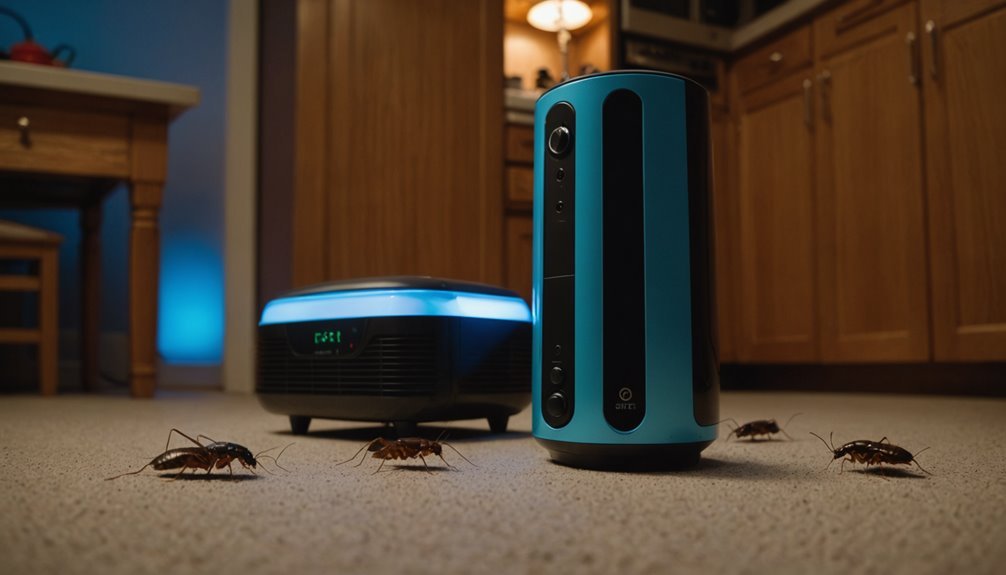
One study on German cockroaches stands out from the rest, reporting a 30.7% overall repellent effect and a 40.8% overall lethal effect from ultrasonic exposure.
The effects hit males harder than females, with male repellency at 19.9% versus 10.7% for females, and male lethal effect at 23.8% versus 17% for females.
However, these results came from controlled laboratory conditions, not real-world settings, and they contrast sharply with the broader body of research that found little to no effect on German cockroaches.
Study’s Key Findings
While most evaluations of ultrasonic pest repellers report little to no measurable effect, a laboratory study on German cockroaches stands out as a notable exception.
The researchers tested whether specific ultrasonic frequencies could repel, injure, or kill cockroaches under controlled conditions, and they found results worth noting.
The study reported a 30.7% overall repellent effect, broken down as 10.7% in females and 19.9% in males. The lethal effect was even higher, reaching 40.8% overall, with 17% in females and 23.8% in males.
Males responded more strongly than females across both categories.
These findings show that ultrasound can produce measurable behavioral and lethal effects on German cockroaches, though you should remember these results came from controlled lab exposure, not consumer plug-in devices used in real homes.
Limitations and Practical Implications
Those lab results carry real weight, but they come with limits you need to understand before drawing broader conclusions. The effects were frequency-specific, species-specific, and measured under controlled conditions—not in cluttered homes where walls and furniture scatter sound.
| Factor | Lab Condition | Real-World Reality |
|---|---|---|
| Species tested | German cockroaches only | Other species untested |
| Sound environment | Open, controlled space | Walls and furniture block waves |
| Frequency used | 35–85 kHz (specific) | Commercial devices vary widely |
| Outcome achieved | Partial repellency/lethality | Full elimination not demonstrated |
You’re also looking at 30.7% repellency and 40.8% lethality—not eradication. Cornell, the University of Arizona, and other reviewers found little to no effect overall, making this study an exception, not the standard.
Why Results in Real Homes Fall Short of Lab Findings
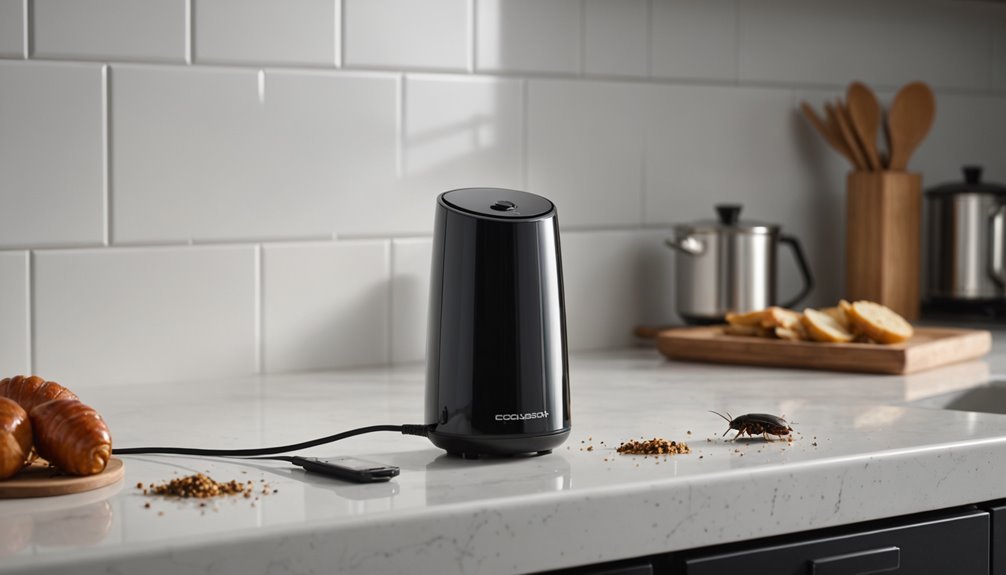
Even when laboratory tests show some pest response to ultrasound, those results rarely translate to real homes. Labs use idealized conditions that isolate sound exposure, but your home adds competing cues like food, moisture, and shelter that can mask any minor behavioral effect.
Commercial devices also use simpler output patterns than lab-grade equipment, making direct comparisons unreliable.
Your home’s layout creates additional problems. Walls, furniture, and clutter block ultrasonic signals, creating shadowed zones where cockroaches remain completely unaffected.
A single plug-in unit can’t deliver uniform coverage across partitioned or cluttered spaces the way an open lab environment can.
Even where cockroaches briefly react, they can habituate over time or return once survival pressures outweigh the annoyance, making any short-lived avoidance practically meaningless against a real infestation.
Why Cockroaches Are so Hard to Repel With Sound
Cockroaches are genuinely difficult to repel with sound because their biology works against the concept from the start. They don’t respond strongly to frequencies above 3,000 Hz, yet ultrasonic repellers emit between 20,000 and 40,000 Hz. That mismatch means the signal you’re relying on likely falls outside the range cockroaches even detect.
Cockroaches don’t strongly detect frequencies above 3,000 Hz—ultrasonic repellers emit far beyond that range.
Their behavior compounds the problem. They hide in cracks, wall voids, and appliance interiors where sound waves don’t penetrate consistently. Even when a device functions correctly, it can’t reliably reach where cockroaches actually live.
Lab results reflect this difficulty. Earlier studies found no repellent effect on German cockroaches at all. A later study recorded only a 30.7% repellent rate.
That’s not a failure of the device—it’s a failure of the concept against this particular pest.
What the FTC and Experts Say About Ultrasonic Cockroach Repellers
If you’re considering an ultrasonic cockroach repeller, you should know that the FTC has already scrutinized these products heavily, sending warning letters to more than 60 manufacturers in 2001 for making unsupported efficacy claims.
The agency requires companies to back pest-control claims with competent and reliable scientific evidence, and a 2003 settlement even barred unsubstantiated claims that such devices repel or eliminate cockroaches.
Independent experts agree with the FTC’s skepticism, as studies from Kansas State University and Cornell University both found that ultrasonic devices have little to no meaningful effect on cockroaches.
FTC Challenges Manufacturer Claims
Despite bold marketing claims, the FTC has repeatedly stepped in to challenge manufacturers of ultrasonic pest-control devices. In 2001, FTC staff sent warning letters to more than 60 manufacturers and retailers, stating that efficacy claims must be backed by competent and reliable scientific evidence or risk violating the FTC Act.
The FTC charged Lentek International with making false and unsubstantiated claims that ultrasonic and electromagnetic technology would drive away cockroaches and other household pests.
A 2003 consent agreement with Global Instruments went further, prohibiting claims that devices repel, control, or eliminate cockroaches without adequate substantiation.
If you’re considering an ultrasonic repeller, you should know the FTC found no reasonable basis for claims that these devices eliminate or repel pests, including cockroaches, from your home.
Expert Consensus on Effectiveness
Both the FTC and independent experts agree that ultrasonic devices don’t work reliably against cockroaches. University-based studies found little measurable effect, and entomologists confirm these devices have never proven effective as control tools. Cockroaches prioritize food, water, and shelter over any temporary sound-based avoidance.
| Factor | Impact on Effectiveness |
|---|---|
| Habituation | Cockroaches adapt quickly, reducing any initial response |
| Physical barriers | Walls and furniture block ultrasonic output |
| Survival drives | Hunger and thirst override short-lived avoidance behavior |
You shouldn’t rely on a plug-in unit to eliminate an infestation. Doing so creates a false sense of security that delays proven treatments like sanitation, exclusion, and baiting—methods that actually address harborage sites and food sources.
How Ultrasonic Repellers Fit Into a Broader Pest Control Plan
When building a pest control plan, you should treat ultrasonic repellers as a low-evidence supplemental option at best, not a primary tool. Independent testing shows little meaningful effect on cockroaches, and any temporary disturbance fades as pests habituate.
Before considering a device, prioritize these proven measures:
Before reaching for any device, proven measures like sanitation, exclusion, and monitoring must come first.
- Inspection and identification – locate harborages and confirm the species driving the infestation
- Sanitation and moisture control – eliminate the food, water, and shelter conditions devices can’t address
- Exclusion – seal cracks and entry points that electronic signals can’t close
- Monitoring – use sticky traps to track whether activity is increasing or decreasing
If you add an ultrasonic device afterward, treat it as an optional add-on. Don’t let it delay stronger interventions or create false confidence about control.
Cockroach Control Methods That Actually Work
Shifting focus from what doesn’t work to what does, the most reliable cockroach control starts with removing the conditions that let them thrive.
Store food in tight-fitting containers, clean up spills immediately, and never leave dishes or pet food out overnight. Fix leaky pipes and faucets, address condensation with better ventilation, and block drains when they’re not in use.
Seal cracks around doors, windows, and pipe penetrations using caulk, foam, or copper mesh.
Place sticky traps along walls, under appliances, and near exterior doors to identify where activity is highest. For treatment, apply gel bait in small dabs inside cracks and crevices, and position bait stations flush against edges.
Dusts like boric acid and diatomaceous earth work well in voids and harborage areas.
Signs Your Cockroach Problem Needs Professional Treatment
Most cockroach infestations don’t announce themselves all at once, but several warning signs suggest you’ve moved past DIY territory. If you’re noticing any of the following, it’s time to call a professional:
- Daytime sightings in multiple rooms, especially kitchens, cabinets, or near appliances
- Droppings, egg cases, or shed skins accumulating near baseboards, food sources, or plumbing
- A persistent musty or oily odor in warm, damp areas even when live roaches aren’t visible
- Continued activity after DIY treatments, including baits, sprays, or traps
These signs collectively indicate an established, spreading infestation that spot treatments can’t resolve.
German cockroaches are particularly prolific, and missing even one harborage area allows the population to rebound quickly.
Frequently Asked Questions
Can Ultrasonic Repellers Harm Pets or Other Animals in the Home?
Ultrasonic repellers can’t physically harm your cats or dogs, but they may stress your small pets like rabbits, guinea pigs, and hamsters. You should monitor your animals’ behavior and stop using the device if they seem anxious.
How Much Do Ultrasonic Pest Repellers Typically Cost to Purchase?
You’ll typically spend around $10 to $30 per unit for basic indoor models. Bundle packs can lower your per-unit cost notably, making multi-packs a smart choice if you’re covering several rooms.
Are Ultrasonic Pest Repellers Safe to Use Around Babies and Children?
They’re generally considered low risk around babies and children since they use sound waves instead of chemicals or toxins. However, evidence isn’t conclusive, so you should always follow manufacturer directions carefully.
Do Ultrasonic Repellers Affect Beneficial Insects Like Bees or Butterflies?
Ultrasonic repellers likely won’t greatly harm bees or butterflies, but you should stay cautious. Bees may lack ultrasonic hearing, and current studies don’t show strong evidence of harm to beneficial insects near these devices.
How Long Do Ultrasonic Pest Repeller Devices Typically Last Before Replacement?
You’ll typically need to replace your ultrasonic pest repeller every 3 to 5 years. Higher-quality models can last up to 7 years, but you should replace yours sooner if you notice reduced effectiveness or increased pest activity.
Conclusion
Ultrasonic pest repellers aren’t a reliable solution for cockroaches in your home. While they might show some effect in controlled settings, you can’t count on them to handle a real infestation. Instead of wasting time and money on unproven devices, you’re better off using proven methods like bait stations, boric acid, and sealing entry points. If your problem persists, don’t hesitate to call a professional pest control service.
