
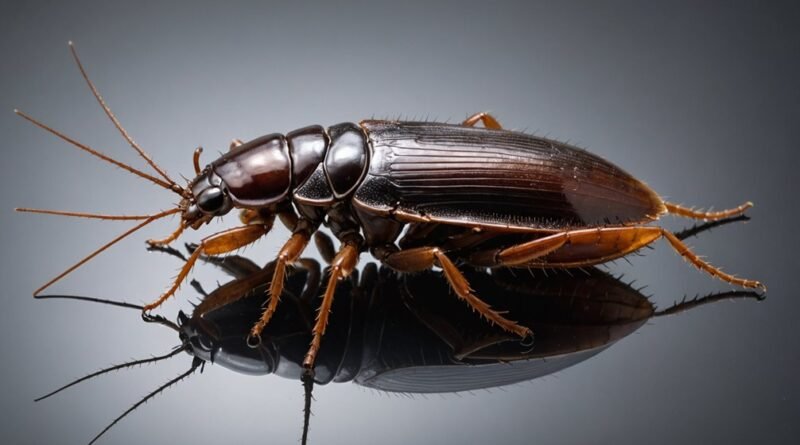
Why Do Cockroaches Die on Their Backs
When a cockroach dies on its back, it’s not random — it’s a chain reaction of physical and biological failures. Insecticides disrupt its nervous system, triggering violent spasms that flip it over. Its top-heavy body and rounded exoskeleton make recovery nearly impossible, and muscle failure prevents its legs from generating enough force to right itself. Smooth indoor surfaces make things even worse. There’s actually a lot more to this phenomenon than you’d expect.
Key Takeaways
- Insecticides disrupt cockroaches’ nervous systems, causing spasms that flip them onto their backs, where muscle failure prevents recovery.
- Cockroaches have a top-heavy, rounded body design that makes them naturally prone to tipping and difficult to right themselves.
- Smooth indoor surfaces lack the traction cockroaches need to flip back over once inverted.
- Healthy cockroaches can right themselves, but weakened, poisoned, or injured ones permanently remain stuck on their backs.
- Not all cockroaches die on their backs; confined spaces, predators, and environmental conditions can alter their final position.
The Real Reason Cockroaches End Up on Their Backs
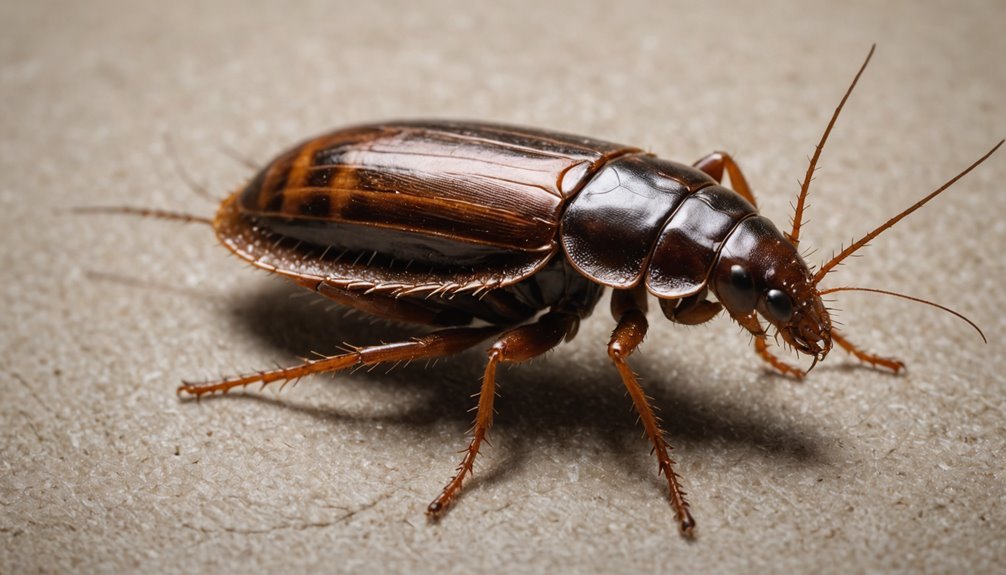
When a cockroach dies on its back, it’s not following some built-in biological script — it’s losing control. The position isn’t a deliberate outcome. It’s the result of several systems failing at once.
When a cockroach is poisoned, the insecticide disrupts its nervous system first. You’ll often see spasms, twitching, and uncoordinated leg movement before the insect goes still. Those final thrashes can easily flip it over.
Once it’s upside down, muscle failure takes over. Without functional muscle tension, it can’t perform the coordinated rocking motion needed to right itself.
Surface conditions make things worse. On smooth indoor floors, there’s little traction for its legs to push against. Even a healthy cockroach struggles on slick surfaces — a dying one has no chance.
What you’re seeing isn’t a death pose. It’s the combined result of nerve disruption, muscle failure, and poor traction leaving the insect exactly where it fell. It’s worth noting that healthy cockroaches can typically right themselves with ease when their muscles and nervous system are still functioning properly.
Why a Cockroach’s Top-Heavy Body Makes It Easy to Flip
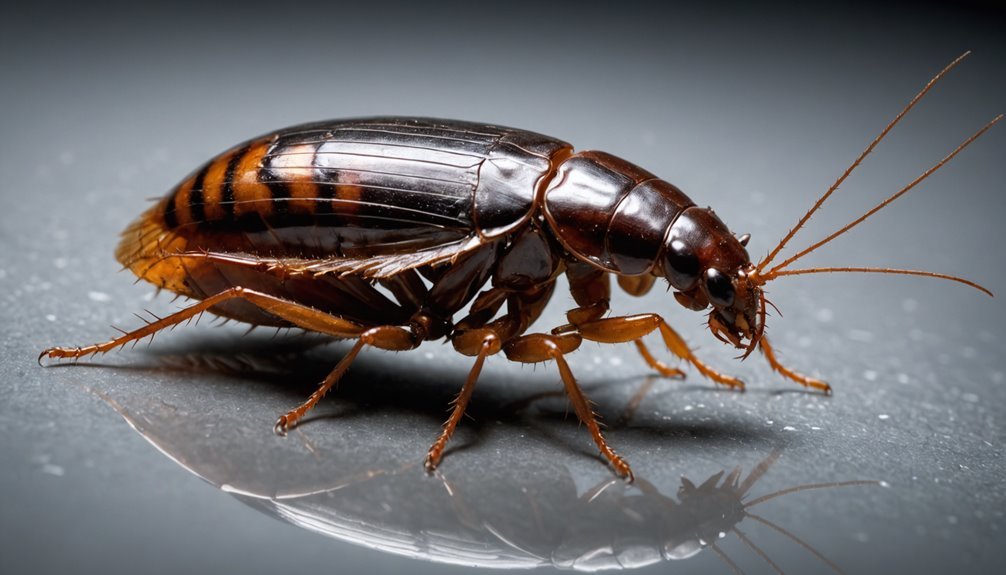
When you look at a cockroach’s body, you’re seeing a top-heavy design where most of the mass sits high and toward the rear, meaning it takes very little tilt before the insect loses balance.
The rounded exoskeleton cuts down on frictional contact with the floor, so once it tips over, its back can’t grip the surface to help anchor a recovery.
Its long legs, built for speed and rough terrain, suddenly work against it on smooth floors, swinging without finding the leverage needed to rock the body upright. Healthy cockroaches, however, can typically use their legs to grab onto surfaces and right themselves when accidentally flipped.
High Center of Gravity
Because cockroaches carry most of their body mass in the abdomen, they’ve got a relatively high center of gravity that makes them easy to tip over. Long, thin legs elevate the body further, shifting the mass upward and reducing stability. When a cockroach weakens, it loses the ability to make small balance corrections, allowing the center of mass to drift beyond the leg support base.
| Factor | Healthy Cockroach | Weakened Cockroach |
|---|---|---|
| Balance corrections | Frequent, effective | Minimal, ineffective |
| Center of gravity | Managed actively | Uncontrolled |
| Tipping risk | Low | High |
Once that threshold is crossed, tipping becomes inevitable rather than recoverable. A top-heavy body combined with declining muscle control creates the perfect conditions for an irreversible fall onto the back. Healthy cockroaches actually use a six-legged tripod gait to distribute weight evenly and maintain stability during movement, a system that completely breaks down once muscle function deteriorates.
Rounded Exoskeleton Reduces Traction
The high center of gravity sets a cockroach up to tip, but its rounded exoskeleton makes recovery nearly impossible once that tipping starts. The shell’s dome-like curve concentrates contact onto a small area, so instead of lying flat, the body rolls past its balance point.
There’s no friction to stop that motion either. Unlike the spines, claws, and pads on its legs, the smooth dorsal shell offers almost no grip against the floor.
Once inverted, the cockroach loses every traction advantage it normally depends on. Its legs can’t reach a stable surface, and the curved shell slides rather than anchors.
The same architecture that protects it from compression actively works against recovery, leaving it stranded on a surface it can’t push against. The exoskeleton’s chitin-protein matrix is built for strength and flexibility, not for generating the friction needed to right itself on a smooth surface.
Legs Struggle for Leverage
Flipping a cockroach isn’t hard precisely because its body works against it. Its long legs lift the body well off the ground, but that height raises the center of gravity and makes tipping more likely when support weakens.
Most of its mass sits above the leg line, so any loss of balance shifts the body downward fast.
Once it’s upside down, recovery requires strong leverage against the surface. The cockroach needs to push and twist its way back onto its feet, but that’s difficult when its legs are already weakened by toxins, illness, or exhaustion.
The legs were built for walking, not for generating the precise rotational force a recovery demands. Without that leverage, it stays stuck. Its rounded, greasy back offers no friction against the surface, making it nearly impossible to gain any grip during a recovery attempt.
Why Do Insecticides Cause the Upside-Down Death Pose?
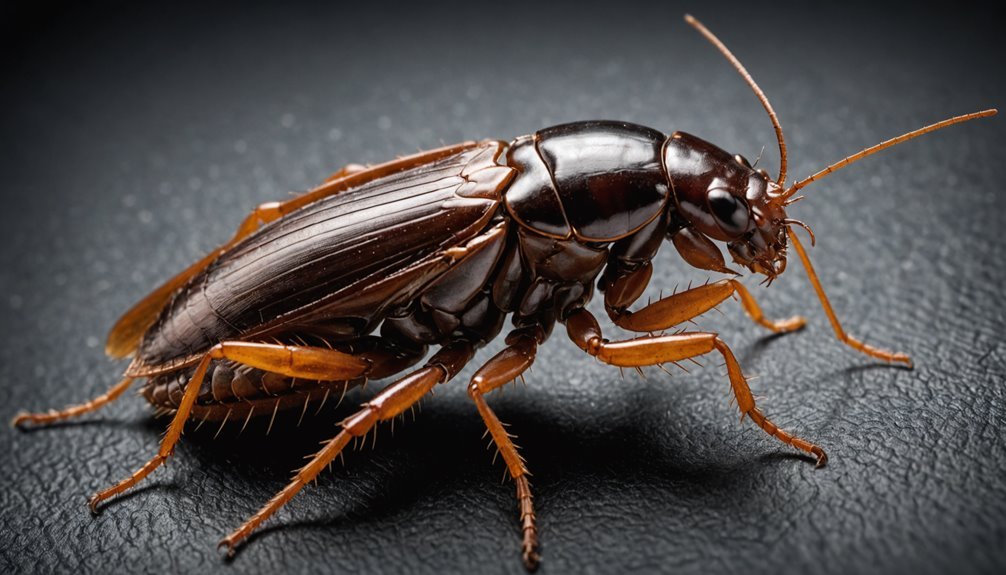
When a cockroach dies from insecticide exposure, it almost always ends up on its back — and that’s no coincidence. Insecticides attack the nervous system, triggering uncontrolled spasms that tip the roach over. Once inverted, its rounded back and high center of gravity make recovery nearly impossible.
| Factor | What Happens | Why It Matters |
|---|---|---|
| Neurotoxin exposure | Disrupts brain-muscle signals | Causes loss of coordination |
| Muscle spasms | Triggers erratic leg contractions | Physically flips the roach over |
| Rounded back shape | Removes stable contact points | Prevents the roach from righting itself |
You’re fundamentally watching three forces combine: chemical disruption, body geometry, and surface friction. Smooth indoor floors offer no traction, so the flailing legs can’t grip anything to push upright. The roach thrashes, goes still, and stays inverted. That upside-down pose isn’t peaceful — it’s the final stage of neuromuscular failure.
How Muscle Failure Leaves a Cockroach Stuck on Its Back
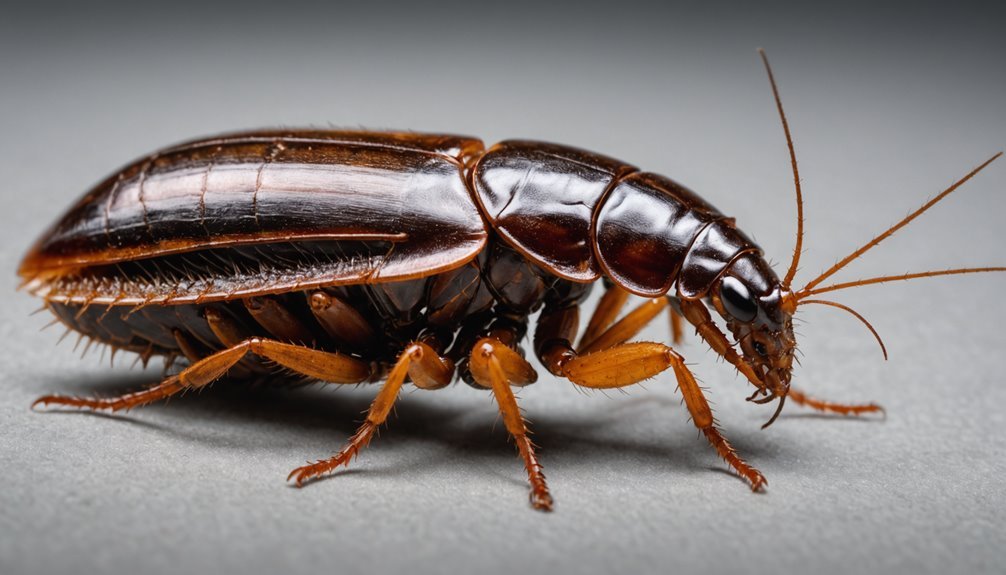
When a cockroach’s muscles begin to fail, its legs lose the grip and coordination needed to push the body upright.
Involuntary spasms then make things worse by forcing the legs to contract beneath the body, tipping the insect onto its back.
Once inverted, the same muscle failure that caused the fall prevents any effective recovery movement, locking the cockroach in place.
Weakening Legs Lose Grip
Once a cockroach’s muscles begin to fail, its legs lose the strength needed to maintain traction and posture.
You’ll notice that weakened legs fold or tuck inward, shrinking the support base that keeps the body upright. On smooth tile or hardwood, there’s almost no friction to compensate for that lost grip, so sliding and tipping become inevitable.
Once the cockroach flips onto its back, the legs can’t generate enough leverage to push the body upright again.
They may still move, but without coordinated strength, those movements accomplish nothing useful. The cockroach can’t stabilize itself long enough to recover balance.
Every failed attempt drains more energy, making the next attempt even less likely to succeed. The overturned position quickly becomes permanent.
Twitching Prevents Recovery
Muscle failure doesn’t just weaken a cockroach’s legs—it actively works against recovery through uncontrolled twitching and spasms. Once inverted, each spasm wastes energy without restoring balance. The nervous system’s breakdown turns movement into chaos rather than coordination.
| Twitching Phase | Effect on Recovery |
|---|---|
| Initial spasms flip the body | Inverted position begins |
| Erratic leg contractions continue | No coordinated righting motion |
| Paralysis overtakes spasms | Legs lose all effective force |
| Final stillness sets in | Death posture becomes permanent |
You’re seeing the result of a complete neuromuscular collapse. The cockroach’s righting reflex fails because its nervous system can no longer send proper signals. Twitching and paralysis aren’t separate problems—they’re one continuous sequence that keeps the cockroach stuck on its back until death.
Can a Cockroach Flip Itself Back Over?
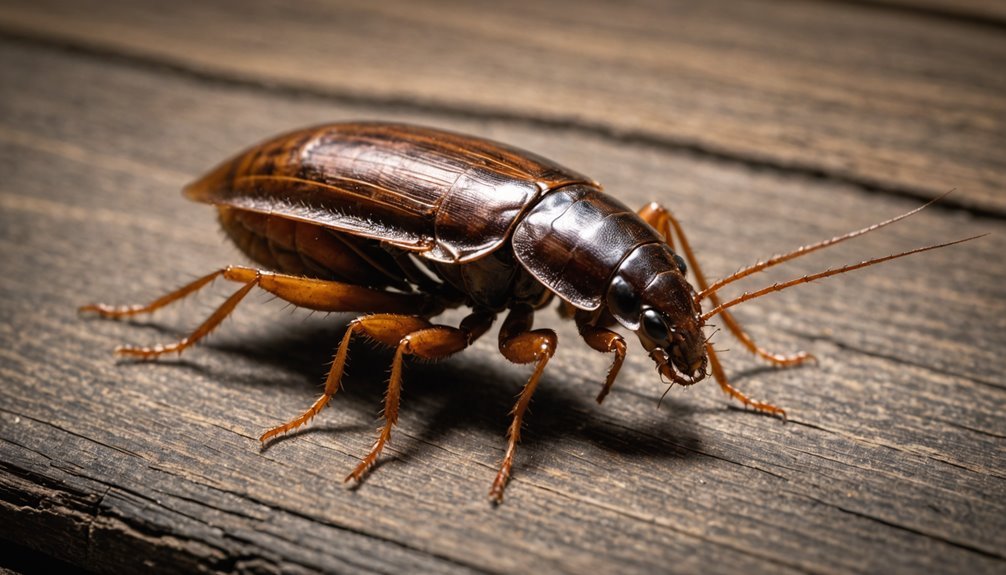
How a cockroach responds to being flipped upside down depends largely on its health. A healthy cockroach can usually right itself by using its six multi-jointed legs to generate enough momentum to roll back over.
A sensory organ in its head detects the inversion, and the nervous system immediately coordinates leg movement to correct its orientation.
However, several factors can prevent recovery. Smooth surfaces reduce traction, making it harder to push upright. Injury, dehydration, or old age can drain the strength needed to complete the flip.
Insecticides are particularly effective at stopping recovery because they disrupt the nervous system, triggering spasms and paralysis that leave the cockroach stuck on its back.
Does the Type of Floor Stop a Cockroach From Recovering?
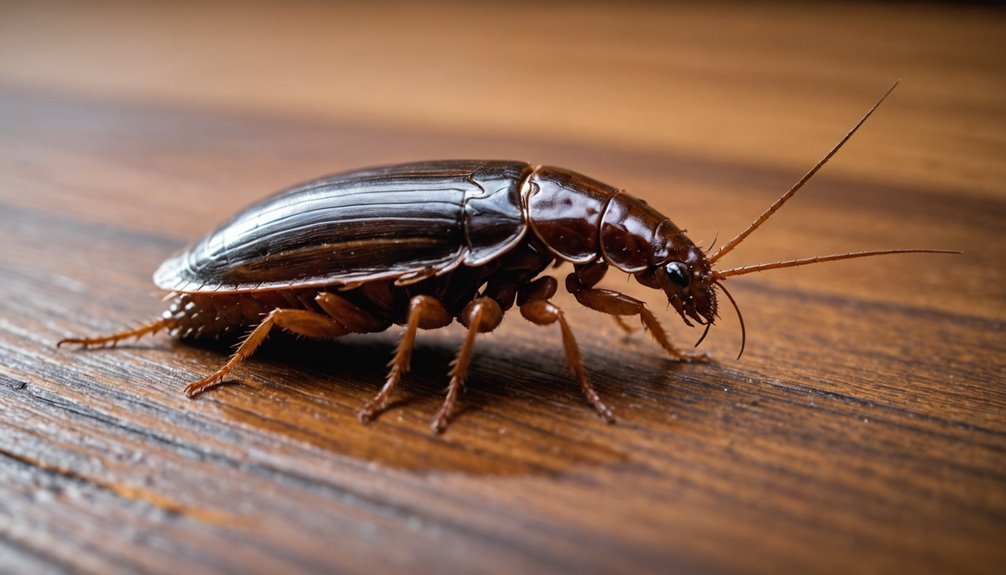
When a cockroach lands on its back, the floor beneath it can make a real difference in whether it recovers. Smooth, hard surfaces like tile or polished wood give its legs less traction, making it harder to brace and rotate upright. Textured surfaces offer more purchase, improving its chances of flipping over.
That said, floor type is just one factor. Cockroaches don’t spend much time on open floors anyway. They concentrate near wall-floor junctions, behind appliances, and inside cracks and crevices where shelter is available. These protected zones matter far more to their survival than whether you have tile or hardwood.
Moisture also outweighs flooring as a factor. Cockroaches need water to survive, and eliminating leaks or standing water puts more pressure on them than any floor surface will.
If you’re trying to reduce cockroach activity, focus on sealing entry points and removing moisture sources rather than changing your floors.
Do Cockroaches Always Die on Their Backs?
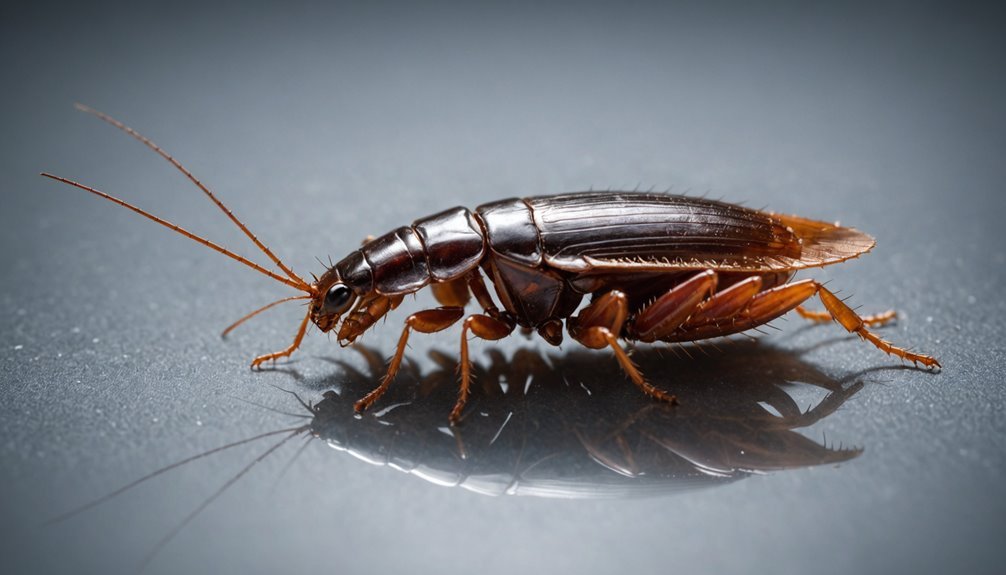
Floor type and traction play a role in how cockroaches meet their end, but that raises a broader question: do they always die on their backs in the first place? The short answer is no.
The belly-up posture is common indoors, especially after pesticide exposure, but it’s not a universal rule. In nature, predators, irregular surfaces, and quick deaths change the outcome entirely.
| Situation | Likely Death Posture | Reason |
|---|---|---|
| Pesticide exposure indoors | Upside-down | Nerve disruption causes spasms and flipping |
| Predator attack outdoors | Any position | Death occurs before posture can develop |
| Death in a crack or crevice | Upright or sideways | Confined space prevents tipping |
| Old age on a smooth floor | Upside-down | Muscle weakness prevents recovery |
You’ll most often see the belly-up position in homes, but it’s best described as a common sign of weakness or poisoning, not a guaranteed death pose.
Frequently Asked Questions
How Long Can a Cockroach Survive While Stuck on Its Back?
A cockroach you’ve found on its back can survive anywhere from a few minutes to several hours. If it’s been poisoned, it’ll die quickly. If it’s healthy, it might last much longer.
Do Baby Cockroaches Also Die on Their Backs Like Adults?
Yes, baby cockroaches, called nymphs, can also die on their backs just like adults. They share the same convex body shape, and if you’ve exposed them to pesticides or weakened them, they’ll struggle to flip back over.
Can Cockroaches Die Upside Down Outdoors as Well as Indoors?
Yes, cockroaches can die upside down outdoors just as they do indoors. You’ll find that the same mechanics apply, but natural surfaces like grass and soil often make upside-down carcasses less visible or obvious.
Are Certain Cockroach Species More Prone to Dying on Their Backs?
You’ll find that no single cockroach species is considerably more prone to dying on its back. All common household species share the same high center of gravity and body mechanics that make upside-down deaths equally likely when weakened.
Does Dying on Its Back Mean a Cockroach Is Definitely Dead?
No, a cockroach on its back doesn’t mean it’s definitely dead. You should check for leg movement, antenna motion, or responses to touch. These signs confirm death more reliably than its position alone.
Conclusion
So now you’ve got the full picture of why cockroaches end up on their backs when they die. It’s a combination of their top-heavy bodies, neurotoxic insecticides, and muscle failure that leaves them helplessly flipped over. Without a rough surface to grip, they can’t right themselves, and they’re done. Not every cockroach dies this way, but when you spot one belly-up, you’ll know exactly what happened.
