
Australian Cockroach Identification Guide
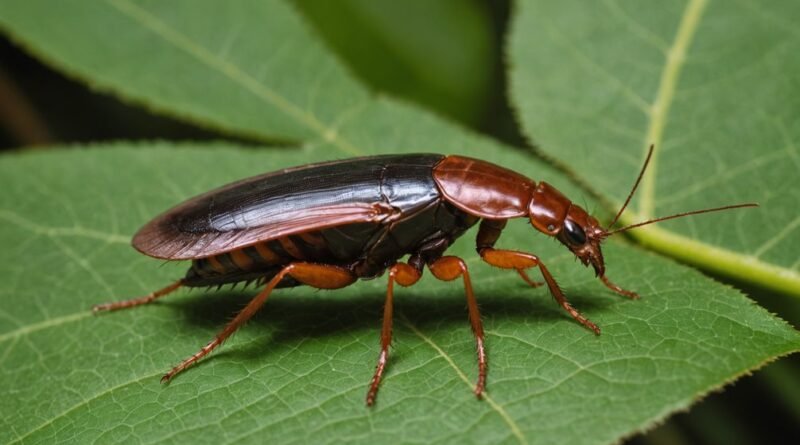
You can identify an Australian cockroach by its reddish-brown body, yellow margin along the pronotum, and yellow streaks running down its wings. Adults measure 23–35 mm, making them noticeably larger than German cockroaches but smaller than American cockroaches. They’re nocturnal, so you’ll likely spot them scattering when you turn on lights at night. If you suspect an infestation, there’s much more to know about their markings, hiding spots, and what’s attracting them indoors.
Key Takeaways
- Australian cockroaches are reddish-brown, 23–35 mm long, with a distinctive yellow margin on the pronotum and yellow wing streaks.
- The yellow pronotum marking is the most reliable feature distinguishing them from American, German, and Oriental cockroaches.
- Nymphs also display yellow markings, making early-stage identification possible before reaching adulthood.
- Signs of a cockroach infestation include black droppings, shed skins, oval egg cases, and chewed food packaging near warm, moist areas.
- They are most active nocturnally, especially within the first two hours after sunset, scattering when exposed to light.
What Does an Australian Cockroach Look Like?
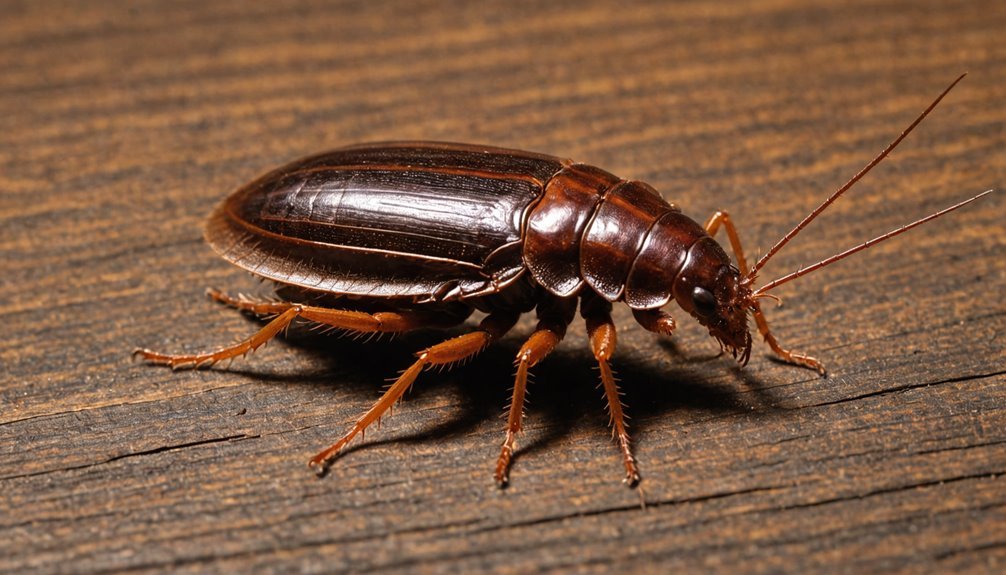
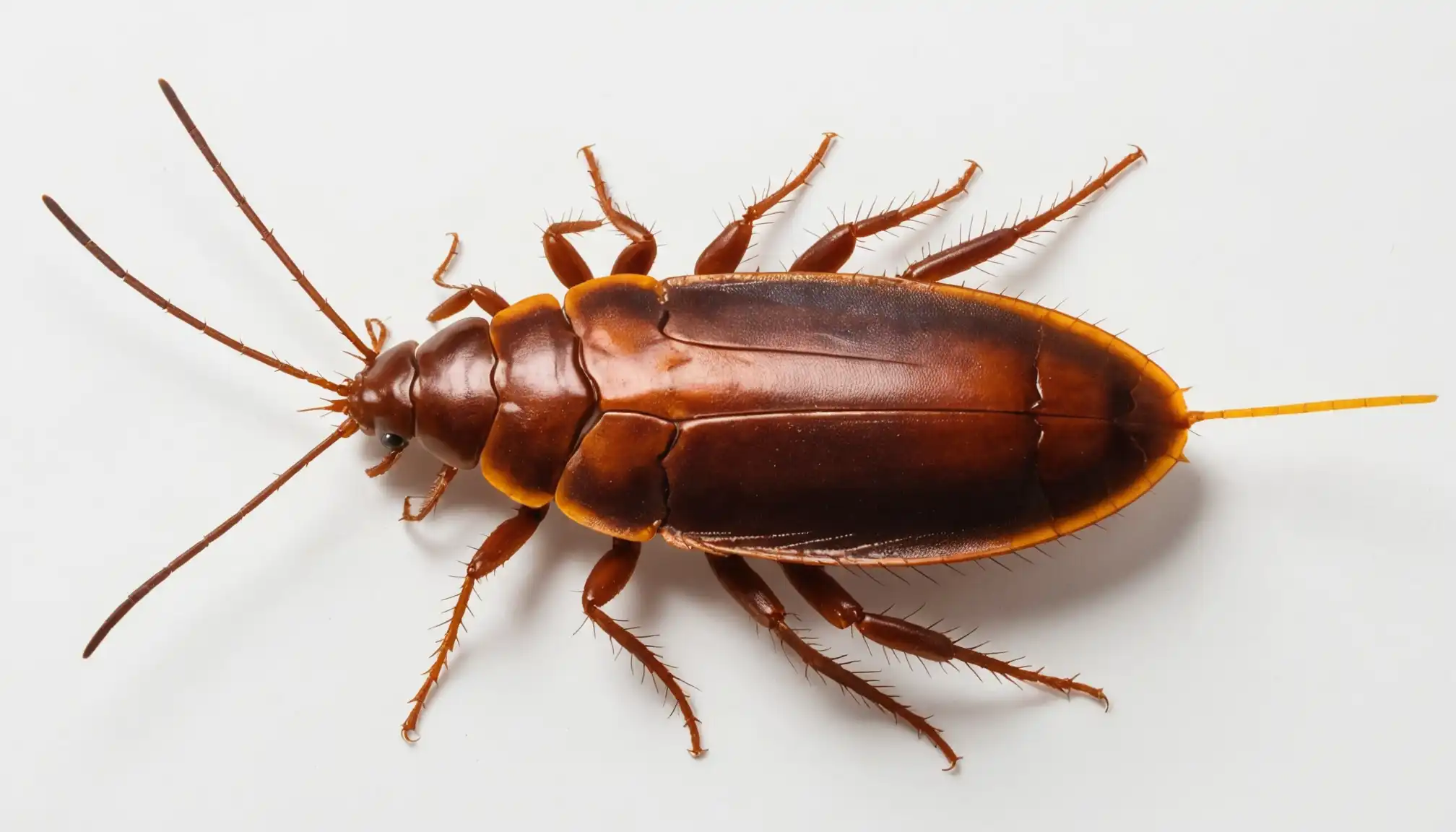
The Australian cockroach has a reddish-brown to dark brown body with a robust, oval shape that sets it apart from slimmer household species. You’ll notice that some individuals appear nearly black, and the coloring can shift slightly with age or environment. The body looks noticeably darker than many smaller common cockroach species.
One of the clearest identifiers is the yellow margin running along the pronotum, the shield-like plate just behind the head. You’ll also spot yellow streaks or bands along the sides of the wings, which extend fully over the abdomen and give the insect an elongated silhouette.
These wing markings are what most reliably separate it from the American cockroach. The head stays small and largely hidden beneath the pronotum, while the antennae are long and slender, sometimes stretching longer than the body itself.
Even nymphs can display yellow markings, making earlier identification possible. Adults typically measure 1.25 to 1.4 inches in length, making them a moderately large species compared to other household cockroaches.
How Big Do Australian Cockroaches Get?
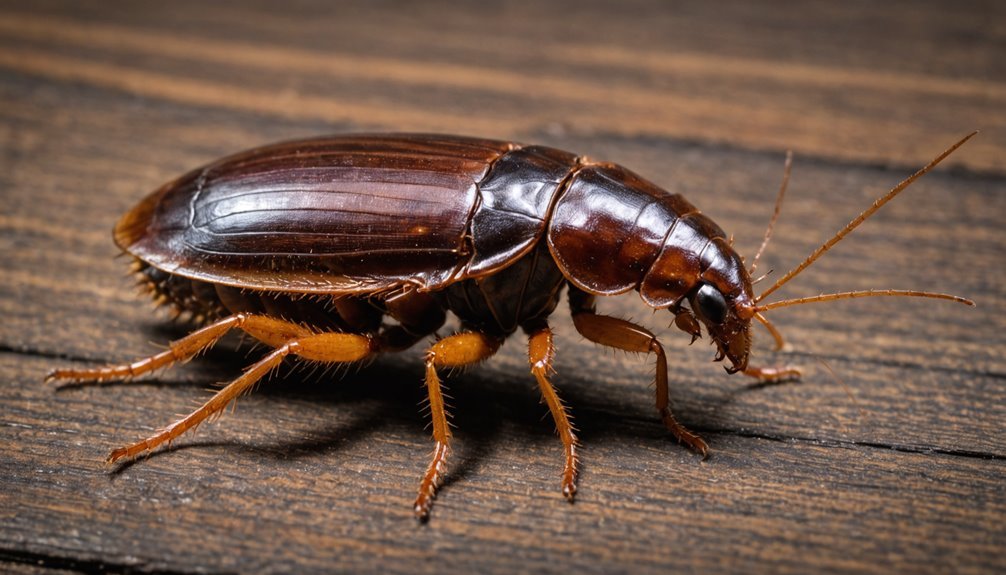
When you spot an Australian cockroach, you’re looking at an adult that typically measures 23–35 mm (roughly 1 to 1.5 inches) in body length, placing it firmly in the large cockroach category.
You’ll find it’s bigger than the German cockroach (13–16 mm) and the Oriental cockroach (20–25 mm), yet noticeably smaller than the American cockroach, which can reach 53 mm.
Females tend to run slightly larger than males, so the size you observe can shift depending on which sex you’re dealing with. Correctly gauging this size difference matters more than you might think, as size estimation errors are one of the most common reasons homeowners misidentify the species they’re dealing with.
Typical Adult Size Range
When you’re measuring, note that these figures cover body length only—not wingspan.
Fully developed adults carry functional wings, which can make them appear larger than the body measurement alone suggests. Larger species like the Australian cockroach can weigh up to 1–2 grams and reach lengths comparable to American or smokybrown cockroaches.
| Species | Adult Body Length |
|---|---|
| German | 13–16 mm |
| Oriental | 20–32 mm |
| Australian | 23–35 mm |
| Smokybrown | 30–38 mm |
| American | 40–53 mm |
Compared To Other Cockroaches
Knowing Australian cockroaches fall in the 23–35 mm range is more useful once you see how that stacks up against other common species.
American cockroaches reach 40–53 mm, so Australian cockroaches are noticeably smaller.
German cockroaches top out around 13–16 mm, making Australian cockroaches much larger by comparison.
Oriental cockroaches measure roughly 20–32 mm, which overlaps enough that you’ll need color and markings to separate them reliably.
Smokybrown cockroaches sit at about 30–38 mm, putting them in nearly the same size band as Australian cockroaches—again, coloration becomes the deciding factor.
Size works well as a first filter.
It quickly rules out German cockroaches and American cockroaches, but when you’re dealing with Oriental or smokybrown cockroaches, you’ll need to look beyond length alone. Australian cockroaches also display a pale-yellow band around the edge of their pronotum, a feature absent in most species they’re commonly confused with.
Size Variation By Sex
Australian cockroaches are large insects, with adults typically measuring around 32–35 mm long—roughly 1.25 to 1.5 inches.
If you’re wondering whether males and females differ noticeably in size, the available identification sources don’t document separate measurements for each sex. No reference confirms that one sex is consistently larger than the other.
For practical identification purposes, both sexes fall within the same published adult size range.
When you’re trying to identify a specimen, you’ll get more reliable results by pairing size with the species’ reddish-brown coloration and pale-yellow wing markings rather than relying on length alone. Australian cockroaches also possess fully functional wings, meaning flight capability can serve as an additional confirmation detail when observing a suspected specimen.
Keep in mind that smaller individuals may still be Australian cockroaches if they haven’t reached full maturity—the quoted measurements apply to adults only, not nymphs.
The Yellow Markings That Identify Australian Cockroaches
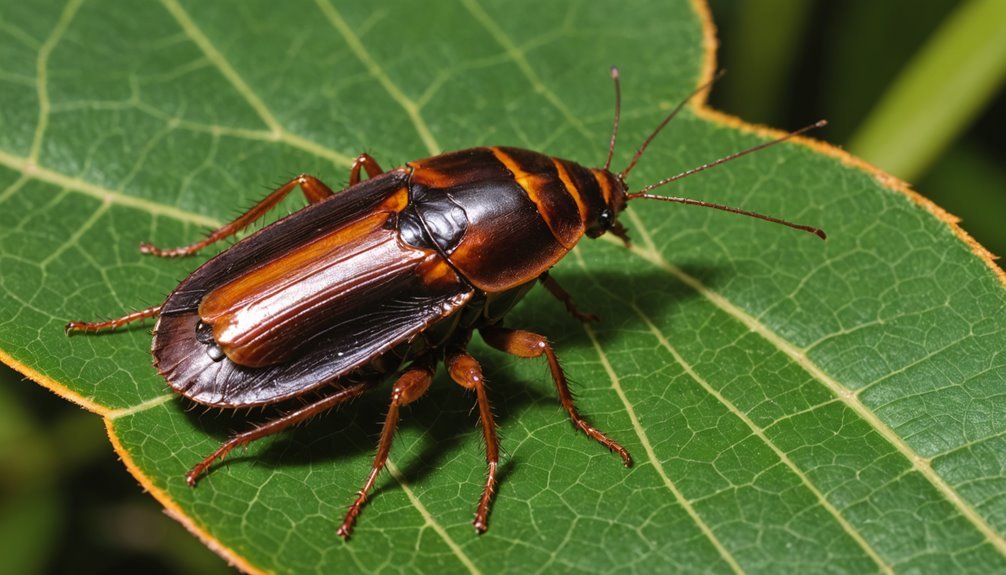
One of the most reliable ways to identify an Australian cockroach is by its yellow markings, which appear on the pronotum and the edges of its forewings.
The pronotum, the shield-like plate behind the head, displays a dark center with an irregular pale yellow band around it. This two-lobed dark spot surrounded by yellow is a strong diagnostic feature.
The pronotum features a dark two-lobed center encircled by an irregular pale yellow band — a reliable diagnostic marker.
On the wings, you’ll notice yellow margins running along the front edges of the forewings. Since adult wings extend past the abdomen, these yellow edges are relatively easy to spot, especially under direct light.
The markings contrast clearly against the reddish-brown body.
These yellow features are what separate Australian cockroaches from similar large species. American cockroaches, for example, share the reddish-brown coloring but lack the yellow wing margins entirely.
When you see both the pronotal banding and the yellow forewing edges together, you can be confident in your identification.
Australian Cockroach Nymphs vs. Adults
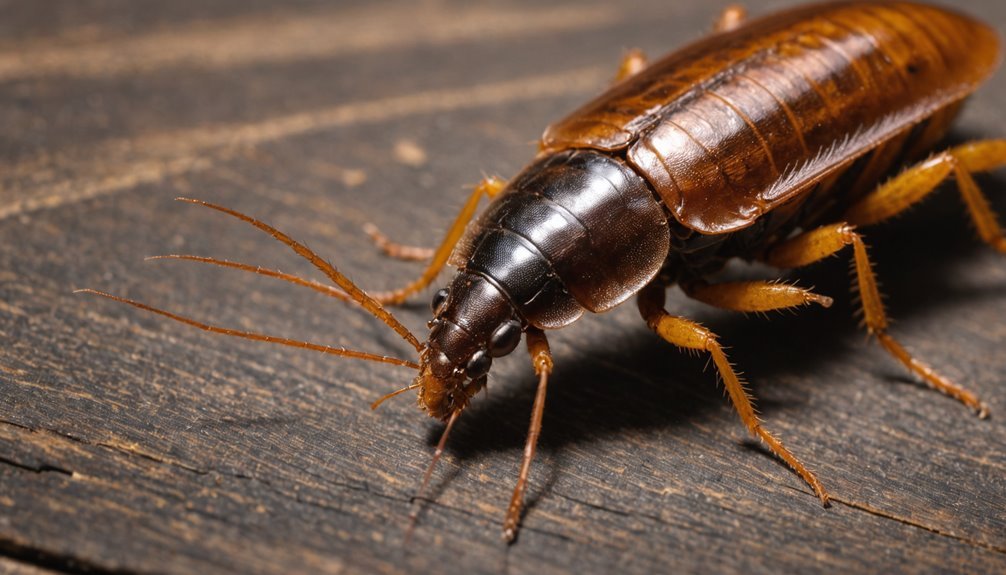
While yellow markings and wing coloring help you identify adult Australian cockroaches, you’ll also need to recognize what the juvenile stage—called a nymph—looks like.
Nymphs go through incomplete metamorphosis, molting multiple times before reaching adulthood, a process that takes roughly 60 days.
Size is your fastest field cue. Nymphs are noticeably smaller and more compact than adults, though late-stage nymphs can approach adult length.
The clearest difference is wings—adults have fully developed wings and can glide short distances, while nymphs only show undeveloped wing pads.
Color-wise, both stages are reddish-brown, but nymphs display less defined pale-yellow markings, mostly along the thorax edges.
Adults show sharper yellow patterning on the pronotum and forewings.
If you spot nymphs alongside shed exoskeletons, egg cases, or droppings, you’re likely dealing with an active infestation rather than an isolated sighting.
Australian Cockroach vs. American Cockroach
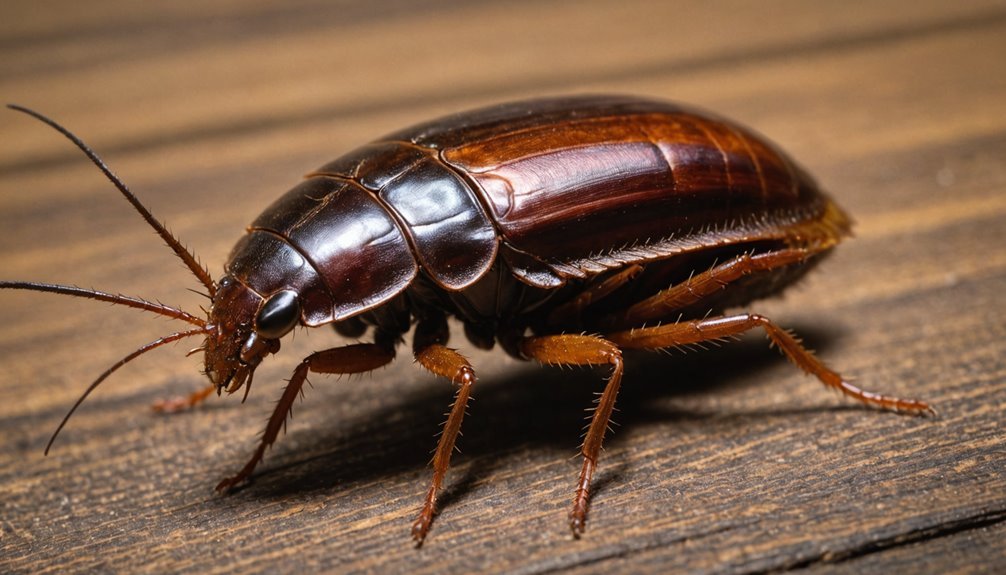
Two cockroach species that often get confused are the Australian and American cockroach—they’re both reddish-brown, similarly shaped, and share overlapping habitats.
However, you can tell them apart using these key differences:
Despite their similar appearance, a few key differences make it easy to tell Australian and American cockroaches apart.
- Markings: Australian cockroaches display a bright yellow band around the pronotum and pale-yellow stripes along the forewing bases. American cockroach markings are less distinct and appear light brown to tan.
- Size: Australian cockroaches measure 1.2 to 1.5 inches, while American cockroaches reach up to 2 inches.
- Habitat preference: Australian cockroaches favor outdoor harborage like mulch, woodpiles, and gardens. American cockroaches more commonly infest indoor spaces.
- Nymph appearance: Australian cockroach nymphs show distinct markings, while American cockroach nymphs are solid colored.
If you spot a reddish-brown roach with sharp yellow thorax markings and wing-margin striping, you’re most likely looking at an Australian cockroach.
Australian Cockroach vs. German Cockroach
Spotting the difference between an Australian and German cockroach is straightforward once you know what to look for.
Australian cockroaches measure 25–35 mm, making them considerably larger than German cockroaches, which are only 13–16 mm long. You’ll also notice color differences: Australian cockroaches are reddish-brown with yellow markings on the thorax and wing edges, while German cockroaches are pale brown with two dark stripes behind the head.
Their behavior sets them apart too. German cockroaches thrive indoors, particularly in kitchens and bathrooms, and they breed rapidly—producing around 30,000 young per year.
Australian cockroaches prefer outdoor harborage areas like mulch, woodpiles, and leaf litter, producing only about 200 young per year.
Control methods also differ. German cockroach treatment focuses on indoor baiting and crack-and-crevice applications, while Australian cockroach pest control prioritizes perimeter treatments, entry-point sealing, and outdoor source reduction.
Where Australian Cockroaches Hide Indoors
Although Australian cockroaches prefer outdoor environments, they’ll move indoors when conditions suit them—and once inside, they exploit a surprisingly wide range of hiding spots.
Australian cockroaches prefer the outdoors—but given the right conditions, they’ll move inside and make themselves at home.
They’re drawn to warmth, moisture, darkness, and low disturbance, making several areas of your home especially vulnerable.
Check these four key hiding zones:
- Kitchens and pantries – Behind refrigerators, ovens, and dishwashers, plus inside cabinet hinges, kickboards, and drain-adjacent spaces where food residue or moisture collects.
- Bathrooms and laundry rooms – Under-sink cabinets, around tubs, toilets, floor drains, and near washers, dryers, and leaky pipes.
- Wall voids and structural gaps – Cracks in walls, gaps around plumbing penetrations, skirting boards, door or window frames, and, in some regions, storm drains and sewers connecting to the property.
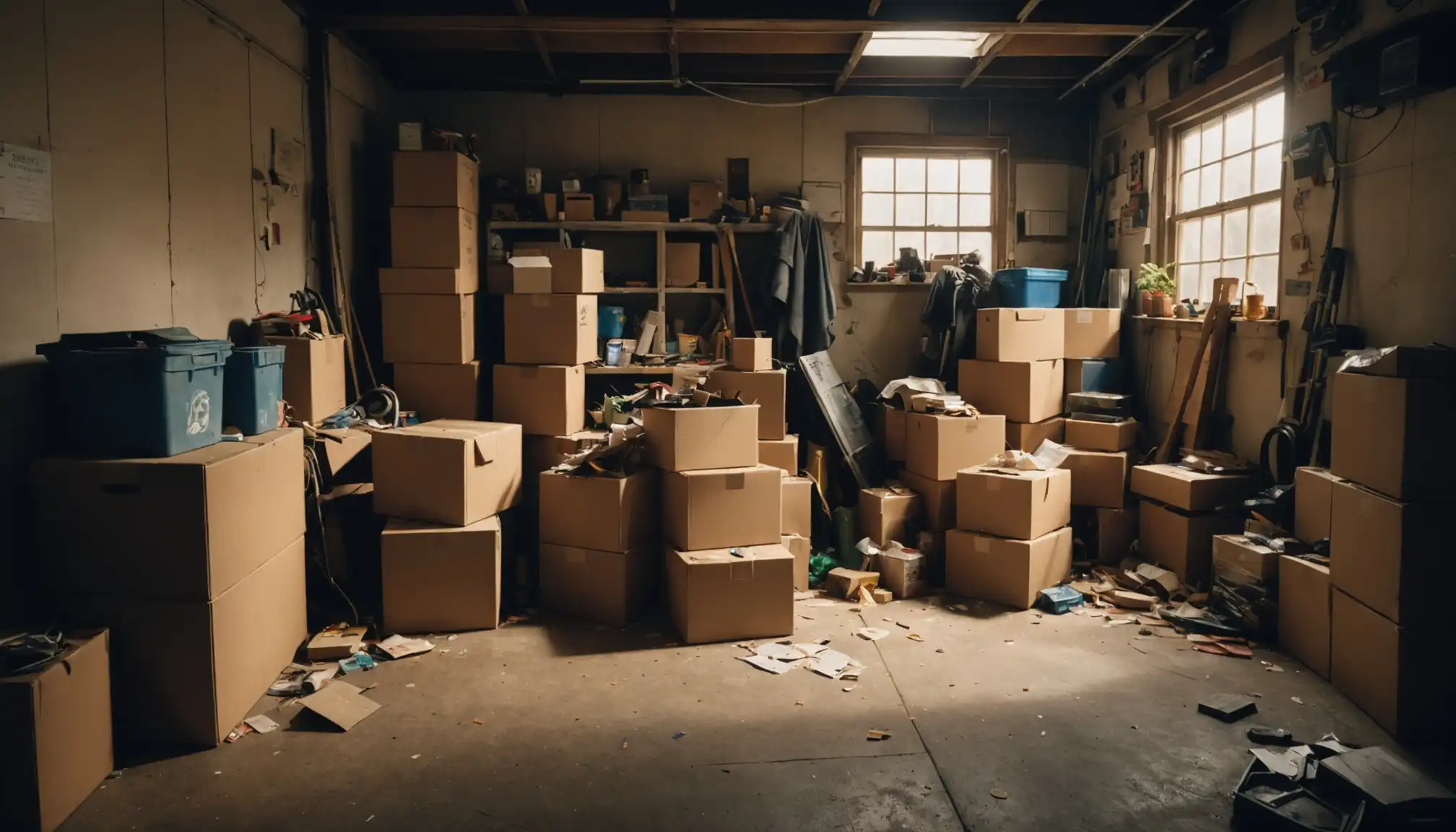
- Cluttered storage areas – Cardboard boxes, roof voids, subfloors, crawl spaces, greenhouses, and crowded shelving where disturbance is minimal.
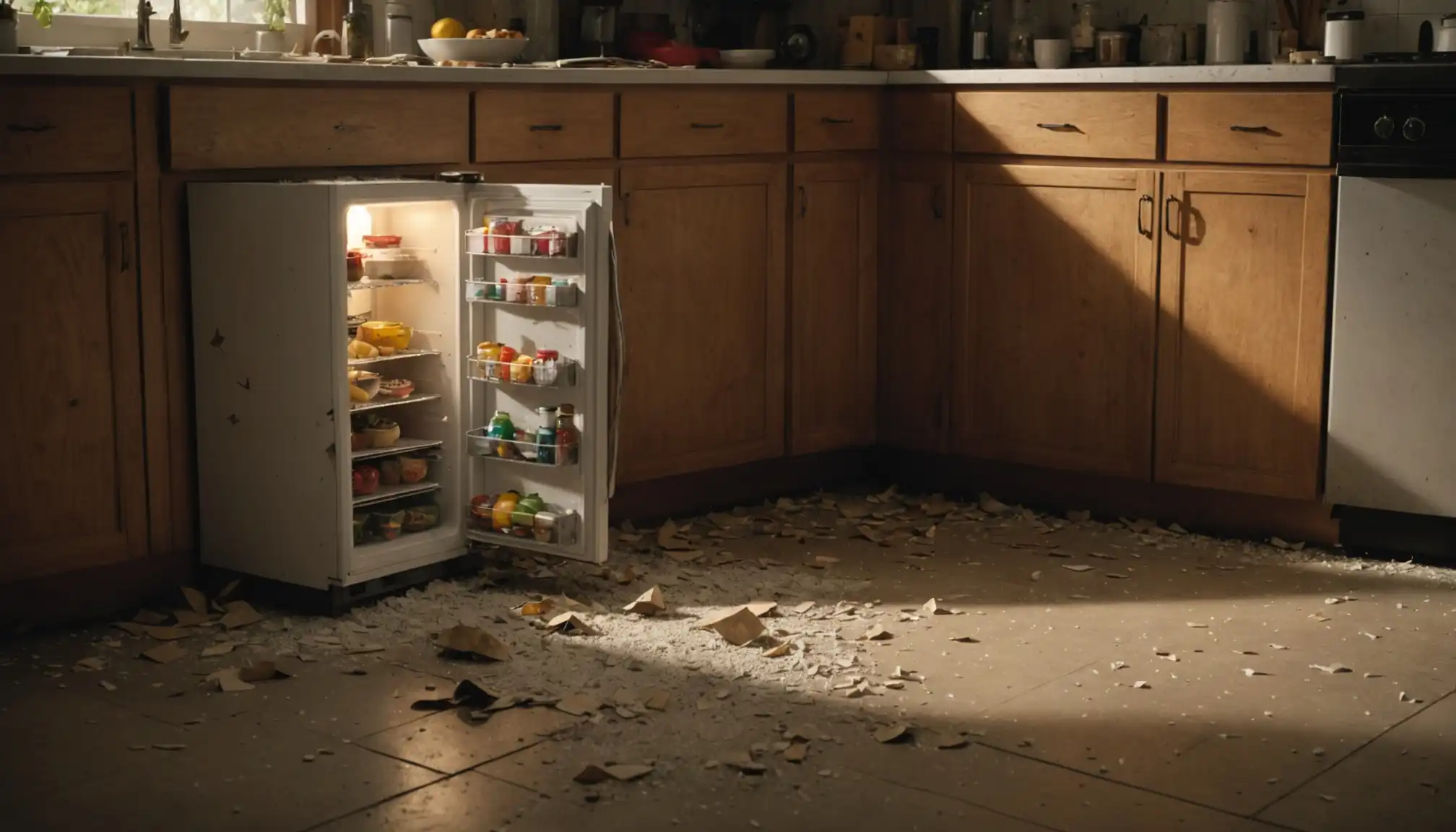
Inspecting these spots early helps you identify and address a cockroach infestation before it spreads.
Signs You’re Dealing With Australian Cockroaches
If you’re finding small black droppings near appliances, cupboards, or food sources, you’re likely looking at early evidence of an Australian cockroach infestation.
Shed skins and dark brown, oval egg cases holding up to 24 eggs each confirm that cockroaches are actively breeding in your space.
Because these insects are nocturnal, any nighttime movement you notice around kitchens or bathrooms points directly to foraging activity.
Repeated sightings after dark suggest an established and growing population.
Physical Evidence Found
Physical evidence is often the first reliable clue that Australian cockroaches have moved into your space.
Check warm, damp areas like kitchens, bathrooms, and basements for these four key indicators:
- Droppings – Look for small black specks or coffee-ground-like material near appliances, cupboards, and cracks where cockroaches travel regularly.
- Shed skins – Discarded exoskeletons in hidden or protected spots confirm active growth and repeated cockroach presence.
- Egg cases (oothecae) – Brown or black, hard, oval-shaped cases tucked behind furniture or inside crevices signal a breeding population.
- Damaged materials – Torn food packaging and chewed cardboard near storage areas indicate active foraging.
Finding multiple signs together gives you stronger confirmation than spotting any single clue alone.
Nighttime Activity Patterns
Because Australian cockroaches are nocturnal, nighttime is when you’re most likely to spot them. They typically become active within the first two hours after sunset, emerging to forage for food and water. If you turn on the kitchen or bathroom light and see them scatter, that’s a strong behavioral indicator of an active infestation.
They tend to travel along wall edges, corners, and hidden routes rather than open floors, moving between harborages and food sources like sinks, drains, and pet bowls. Repeated sightings along the same paths suggest an established population nearby.
Don’t assume low daytime visibility means no infestation. Cockroaches stay concealed during the day, so frequent nighttime appearances with little daytime evidence often signal a well-established harborage network close to where you’re seeing them.
What Keeps Drawing Australian Cockroaches Inside?
Australian cockroaches don’t wander inside by accident — they’re drawn in by reliable access to food, water, and shelter. If your home consistently offers these three things, cockroaches will keep returning regardless of how many you eliminate.
Here’s what’s actively pulling them in:
- Food residues — Grease on stovetops, crumbs on floors, dirty dishes left overnight, and unsealed bins all signal a dependable food source.
- Moisture — Leaky pipes, dripping taps, and damp areas around sinks, showers, and dishwashers satisfy their constant need for water.
- Shelter — Cardboard boxes, cluttered storage, wall voids, and subfloors give them dark, protected spaces to nest and hide.
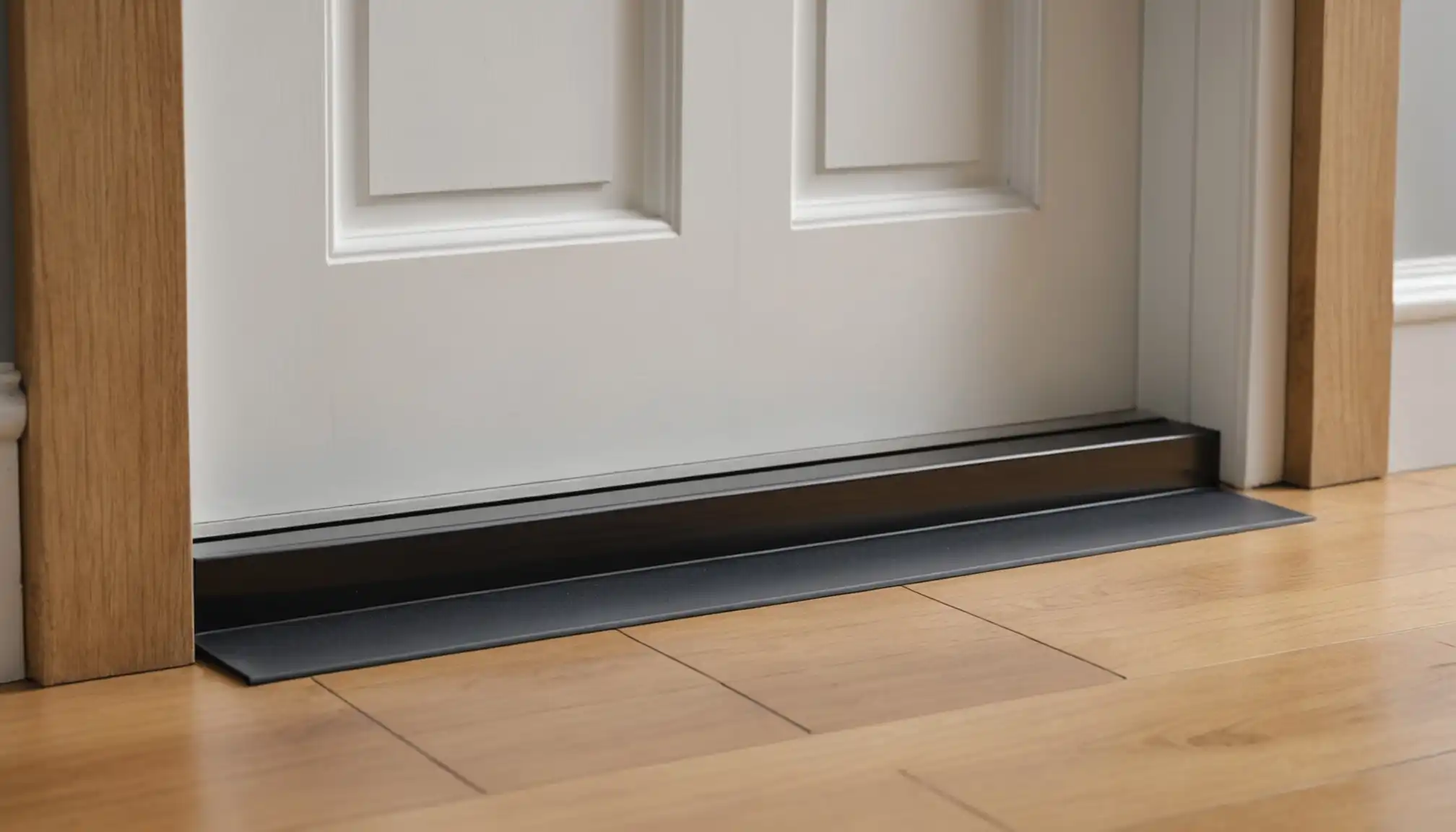
- Entry points — Gaps around doors, windows, plumbing penetrations, and unsealed vents let them move indoors from gardens, woodpiles, greenhouses, and leaf litter nearby.
Remove the attractants, and you remove their reason to stay.
Which Climates and Regions Have Australian Cockroaches?
If you live in a warm, humid region like Florida, coastal southeastern states, or tropical Australia, you’re far more likely to encounter Australian cockroaches than someone in a cooler, drier climate.
These cockroaches thrive outdoors in subtropical and tropical zones, staying active year-round where temperatures and moisture levels remain consistently high. In some areas they’re also documented turning up in sewers, storm drains, and greenhouses, anywhere warmth and moisture stay consistent regardless of the season above ground.
In cooler months or colder regions, you’ll notice their activity drop markedly, since cold conditions work against their survival and reproduction.
Preferred Warm, Humid Climates
Warm, humid environments are where Australian cockroaches thrive, making tropical and subtropical regions their primary strongholds. If you live in a warm climate, you’re more likely to encounter them year-round.
Heat combined with moisture creates the conditions they need to reproduce and persist.
Here’s what makes a climate suitable for them:
- High temperatures sustain their activity and accelerate reproduction.
- Humidity provides the moisture they depend on for survival.
- Tropical and subtropical zones match their core environmental needs.
- Warm seasons in temperate regions can trigger temporary population increases.
Cold, dry conditions limit their spread, so you’re far less likely to deal with them in cooler climates.
Moisture remains the critical factor regardless of location.
Common Geographic Regions
Knowing which climates suit Australian cockroaches helps you narrow down where you’re likely to encounter them. They thrive in warm, humid tropical and subtropical regions worldwide.
In the United States, you’ll find them most commonly in Florida and the coastal southeastern states, where southern Florida reports them as the dominant outdoor cockroach species.
In Australia, their range runs along the east coast from Cape York down to the Victorian border, with populations increasing from the North Coast of NSW northward into tropical zones.
Beyond Australia and the U.S., they’ve established themselves across multiple continents wherever warm, humid conditions exist.
Whether indoors or outdoors, their presence depends heavily on climate suitability rather than geography alone, making warm coastal and tropical belts their defining regional strongholds.
Seasonal Activity Patterns
Australian cockroach activity doesn’t follow a fixed calendar—it tracks temperature and humidity more than anything else.
You’ll generally see peak activity from October through April, but your local climate shapes what that actually looks like.
Here’s what to expect based on where you live:
- Tropical north – Warm, humid conditions support year-round activity with only slight wet-season peaks.
- Subtropical regions – Extended warm periods mean longer active seasons and faster population growth.
- Temperate south – Cooler, drier winters slow activity, but populations remain present indoors.
- Indoor environments – Stable shelter and moisture keep cockroaches active even when outdoor conditions cool down.
Humidity drives surges more than heat alone, so moisture control matters regardless of the season.
Frequently Asked Questions
How Long Do Australian Cockroaches Typically Live as Adults?
You’re looking at an adult lifespan of roughly 4–8 months, though they can live up to 12 months in favorable conditions with abundant food, water, and shelter available.
How Many Eggs Does an Australian Cockroach Produce in Its Lifetime?
You’re dealing with a highly prolific breeder. A female Australian cockroach can produce up to 700 eggs in her lifetime, laying 12 to 30 egg cases, each containing 16 to 24 eggs.
Are Australian Cockroaches Dangerous to Human Health?
Australian cockroaches aren’t directly dangerous, but they can harm your health by contaminating food and surfaces with pathogens such as Salmonella and E. coli. Their droppings and shed skin can also trigger your allergies and worsen asthma.
Can Australian Cockroaches Fly, and How Often Do They?
Yes, Australian cockroaches can fly, and they’re strong fliers. However, you won’t see them flying constantly; they typically fly when they’re disturbed, searching for food, or attracted to light sources.
How Long Does It Take Australian Cockroach Eggs to Hatch?
You’re looking at roughly 30–80 days for Australian cockroach eggs to hatch, with most oothecae hatching around 60 days. Warmer, humid conditions speed things up, while cooler, drier environments slow development considerably.
Conclusion
Now that you know what to look for, you’re better equipped to identify Australian cockroaches in and around your home. You’ve learned their key markings, size, preferred hiding spots, and what attracts them indoors. If you’re spotting these pests regularly, don’t wait—take action quickly before an infestation grows. The sooner you address the problem, the easier it’ll be to reclaim your space.
<!–
============================================================
SCHEMA MARKUP — add via RankMath/Yoast custom schema, or in
Not part of the visible body content above.
============================================================
–>
{
“@context”: “https://schema.org”,
“@type”: “Article”,
“headline”: “Australian Cockroach Identification Guide”,
“description”: “How to identify Australian cockroaches by their reddish-brown body, yellow pronotum band, and yellow wing streaks, plus size, habitat, and signs of infestation.”,
“author”: {
“@type”: “Organization”,
“name”: “CockroachCare”
},
“publisher”: {
“@type”: “Organization”,
“name”: “CockroachCare”,
“logo”: {
“@type”: “ImageObject”,
“url”: “https://cockroachcare.com/wp-content/uploads/logo.png”
}
},
“mainEntityOfPage”: {
“@type”: “WebPage”,
“@id”: “https://cockroachcare.com/australian-cockroach-identification/”
},
“image”: [
“https://cockroachcare.com/wp-content/uploads/2026/05/reddish_brown_cockroach_with_markings_go5ve.jpg”,
“https://cockroachcare.com/wp-content/uploads/2026/05/australian_cockroaches_measure_23_35_mm_ta7v7.jpg”,
“https://cockroachcare.com/wp-content/uploads/2026/05/yellow_markings_identify_cockroaches_2p80q.jpg”
],
“datePublished”: “2026-05-01”,
“dateModified”: “2026-09-24”
}
{
“@context”: “https://schema.org”,
“@type”: “FAQPage”,
“mainEntity”: [
{
“@type”: “Question”,
“name”: “How Long Do Australian Cockroaches Typically Live as Adults?”,
“acceptedAnswer”: {
“@type”: “Answer”,
“text”: “An adult lifespan of roughly 4 to 8 months, though they can live up to 12 months in favorable conditions with abundant food, water, and shelter available.”
}
},
{
“@type”: “Question”,
“name”: “How Many Eggs Does an Australian Cockroach Produce in Its Lifetime?”,
“acceptedAnswer”: {
“@type”: “Answer”,
“text”: “A female Australian cockroach can produce up to 700 eggs in her lifetime, laying 12 to 30 egg cases, each containing 16 to 24 eggs.”
}
},
{
“@type”: “Question”,
“name”: “Are Australian Cockroaches Dangerous to Human Health?”,
“acceptedAnswer”: {
“@type”: “Answer”,
“text”: “Australian cockroaches aren’t directly dangerous, but they can harm health by contaminating food and surfaces with pathogens such as Salmonella and E. coli. Their droppings and shed skin can also trigger allergies and worsen asthma.”
}
},
{
“@type”: “Question”,
“name”: “Can Australian Cockroaches Fly, and How Often Do They?”,
“acceptedAnswer”: {
“@type”: “Answer”,
“text”: “Yes, Australian cockroaches can fly and are strong fliers. They typically fly when disturbed, searching for food, or attracted to light sources, not constantly.”
}
},
{
“@type”: “Question”,
“name”: “How Long Does It Take Australian Cockroach Eggs to Hatch?”,
“acceptedAnswer”: {
“@type”: “Answer”,
“text”: “Roughly 30 to 80 days, with most oothecae hatching around 60 days. Warmer, humid conditions speed things up, while cooler, drier environments slow development.”
}
}
]
}
