
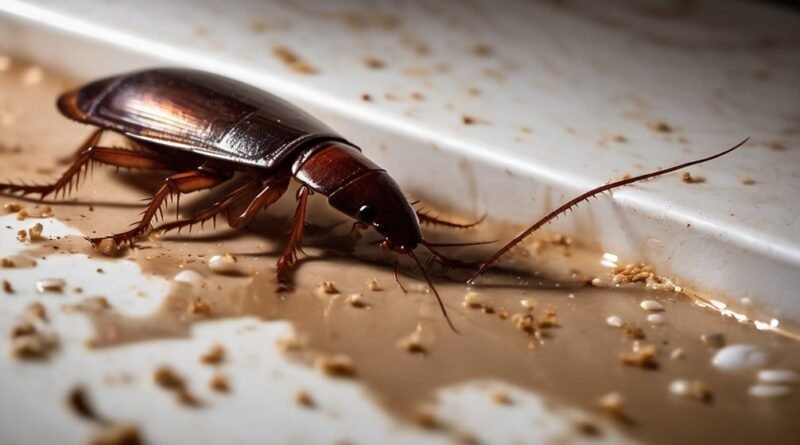
Cockroach Behavior: Nocturnal Habits & Hiding Spots
Cockroach behavior is governed by three core drives: finding food and water, avoiding threats and light, and reproducing. These drives produce predictable patterns including nocturnal foraging, aggregation in warm humid harborage zones, chemical communication through pheromones, and alarm-triggered escape responses. Understanding these behavioral patterns directly improves both prevention and control effectiveness by revealing where cockroaches concentrate, when they are most active, and what triggers their movement.
Key Takeaways
Cockroach behavior follows consistent biological rules that hold across species, with some variation in habitat preferences and lifestyle details.
- Cockroaches are primarily nocturnal with peak activity during the transition from light to dark; finding them during daylight is a sign of overcrowding or heavy infestation.
- They aggregate in warm, humid harborage zones guided by pheromones in feces; these zones are the primary target for gel bait placement.
- Negative phototaxis, the drive to avoid light, shapes all their daytime hiding behavior and determines which cracks and voids they select for harborage.
- Cockroaches are omnivorous scavengers that consume virtually any organic material including paper, glue, and soap when preferred food sources are unavailable.
- German cockroaches reproduce faster than any other common household species; understanding their reproductive behavior is essential for breaking the infestation cycle.
Nocturnal Behavior and Circadian Rhythms
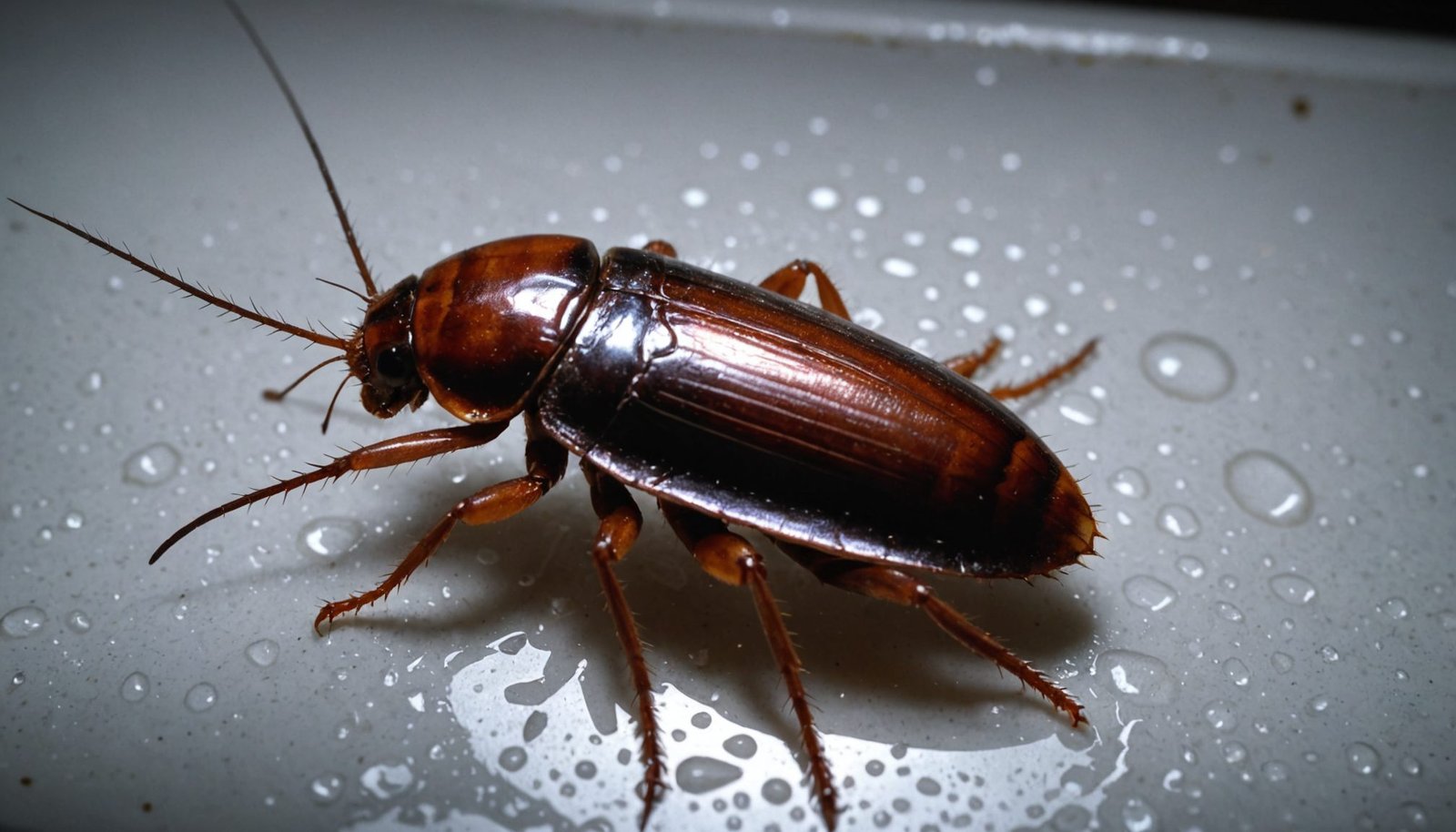
Cockroaches are nocturnal insects governed by internal circadian rhythms that run on roughly 24-hour cycles. Their biological clock, regulated by neurons in the optic lobes that respond to light and dark cycles, synchronizes feeding, mating, and movement with nighttime conditions. Even in constant darkness, cockroaches maintain their nocturnal activity pattern through their internal clock rather than relying solely on environmental light cues.
Peak activity occurs during the transition from light to dark and continues through the early hours of darkness. German cockroaches are most active during the first third of the dark period. American cockroaches show more flexible activity timing but still concentrate foraging in darkness. When light suddenly appears in a dark environment, cockroaches exhibit an immediate survival response: they either freeze in place momentarily or scatter rapidly toward the nearest dark crevice.
Why Daytime Cockroach Sightings Signal a Serious Problem
Cockroaches seen actively foraging during daylight hours are not behaving normally. This daytime activity is almost always a sign that the harborage zone has become severely overcrowded, forcing individuals out during their normally inactive period. This behavioral signal means the population has grown large enough that competition for space and resources is driving cockroaches into the open when they would otherwise be sheltering. A single daytime sighting in a kitchen or bathroom warrants immediate deployment of sticky monitoring traps to assess actual population levels.
Hiding Behavior and Harborage Selection
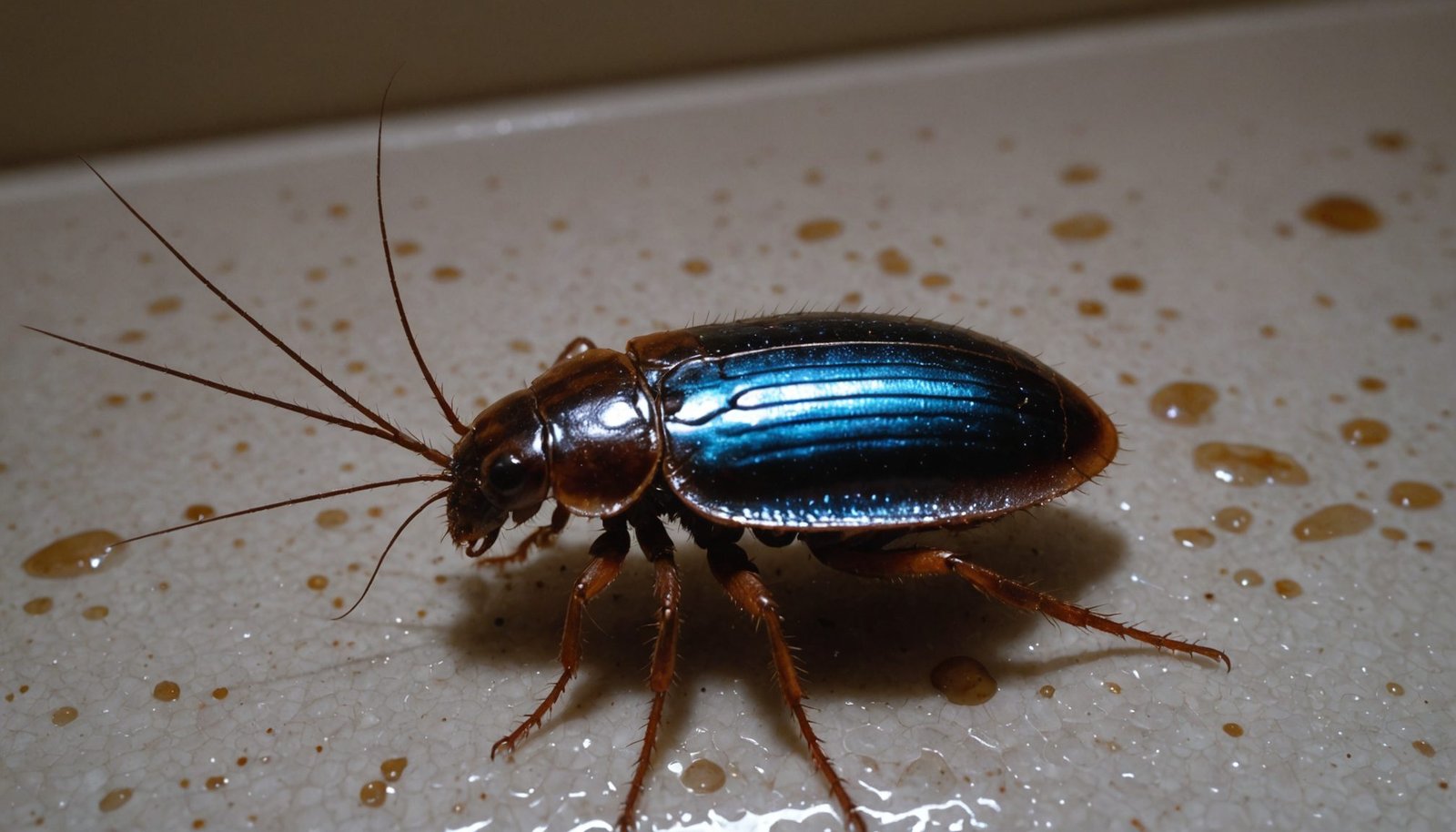
Cockroaches select harborage sites based on a specific combination of environmental conditions: darkness, warmth, humidity, and tight spaces where multiple body surfaces contact a solid wall simultaneously. This preference for contact on multiple sides, called thigmotaxis, is why cockroaches consistently choose cracks, hinges, and gap spaces over open surfaces. A crack that presses against the cockroach’s dorsal and ventral surfaces simultaneously is more attractive than an open dark space of equivalent darkness.
Preferred indoor harborage locations concentrate where these conditions converge with proximity to food and water sources. Kitchen cabinet bases where warm motor heat radiates from appliances, under-sink areas where pipe penetrations create gaps and moisture condenses, the backs of dishwashers and refrigerators, and wall voids adjacent to warm water pipes are all premium harborage real estate for German cockroaches.
Harborage Preferences by Species
Different cockroach species select harborage in predictable locations based on their biology and habitat preferences, which guides where to focus inspection and treatment.
- German cockroaches concentrate in kitchens and bathrooms, with harborage inside cabinet bases, appliance voids, and under-sink spaces being almost universal
- American cockroaches prefer basement drains, sewer connections, boiler rooms, and utility spaces; they access kitchens through drain connections rather than living there primarily
- Oriental cockroaches occupy cool, damp basements, crawl spaces, and drain areas; they are rarely found in warm, dry living spaces
- Brown-banded cockroaches are the exception, preferring elevated indoor harborage including furniture undersides, inside electronics, and bedroom areas rather than kitchens
| Location | Primary Harborage Spots | Typical Species |
|---|---|---|
| Kitchen | Cabinet bases, under appliances, hinges | German |
| Bathroom | Vanity base, drain connections, toilet base | German, American |
| Basement and drains | Floor drains, wall edges, pipe chases | American, Oriental |
| Bedroom and furniture | Furniture undersides, electronics, closets | Brown-banded |
Feeding Behavior and Food Preferences
Cockroaches are generalist omnivorous scavengers that consume virtually any organic material available in their environment. They show strong preference for starchy and sugary foods, greasy residues, and fermenting organic matter, but their diet extends far beyond human food. When preferred food sources are exhausted, cockroaches consume paper, cardboard, glue from book bindings, soap, leather, hair, and other organic materials that most pests cannot metabolize. This dietary flexibility is one of the behavioral traits that makes them exceptionally difficult to starve out.
Feeding behavior is concentrated during the active nocturnal period. Cockroaches use chemical sensing through their antennae to locate food sources, following pheromone trails and odor gradients toward nutrient-rich areas. They feed opportunistically on any accessible food debris, which is why consistent sanitation is a direct form of population control rather than merely a preventive measure.
Why Competing Food Sources Undermine Gel Bait Programs
One of the most practically important aspects of cockroach feeding behavior is how available competing food sources reduce gel bait effectiveness. When cockroaches have access to abundant food debris from crumbs, grease, pet food, and open trash, they are less motivated to seek out and feed on gel bait placements. Research consistently shows that bait programs perform significantly better when sanitation removes competing food sources before and during treatment. This is not optional; it is a prerequisite for gel bait to work at the levels that produce meaningful population decline within the first two weeks.
Pheromone Communication and Aggregation Behavior
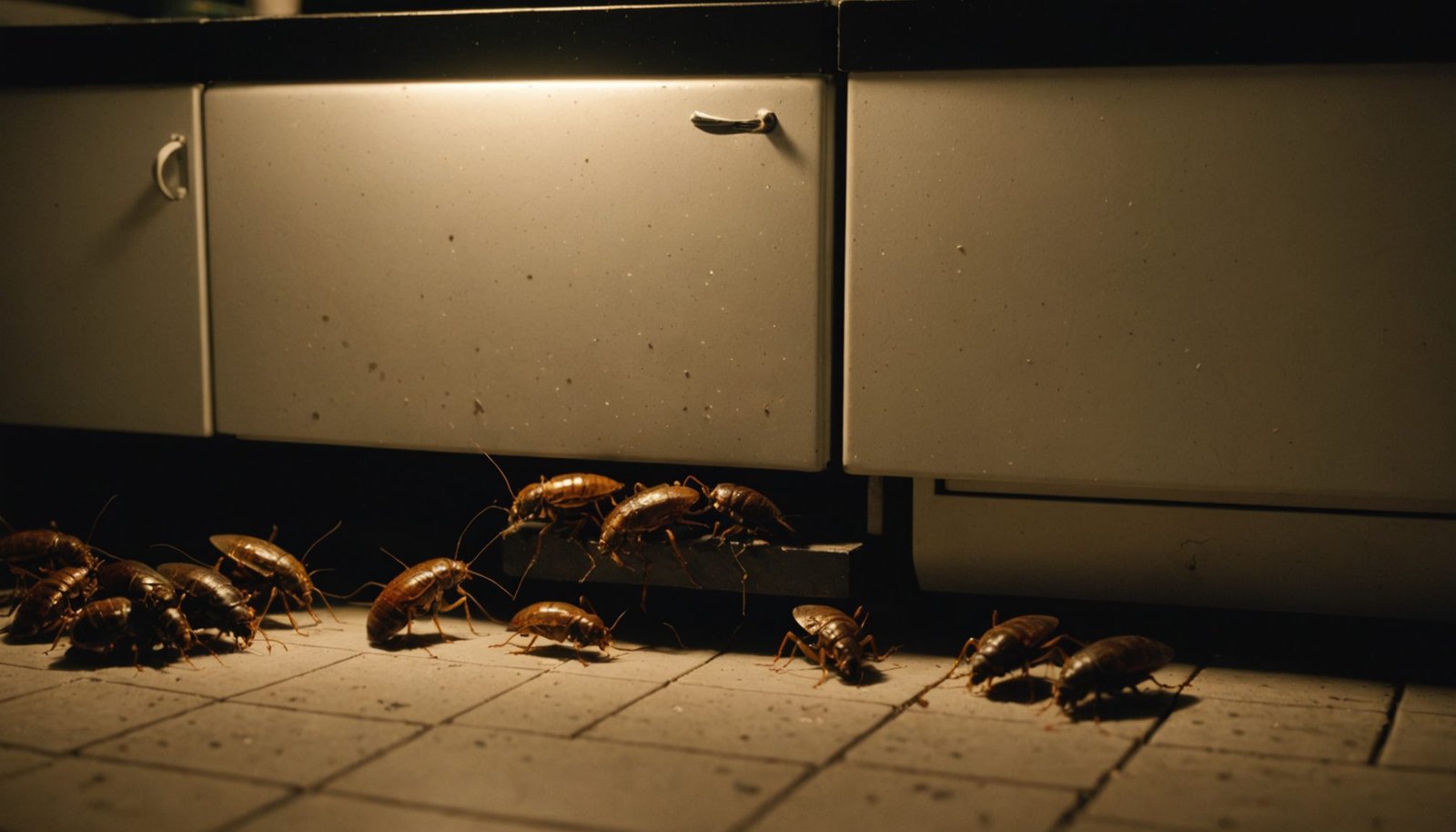
Cockroaches communicate chemically through pheromones that coordinate aggregation, mating, and territory. The most practically important pheromone for infestation management is the aggregation pheromone found in cockroach feces. This chemical signal attracts other cockroaches to established harborage sites, creating the characteristic concentration of cockroaches in specific locations rather than distributed uniformly throughout an infested building.
Aggregation pheromones explain why sticky trap captures in some locations are dramatically higher than in others. The highest trap counts indicate harborage zones where aggregation pheromone concentration is drawing colony members from surrounding areas. These high-count zones are where gel bait placement has the greatest impact because they intersect feeding travel routes and concentration points simultaneously.
Alarm Pheromones and Escape Behavior
When threatened, cockroaches release alarm pheromones that trigger escape responses in nearby colony members. This chemical alarm system, combined with the mechanoreceptive hair sensing on their cerci that detects air pressure changes within milliseconds, produces the rapid scatter response that makes cockroaches so difficult to catch or kill manually. The neural pathways transmitting escape signals operate at speeds up to 3 meters per second, faster than most vertebrate motor neurons, which is why cockroaches are already moving before most humans complete a swatting motion.
- Air pressure changes detected by cerci hairs trigger neural escape responses within 50 milliseconds of threat detection
- Escape direction is oriented away from the pressure source and toward the nearest dark shelter rather than in a random direction
- Alarm pheromones spread escape behavior to colony members not directly detecting the threat, amplifying the scatter response beyond the immediate threat zone
- Repeated disturbances in a harborage zone cause cockroaches to relocate to secondary harborage sites, which can disperse an infestation that was previously concentrated
Reproductive Behavior and the Cockroach Lifecycle
Cockroach reproductive behavior directly determines how fast an infestation grows and how long it takes for treatments to produce measurable population decline. The cockroach life cycle consists of three stages: egg inside the ootheca, nymph through multiple molting instars, and adult. Unlike insects with complete metamorphosis, cockroaches do not have a pupal stage. Nymphs resemble small wingless adults and compete directly with adults for food and harborage from the moment they hatch.
German cockroach females reach sexual maturity approximately 36 days after the final nymphal molt and begin producing oothecae shortly after mating. A single female produces 4 to 8 oothecae during her adult life, each containing 30 to 50 eggs. With a development time from egg to reproductive adult of 50 to 60 days under warm conditions, German cockroach populations have the potential to double multiple times within a single season if no control measures interrupt the cycle.
Mating Behavior and Mate Selection
Male cockroaches use pheromone detection to locate receptive females and perform courtship displays that involve wing raising and abdominal gland secretion. German cockroach males are more likely to fly short distances during mating season, which is one of the few contexts in which German cockroaches actually use their wings. Female cockroaches can store sperm and produce multiple oothecae from a single mating, meaning a single mated female introduced into a new location can establish an infestation without requiring a male to be present.
Nymph Development and Population Growth
- German cockroach nymphs complete 5 to 7 molts over 50 to 60 days before reaching adulthood under optimal temperature and humidity conditions
- Each successive generation potentially quadruples or more relative to the previous generation if no population control is applied
- Nymphs are more vulnerable to desiccation than adults and die faster without water, making moisture control proportionally more effective against growing populations than established ones
- Insect growth regulators that prevent nymphs from completing development to adulthood attack the population at its fastest-growing stage
Environmental Factors That Drive Cockroach Activity
Temperature and humidity are the two environmental variables that most directly control cockroach activity levels, development speed, and reproductive output. Cockroaches thrive at temperatures between 70 and 90 degrees Fahrenheit and humidity levels of 50 to 70 percent. These conditions maximize metabolic efficiency, accelerate nymph development, and increase egg production in reproductive females.
At temperatures below 60 degrees Fahrenheit, cockroach activity drops significantly and development slows substantially. This is why cockroach problems are generally more severe in heated buildings, southern climates, and during summer months in temperate regions. During periods of heavy rainfall, cockroaches may increase indoor activity as outdoor harborage becomes flooded, driving them to seek indoor shelter. During dry spells, they concentrate near indoor moisture sources more intensively.
Seasonal Behavior Patterns
- Late spring and summer represent peak reproduction season for most species as temperatures rise and humidity increases
- German cockroaches maintain year-round reproduction in heated buildings regardless of exterior season
- American and smokybrown cockroaches show increased building entry attempts in fall as outdoor temperatures drop toward their activity minimum
- Winter cold does not eliminate indoor infestations of established species but does reduce reproductive rate and activity intensity temporarily
Light Avoidance and Negative Phototaxis
Cockroaches exhibit strong negative phototaxis: they actively move away from light rather than passively avoiding it. Their visual system includes both compound eyes that provide wide-angle motion detection and ocelli, simpler light-sensing organs that detect overall illumination intensity. Their ocelli can detect light levels as low as 0.003 lux, allowing them to identify lit versus dark zones even in near-total darkness.
This strong light avoidance shapes every aspect of their daytime behavior. When selecting harborage, cockroaches prioritize dark locations over equally warm or humid spots with poor light cover. When disturbed, their escape movement is oriented toward dark crevices rather than open spaces. When foraging at night, they preferentially use darker routes along wall edges and under appliances rather than crossing open lit floor areas.
Some species, particularly smokybrown cockroaches, are positively phototactic and are attracted to light rather than repelled by it. This is why smokybrown cockroaches fly toward illuminated windows and porch lights at night, a behavior that German and American cockroaches do not share. Understanding this species difference matters for control because light-reduction measures are effective deterrents for smokybrown cockroaches but have little impact on German cockroach activity.
Using Cockroach Behavior for More Effective Control
Every aspect of cockroach behavior described above has a direct practical application for more effective pest control. Nocturnal activity means treatments applied in late evening reach cockroaches at their most active foraging phase, maximizing contact with gel baits and sticky traps. Aggregation pheromone behavior means that highest-count trap locations should receive the highest gel bait density. Feeding behavior means removing competing food sources before applying bait dramatically improves bait uptake rates.
Alarm and escape behavior means avoiding unnecessary disturbance of harborage zones during treatment, since dispersing a concentrated colony spreads it to secondary harborage locations that are harder to treat comprehensively. Thigmotaxis means that bait placed in cracks and crevices where cockroaches contact walls on multiple sides receives more feeding visits than bait placed on open surfaces.
Selecting the right gel bait formulation that exploits these behavioral tendencies delivers far better results than choosing products based on active ingredient strength alone. Professional pest control programs that incorporate behavioral knowledge into inspection-driven placement consistently outperform generic spray-and-pray approaches because they work with cockroach behavior rather than against it.
Frequently Asked Questions
Why Do Cockroaches Run When the Lights Come On?
Cockroaches have a strong negative phototaxis response: they are genetically programmed to move away from light rather than simply preferring darkness. When sudden light appears, sensory neurons in their ocelli detect the change almost instantaneously and trigger movement toward darkness. This is a survival behavior shaped by millions of years of predation pressure from diurnal predators. The rapid scatter response is amplified when multiple cockroaches are present because alarm pheromones released by the first individuals to react spread the escape behavior to nearby colony members.
What Do Cockroaches Eat?
Cockroaches are generalist omnivorous scavengers with dietary preferences for starchy and sugary foods, grease, fermenting organic matter, and protein sources. However, they also consume paper, cardboard, book glue, soap, leather, dead insects, and hair when preferred food is unavailable. This dietary flexibility is why starving cockroaches out by removing food is difficult; they will find organic material to sustain themselves in virtually any environment. Effective sanitation removes preferred food sources and forces cockroaches toward gel bait placements rather than providing a realistic path to starvation-based elimination.
Do Cockroaches Live in Colonies?
Cockroaches do not form organized social colonies in the way that ants, bees, or termites do. They lack caste systems, division of labor, and centralized colony governance. However, they do aggregate in groups in shared harborage zones guided by aggregation pheromones, and these aggregations function somewhat like colonies in terms of shared resources, chemical communication, and population dynamics. German cockroach aggregations can number in the hundreds to thousands in a single harborage zone. The practical implication is that finding even a small number of cockroaches suggests a much larger aggregation is nearby rather than isolated individuals.
How Do Cockroaches Find Their Way Back to Harborage?
Cockroaches navigate using chemical trails, mechanoreceptive sensing through antenna contact with walls, and memory of spatial layouts. They deposit aggregation pheromones along regularly traveled routes that function as chemical highways back to harborage. After foraging excursions, they follow these chemical trails back to the harborage zone. Cockroaches also demonstrate spatial memory, mapping the layout of familiar environments and using this internal map to navigate efficiently in darkness. Cleaning away pheromone deposits during treatment disrupts these navigation pathways and can reduce the efficiency of cockroach movement back to harborage, increasing exposure to treated surfaces during disorientation.
Why Do Cockroaches Aggregate Together?
Aggregation behavior in cockroaches is driven by chemical pheromones present in feces deposited in harborage zones. These aggregation pheromones attract other cockroaches to locations where others have already established themselves, creating self-reinforcing concentration points. The behavior provides practical advantages including shared warmth in thermal microhabitats, improved humidity retention in tight spaces, and potentially faster location of suitable mates. From a pest management perspective, aggregation behavior is both a diagnostic tool, revealing primary harborage through trap captures, and a treatment opportunity, since concentrated populations are more efficiently addressed by precise bait placement than dispersed ones.
{
“@context”: “https://schema.org”,
“@type”: “FAQPage”,
“mainEntity”: [
{
“@type”: “Question”,
“name”: “Why Do Cockroaches Run When the Lights Come On?”,
“acceptedAnswer”: {
“@type”: “Answer”,
“text”: “Cockroaches have a strong negative phototaxis response: they are genetically programmed to move away from light rather than simply preferring darkness. When sudden light appears, sensory neurons in their ocelli detect the change almost instantaneously and trigger movement toward darkness. This survival behavior was shaped by millions of years of predation pressure from diurnal predators. The rapid scatter response is amplified when multiple cockroaches are present because alarm pheromones released by the first individuals to react spread the escape behavior to nearby colony members.”
}
},
{
“@type”: “Question”,
“name”: “What Do Cockroaches Eat?”,
“acceptedAnswer”: {
“@type”: “Answer”,
“text”: “Cockroaches are generalist omnivorous scavengers with dietary preferences for starchy and sugary foods, grease, fermenting organic matter, and protein sources. However, they also consume paper, cardboard, book glue, soap, leather, dead insects, and hair when preferred food is unavailable. This dietary flexibility is why starving cockroaches out by removing food is difficult; they will find organic material to sustain themselves in virtually any environment. Effective sanitation removes preferred food sources and forces cockroaches toward gel bait placements.”
}
},
{
“@type”: “Question”,
“name”: “Do Cockroaches Live in Colonies?”,
“acceptedAnswer”: {
“@type”: “Answer”,
“text”: “Cockroaches do not form organized social colonies the way ants or termites do. They lack caste systems, division of labor, and centralized colony governance. However, they do aggregate in groups in shared harborage zones guided by aggregation pheromones, and these aggregations can number in the hundreds to thousands in a single harborage zone. Finding even a small number of cockroaches suggests a much larger aggregation is nearby rather than isolated individuals.”
}
},
{
“@type”: “Question”,
“name”: “How Do Cockroaches Find Their Way Back to Harborage?”,
“acceptedAnswer”: {
“@type”: “Answer”,
“text”: “Cockroaches navigate using chemical trails, mechanoreceptive sensing through antenna contact with walls, and memory of spatial layouts. They deposit aggregation pheromones along regularly traveled routes that function as chemical highways back to harborage. Cockroaches also demonstrate spatial memory, mapping the layout of familiar environments to navigate efficiently in darkness. Cleaning away pheromone deposits during treatment disrupts these navigation pathways and can reduce the efficiency of cockroach movement back to harborage, increasing exposure to treated surfaces.”
}
},
{
“@type”: “Question”,
“name”: “Why Do Cockroaches Aggregate Together?”,
“acceptedAnswer”: {
“@type”: “Answer”,
“text”: “Aggregation behavior in cockroaches is driven by pheromones present in feces deposited in harborage zones. These aggregation pheromones attract other cockroaches to locations where others have already established themselves, creating self-reinforcing concentration points. The behavior provides advantages including shared warmth, improved humidity retention, and faster mate location. From a pest management perspective, aggregation behavior is both a diagnostic tool, revealing primary harborage through trap captures, and a treatment opportunity, since concentrated populations are more efficiently addressed by precise bait placement.”
}
}
]
}
