
How Old Are Cockroaches? A 300-Million-Year Survivor
Cockroaches are roughly 300 to 350 million years old, tracing their origins to the Carboniferous period — long before dinosaurs ever walked the Earth. The last common ancestor of all living cockroaches appeared around 235 million years ago, and modern cockroach families showed up in the fossil record about 125 to 140 million years ago. They’ve survived every major mass extinction since. Stick around, and you’ll discover exactly how they pulled it off.
Key Takeaways
- Cockroaches first appeared 300 to 350 million years ago during the Carboniferous period, making them one of Earth’s oldest surviving insects.
- The last common ancestor of all living cockroaches existed approximately 235 million years ago.
- Modern cockroach families emerged in the fossil record roughly 125 to 140 million years ago during the Cretaceous period.
- Cockroaches survived every major mass extinction event through omnivorous scavenging, flat body profiles, and resilient egg cases called oothecae.
- Despite their ancient origins, cockroaches continue diversifying today, with approximately 4,600 species occupying specialized habitats worldwide.
How Old Are Cockroaches, Really?
The answer depends on how you define “cockroach.”
If you’re referring to the broader roach lineage, estimates stretch back roughly 300 to 350 million years, placing their ancestors in the Carboniferous period. That’s the origin of the famous “300-million-year survivor” label you’ve probably heard before.
Cockroach ancestors trace back 300 to 350 million years, straight to the Carboniferous period.
But that number tells only part of the story.
Molecular-clock studies estimate the last common ancestor of all living cockroach species at around 235 million years ago. Clearly identifiable modern cockroach families appear even later in the fossil record, roughly 125 to 140 million years ago. Cockroaches have persisted across these vast timescales partly because they deposit eggs in protective leathery cases called ootheca.
What the Cockroach Fossil Record Actually Shows
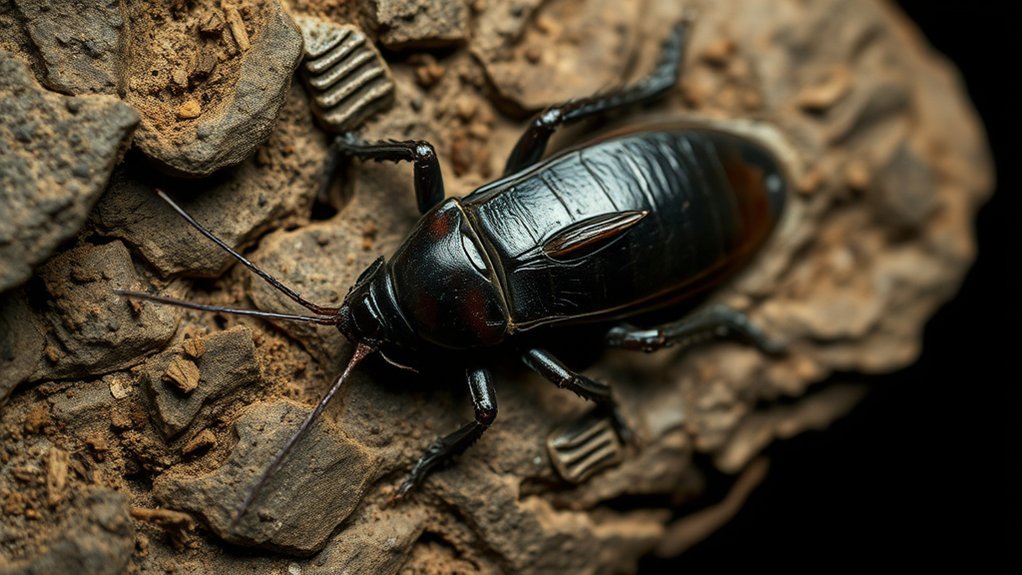
When you look at the cockroach fossil record, you’ll find that Upper Carboniferous coal deposits preserve so many cockroach-like remains that scientists once called that era the “Age of Cockroaches.”
Most of what you’re actually looking at, though, are isolated wings and wing fragments rather than complete bodies, which makes precise classification difficult. Many of these ancient specimens, known as “roachoids,” possessed external ovipositors that are entirely absent in extant cockroach species.
The first fossils belonging to modern cockroach families don’t appear until the Jurassic and Cretaceous, tens of millions of years after those ancient coal-seam specimens.
Carboniferous Coal Seam Fossils
Buried within Carboniferous coal seams lies one of the richest insect fossil records ever discovered, so abundant that scientists have nicknamed this period the “Age of Cockroaches.” Sites like Mazon Creek, Commentry, and Montceau-les-Mines repeatedly turn up cockroach-like remains, and a single locality at Writhlington yielded over 700 blattodean specimens alone.
These deposits don’t preserve just one life stage—you’ll find wings, nymphs, abdomina, and wing pads across multiple sites.
| Site | Notable Find |
|---|---|
| Writhlington | 700+ blattodean specimens |
| Mazon Creek | Classic Carboniferous cockroach fossils |
| Coseley | Archimylacris eggintoni, ~311 million years old |
About 90% of recovered material is wings or wing fragments, so complete specimens remain rare, making intact finds especially valuable to researchers. Their firmly chitinized wings and bodies made cockroaches especially prone to fossilization, which helps explain why their remains appear so consistently across Carboniferous deposits worldwide.
Wings Dominate Fossil Record
Roughly 90% of cockroach fossils are wings or wing fragments, and that single fact shapes nearly everything scientists know about the group’s ancient history. Complete cockroach fossils account for only about 5% of the record, so you’re looking at a history reconstructed almost entirely from detached pieces.
Wings survive because they’re heavily sclerotized, especially the front wings, or tegmina, which resist decay far better than soft tissue. Fine-grained sediments like shale capture wing impressions with remarkable detail, while softer body parts vanish entirely.
This preservation bias isn’t neutral. It overrepresents wing anatomy and underrepresents everything else. But wings still carry real evolutionary information—their venation patterns preserve phylogenetic signals, letting scientists trace cockroach lineages even when bodies are missing. High variability in wing vein numbers within a single species, as seen in Blattella germanica, further complicates the reliability of wing morphology as a taxonomic tool.
First Modern Family Fossils
That preservation bias matters when you’re trying to pinpoint when modern cockroach families actually show up. The first unambiguous fossils of extant families appear in the early Cretaceous, with estimates ranging from 120 to 140 million years ago depending on taxonomic criteria used.
| Family | Earliest Fossil Record | Period |
|---|---|---|
| Blaberidae | Extended into Cretaceous | ~100 MYA |
| Ectobiidae | Possible records | ~90 MYA |
| Modern genera (Ectobius) | Confirmed fossils | ~50 MYA |
These dates represent minimums, not true origins. Gaps exist because family-level identification requires well-preserved body characters, not just wing fragments. You’re looking at a patchy record shaped by uneven preservation across time and geography, so each confirmed fossil carries significant weight. The earliest cockroach-like fossils, however, trace back to the Carboniferous period, pushing the broader lineage well beyond what modern family records alone suggest.
How Modern Cockroaches Have Actually Changed
When you compare ancient cockroach fossils to living species, you’ll notice the external body plan has stayed remarkably stable, but that surface similarity masks real internal changes.
Modern synanthropic species like the German cockroach have developed enhanced detoxification systems, sharper sensory abilities, and stronger immune responses that their prehistoric ancestors never needed.
These internal shifts, combined with lineage-level diversification across thousands of species, show that cockroaches haven’t simply frozen in time—they’ve kept adapting while holding onto what already worked.
Ancient Versus Modern Forms
Despite cockroaches’ reputation as living fossils, the modern forms you see today aren’t identical to their ancient predecessors. Several clear differences separate them from their Carboniferous relatives.
The most visible change involves the ovipositor. Ancient cockroach-like insects carried long, external egg-laying structures. Modern cockroaches lost those entirely, evolving instead to producing enclosed egg cases called oothecae. That shift was complete by the Jurassic-Cretaceous transformation.
Wing structure also changed notably. Ancient forms had forewings and hindwings that looked more alike. Today, you’ll notice modern cockroaches have simplified forewing venation and hindwings specially adapted for tight folding beneath them. Some lineages dropped wings altogether.
These changes reshaped external anatomy without redesigning the core body plan, which is why cockroaches still look remarkably familiar after 300 million years.
Internal Adaptations Over Time
While their body plan stayed largely the same, modern cockroaches changed considerably on the inside. Over millions of years, they’ve expanded critical gene families that handle toxins, fight pathogens, and sharpen sensory detection.
| Internal System | Key Adaptation | Survival Benefit |
|---|---|---|
| Detoxification | Expanded P450s, glutathione transferases | Breaks down insecticides and plant chemicals |
| Immune Defense | Toll, Imd, JAK-STAT pathway expansion | Neutralizes bacteria, fungi, viruses |
| Chemoreception | 1,000+ sensory receptor genes | Detects food, toxins, and environmental cues |
These aren’t minor tweaks. You’re looking at hundreds of additional genes driving flexibility in feeding, chemical resistance, and immunity. This internal rewiring explains why cockroaches thrive in toxic, pathogen-heavy human environments where most insects simply can’t survive.
Lineage Shifts and Diversity
Although cockroaches look remarkably similar to their ancient ancestors, their evolutionary story isn’t one of stagnation—it’s one of branching. The real shift has been diversification—splitting into distinct families, genera, and ecological roles across hundreds of millions of years.
Today’s cockroach fauna reflects that long history of lineage splitting:
- Three major living lineages exist: Corydioidea, Blaberoidea, and Blattoidea
- Around 500 genera and up to 4,600 species have been described
- Specialized habitats—caves, leaf litter, and arid zones—shaped distinct lineage trajectories
- Some groups diversified rapidly, like Corydiidae, long after their family origins
You’re looking at an order that didn’t stay static—it expanded, specialized, and spread across every continent, producing far more variety than most people realize.
How Cockroaches Survived Every Mass Extinction
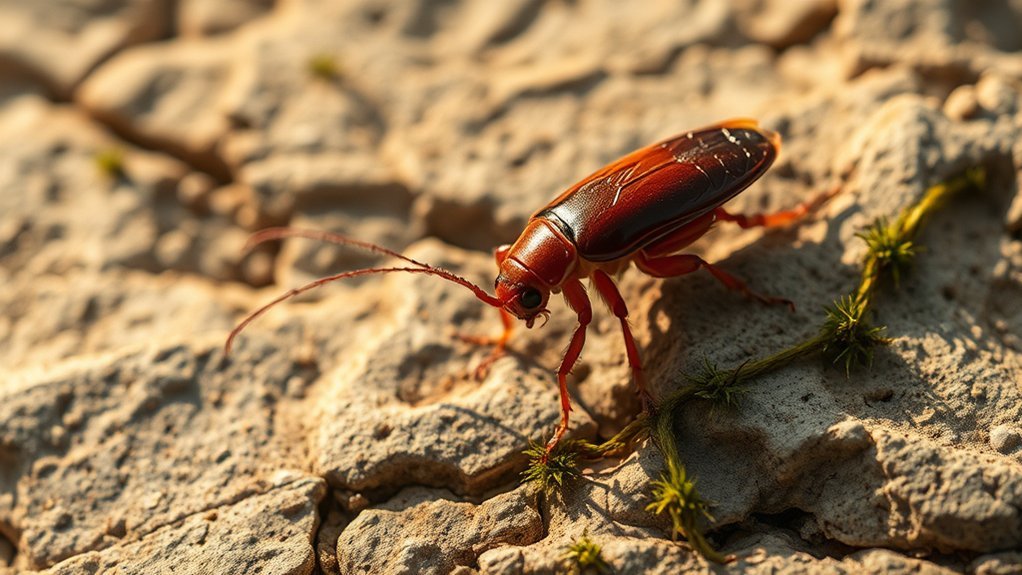
Cockroaches have survived every major mass extinction event in Earth’s history, and understanding how they did it reveals a set of traits that made them nearly impossible to wipe out. They made it through the Permian-Triassic extinction 252 million years ago and the asteroid-driven end-Cretaceous event 66 million years ago that killed non-avian dinosaurs.
Three traits drove their survival. First, they’re omnivorous scavengers, so when specific food webs collapsed, they shifted to decaying matter, plant debris, or animal remains.
Second, their flat bodies let them squeeze into soil crevices and tight shelters, shielding them from heat, debris, and temperature extremes.
Third, their eggs develop inside tough protective cases called oothecae, which resist physical damage, flooding, and drought.
You don’t need a large surviving population when sheltered individuals and intact egg cases can rebuild it. That combination of dietary flexibility, physical access to refuge, and protected reproduction made cockroaches remarkably hard to eliminate.
The Anatomy Features That Made Cockroaches Nearly Indestructible
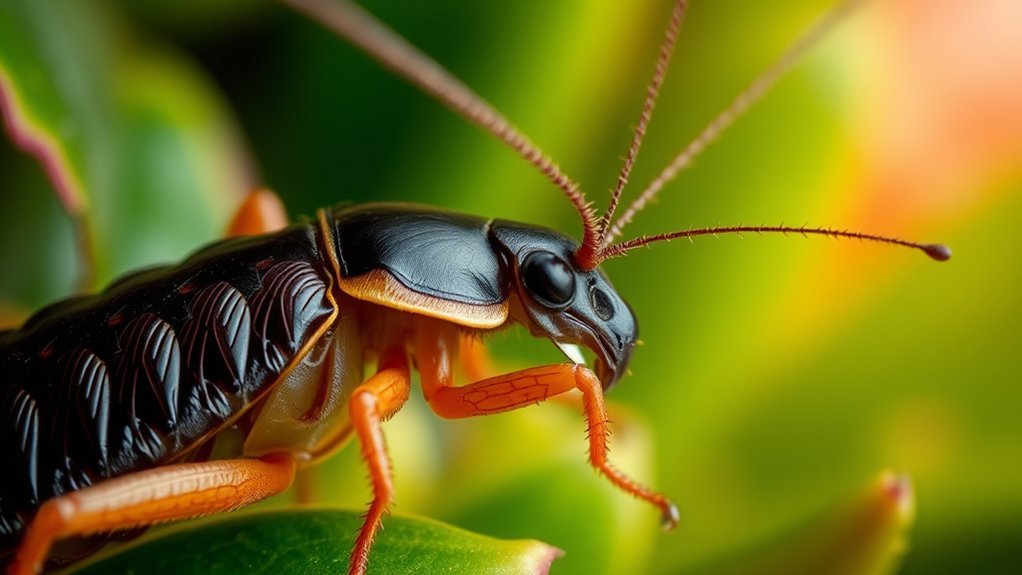
Their survival through five mass extinctions wasn’t luck—it was anatomy.
Cockroaches carry a chitin-based exoskeleton built from segmented, overlapping plates connected by flexible membranes. This design distributes mechanical stress instead of concentrating it, letting the body absorb punishment without catastrophic failure.
Their flattened profile allows them to compress vertically, squeezing through tight crevices while maintaining full mobility.
Here’s what makes their body plan remarkably effective:
- Segmented plates slide over each other under pressure, preventing crushing
- Spiracles and tracheal tubes deliver oxygen directly to tissues, bypassing a centralized organ
- Closeable spiracles limit water loss and reduce exposure to smoke or dry air
- A waxy cuticle slows dehydration and shields internal organs from environmental damage
You’re looking at a body designed for endurance.
Every structural feature—flexible armor, decentralized breathing, moisture control—works together, explaining why cockroaches have outlasted nearly everything that tried to kill them.
What Cockroaches Can Actually Survive (And What They Can’t)
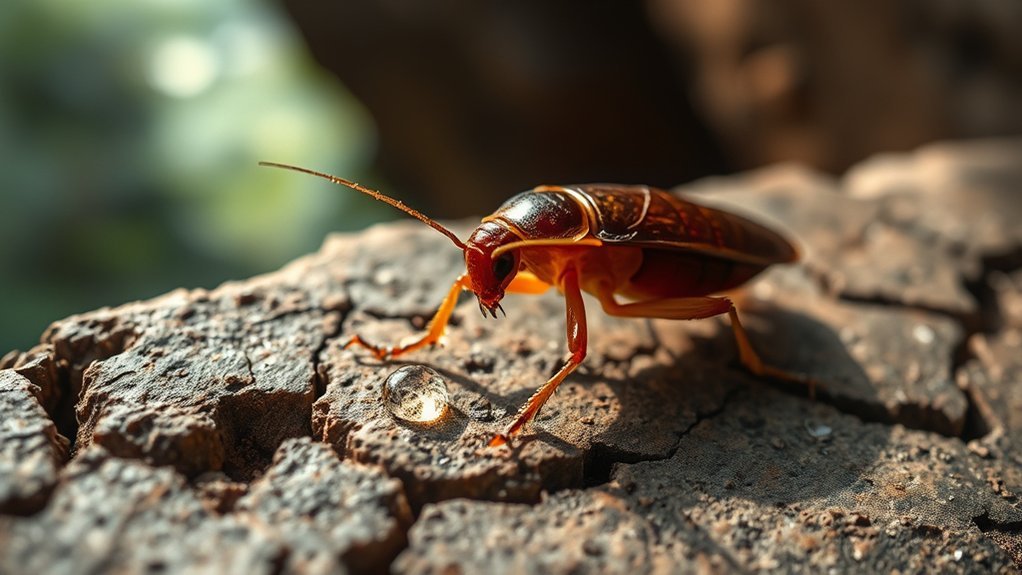
Surviving five mass extinctions demands real limits—and cockroaches have them. You might assume these insects can outlast anything, but reality draws a sharper line.
Water kills them faster than starvation. Without moisture, cockroaches die within roughly a week. Cut off their food, and they’ll still last a month—sometimes two to three months for American cockroaches. That slow metabolism buys time, but it doesn’t buy forever.
Oxygen deprivation becomes fatal after about 40 to 45 minutes. Extreme cold, once it exceeds brief tolerance windows, kills them.
Radiation resistance is real—cockroaches tolerate roughly 6 to 15 times the dose that kills humans—but high enough exposure still finishes them.
Fire and extreme heat remain among the most direct threats. Targeted pesticides and physical extermination also defeat their natural advantages.
They’re resilient, not invincible. Knowing their actual limits tells you more about their survival than the myths ever could.
Why Cockroaches Are Thriving in Modern Urban Environments
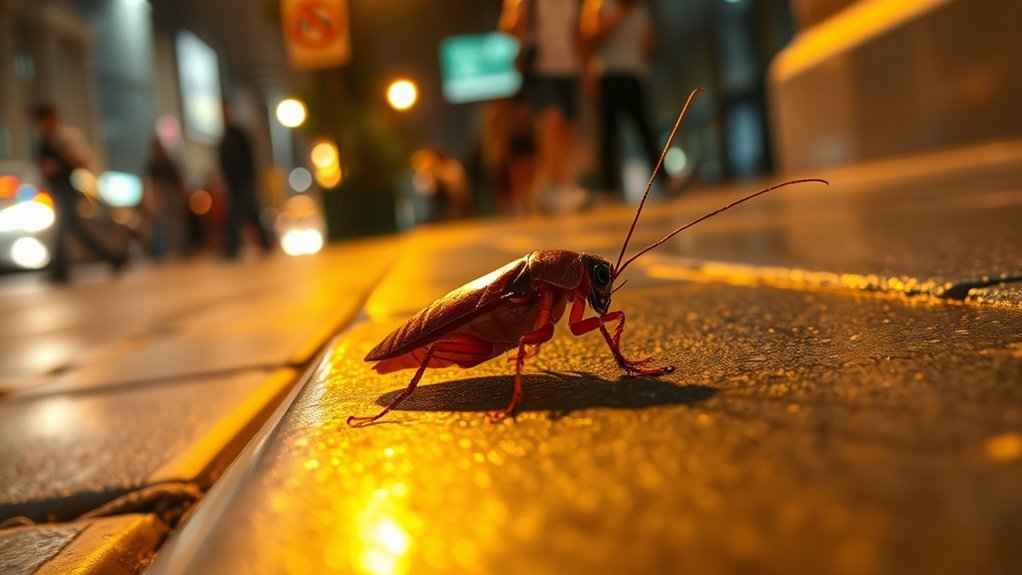
Modern cities are built for cockroaches, even if unintentionally. Every leaking pipe, wall void, and overflowing dumpster makes urban environments nearly ideal for them. You’re fundamentally sharing your building with insects that evolved to exploit exactly what cities offer.
Here’s what drives their success in modern environments:
- Food access – Restaurants, grocery stores, and residential kitchens create constant feeding opportunities year-round.
- Moisture – Leaking pipes, clogged drains, and condensation provide the humidity cockroaches need to survive and reproduce.
- Shelter – Wall voids, utility penetrations, and aging infrastructure give them protected, concealed nesting sites.
- Heat – Urban heat islands and heated buildings extend their breeding season and keep populations active through winter.
Sewer systems connect buildings across entire neighborhoods, meaning controlling cockroaches in one unit doesn’t eliminate the broader population.
Their adaptability to human-built environments is precisely why they’re so difficult to remove.
Frequently Asked Questions
Are Cockroaches More Closely Related to Termites or Other Insects?
You’ll find that cockroaches are more closely related to termites than to other insects. Termites actually evolved from within cockroach lineage, making them fundamentally eusocial cockroaches sharing common ancestors around 275 million years ago.
Which Continents Have the Highest Diversity of Wild Cockroach Species?
You’ll find the highest wild cockroach diversity in Asia and Australasia, with Australia leading globally at 568 species, while Africa and South America also host remarkably rich cockroach faunas, especially in tropical regions.
How Does Continental Drift Explain Modern Cockroach Global Distribution Patterns?
You’ll find that continental drift split ancient cockroach populations as landmasses separated, isolating lineages across Africa, South America, Australia, and India. These tectonic divisions, combined with later ocean dispersal and human transport, shaped today’s global cockroach distribution.
Do Cockroaches Play Any Beneficial Ecological Roles in Natural Environments?
You’d be surprised — cockroaches genuinely benefit ecosystems! They decompose dead matter, recycle nutrients like nitrogen and phosphorus back into soil, support plant growth, and serve as prey that sustains predators like birds, lizards, and frogs.
How Many Cockroach Species Currently Exist Worldwide Today?
You’ll find roughly 4,500 to 4,600 cockroach species worldwide today. Most inhabit tropical and subtropical forests, and only about 30 to 50 species are considered common household pests.
Conclusion
You’ve just learned why cockroaches have outlasted dinosaurs, ice ages, and mass extinctions. Their flattened bodies, rapid reproduction, and dietary flexibility have kept them thriving for over 300 million years. They’re not just survivors — they’re masters of adaptation. Whether you find them fascinating or terrifying, you can’t deny their resilience. Understanding what makes cockroaches nearly indestructible gives you a deeper appreciation for one of Earth’s most ancient and successful creatures.
