
How to Use Advion Cockroach Gel Bait: Application Guide
To use Advion Gel Bait, apply small pea-sized dots (about 0.5 grams) in cracks, crevices, and hidden areas where cockroaches hide. For light infestations, place 1 to 3 spots per 10 linear feet, and 3 to 5 spots for heavy ones. Avoid treated surfaces, moisture-prone areas, and food-prep zones. Check placements every 7 to 14 days, replacing dried or consumed bait. There’s much more to know about getting the best results.
This post contains affiliate links. As an Amazon Associate, we earn from qualifying purchases at no extra cost to you.
Key Takeaways
- Apply pea-sized spots (0.5 grams) in cracks, crevices, and hidden areas where cockroach activity is confirmed, avoiding open surfaces.
- Use 1–3 spots per 10 linear feet for light infestations and 3–5 spots for heavy infestations.
- Never apply bait on food-prep surfaces, wet areas, or surfaces treated with residual insecticide sprays.
- Check placements every 7–14 days, removing dried or consumed bait before applying fresh gel.
- Cockroaches ingest the bait and spread it to others, allowing one placement to kill up to 40 roaches.
How Advion Gel Bait Works Against Cockroaches
Advion Cockroach Gel Bait kills cockroaches through indoxacarb, a pro-insecticide that isn’t activated until a roach ingests it. Once inside the roach’s body, metabolic enzymes convert indoxacarb into its active form, which blocks sodium channels in the nervous system, causing paralysis and death.
Because activation only happens after ingestion, non-target organisms remain largely unaffected.
Because indoxacarb only activates inside a roach’s body, pets, people, and beneficial insects remain largely unaffected.
The delayed kill is intentional. Poisoned roaches return to their harborages before dying, exposing nestmates through contact, grooming, feces, and cannibalism. This horizontal transfer means one feeding roach can impact up to 40 others through secondary and tertiary spread.
You’re not just killing individual roaches — you’re triggering a chain reaction throughout the colony. The combination of high attractiveness, delayed mortality, and transfer-based spread makes Advion effective even against severe infestations where visible roaches represent only a fraction of the population. Head-to-head studies from Purdue University and Texas A&M have demonstrated that Advion achieves 100% colony control, outperforming competing gel baits while requiring less product overall.
Which Cockroach Species Does Advion Control?
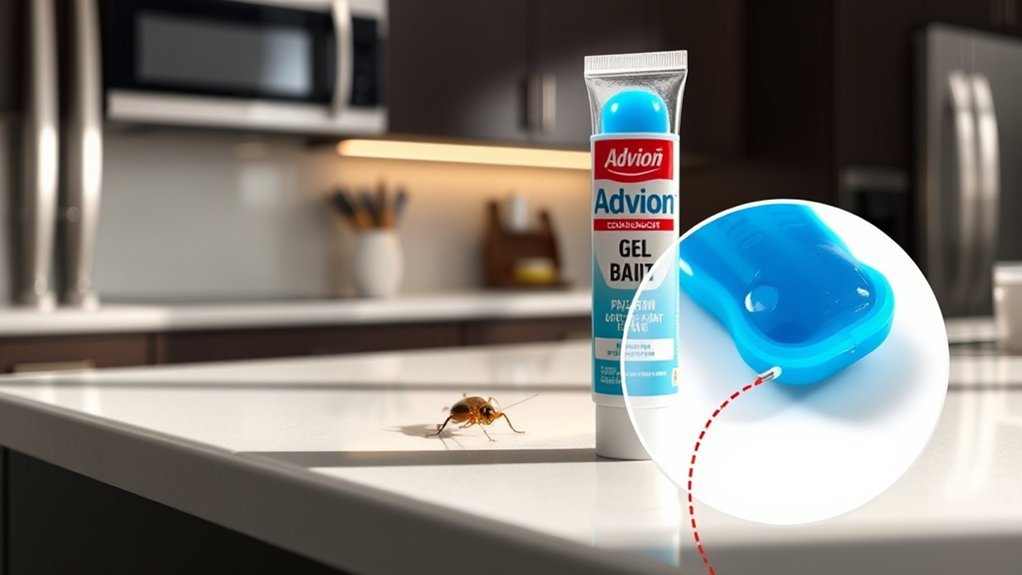
Knowing how Advion kills roaches is only part of the picture — you also need to know whether it’ll work on the species you’re dealing with.
Advion Cockroach Gel Bait is designed to control pest species of cockroaches, and its coverage spans eight common pest cockroaches:
- German cockroach
- American cockroach
- Australian cockroach
- Smoky-brown cockroach
- Brown cockroach
- Asian cockroach
- Oriental cockroach
- Brown-banded cockroach
German cockroaches receive the strongest emphasis across label materials, with American cockroaches consistently named as a second primary target.
Oriental and brown-banded cockroaches are also included among the controlled species.
It’s worth noting that Advion is also effective against bait-averse German cockroach populations — a detail that matters if you’ve tried other baits without success.
Advion isn’t species-limited. If you’re dealing with any of these eight common pest cockroaches, it’s built to handle them. The active ingredient responsible for this broad-spectrum control is Indoxacarb, which disrupts the nervous system of cockroaches upon ingestion.
Where Should You Place Advion Gel Bait for Best Results?
Placement is what separates a working bait program from one that sits ignored. Cockroaches won’t travel far to feed, so you need to bring the bait directly to their world.
Target cracks, crevices, and voids where roaches hide. Insert the applicator tip (buy at Amazon.com) about half an inch into openings along wall-floor junctions, cabinet seams, and hollow gaps. Place bait behind refrigerators, stoves, and other warm appliances. Treat under sinks, around plumbing pipes, and near entry points like doors and utility gaps.
Roaches hide deep in cracks, crevices, and voids — bring the bait directly to them.
Prioritize spots with confirmed activity — live roaches, fecal spots, or shed skins signal active harborages worth treating first.
Keep each placement small. Use pea-sized dots or thin beads under two inches long, distributed across multiple locations. Avoid open surfaces, large globs, and anywhere children or pets can easily reach.
Multiple small placements outperform a few large ones every time. For heavy infestations, use 3-5 dots per 10 linear feet to ensure adequate coverage across active areas.
How Much Advion Gel Bait Should You Apply?
Using too much bait doesn’t speed up results—it wastes product and can actually repel roaches. Each spot should weigh about 0.5 grams and measure roughly 1/4 inch in diameter, about the size of a small pea.
Keep every placement consistent so roaches encounter the same bait density throughout the treated area.
Your application rate depends on infestation severity. For light to moderate infestations, apply 1 to 3 spots per 10 linear feet. For heavy infestations, increase that to 3 to 5 spots per 10 linear feet.
Scale the total amount based on how much area you’re treating. If you don’t already have a syringe on hand, Advion Cockroach Gel Bait comes pre-loaded and ready to apply straight from the box.
If you prefer a bead instead of spots, keep it under 1/8 inch wide and about 2 inches long, which equals roughly 1 to 2 grams.
Either way, small and measured placements outperform large, irregular ones every time. Advion Trio combines three active ingredients, including two insect growth regulators that interrupt the cockroach life cycle by preventing egg production and maturation.
How Do You Apply Advion Gel Bait Correctly?
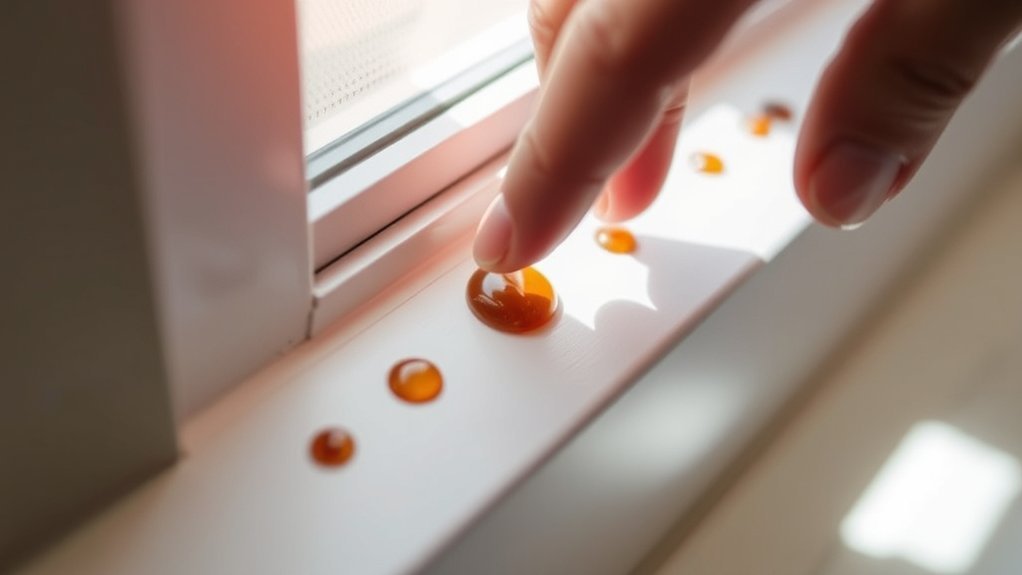
To apply Advion gel bait correctly, you’ll need to focus on two things: where you place it and how much you use.
For light to moderate infestations, apply 1–3 spots per 10 linear feet, increasing to 3–5 spots for heavy infestations, with each spot roughly 0.5 grams or about 1/4 inch in diameter.
Use the applicator tip to deposit small dots directly into cracks, crevices, and voids where cockroaches travel and hide. For outdoor applications, focus placement near entry points where cockroaches are likely to gain access to the structure.
Placement Techniques That Work
Where you place Advion gel bait matters just as much as how much you apply. Insert the applicator tip about half an inch into cracks, crevices, and openings rather than smearing gel across exposed surfaces. Target areas where cockroaches travel, hide, and feed — behind appliances, under sinks, around pipes, and inside cabinet hinges.
Apply small pea-sized spots or short, thin beads along edges and seams where roaches naturally move. Avoid open center areas and large surface applications, as cockroaches tend to avoid them.
Use multiple placement sites within infested zones so roaches encounter bait quickly. Keep each placement concealed, protected from air currents and sunlight, and away from children and pets.
Focus on spots showing fecal marks, shed skins, or live roach activity.
Bait Amounts and Spacing
Applying the right amount of Advion gel bait in the right spots makes the difference between a treatment that works and one that doesn’t. For light to moderate infestations, place 1 to 3 spots per 10 linear feet. For heavy infestations, increase that to 3 to 5 spots per the same distance. Keep each spot around 0.5 grams, roughly 1/4 inch in diameter.
Don’t compensate for fewer placements by making each one larger. Several small, evenly distributed spots outperform one or two large deposits.
If you’re treating a crack or narrow crevice, switch to a thin bead instead, keeping it under 1/8 inch wide and about 2 inches long. Match your application rate to both the infestation level and the linear footage you’re treating.
What Should You Avoid When Using Advion Gel Bait?
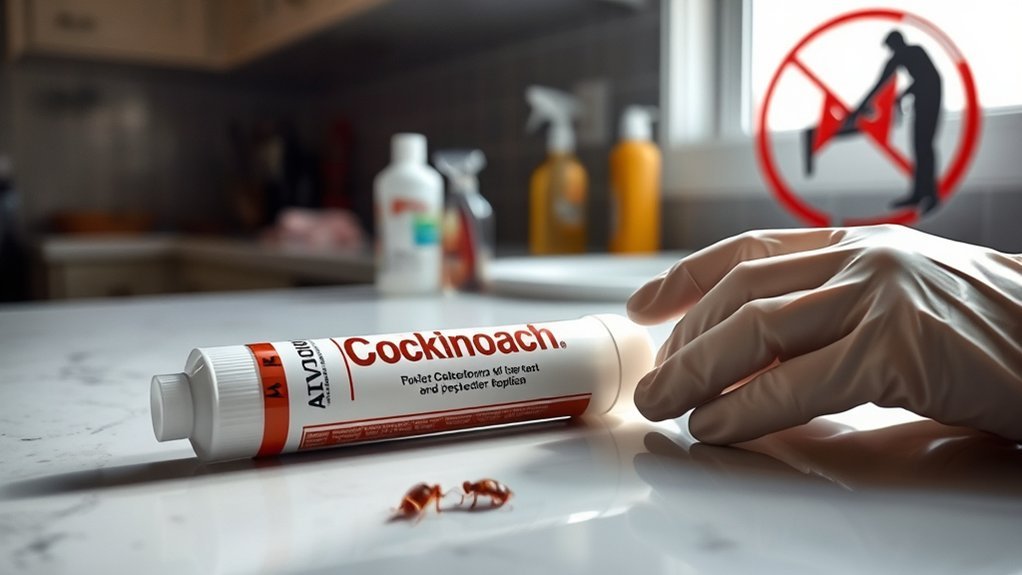
When applying Advion gel bait, you’ll want to skip any surfaces recently treated with residual sprays, since repellent chemicals reduce bait effectiveness and stop cockroaches from feeding.
Keep the gel away from food-contact and food-prep surfaces, as contamination risks make these spots unsuitable for placement.
You should also avoid areas prone to moisture, drains, or washdown zones, since water exposure breaks down the bait and eliminates its ability to attract cockroaches.
Avoid Spray-Treated Surfaces
One of the most important rules when using Advion Cockroach Gel Bait is to keep it away from spray-treated surfaces. If you apply the gel where residual insecticide sprays have been used, the spray residue can repel cockroaches and reduce bait acceptance.
Cockroaches are less likely to feed on bait placed in areas with repellent chemical deposits. Before placing the gel, check whether the target area has been previously sprayed. Only apply it to untreated cracks, crevices, and protected harborage points.
Similarly, don’t spray residual insecticides over existing bait placements, as direct contact can contaminate or destroy the gel entirely. Use either bait or spray on a given surface, not both.
Keeping these two treatment methods separated guarantees the gel performs as intended.
Skip Food-Contact Areas
Cockroaches may be resourceful, but that doesn’t mean you should place bait just anywhere. Keep the gel away from any surface that directly contacts food—countertops, cutting boards, prep tables, and food utensils are all off-limits.
Don’t apply bait near open or unpackaged food, and never place it on surfaces used for receiving, prepping, packing, or serving edible items.
In food-handling facilities, stick to crack-and-crevice applications only. Inject the gel into hidden harborages, entry points, and concealed openings rather than exposed work surfaces.
Also avoid areas that get routinely washed—frequent cleaning removes the bait before cockroaches can consume it. If gel accidentally lands on a food-prep surface, remove it immediately and wash the area with soap and water.
Prevent Moisture Exposure
Moisture is just as important to manage as food-contact surfaces when placing Advion Cockroach Gel Bait.
Wet conditions dilute, dislodge, or wash away the gel entirely, killing its effectiveness before roaches ever reach it.
To keep bait working longer, avoid these four problem areas:
- Wet or routinely washed surfaces — don’t place bait where cleaning, hose spray, or runoff can reach it.
- Standing water and damp spots — fix leaks and dry sinks before applying nearby.
- Outdoor rain exposure — skip open placements if rain is forecast within 24 hours.
- Open water sources — remove pet bowls and reduce humidity near placement areas.
Dry, protected placements preserve bait integrity and keep roaches feeding on it consistently.
How Do You Monitor and Reapply Advion for Ongoing Control?
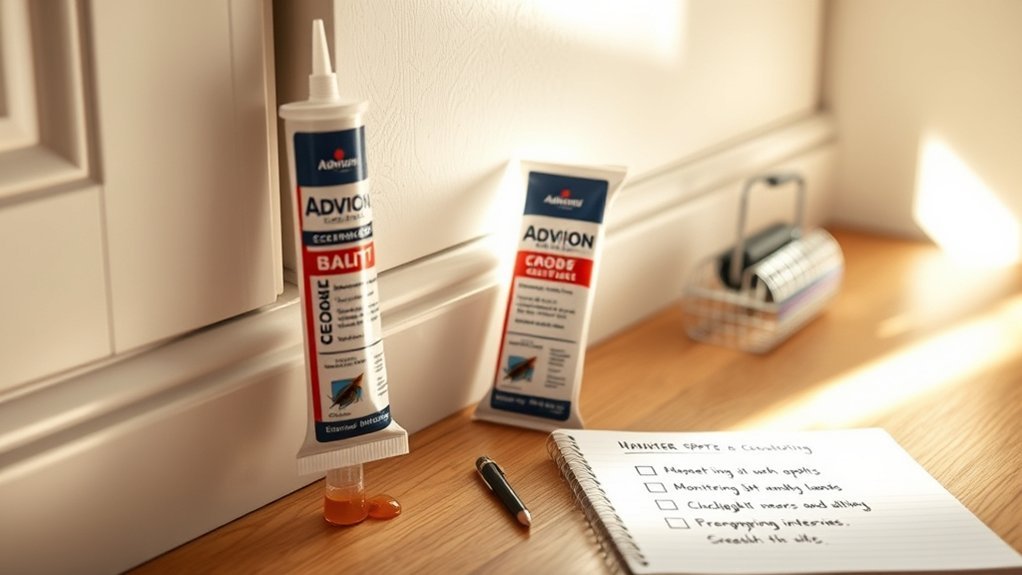
Once you’ve applied Advion, you’ll need to check your bait placements every 7–14 days to keep control on track. During each inspection, look for consumed, dried-out, or missing bait.
If cockroach activity remains visible near treated areas, that’s another sign reapplication is needed. In heavy infestations, inspect more frequently and expect to repeat applications over several cycles.
When renewing placements, remove old or dried bait before applying fresh gel.
Reapply in cracks, crevices, and high-traffic zones close to harborage points. Use small spots — about 0.5 grams each — rather than large deposits. Apply 1–3 spots per 10 linear feet for light to moderate infestations and 3–5 spots for heavy ones.
Track bait consumption over time. Decreasing consumption signals improving control. You should see reduced cockroach activity within 1–2 weeks.
Continue reapplying until you observe no cockroach activity at all. If activity persists after several full cycles, it’s a sign the infestation needs a broader DIY or professional treatment plan rather than bait alone.
Frequently Asked Questions
Can Advion Gel Bait Be Used Outdoors in Garden or Yard Areas?
You shouldn’t use Advion gel bait across garden beds, turf, or open yard areas. It’s labeled for outdoor crack-and-crevice treatments near entry points, walls, and structural gaps around your home only.
How Long Does Advion Gel Bait Remain Effective Before It Expires?
Advion gel bait stays effective for up to three months in the field. If it’s unopened, you’ve got up to five years of shelf life. Once opened, use it within one year for best results.
Is Advion Gel Bait Safe to Use in Homes With Pets?
You can use Advion Gel Bait safely in homes with pets if you apply it exactly as labeled. Place it in hidden cracks, crevices, or tamper-resistant bait stations that your pets can’t reach.
Can Advion Gel Bait Be Used Alongside Other Cockroach Control Products?
You can use Advion gel bait alongside other cockroach control products, but don’t let them overlap. Keep repellent sprays away from bait placements, as they’ll reduce bait acceptance and interfere with cockroaches feeding on it.
How Should Unused Advion Gel Bait Be Stored Between Applications?
Store your unused Advion Gel Bait in a cool, dry place, away from sunlight and temperature extremes. Keep it in its original syringe, tightly closed, and out of reach of children and pets.
Conclusion
When you’re dealing with a cockroach infestation, Advion Gel Bait gives you a powerful, proven solution. You’ve learned how it works, where to place it, and how much to apply. By following these guidelines and avoiding common mistakes, you’ll achieve the best results. Keep monitoring bait placements and reapplying as needed, and you’ll maintain long-term control over even the toughest cockroach populations in your home or business.
